My Sister-in-Law Burned My Daughter—Then My Family Made Them Pay
The humidity of that Georgia July was a physical weight, the kind of heat that made the cicadas scream in the water oaks and turned the air into a damp shroud. I pulled our SUV into the gravel driveway of the house Ethan had grown up in—a sprawling, white-columned estate that radiated old money and the silent, suffocating expectation of perfection. Ethan’s family, the Blackwoods, didn’t just host cookouts; they held court.
I was alone with Lily, our two-year-old, because Ethan had been called into the architecture firm for an emergency structural review. “I’ll be there by three, Maya,” he’d promised, kissing my cheek as I buckled Lily into her car seat. “Just stay on Diane’s good side. Don’t mention the election, and definitely don’t mention that we’re looking at preschools in the city.”
I had arrived with a ceramic tray of pasta salad and a diaper bag, feeling that familiar, low-level anxiety that came with entering the Blackwood orbit. Lily, oblivious to the generational tension, was a burst of sunshine in a yellow smocked sundress, her curls bouncing as she hit the grass.
The backyard was a tableau of Southern privilege. My father-in-law, Robert, was presiding over a professional-grade smoker, wearing an apron that said The Captain. My mother-in-law, Diane, was orchestrating the patio table with the precision of a diamond cutter. And then there was Vanessa.
Vanessa was married to Ethan’s older brother, Mark, the “golden son” who had followed Robert into corporate law. Vanessa viewed life as a zero-sum game, and in her mind, every ounce of attention Lily received was a theft from her own son, Caleb. Caleb was four, a child who had already learned that he could do no wrong in this house.
“You’re late, Maya,” Diane said without looking up from the linen napkins. “The deviled eggs are already sweating.”
“Traffic on the I-85,” I lied politely. “Lily, say hi to Grandma.”
Lily waved a chubby hand, but her eyes were locked on the patio steps where Caleb was playing with a heavy, die-cast yellow construction truck. It was a rugged thing, with sharp metal edges and oversized wheels.
The afternoon proceeded with the brittle etiquette that defined the Blackwoods. We ate in a silence broken only by Robert’s monologues about his investment portfolio. Vanessa sat across from me, sipping an oversized mug of coffee despite the sweltering heat. She watched Lily with a hawk-like intensity, her lips pressed into a thin, bitter line every time Robert made a rare, gruff comment about how much Lily looked like the Blackwood side of the family.
The breaking point arrived at 2:15 PM.
Caleb had grown bored with the truck and abandoned it near the edge of the patio to go chase a dragonfly. Lily, captivated by the bright yellow color, toddled over. She didn’t snatch it. She didn’t scream. She sat down on her diapered bottom, picked it up with both hands, and began to spin the wheels, making a soft vroom-vroom sound.
Vanessa’s head snapped toward her. “Caleb’s toy,” she barked.
“He’s not using it, Vanessa,” I said, my voice steady but firm. “She’s just looking at it. I’ll make sure she doesn’t take it inside.”
“I said, tell your brat to stop touching my son’s things,” Vanessa hissed. Her face was suddenly contorted with a rage that seemed entirely disproportionate to a plastic-and-metal truck.
I began to stand up, reaching out to scoop Lily away from the brewing storm. “Lily, honey, let’s give the truck back to—”
I never finished the sentence.
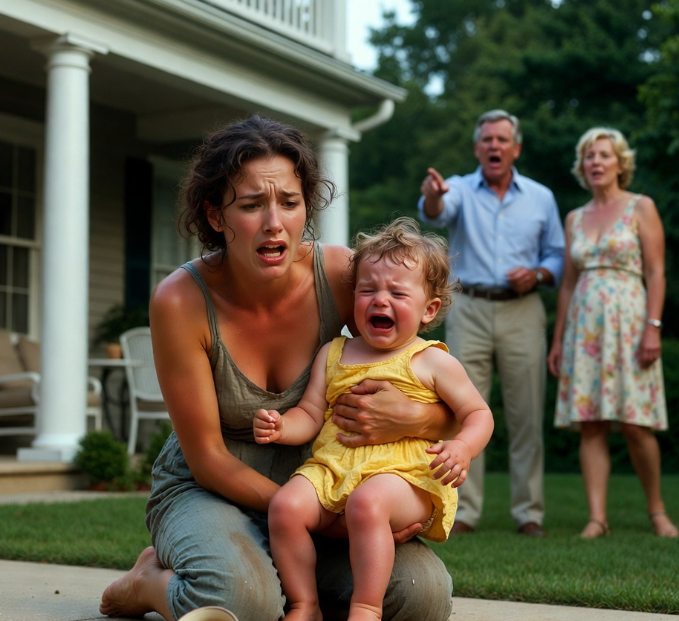
In one fluid, violent motion, Vanessa stood up. She gripped the heavy ceramic mug in her right hand—a mug Diane had just refilled with steaming, black coffee from the percolator. With a guttural snarl, she flung the contents and the mug itself straight at my daughter’s face.
The world went silent for a heartbeat, the kind of silence that exists in the center of an explosion. Then, the screaming began.
It wasn’t a toddler’s tantrum. It was a high-pitched, jagged sound of pure agony. The scalding liquid had splashed across Lily’s forehead, her cheek, and down the sensitive skin of her neck. The heavy mug had clipped her shoulder before shattering on the concrete.
“Lily!” I shrieked, lunging for her. I hit the concrete on my knees, pulling her into my lap. Her skin was already turning a terrifying, angry shade of plum-red. Blisters were rising before my eyes.
I looked up, expecting horror from the grandparents. I expected Robert to grab the garden hose. I expected Diane to run for ice and clean towels.
Instead, Diane stood over us, her face a mask of cold indignation. “Look at the mess you’ve made, Maya,” she snapped. “Stirring Vanessa up like that. You always have to be so provocative.”
Robert stepped forward, his face flushed with a dark, patriarchal fury. He didn’t look at his granddaughter, who was convulsing in my arms, her yellow dress stained dark with coffee and tears. He pointed his finger toward the side gate.
“Get that child out of our house right now!” he bellowed. “I will not have this hysterics on my property! Go! Take your drama and get out!”
Vanessa sat back down, her chest heaving, a look of twisted triumph on her face. Caleb stood nearby, clutching his truck, looking confused but silent.
I didn’t argue. I didn’t beg. A cold, crystalline clarity settled over me—the kind of stillness that comes when you realize you are surrounded by monsters. I scooped Lily up, her weight dead and heavy in my arms, and ran for the SUV. I didn’t even grab the diaper bag.
I drove like a madwoman to County Memorial, one hand on the steering wheel, the other reaching back to touch Lily’s leg, whispering to her over her hoarse, rhythmic sobbing.
In the emergency room parking lot, I stopped. My phone was buzzing. It was Ethan. I didn’t answer. My hands were shaking so hard I could barely hold the device. Instead, I scrolled to a contact I hadn’t called for help in five years.
“Dad,” I whispered when he picked up. “It’s Lily. Vanessa… she burned her. With coffee. On purpose. And Robert and Diane kicked us out while she was screaming. We’re at the ER.”
There was a silence on the other end—the terrifying silence of Richard Bennett. My father was a man who had built a multi-state construction empire not through noise, but through the ruthless application of leverage and law.
“Maya,” he said, his voice a low, vibrating hum. “Stay with the baby. Document everything. Do not speak to Ethan’s parents. Do not speak to the brother. Tomorrow, we end them.”
The next four hours were a descent into a sterile nightmare. The pediatric burn unit was a place of white light and the smell of silver sulfadiazine. Lily had to be sedated so they could debride the wounds. They were second-degree partial-thickness burns. If the coffee had been a half-inch higher, she would have lost her sight in one eye.
The hospital social worker, a woman named Sarah with kind eyes and a digital recorder, sat with me. I told her everything. I told her about the truck. I told her about the mug. I told her about the grandparents shouting for us to leave while my child’s skin was peeling.
“The police are on their way, Mrs. Blackwood,” she said softly.
“It’s just Maya,” I said. “I don’t think I’ll be using that name much longer.”
Ethan arrived at 6:00 PM. He looked like he’d been through a thresher. He had gone to his parents’ house first, and they had fed him a masterpiece of a lie. They told him Lily had reached for the mug and knocked it over herself, and that I had “lost my mind” and started attacking Vanessa, forcing them to ask me to leave for everyone’s safety.
But then he stepped into the room. He saw his daughter wrapped in gauze, her face swollen, her breathing heavy under the influence of pain medication. He saw the police officer standing at the foot of the bed taking my formal statement.
“Ethan,” I said, my voice sounding like it was coming from a great distance. “Choose carefully. Because if you defend them, even for a second, you are dead to us too.”
Ethan looked at Lily, then at the officer, then back at me. The lie his parents had carefully constructed dissolved in the face of the clinical reality of the burn patterns. A child reaching for a mug doesn’t get burned across the top of the forehead and the back of the neck simultaneously. That was a splash pattern. A thrown pattern.
“I called your father, Robert,” Ethan whispered, his voice cracking. “He told me… he told me it was an accident.”
“It wasn’t,” the police officer said, flipping his notebook shut. “The debridement photos and the liquid trajectory analysis from the specialist don’t lie, Mr. Blackwood.”
Ethan sat down in the plastic hospital chair and wept. Not for his parents, but for the realization of who they were.
My father arrived at midnight. He didn’t come alone. He came with two men in dark suits—his lead corporate counsel and a private investigator who specialized in digital forensics.
Richard Bennett kissed my cheek and then stood over Lily’s bed for a long time. When he turned back to us, the air in the room seemed to chill.
“Here is what they don’t know,” my father said, his voice calm and melodic. “Robert Blackwood’s firm is currently the lead counsel for the redevelopment project my company is funding in North Atlanta. Twenty million dollars in legal fees are tied to my signature. Vanessa’s ‘socialite’ charitable foundation? It’s housed in a building I own through a holding company. And Mark’s ‘golden’ reputation in the bar association? My investigator just spent the last four hours pulling the server logs from the country club’s exterior security cameras. Diane forgot they installed high-definition 4K cameras on the patio last month.”
He pulled a tablet from his briefcase and hit play.
The footage was crystal clear. It showed the entire scene: Vanessa standing, the deliberate aim, the hurl of the mug. It showed the coffee hitting Lily. It showed me falling to my knees. And most damningly, it showed Diane and Robert standing over us, pointing to the gate, their mouths moving in synchronized vitriol while a two-year-old child screamed in the dirt.
“They think they are the law in this town,” my father said. “They think they can rewrite the truth because they have a certain last name. But by noon tomorrow, Vanessa will be in custody for felony aggravated assault on a minor. Robert and Diane will be named as accomplices after the fact for witness intimidation and failure to render aid. And then, I’m going to call in every debt, every lease, and every contract the Blackwood name is attached to.”
He looked at Ethan. “Are you in, son? Or are you in the way?”
Ethan stood up. He looked at Lily’s bandaged face, then at the monster on the screen—the mother who had raised him, now shown as a woman who could watch a baby burn and feel only annoyance.
“I’ll give the police the keys to the side gate,” Ethan said, his voice hard. “And I have the recordings of the voicemails they left me tonight. The ones where they told me to ‘keep my wife in check’ or they’d cut off my inheritance.”
The next morning, the Blackwood world didn’t just crack; it disintegrated.
The police arrived at the estate at 8:00 AM. Vanessa was taken out in handcuffs in front of the neighbors she so desperately wanted to impress. Robert and Diane were served with emergency protective orders that barred them from coming within five hundred yards of Lily or me.
By 10:00 AM, my father’s legal team filed a civil suit for ten million dollars, citing intentional infliction of emotional distress and battery.
By 2:00 PM, the bank notified Robert that his lines of credit—secured by the redevelopment project—were being frozen due to “character clauses” in the contract.
They tried to fight. They sent a flurry of “fixers” and fellow lawyers to the hospital. But the video was already leaked to the local news. The image of the “Perfect Blackwoods” was replaced by the image of a screaming toddler and a thrown mug.
Vanessa took a plea deal two months later: five years, three to serve. Robert and Diane lost the estate; the legal fees and the collapsed contracts stripped them of the white-columned facade they had spent forty years building. They moved into a two-bedroom condo in a town where no one knew their name, or worse, where everyone did.
Lily healed. The physical scars faded into thin white lines that only I could see if the light hit her cheek just right. But the yellow sundress stayed in a box, a reminder of the day we learned that blood isn’t family—loyalty is.
Ethan and I moved to the city. We changed our last name to Bennett. And every year, on that July anniversary, we sit in the backyard of our new home, watching Lily run through the sprinklers.
Sometimes, Ethan looks toward the horizon, a shadow of the old pain in his eyes. But then Lily laughs, and the sound is clear and bright, a victory over the silence they tried to force upon us.
We didn’t just survive them. We ended the version of ourselves that believed they had power over us. And in the end, that was the greatest inheritance of all.