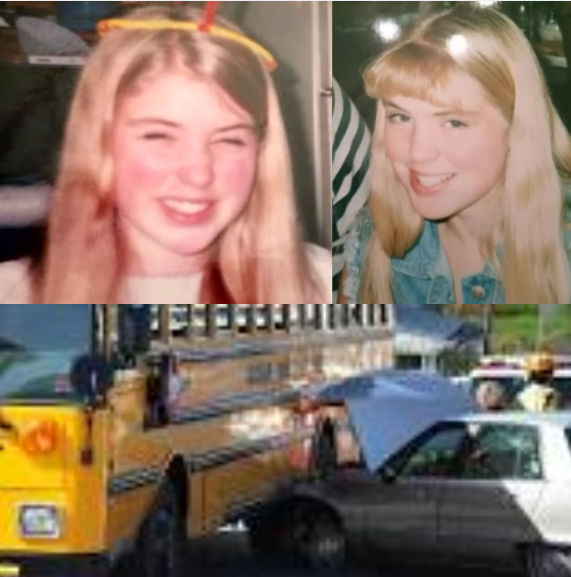
Sara Bushland disappearance: Sister’s never-ending search for answers decades later
On a crisp afternoon in April 1996, the hydraulic doors of a school bus hissed open at the end of a gravel driveway in rural Washburn County. Fifteen-year-old Sara Bushland stepped off, her backpack slung over her shoulder, just a few yards from the front door of her home. It was a routine she had performed hundreds of times.
She was never seen again.
For thirty years, that short walk—a distance that should have taken less than a minute—has become an infinite void. Today, as part of our “Missing” series, we revisit the case of Sara Bushland. It is a story not just of a vanished child, but of a catastrophic failure by law enforcement, a domestic environment shrouded in secrets, and the unrelenting resilience of a sister, Lesley Small, who refuses to let the world forget Sara’s name.
The Driveway That Swallowed a Life
April 3, 1996, was a Wednesday. In the small town of Spooner, Wisconsin, the transition from winter to spring was in its messy, mud-caked middle. Sara, a sophomore at Spooner High School, was known as a bright, if somewhat troubled, teenager. Like many fifteen-year-olds, she was navigating the complexities of adolescence, but her home life added layers of stress that most of her peers couldn’t imagine.
Witnesses on the bus confirmed that Sara exited the vehicle at approximately 4:00 PM. The bus driver watched her start toward the house. There was no sign of a struggle, no mysterious vehicle waiting in the wings, and no indication that Sara was planning to leave. She left behind her clothes, her makeup, and the typical artifacts of a teenage girl’s life.
When Sara didn’t emerge for dinner, and as night fell over the dense Wisconsin woods, the silence became deafening. However, the urgency that should have followed her disappearance was met with a wall of institutional apathy that would haunt the case for the next three decades.
The Cost of the “Runaway” Label
One of the most devastating hurdles in missing persons cases, particularly involving teenagers in the 1990s, was the immediate classification of the child as a “runaway.” Because Sara had experienced conflict at home, authorities were quick to assume she had simply hopped in a car with a boyfriend or hitched a ride to a nearby city to escape her troubles.
This assumption dictated the (lack of) pace of the investigation. The Washburn County Sheriff’s Office received the report of her disappearance within days, yet the response was lethargic at best. It took six months for deputies to begin checking locations Sara might have frequented or to conduct formal interviews with those last seen with her.
Even more staggering is the fact that a full-scale investigation—the kind involving forensic searches, wide-scale canvassing, and the dedicated pursuit of leads—wasn’t launched until two years after she vanished. By then, the trail wasn’t just cold; it was frozen. Physical evidence at the scene had been washed away by two seasons of Wisconsin snow and rain. Memories had blurred. Potential witnesses had moved on.
For Lesley Small, Sara’s sister, these delays were a betrayal. “They didn’t look for her,” Lesley has stated in various appeals over the years. “They gave her a label and they closed the book before they even opened it.”
A Home Life Shadowed by Fear
As the years turned into decades, the narrative surrounding Sara’s disappearance began to shift. The “runaway” theory started to crumble under the weight of new information regarding the reality of Sara’s daily life leading up to April 1996.
Investigators and family members eventually began to speak more openly about the abuse Sara allegedly endured at home. Reports suggested a domestic environment rife with tension and volatility. In the weeks leading up to her disappearance, Sara’s behavior had changed. She wasn’t just a rebellious teen; she was a girl living in a state of high alert.
The focus eventually turned toward her stepfather and the men in her immediate orbit. Information emerged that Sara may have been planning to speak out about the abuse she was suffering. This provided a chilling new motive: was Sara’s disappearance not an escape, but a silencing?
The “break” in the case that many had hoped for came when more modern investigative techniques and a more empathetic look at her domestic situation revealed that Sara had been terrified. She had expressed fear for her safety to friends, yet in 1996, these cries for help were dismissed as teenage drama.
The Sister’s Crusade: Lesley Small’s Persistence
If there is a hero in the grim saga of Sara Bushland, it is undoubtedly her sister, Lesley. For thirty years, Lesley has acted as her sister’s advocate, investigator, and spokesperson. She has navigated the agonizing process of pushing a reluctant justice system to do its job.
Lesley’s search has taken her into the dark corners of the internet, into the offices of cold case investigators, and into the very woods where Sara was last seen. She has organized searches, maintained social media pages, and worked with organizations like the National Center for Missing & Exploited Children (NCMEC).
“I don’t get to stop,” Lesley says. “Sara doesn’t have a voice, so I have to be hers.”
The emotional toll of this “never-ending search” is immeasurable. Lesley has had to balance her own life—career, family, and personal growth—with the constant, gnawing presence of a tragedy that remains frozen in time. Every lead that goes nowhere, every “tip” that turns out to be a hoax, is a fresh wound. Yet, she continues to provide the Washburn County Sheriff’s Office with any information she gathers, effectively forcing them to keep the file open.
Tactical Errors and Modern Hope
Looking back with the benefit of 21st-century forensic standards, the errors made in Sara’s case are a blueprint for what not to do. The failure to secure the home as a potential crime scene in the first 48 hours is perhaps the most egregious. In modern investigations, the “Golden Hour” refers to the initial period where evidence is most likely to be preserved. For Sara, that hour was ignored.
However, the dawn of DNA technology and advanced geological scanning has offered a glimmer of hope. In recent years, there have been renewed searches of properties associated with the family and the “weeks leading up” to the disappearance. Divers have searched nearby ponds, and ground-penetrating radar has been used to scan areas of interest.
The Washburn County Sheriff’s Office, now under different leadership than it was in 1996, has acknowledged the failures of the past. There is a renewed commitment to finding Sara, fueled largely by the pressure applied by Lesley and the growing community of true crime advocates who have taken up Sara’s cause.
The “Weeks Leading Up”: Reconstructing the Timeline
To understand what happened to Sara, investigators have had to painstakingly reconstruct the month of March 1996. What they found was a girl at a breaking point.
Sara had been staying with her mother and stepfather, but the arrangement was failing. There were reports of physical altercations. There were rumors of Sara being involved with older men in the community—men who may have seen a vulnerable girl as an easy target.
The investigation now weighs two primary theories:
- Foul Play at Home: That the abuse escalated to a fatal point on the afternoon of April 3rd, and the “runaway” narrative was a cover story that law enforcement unwittingly helped sustain.
- The Predatory Third Party: That Sara was lured away from her driveway by someone she knew—someone who was aware of her desire to leave home and exploited it.
Both theories lead to the same heartbreaking conclusion: Sara Bushland did not choose to disappear. She was taken.
The Impact on Spooner
The disappearance of a child leaves a permanent scar on a small town. For the people of Spooner, Sara’s face on “Missing” posters became a part of the landscape. For a generation of parents, the case ended the era of “letting kids play until the streetlights come on.”
The case serves as a reminder of the vulnerability of children in rural areas and the vital importance of a responsive, unbiased police force. The fact that it took two years for a full investigation is often cited in criminal justice classes in the region as a case study in systemic failure.
Conclusion: Waiting for the Final Word
Thirty years is a lifetime. In the three decades since Sara Bushland got off that school bus, the world has changed beyond recognition. We have the internet in our pockets; we can map the human genome; we can see into the furthest reaches of the galaxy. Yet, we still cannot say what happened in that short stretch of driveway in 1996.
Lesley Small remains undeterred. Her search is not just for a body, but for the truth—no matter how ugly that truth might be. “We know she didn’t just walk away and start a new life,” Lesley says. “Someone knows exactly where she is. Someone has lived with this secret for thirty years.”
As the Washburn County Sheriff’s Office continues to process old evidence with new technology, the hope is that a single strand of hair, a drop of blood, or a long-dormant conscience will finally provide the answer. Until then, Sara Bushland remains a fifteen-year-old girl in a sophomore school photo, forever walking toward a home she would never enter.
If you have any information regarding the disappearance of Sara Bushland, please contact the Washburn County Sheriff’s Office at (715) 468-4720. Even the smallest detail could be the key to bringing Sara home.