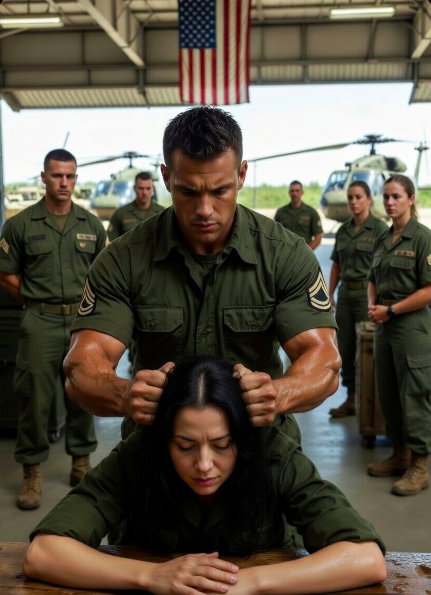
🔥 One Wrong Move—And He Picked the Wrong Woman to Prove a Point
The neon sign for The Rusty Anchor flickered with a rhythmic buzz, casting a sickly yellow glow over the oil-stained pavement of San Diego’s waterfront. Inside, the air was a thick soup of stale beer, cheap tobacco, and the restless energy of men who spent too much time at sea. It was a Saturday night, and the bar was packed to the rafters with sailors, dockworkers, and tourists looking for “authentic” naval grit.
In the back corner, tucked away in a booth that the shadows seemed to favor, Sarah Martinez sat alone. She was a ghost in a room full of shouting spirits. Her attire was deliberately unremarkable: a faded pair of Levi’s, a black t-shirt, and a worn leather jacket that had seen better decades. Her dark hair was pulled back into a practical knot. She held a glass of neat whiskey, her fingers wrapped around it not with the desperation of a drinker, but with the stillness of a statue.
Sarah looked like any other woman in her mid-thirties trying to decompress after a long shift. She didn’t look like a woman who had spent twelve years in the Naval Special Warfare Command. She didn’t look like the person who had led extraction teams in the Hindu Kush or conducted VBSS (Visit, Board, Search, and Seizure) operations in the dead of night in the South China Sea.
That was the point. In her world, if they saw you coming, you had already failed.
Across the room, the atmosphere was different. Near the pool tables, a trio of young men in their early twenties were making sure everyone knew they were there. They wore their hair in high-and-tight fades so fresh the skin on their necks was still pink. Their voices carried over the jukebox, fueled by a lethal combination of cheap domestic lager and the invincibility of youth.
The leader of the group was a man named Derek. He was broad-shouldered, with a jawline he clearly thought was cinematic and eyes that moved restlessly, looking for an audience. He was a BUD/S (Basic Underwater Demolition/SEAL) candidate—or at least, he was in the pre-training phase, brimming with the misplaced arrogance of someone who had passed a fitness test but had never tasted salt-water sand in his lungs for seventy-two hours straight.
“I’m telling you guys,” Derek barked, slamming his empty mug onto the wooden table hard enough to make the neighboring patrons flinch. “The instructors at Coronado? They’re just looking for an excuse to quit. But they won’t find it with me. I’m built for the Teams. I’ve got the DNA. My old man was a Ranger, and I’m gonna be the first SEAL in the family. Nothing’s gonna stop me.”
His friends, Miller and Jenkins, nodded enthusiastically. They were younger, smaller, and clearly content to ride in Derek’s wake.
“You see that guy over there?” Derek pointed a thumb toward a grizzled old man at the bar. “Probably spent twenty years in the surface fleet chipping paint. That ain’t me. I’m going for the Trident. I’m gonna be the tip of the spear.”
He stood up, his movements erratic and heavy. “I need another round. The ‘future of the Navy’ is thirsty.”
Derek turned blindly, his chest puffed out, and began a swaggering march toward the bar. He wasn’t looking at the floor, or the tables, or the people. He was looking at his own reflection in the mirror behind the bar.
CRASH.
He walked straight into the corner of Sarah’s booth. The impact was jarring. Sarah’s hand remained steady, but the sudden jolt sent her whiskey glass tipping over. The amber liquid bled across the scarred wood, dripping onto her jeans and the floor.
The silence that followed wasn’t immediate, but it radiated outward from the booth like a cold front.
Sarah didn’t jump. She didn’t gasp. She simply looked down at the puddle, then up at the towering young man who had caused it. Her eyes were a flat, calm brown—the color of deep earth.
“Watch where you’re going,” she said. Her voice was quiet, devoid of anger, possessing only the weight of a factual statement.
Derek blinked, looking down at her. He felt the eyes of his friends on him. He felt the eyes of the bar. To apologize would be to admit he was clumsy. To apologize would be a “weakness” he hadn’t yet learned was actually a strength.
A slow, ugly smirk spread across his face. He leaned down, placing his large hands on the edge of her table.
“You got a problem, sweetheart?” he sneered. “The table moved. Maybe you shouldn’t be sitting in the way of people who actually have places to go.”
Behind him, Miller and Jenkins approached, sensing a confrontation. They didn’t intervene; they just added to the wall of muscle Derek was trying to build.
Sarah stood up. She wasn’t particularly tall—maybe five-foot-six—but as she rose, the air in the immediate vicinity seemed to change. It was a subtle shift in pressure, the kind sailors feel right before a massive storm breaks the horizon. She didn’t square her shoulders; she didn’t need to. Her posture was perfectly balanced, her weight distributed on the balls of her feet.
“Just apologize,” Sarah said, her voice still low, still steady. “And walk away. It’s a simple transaction.”
Derek laughed. It was a harsh, barking sound. He looked at his friends. “Hear that? She wants an apology. I’m about to go through the toughest military training on the planet, and this girl in a biker jacket wants me to say sorry for a spilled drink.”
He turned back to Sarah, his face inches from hers. He could smell the beer on his own breath reflecting off her stoic expression. “How about this? You go buy me a drink for the inconvenience, and I might let you keep the seat.”
“Last chance,” Sarah whispered.
Derek’s ego had reached the point of no return. He wanted to show off. He wanted to feel the power he thought he was entitled to. He raised a hand and shoved her.
It wasn’t a playful push. It was a hard, aggressive shove intended to send her reeling back into the booth.
Sarah took one step back to absorb the momentum. Her expression didn’t shatter; it tightened. The “civilian” mask she wore every day dropped, revealing the apex predator beneath.
“Wrong choice,” she said.
Derek, seeing her step back, thought he had won. He swung a wild, haymaker punch—a “sloppy, predictable Sunday-morning-cartoon” of a move. To an untrained eye, it looked fast. To Sarah, who had trained in Krav Maga, Brazilian Jiu-Jitsu, and Muay Thai under the harshest conditions imaginable, it looked like it was moving through molasses.
She didn’t duck; she moved.
With a fluidity that seemed to defy the cramped space, she stepped inside the arc of his punch. Her left hand parried his forearm, redirecting his energy harmlessly past her ear. At the same time, the heel of her right hand struck the center of his chest—the solar plexus—with the force of a hydraulic piston.
The air left Derek’s lungs in a sickening whump.
Before he could even register the pain, Sarah’s hand snaked behind his neck. She used his own forward momentum against him. In a blur of motion, she spun him around. She didn’t use a flashy throw; she used physics.
One second, Derek was the king of the bar. The next, he was face-down on the sticky, beer-soaked floorboards.
Sarah’s knee was buried in the small of his back, locking his spine. His right arm was twisted behind his back in a shoulder lock that was millimeters away from a dislocation. Her grip was like iron.
The bar went dead silent. Even the jukebox seemed to lower its volume.
Miller and Jenkins took a step forward, their faces pale.
“Don’t,” Sarah said, looking up at them. Just one word. It was enough to freeze them in their tracks. They saw something in her eyes that they hadn’t seen in any of their recruiters or drill sergeants. They saw a quiet, absolute readiness to do violence.
She looked down at the man beneath her. Derek was gasping for air, his face pressed against the wood, his “future SEAL” bravado leaking out of him in the form of panicked whimpers.
“I’m going to let you up,” Sarah said into his ear, her voice calm and terrifyingly professional. “And you’re going to apologize to me. Not because I’m a woman, and not because you’re drunk. But because you’re a sailor in the United States Navy, and you’ve forgotten what it means to carry yourself with honor.”
She released the pressure. She didn’t jump back; she stepped away with the same casual grace she’d used to sit down.
Derek scrambled to his feet, clutching his shoulder. He looked like he wanted to cry, to vomit, and to run all at the same time. The “warrior” he thought he was had been dismantled in less than three seconds by someone he hadn’t even considered a threat.
“I— I’m sorry,” he stammered, his voice cracking. “I’m sorry, ma’am.”
Sarah didn’t respond immediately. She reached into the inner pocket of her leather jacket. The movement was slow and deliberate. For a moment, the room held its breath, wondering if she was reaching for a weapon.
Instead, she pulled out a small, leather wallet. She flipped it open and extracted a single, laminated card.
She held it up. Not to the whole bar, but directly in front of Derek’s eyes.
The card was gold and black. It bore the crest of the United States Navy, but it wasn’t a standard ID. It was a retired service credential, but beneath her name—Command Master Chief Sarah Martinez—and her photo, there was a small, unmistakable symbol.
The Special Warfare Insignia. The Trident.
But it wasn’t just any Trident. There were small markings on the side of the card, a specific code that denoted her status as an instructor and a plank-owner of a specific, high-tier development group.
Derek’s face went from pale to a ghostly, translucent white. His knees actually shook.
In the world of the Navy SEALs, there are legends. There are the men who wrote the books, and then there are the few women who broke the glass ceilings in the shadows, serving in capacities that the public wouldn’t know about for another fifty years. Sarah Martinez was a name spoken with reverence in the halls of Coronado. She wasn’t just a SEAL-qualified officer; she was one of the primary architects of the modern urban extraction course. She was the “Mother of Ghosts.”
Derek realized he hadn’t just shoved a stranger. He had shoved a woman who probably knew his future instructors by their first names. He had shoved a woman who could end his career with a single phone call—or, as she had just demonstrated, with her bare hands.
“You want to be a SEAL?” Sarah asked, her voice cutting through the silence like a blade.
Derek couldn’t speak. He just nodded dumbly.
“The Teams aren’t about being the loudest man in the bar,” she said. “They aren’t about the Trident on your chest. They are about the discipline in your soul. If you can’t control yourself against a ‘sweetheart’ in a bar, how are you going to control yourself when you’re cold, wet, tired, and people are actually trying to kill you?”
She stepped closer, and Derek instinctively flinched.
“Go home,” she commanded. “Tell your friends to take you back to the barracks. Spend tonight thinking about whether you want to be a bully or a brother. Because if I see your name on a training roster and you haven’t changed that attitude, I will personally ensure you spend the rest of your enlistment peeling potatoes in the hull of an aircraft carrier.”
“Yes, Senior… I mean, yes, Master Chief!” Derek choked out.
He didn’t wait for a second dismissal. He turned and bolted for the door, Miller and Jenkins trailing behind him like whipped dogs.
The door swung shut, and the muffled sound of the San Diego night rushed in before being cut off again.
The bartender, an old veteran with a prosthetic arm, looked at Sarah. He quietly took her spilled glass, wiped the table with a clean cloth, and set down a fresh double of the most expensive whiskey on his shelf.
“On the house, Master Chief,” he grunted, a flicker of a smile on his face. “Been a long time since I saw a ‘teachable moment’ delivered that cleanly.”
Sarah looked at the drink. She felt the adrenaline receding, leaving behind the familiar, hollow ache of a life spent in the shadows. She took a slow sip, the heat of the alcohol blooming in her chest.
“He’s got the build,” she murmured to the bartender. “But he doesn’t have the heart. Not yet.”
She sat back down in the booth, once again becoming the unremarkable woman in the leather jacket. She watched the crowd return to their noise, their laughter, and their careless lives. She was a guardian of a world they would never understand, a silent sentinel who had spent her life protecting their right to be loud, arrogant, and safe.
The Trident’s shadow was long, but for tonight, it was enough to keep the peace in a small corner of the world.
Two Years Later
The sun was beating down on the asphalt of the Naval Special Warfare Center at Coronado. It was graduation day for Class 352. Out of the hundred-plus men who had started, only eighteen remained. They stood in their dress whites, their faces lean, their eyes reflecting a hard-won maturity that no bar-room brawl could ever provide.
At the end of the ceremony, as the families cheered and the new SEALs pinned their Tridents to their chests, one young man stood apart. He was broad-shouldered, with a steady gaze and a humble posture.
He walked toward a woman standing near the pier, away from the main stage. She was wearing a sharp Navy uniform, her shoulders heavy with the stripes of her rank.
The young man stopped three paces away and snapped a crisp, perfect salute.
“Master Chief Martinez,” he said.
Sarah returned the salute with practiced ease. “Ensign Miller. Congratulations.”
Derek—for it was him, though he looked ten years older than the boy from the bar—lowered his hand. “I wanted to thank you, ma’am. That night at The Rusty Anchor… I hated you for a long time. I thought you’d humiliated me.”
“And now?” Sarah asked.
“Now I realize you saved me,” Derek said. “If I’d gone into training with that ego, I would have washed out in Hell Week. Or worse, I would have gotten someone killed down the line. You taught me the most important lesson before I even set foot in the water.”
Sarah looked at the gold bird pinned to his chest. It shone in the California sun.
“Humility is the foundation of courage, Derek,” she said softly. “Never forget that. The Trident is heavy. Don’t let it crush your character.”
“I won’t, ma’am.”
She watched him walk away to join his teammates. For a moment, she felt a rare sense of pride. Her career was coming to an end, the years of combat and secrecy winding down into a quiet retirement. But the legacy continued. It wasn’t just about the missions she’d completed or the enemies she’d defeated. It was about the people she’d forged, the ghosts she’d raised, and the honor she’d preserved in the most unlikely of places.
She turned back toward the ocean, the salt air filling her lungs. The waves crashed against the shore, timeless and relentless. Somewhere out there, the next generation was waiting to be tested.
And Sarah Martinez, the legend in the leather jacket, knew that the shadows would always find a way to light the path.
Epilogue: The Letter
A month after the graduation, Sarah received a package at her small home overlooking the Pacific. Inside was no note, only a weathered, beer-stained leather jacket—the one she had worn that night at The Rusty Anchor. It had been lost in the shuffle of her final deployment.
Tucked into the pocket was a new card. It wasn’t a military ID. It was a simple business card for a veterans’ outreach program. On the back, in neat, disciplined handwriting, were five words:
“The drink is on me.”
Sarah smiled, hung the jacket in her closet next to her medals, and went out to watch the sunset. The war was over for her, but the peace was just beginning.
In the distance, the muffled sound of a distant explosion echoed from the training range at Coronado. A new class was hitting the surf. The cycle continued, and for the first time in a decade, Sarah Martinez finally let out a long, deep breath, and let the silence of the evening take her home.
The legend was retired, but the lesson would live forever in the hearts of those who dared to step into the trident’s shadow.