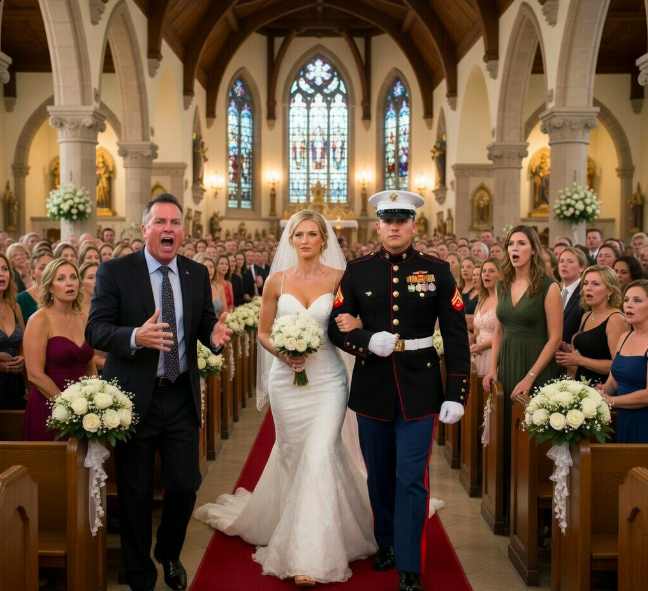
🚨 My Father Refused To Walk Me Down the Aisle Because My Sister, Who Envied Me, Faked A…
Part 1
My name is Sergeant Nancy Watts, I was twenty-nine years old, and two weeks before my wedding, the man I had spent my whole life trying to make proud abandoned me with the calm voice of someone canceling a dentist appointment.
I was sitting in the common room at Fort Bragg that afternoon, sunk into one of those old vinyl couches that always made a little sighing sound when you shifted your weight. The place smelled exactly the way it always did—stale coffee, floor cleaner, sun-warmed dust, and that faint metallic edge that seems to cling to military buildings no matter how much bleach you throw at them. Outside the windows, late sunlight came through the blinds in pale gold bars. Somewhere beyond the parking lot, I could hear a platoon on a run, boots landing in rhythm, somebody calling cadence in a voice already gone hoarse.
On my tablet, I was comparing wedding bouquets like it mattered more than ammo counts or convoy routes. Peonies. White roses. Maybe eucalyptus if I wanted to pretend I was laid-back. A small part of me felt ridiculous every time I pinched and zoomed on flower arrangements. Another part of me felt something softer and almost unfamiliar.
Safe.
That was the strange thing about Caleb. With him, thinking about the future didn’t feel like tempting fate. It didn’t feel like making promises the Army could snatch away with a set of orders. It felt possible. A home. A porch. His boots by the door. My coffee mug next to his. A life not measured in leave forms and training calendars.
My phone buzzed against the couch cushion beside me.
It was a text from Caleb: a picture of a squirrel wearing a tiny toy helmet, captioned, Reporting for husband duty. Still unqualified.
I laughed out loud, the sound bouncing off the cinderblock walls. It surprised me how easy it came. I texted back, Barely meeting standard, and was still smiling when my phone lit up again with an incoming call.
Dad.
Warmth hit me so fast it was almost automatic. It didn’t matter that I was grown, or that I wore stripes on my chest, or that I’d seen things that changed the shape of me. Some part of me still turned toward that name like a sunflower toward heat.
I answered on the second ring. “Hey, Dad. What is it, did you finally decide navy ties are an insult to civilization?”
There was a pause.
Not the absent-minded pause of somebody settling a phone against their shoulder. Not the pause of a smile. A different kind. Dense. Airless.
Then he spoke, and every small, easy feeling inside me went cold.
“Nancy. I need to discuss June fifteenth. There’s been a change of plans.”
He had used my name the way he used it when I was sixteen and had backed his truck into the mailbox. Flat. Formal. No honey. No warrior. No kiddo. Just Nancy, like I was a problem to be managed.
I sat up so quickly the tablet slid off my knees and clattered onto the floor.
“A change of plans?” I repeated. “Dad, that’s my wedding day.”
“I’m aware.”
His voice was crisp, retired-colonel crisp, even now. The voice that had once made me straighten my spine from three rooms away. “Saraphina has an important investor reception in Charlotte. High-level people. This could have a significant impact on her career trajectory. She asked me to be there.”
For a second I honestly thought I had misheard him.
I looked around the empty room like maybe someone else had heard it too and could translate. There was the humming vending machine. The bulletin board with crooked memos. The smear of orange sky through the window. Everything looked weirdly normal.
“You promised,” I said.
He exhaled through his nose, already irritated. “Nancy—”
“No.” My throat had gone dry, and I had to force the words out. “No, you promised. We talked about this. You said you’d walk me down the aisle.”
There was another silence, then the sound of him shifting the phone. I could picture him exactly: standing in his kitchen in Fayetteville, shoulders squared, jaw hard, already framing himself as the reasonable one.
“You’re a soldier,” he said. “You more than anyone should understand sacrifice for the greater good.”
The greater good.
I repeated it in my head because my brain refused to accept that sentence on the first pass.
He kept going, and every word was worse than the last.
“Saraphina’s event matters. These things build networks. They create opportunity. Your wedding is personal. Important, yes, but personal. It doesn’t carry the same strategic weight.”
Strategic weight.
He used the language of my whole life—the language of duty, of mission, of sacrifice—and laid it over me like a cold wet sheet. My wedding. My life. My father’s role in it. He had just ranked it beneath my sister’s cocktail party like he was triaging supplies.
My fingers tightened so hard around the phone my knuckles hurt.
“And what exactly am I supposed to do?” I asked. My voice sounded distant, like it was traveling in from somewhere far away.
He answered immediately, like he had already solved this in his head and was impatient that I hadn’t caught up.
“Ask Caleb’s uncle. Jed, isn’t it? He seems like a decent man. He can fill in.”
Fill in.
Like my fatherhood slot had become a vacant shift on a duty roster. Like the role he was throwing away could be covered by whoever was nearby and properly dressed.
Something inside me made a soundless crack.
I didn’t yell. That’s what people always expect when they think about heartbreak—that it comes with noise. But sometimes it arrives so clean and sharp all it can do is freeze you in place.
I ended the call because if I had stayed on the line one second longer, I might have said something I couldn’t take back. Or worse, I might have begged.
I set the phone in my lap and stared at the far wall.
The unit motto was stenciled there in big black letters, faded around the edges from years of sun and bleach and people walking past it without looking.
All the way.
My father had taught me that phrase before the Army ever did. Finish what you start. Don’t quit on your people. Don’t leave someone exposed if they trust you to hold the line.
Outside, the cadence got louder for a moment, then moved away down the road.
I sat there without blinking, and the memories started coming, one after another, not because I wanted them but because some part of me already knew the truth. This wasn’t a surprise attack. This wasn’t even a new injury.
This was just the first time the knife had gone in deep enough that I couldn’t pretend it was an accident.
By the time Sergeant Miller stuck his head into the common room and asked if I was coming to the briefing, I already knew one thing for sure:
My father hadn’t just changed plans. He had picked a side.
And the worst part was, when I really let myself think about it, I realized he had been picking it for years.
Part 2
When pain hits me hard enough, my mind starts making inventory.
Not the dramatic kind. Not a montage. It’s more like opening a drawer and finding every old receipt you forgot you kept. Proof of what things really cost.
So while the common room dimmed around me and the afternoon slid toward evening, I sat there and remembered exactly how long this war had been going on.
The first clear memory was my sixteenth birthday.
I had spent ten sticky July days at a junior leadership camp in the Blue Ridge Mountains and came home feeling ten feet tall. My duffel smelled like damp socks, bug spray, and pine needles. I had mosquito bites on both ankles and a sunburn across the bridge of my nose, and tucked inside the side pocket of my bag was a little plastic plaque that said Top Cadet. It wasn’t fancy. The gold lettering was already crooked. But I had imagined my father turning it over in his big hands and smiling in that quiet, proud way he had when I learned to change a tire without help.
On the bus ride home, I’d built a whole scene in my head. Maybe burgers on the grill. Maybe a grocery-store cake with too much frosting. Maybe Dad pretending not to be sentimental and then being sentimental anyway.
Instead, when I pushed open the front door, the house smelled like takeout pizza and cold air conditioning. No balloons. No wrapping paper. No cake box on the counter.
My father and Saraphina were at the dining room table, halfway through dinner.
Saraphina looked up first. She was already practicing that soft, expensive kind of beauty at sixteen—blown-out hair, glossy lips, one wrist bent just right when she lifted her soda can.
“Oh my God,” she said, putting a hand to her chest like she was onstage. “Nancy. We thought you came back tomorrow.”
She didn’t sound sorry. She sounded entertained.
My dad glanced at the clock on the microwave, then back at me. “We’ll celebrate tomorrow, warrior.”
Tomorrow never happened.
The next day, Saraphina had a meltdown over a friend not inviting her to something in Charlotte. The day after that, Dad needed to take the car in. Then he had errands. Then I had chores. The whole thing slid off the table like spilled water, and nobody mentioned it again.
That night I sat in my room in the dark eating a Hershey bar from the bus station because it was the closest thing I had to birthday cake. The chocolate had that faint waxy taste cheap candy gets when it’s been sitting under fluorescent lights too long. I remember licking a smear from my thumb and whispering happy birthday to myself because hearing it from somebody felt better than hearing nothing at all.
That should have been the moment I learned the rule. I didn’t.
I was still stupid enough to believe isolated things could stay isolated.
A few years later, after I enlisted, I got my first reenlistment bonus. To me it felt enormous. Life-changing. Real freedom money.
My old Ford pickup was one cough away from death most mornings. The transmission slipped, the driver’s side window had to be smacked with the heel of my hand to go up, and sometimes at red lights the engine shuddered like it was remembering a war of its own. I had a plan: new transmission, decent tires, maybe finally fix the seat spring that poked the back of my thigh on long drives.
The morning the money hit my account, Saraphina called crying.
Not pretty tears. Weaponized tears. Wet breathing. Hiccups placed exactly where they’d do the most damage.
She had maxed out a credit card. The bill was due. Dad could never find out. He thought she was “so responsible.” Her exact words. She said them twice, making sure they landed. Then she said, “Please, Nance. You know he’d be disappointed in me.”
That sentence was a tripwire. My whole body had been rigged to react to it since childhood.
So I sent her the money.
All of it.
A week later, I was eating lunch in uniform in a parking lot outside the motor pool when I saw her Instagram story. She was standing in a boutique mirror with one knee bent, smiling like a toothpaste ad. On her arm was a designer handbag so expensive I had to look it up because I didn’t believe the price.
The caption said: Hard work pays off. Little reward for myself.
I sat in my truck afterward with the AC rattling and stared at my cracked dashboard until the food in my stomach felt like gravel. Out in the lot, two privates were laughing over something on a phone. A mechanic’s impact wrench barked from the bay. My pickup still stalled at red lights. My sister had turned my bonus into leather with a gold clasp.
And somehow I was the one who felt ashamed.
There were smaller things too, and sometimes those are the ones that leave the deepest marks.
One Christmas I flew home from Germany on leave. I hadn’t slept properly in two days. My eyes were full of grit, my skin felt too tight, and all I wanted was to sit somewhere quiet and let my brain catch up with my body. At the family gathering I ended up in an armchair near the den, holding a mug of coffee gone lukewarm in my hands.
From the kitchen I heard Saraphina’s voice drifting over the clink of serving spoons and casseroles.
“She’s different now,” she told my aunts. “The Army made her so hard. I don’t think she really likes being around family anymore.”
She said it with the gentle sadness of somebody reporting a terminal diagnosis.
Later my father pulled me aside by the coat rack. “You should try a little harder to engage,” he said. “Your sister is worried about you.”
Worried about me.
I can still remember the smell of cinnamon candles and ham glaze in that hallway. The pressure of my own fingernails digging into my palm inside my coat pocket so I wouldn’t say something ugly. I had crossed an ocean to be there, and she had turned my exhaustion into evidence against me before I’d even had a second cup of coffee.
Then came my promotion to sergeant.
That one hurt in a clean, private way, because I had still been hoping.
The parade field was bright enough to make me squint. The grass had just been cut, and the whole place smelled green and sharp and hot. My uniform was pressed so crisp it almost crackled when I moved. Families stood along the edge of the field, cameras up, people shifting from one foot to the other, proud and awkward and excited.
I kept scanning the crowd for my father.
Every tall man in a blazer made my heart jump. Every time it wasn’t him, something in me dropped a little farther.
He didn’t come.
That night, when I called, he answered on the second ring and said, “Sorry, warrior. Saraphina had a presentation she needed help with.”
Then, muffled in the background, I heard her voice.
“Dad, tell her you’re proud of her.”
There was a pause. Then his tone changed.
“I’m proud of you, son.”
The words should have meant everything. Instead they landed dead.
Because I heard the ventriloquist behind the curtain.
By then I should have understood my position in the family structure. Saraphina was the sun, and the rest of us orbited accordingly. I was useful when I was self-sufficient, admirable when I was far away, and easiest to love when I needed nothing.
But memory is strange. It doesn’t only drag back the things that wounded you. Sometimes, just when you’re choking on the old poison, it shows you the first place you ever tasted clean water.
As I sat there in that dim common room, hearing again the scrape of my father’s voice saying Ask Jed, another memory rose up to meet it.
A porch swing in Apex.
Barbecue smoke hanging sweet and thick in humid air.
Johnny Cash playing low from somewhere near the back door.
And Caleb’s mother, flour on her hands, opening the screen door and looking at me like I was something to be welcomed instead of measured.
I had gone there expecting inspection.
I had no idea I was about to meet the family that would make my own look like a badly trained unit with a smiling face and a rotten core.
And once I remembered that first night with the Thorns, I knew exactly who I needed to call next.
Part 3
The first time Caleb took me to his parents’ house in Apex, I treated it like an interview.
I changed shirts three times before settling on a blue button-down that made me look, I hoped, like someone both respectable and human. Not too stiff. Not too casual. Not too military, but not sloppy either. In the passenger seat of Caleb’s truck, I mentally rehearsed answers to questions nobody had actually asked yet.
How long do you plan to stay in?
Have you seen combat?
Do you think you can really balance marriage and service?
What are your long-term goals?
Caleb drove one hand on the wheel, the other resting easy on the console. He glanced over at me at a red light and smiled. “You look like you’re about to testify before Congress.”
“I like preparation.”
“You like planning for emotional artillery.”
He wasn’t wrong.
Then we turned into a quiet neighborhood with big maple trees and basketball hoops over driveways, and I realized almost immediately that I had prepared for the wrong battle.
The Thorn house was a low ranch painted the kind of soft faded blue that looks best in late afternoon light. There were potted plants on the front steps, wind chimes under the porch eave, and a little wooden sign by the door that said Come Hungry, Leave Loved. I saw it and almost laughed because it felt too on the nose, like something from a movie written by somebody who had never actually met Southern people.
Then Caleb parked, and the truck doors opened, and the air hit me.
Smoke from ribs. Cut grass. Sweet tea. Warm dirt. A little bit of citronella from one of those candles people light when they’re serious about mosquitoes.
From the backyard, Johnny Cash was singing low and scratchy about a burning ring of fire. A man I later learned was Marcus Thorn was leaning over the back fence talking to a neighbor about carburetors like it was a matter of national importance. The sound of his laugh rolled across the yard before I ever shook his hand.
Before I could straighten my shirt or school my face into something polite, the screen door slammed and Caleb’s mother came out.
Ara Thorn was wearing an apron dusted with flour and reading glasses perched on top of her head. She took one look at me, lit up from the inside, and said, “Oh, she’s gorgeous,” like she had discovered buried treasure in her azaleas.
Then she hugged me.
No pause. No evaluation. Just both arms around me, warm and firm, smelling like butter and cinnamon and laundry detergent.
I went stiff for half a second because no woman in my family hugged without calculation. Then she let me go, held me by the shoulders, and beamed. “Baby, why are you standing in the driveway? Get in this house before the mosquitoes carry you off.”
I walked in feeling vaguely shell-shocked.
The house was loud in the best way. Cabinet doors opening and closing. Somebody laughing from the den. The television low in the background with a baseball game nobody was really watching. Cornbread cooling on the counter. A bowl of sliced tomatoes sweating onto a paper towel. The kind of place where people moved around each other without apology because they all belonged there.
Later, after dinner started and I had survived the first hour without being asked a single hostile question, I ended up on the back porch swing with a glass of sweet tea so cold the glass kept slipping in my hand. The dusk was soft and blue, tree frogs had started up in the bushes, and I was just beginning to relax when Ara came out and sat beside me.
This, I thought. Here it comes.
Instead she tucked one foot up under herself and asked, very gently, “Honey, do they feed y’all good on base?”
I turned my head and looked at her.
I had been prepared to discuss rank, retirement, danger, politics, my five-year plan. I had not been prepared for somebody’s mother wanting to know whether I ate well.
It hit me in such a simple, humiliating place I nearly cried on her porch.
She must have seen it because she didn’t make a fuss. She only patted my knee once and said, “Well, if they don’t, you just say the word. I can pack a cooler that’ll make grown men weep.”
I laughed, but it came out crooked.
That was the moment the ground shifted.
In my own family, my value had always been tied to output. Performance. Toughness. Whether I was useful. With the Thorns, there I was on a porch swing with condensation running down my wrist, and the first serious question anybody asked was whether I was being fed.
Not whether I was impressive.
Whether I was okay.
A little later, Caleb’s uncle Jed came around the side of the house carrying a stack of folded chairs like they weighed nothing. He was tall and broad through the shoulders, the kind of man who moved like he had spent a long time in bodies that needed careful management. His hair was silver at the temples. His hands looked like they belonged to a carpenter or a mechanic or both.
“Jed,” Caleb said, coming out behind him, “this is Nancy.”
Jed set the chairs down, wiped one hand on his jeans, and shook mine.
His grip was firm without being performative. He looked me in the eye for one steady second and said, “Welcome home, Sergeant.”
Just that.
Four syllables at the end there—Sergeant—that somehow held more recognition than years of trying to explain myself to blood relatives. He saw me all at once: the uniform, the cost of it, the pride and the tiredness braided together.
That night, driving back to base, Caleb asked, “You okay?”
I stared out the window at passing headlights and said the truest thing I had said in months.
“I didn’t know family could feel like that.”
He didn’t answer right away. He just reached over and squeezed my hand.
A year later, he proposed to me at Jordan Lake just before sunset. The water had gone coppery, and the air smelled like warm pine bark and lake mud. There were geese somewhere making rude sounds at each other, and a little boy in a Spider-Man shirt was throwing chips at them while his exhausted mother pretended not to notice.
It wasn’t some grand kneeling spectacle. Caleb wasn’t that kind of man. He took my hand, thumb rubbing the inside of my wrist where my pulse jumped, and said, “I know you don’t need rescuing. That’s not what I’m offering. I just want to be the place you don’t have to fight.”
I still remember the exact shape of those words landing in me.
The place you don’t have to fight.
I said yes before he even got the ring box fully open.
Then came planning. Venue, invitations, flowers, guest list. We picked a restored barn in Pittsboro with white beams, high windows, and old wood floors that smelled faintly like cedar and dust in the sun. I loved it right away. It felt honest. Not flashy. Not pretending to be anything it wasn’t.
Saraphina hated it on sight.
“Oh,” she said when I sent her pictures. “A barn. That is… rustic.”
She let the word sit there and curdle.
A few days later she called again. “Do you think Dad’s friends will be comfortable there? I’m just worried it’s maybe not quite… elevated enough.”
Then, after she saw the finalized guest list: “You invited Caleb’s whole family? That’s sweet. I just hope they don’t feel awkward around our crowd.”
Our crowd.
Like I was marrying below my station and dragging hay into a ballroom.
I tried, for a few stupid hopeful weeks, to convince myself she was just being her usual glossy, mean self and that she would still show up, smile for the pictures, and keep the poison mild enough not to ruin the day.
Then she called me on a Tuesday evening with her voice pitched high and breathless and triumphant.
“You are not going to believe this,” she said. “A private investor event just opened up for me during the June market. This is huge, Nance. Huge.”
I stood in my kitchen with a wooden spoon in one hand and spaghetti sauce bubbling behind me and listened while she spun the story. Luxury market. New York money. Career-defining opportunity. The sort of thing that only comes once. And, what terrible luck, it happened to land on June fifteenth.
My wedding day.
She let me sit in silence long enough for it to hurt, then added, soft and sorrowful, “I know you’ll understand. This is for the future. For all of us.”
There are lies so polished they gleam. Hers was one of them. She had wrapped it in just enough truth—High Point, investors, timing—to make it sound real.
But something about it scraped the wrong way.
Maybe it was because she was too practiced. Maybe because she never named the investor. Maybe because she was already speaking like the noble victim making the hard sacrifice before I had even objected.
When I finally did object, her voice changed. The sugar burned off.
“Don’t be dramatic,” she said. “Your wedding is a party. My career is my life.”
Then, because she knew exactly where to put the blade, she added, “You’re marrying a contractor, Nancy. A sweet one, sure. But not everyone can build a future on camouflage and sentiment.”
I hung up with the sauce burning on the stove and my heart pounding so hard it made my fingers tingle.
There was only one person I still believed might see through her.
Only one person whose promise still meant something to me, even after all those years of broken pieces.
I called my father because I thought facts would save me.
I did not know yet that he had already chosen which daughter he intended to believe.
Part 4
I made my case to my father the way I would have briefed a superior before a deployment.
Clear timeline. Relevant details. Identified inconsistencies.
Saraphina had suddenly landed a “private investor reception” on my wedding day, but she couldn’t name the firm. She claimed it was essential, but it sounded social, not contractual. She had already begun floating the story to extended family before I’d even had a chance to process it. She had insulted Caleb. She had framed the whole thing as sacrifice for the family, which, in our household, was her favorite way of disguising selfishness as duty.
I laid it out calmly, because calm had always been the only language my father respected.
He listened without interrupting. For a second, while the refrigerator hummed behind him and I heard a dish set down somewhere in his kitchen, I let myself believe I had reached him.
Then he cleared his throat.
“Nancy,” he said, in the tired tone of a man correcting a child who had missed the obvious, “the business world is not the Army.”
I shut my eyes.
“She doesn’t have your stability. Your pension. Your structure. She’s building something in a very competitive environment.”
I leaned against the kitchen counter so hard the edge dug into my hip. “Dad. It’s my wedding.”
“And you are strong.”
That sentence should have been a compliment. Coming from him, it was a dismissal with polished edges.
“You’ve always been strong,” he went on. “You can handle disappointment. Saraphina can’t. She needs support right now.”
I still remember the exact sound my sauce made on the stove then—soft wet bubbles bursting, one after another, like tiny things dying.
I said, “I need you.”
It came out more quietly than I meant it to. I hated that. Hated the nakedness of it. Hated hearing the daughter in my own voice after spending years building the sergeant.
He didn’t soften.
“Don’t do this,” he said. “Don’t make this harder than it has to be.”
Make this harder.
As if I were the complication. As if his absence had already become a settled matter and my pain was just bad logistics.
When we hung up, I stood in my kitchen until the sauce burned black at the bottom of the pan and the whole apartment smelled bitter and smoky.
Then my phone chimed.
An email.
From Saraphina.
Subject line: Family Update.
She had cc’d every living branch of the Watts tree—our aunts in Wilmington, cousins in Greensboro, Uncle Ray in Tennessee who still sent chain emails with bald eagle graphics. I opened it and there it was: her voice in writing, bright and generous and poisonous.
She was “heartbroken” to miss my wedding. She had been presented with a “once-in-a-lifetime professional opportunity.” She knew “true family” would understand difficult choices made for a better future.
It was perfect. Public. Preemptive. Built to make me look petty if I objected and saintly if I stayed quiet.
I read it twice, then walked out of my apartment before I did something stupid like throw my phone through drywall.
The evening outside was thick and stormy. The parking lot shimmered in leftover heat. Somewhere nearby somebody was grilling, and the smell of charcoal drifted over the rows of trucks and sedans. I got into my pickup, slammed the door, and finally let myself shake.
Not cry. Shake.
I gripped the steering wheel and tried to breathe around the pressure in my chest. My phone was still in my hand, and because the human brain is a weird, unhelpful machine, I opened YouTube just to hear something that wasn’t my own pulse.
The algorithm handed me an old commencement speech by Admiral McRaven.
I let it play because I didn’t care enough not to.
His voice filled the cab, calm and gravelly. Make your bed. Find someone to help you paddle. Don’t ring the bell.
Most of it drifted past me in fragments until one line landed hard enough to stick.
You cannot paddle the boat alone.
I stared through the windshield at the motor pool fence and the glow of sodium lights just starting to come on. For years, Saraphina’s best weapon had been isolation. Make me feel like I was overreacting. Make me feel like I was too strong to deserve comfort. Make me feel like needing anything was weakness.
But I wasn’t alone anymore.
That realization came over me so fast it felt like cold water down the spine.
My father had abandoned post. Fine.
The mission didn’t disappear because one man failed it.
My breathing steadied. The shaking stopped. The anger didn’t go away, but it changed shape. Less wildfire. More blade.
I called Caleb.
He picked up on the first ring. “Hey, beautiful.”
“My love,” I said, and my voice sounded strange to my own ears—too calm. “I need you to assemble the unit tonight. Your parents’ house. We need a strategy meeting.”
There was a pause so brief it barely counted, then: “Done.”
No questions. No panic. No tell me what happened over the phone while I sat in a parking lot unraveling. Just done.
That alone almost undid me.
After I hung up, I sat with the phone in my hand for a second longer. There was one more call I needed to make, not because I owed it to him, but because I needed to hear myself say the words.
Dad answered on the third ring. “Nancy—”
“I’m calling to inform you, not to discuss,” I said.
Silence.
“My wedding will proceed as planned on June fifteenth at two p.m. at the Barn at Valhalla in Pittsboro. You are invited to attend in your role as father of the bride.”
I let that sit.
“However, if you choose to prioritize Saraphina’s event, I understand. I have arranged a contingency.”
The word contingency changed the air between us. He heard it. I knew he heard it.
When he spoke again, his voice was lower. “Is that supposed to be a threat?”
“No,” I said. “It’s a fact.”
I ended the call before he could recover enough to reassert control.
As I drove to Apex, rain started in thin scattered drops, ticking against the windshield like fingers on glass. The wipers squeaked on the first pass. Streetlights smeared gold over wet pavement. I had no idea what I was going to say once I got there, only that I couldn’t keep carrying this alone.
By the time I turned onto the Thorns’ street, I knew the exact moment the old version of me had ended.
It wasn’t when my father chose my sister.
It was when I stopped asking him to undo it.
And as I parked in front of the house with the porch light warm against the rain-dark evening, I realized the hardest part was still ahead of me.
I had a new plan.
Now I had to ask another man to stand where my father had refused to stand.
Part 5
When I walked into the Thorns’ house that night, it felt less like arriving at family dinner and more like entering a command post disguised as a home.
Ara had fried chicken cooling on the stove, and the whole place smelled like salt, pepper, warm oil, and cornbread. The kitchen light spilled golden into the dining room. Marcus had cleared the table except for a legal pad, three pens, and a bowl of pickles because, apparently, strategy in that family required snacks. Caleb had dragged in a whiteboard from his contracting office and propped it against the wall between a china cabinet and a framed photo of him at age ten holding a fish longer than his torso.
Nobody rushed me.
Nobody said, “Oh honey,” in that way people do when they want you to start crying so they can feel useful.
They just looked at me and waited.
I gave the report standing up.
That sounds cold, but it helped. The shape of it. The order of it. Timeline, facts, impact. I explained the fake investor event, my father backing out, the email blast to the family, the language he used, the way he had suggested Jed like a replacement battery he had lying around in the garage.
When I was done, the room went quiet.
Ara’s mouth had thinned into a flat line. Marcus rubbed a hand over his jaw once. Caleb stood by the whiteboard with both arms folded, eyes on me, not interrupting, not trying to soften it.
Then Ara spoke first.
“That girl is mean on purpose.”
The sentence was so simple and so accurate I almost laughed.
Marcus nodded once and looked at me. “All right,” he said. “What do you need us to do?”
There it was again. Need. Us.
Not what’s wrong with your family, not are you sure, not maybe it’ll blow over. Just a practical offer to join the work.
The pressure behind my eyes got suddenly dangerous. I swallowed it down and turned to Jed, who had been sitting in the armchair near the fireplace with one ankle crossed over the other, quiet as winter.
“Jed,” I said.
He lifted his eyes to mine.
I had planned the sentence on the drive over. In my head it had sounded steady. In the room, with all of them watching and my own voice turning soft at the edges, it came out almost reverent.
“My father suggested I ask you,” I said. “He meant it like an afterthought. I don’t. I know what I’m asking, and I know it’s big. But if you’d be willing… I would be honored if you walked me down the aisle.”
Jed didn’t answer right away.
He stood up slowly, which somehow made the moment bigger, not smaller. He came over and stopped in front of me. His face was calm, but his eyes were bright in that flinty Marine way that says emotion is present and under complete control.
“Sergeant,” he said, “that is not a favor.”
I held my breath.
“That is a mission. And I do not leave missions unfinished.”
Something in my chest gave way then, not in pain this time but in relief so sharp it almost hurt more.
I nodded because speech had become a risky activity.
The room moved at once after that, like the whole family had been waiting for coordinates.
Ara got her phone and said she’d call the cousins most likely to gossip and get in front of Saraphina’s version. Marcus offered money if we needed it, manpower if we needed it, trucks if we needed them. Caleb started listing vendors out loud—venue, photographer, florist, DJ—so there would be no confusion about who was escorting me and no opportunity for last-minute chaos.
Nobody treated me like I was fragile.
They treated me like I was under fire and worth protecting.
That difference mattered more than I can explain.
The next two weeks passed in the strange sped-up, slowed-down way big emotional events do. Days vanished into fittings, final head counts, menu confirmations, and little bursts of panic over ribbons or candles or whether the seating chart would trigger a diplomatic incident between Aunt Denise and Uncle Ray. In between all that, my father remained absent. Saraphina remained theatrically unavailable. And the Thorns remained exactly what they had promised to be.
Present.
On the morning of June fifteenth, I woke before my alarm in the bridal suite at the venue. Light was already pressing through the curtains in warm rectangles, and somewhere outside I could hear folding chairs being arranged on the lawn with little metallic scrapes. My makeup artist had set up by the window. The room smelled like hairspray, coffee, and the peonies somebody had brought in before dawn.
My phone buzzed while I was still in the chair with one eye half-lined.
The first message was from my father.
Good luck today. Report back after. Save me some cake.
I stared at the screen until the letters blurred.
Report back after.
Even now he couldn’t speak to me like a father. I was still something to be debriefed.
Then another message came in.
From Jed.
Alpha unit en route to rally point. Ready to escort the CO.
I let out a laugh that came from somewhere deeper than humor. The makeup artist glanced at me in the mirror, startled, and I said, “Sorry. Good text.”
A few minutes later there was a knock on the door.
Jed stepped in wearing a dark navy suit that fit him like it had been cut from a blueprint. Clean lines. Broad shoulders. Quiet dignity. He didn’t crowd the room with words. He just came over and held out a small wooden box.
It was smooth with age, the corners softened from years of handling. When I opened it, there was a brass compass inside, old and heavy, the glass lightly scratched.
“It was my father’s,” Jed said. “He used it on a shrimp boat off the Carolina coast before I was born. He used to say when the weather got ugly, the trick wasn’t to control the storm. It was to keep knowing where home was.”
I lifted the compass out. It was cool against my palm.
“Thought you might need that,” he added.
I could not trust my face, so I looked down at the little needle trembling into place.
When I finally stood in my dress and took Jed’s arm, the barn doors still closed ahead of us, the music just beginning outside, I had one bright, painful thought:
This was not the walk I had planned.
But it was the one I had been given by people who actually understood honor.
Then the first notes of the processional floated through the wood and sunlight, and the coordinator reached for the doors.
I squared my shoulders, tightened my grip on the brass compass, and stepped forward.
At that exact moment, I thought the hardest thing waiting for me was the empty space where my father should have been.
I had no idea the day still had one more betrayal left to uncover.
Part 6
The doors opened, and for one breathless second everything went white with light.
Then the shape of the ceremony came into focus.
Rows of chairs set on the lawn. White ribbons stirring in the warm wind. The oak trees beyond the aisle holding shadows underneath them like secrets. Caleb waiting at the front in a dark suit, face already wrecked the way men’s faces get wrecked when they’re trying very hard not to cry in public.
His expression saved me.
Not because it erased anything, but because it reminded me what the day was actually for.
Jed’s arm under my hand was steady as granite. The grass smelled sun-baked and sweet. Somebody in the front row sniffled. Somewhere behind me a child whispered too loudly, “She looks like a princess soldier,” and got shushed.
When we reached the end of the aisle, Jed placed my hand in Caleb’s with a solemn care that nearly broke me. It was done so simply—no flourish, no performance—just one honorable man entrusting me to another. Caleb’s fingers closed around mine, warm and rough and trembling a little.
“You okay?” he murmured without moving his smile.
“Yes,” I whispered back, and for that moment it was true.
The ceremony itself passed in flashes I still revisit when I can’t sleep.
Sunlight on Caleb’s cheekbone. The minister forgetting a line and laughing at herself. A bee circling the hydrangeas near the altar. My own voice saying vows I had thought about for months and somehow still hearing them as if somebody else had written exactly what I felt. When I said I choose your peace and your honesty and your ordinary Tuesday kindness, Caleb’s mouth quivered and I nearly lost it.
We got married under a clean Carolina sky while cicadas buzzed in the distance and a breeze lifted the edge of my veil.
For a few hours afterward, at the reception in the barn, I let myself live inside joy without checking the doors.
That was no small thing.
The room glowed with strings of lights looped along the beams. The air carried butter, smoked brisket, cake icing, and the green smell of cut flowers warming in the room. My cousins danced. Ara cried through her toast and then denied it. Marcus told Caleb if he ever hurt me he’d bury him under the deck, and the whole room laughed because Marcus looked exactly sincere enough to make it funny.
I was laughing near the old oak at the edge of the property when Orion found me.
Orion was my mother’s sister’s son, two years older than me, smart in a quick-eyed way that made him look perpetually amused by something just offscreen. He worked in event marketing and always dressed like he had accidentally wandered out of a brewery ad. At the reception he had loosened his tie and rolled his sleeves, and even from twenty feet away I could tell something was wrong.
“Nancy,” he said quietly when he reached me. “Can I talk to you?”
The tone got my full attention.
We stepped away from the music toward the far side of the lawn, where the noise from the barn dulled to a soft muffled thump and the grass was cooler in the shade.
Orion pulled out his phone.
“I had a job in Charlotte this afternoon,” he said. “On my way back, I got curious.”
My mouth went dry.
He turned the screen toward me. There was a photo. Saraphina’s apartment building. Her balcony. A handful of people holding drinks. No signage. No valet. No polished investor reception. Just about ten overdressed idiots at a private cocktail party.
“There was no big event,” he said. “Not the kind she described, anyway. Just friends. Music. Catering from that tapas place she likes.”
I took the phone from him because my fingers had stopped feeling like mine.
Then he showed me something worse.
A text thread from two months earlier.
Saraphina had written: Just wait. I’m about to teach little Miss Captain America a lesson about who Dad actually shows up for.
I read it once. Then again.
The world didn’t tilt dramatically or anything cinematic. That’s not how it happens. It got sharper. Every sound too distinct. Every color too bright. The wind moved the leaves over our heads. Somebody in the barn whooped. A truck backfired on the road. My sister’s malice sat in my hand in black text on white light.
Proof.
Not suspicion. Not instinct. Not the old familiar feeling of being crazy because nobody else wanted to say what she was doing.
Proof.
I handed the phone back carefully, like it might explode. “Will you send that to me?”
“Already did.”
I didn’t realize my own phone had buzzed until I felt it against my thigh through the dress. The message preview glowed on the lock screen.
Dad: Running late. Be there soon.
Soon.
Hours after the ceremony. After the vows. After the walk. After the moment he had thrown away.
And he really came, too.
An hour later, just as the band was easing into a slower song and people were drifting back toward the dance floor with fresh drinks, I saw him enter the barn carrying a gift bag with white tissue paper sticking out of it like surrender flags.
He looked immaculate. Navy blazer. Pressed slacks. Flag pin on the lapel. He wore the face he used at public functions—the composed, civic-minded face of Colonel Alistair Watts, retired, respected, dependable. He scanned the room, smiling politely, until his eyes found me standing beside Jed near the dance floor.
The smile vanished.
He crossed the room fast, not even trying to conceal the anger in his stride. Up close I caught the smell of aftershave and fresh laundry and the faint starch smell of his shirt. My body reacted before my mind did. Years of training. Years of reading the weather in his shoulders.
He wasn’t here to apologize.
He stopped in front of Jed and spoke through clenched teeth. “Who gave you the authority to do this?”
He didn’t even look at me when he said it.
The old reflex rose in me—the one that said keep peace, shrink, soften, make it easier. I felt it rise and then, just as quickly, die.
I stepped between them.
“I did,” I said.
His eyes snapped to mine.
The band faltered into silence one instrument at a time. Conversations thinned around us. I could feel the room paying attention without wanting to.
I didn’t raise my voice. I didn’t have to.
I told him about Charlotte. About Orion driving by. About the balcony. About the text. I recited the facts the way I should have done years ago, not begging to be believed anymore, only placing truth where everyone could see it.
My father’s face changed by degrees. First anger. Then disbelief. Then something uglier and more frightened.
“That’s not possible,” he said. “Saraphina said—”
He stopped.
Because across from him, Jed had gone very still.
When Jed spoke, his voice wasn’t loud, but it cut through the room clean as wire.
“With respect, Colonel,” he said, “being a father isn’t different from being a commanding officer in the ways that matter.”
My father stared at him.
“Your job,” Jed continued, “is to show up for your people when the moment comes. Not after. Not when it’s convenient. When it matters.”
The air in the barn had gone so quiet I could hear the refrigeration unit kick on behind the bar.
Jed held my father’s gaze and delivered the last line like a verdict.
“Nancy was your soldier today. And at the critical hour, you went AWOL.”
That word landed like a physical thing.
I saw it hit him. Saw the blood drain out of his face. Saw the public man in him understand, all at once, exactly what had just happened. His own language had been turned back on him. Not by me, which he might have dismissed as emotion, but by another serviceman. Another man who knew what duty meant.
My father looked around then, finally seeing the faces in the room. The witnesses. The silence. The truth.
His mouth opened once, closed again.
Then he set the gift bag down on a side table without looking at it and walked out.
Not proudly. Not angrily.
Just fast.
Like a man fleeing a fire he had started himself.
I stood there while the room slowly began breathing again, while someone touched my elbow, while music started up weakly from the corner like the band didn’t know whether they were allowed to exist.
I should have felt triumphant. Instead I felt hollow and hot and exhausted down to the bone.
My father had been exposed.
But when he disappeared through those barn doors, I had the strangest, sickest feeling that the real fallout was only beginning.
Because shame has a way of traveling after the party ends.
And I was about to hear how it sounds when it starts calling you back.
Part 7
Caleb and I spent our honeymoon in a cabin outside Asheville, tucked so deep into the Blue Ridge that cell service gave up three curves before the driveway.
I had chosen it months earlier because the listing photos showed a stone fireplace, a rust-red porch swing, and nothing visible through the windows but trees. After the wedding, the silence there felt less like a vacation and more like emergency treatment.
The first morning I woke to fog hanging low between the pines and the smell of coffee already brewing. Caleb was barefoot in the kitchen in a T-shirt and flannel pajama pants, making eggs in a cast-iron skillet like that was the only thing in the world he needed to do. Outside, something small and determined scratched through leaves under the porch. The air had that mountain chill that wakes up your skin before your brain.
I turned my phone off and shoved it into my suitcase.
For a week, we hiked. We ate trout at a diner where the waitress called everyone baby and kept refilling my tea before I asked. We sat on the porch at dusk with blankets over our legs and listened to the woods rearrange themselves in the dark. We made love with the windows cracked so cold air moved over our skin and the fire popped in the next room. We existed, for a few precious days, in a world where nobody wanted anything from me except honesty.
One night, rain worked its way over the mountain and tapped against the roof while we sat in front of the fireplace with whiskey in squat glasses.
Caleb looked at the flames for a while and asked, “Do you regret any of it?”
I knew what he meant.
The confrontation. The public part of it. Letting Jed say the thing out loud in a room full of people.
I rested my feet in his lap and thought about it.
“No,” I said finally. “I regret that it was necessary. I regret that he made it necessary. But I don’t regret the truth.”
Caleb nodded.
I watched the fire shift and settle. “I’m not grieving the man who left the reception,” I said after a minute. “I think I’m grieving a man who maybe never existed the way I wanted him to. That’s different.”
Caleb rubbed his thumb over my ankle once. “Yeah.”
That was one of the things I loved most about him. He didn’t jump in with rescue language. He didn’t tidy my feelings into something neater than they were. He made room and sat beside me in it.
When the week ended and we drove home, I turned my phone back on somewhere outside Morganton.
It came alive in my hand like a trapped animal.
Messages. Voicemails. Notifications stacked so fast they blurred.
Thirty-two missed calls.
All from my father.
I felt my heartbeat in my throat.
That night, after we unpacked and I stood in our bedroom looking at the half-empty suitcases on the floor, I sat down on the edge of the bed and started listening.
The first voicemail had been left the night of the reception. His voice was sharp with fury.
“How dare you humiliate me in public, Nancy? After everything I’ve done for you—”
Delete? No. I kept listening.
The second was less certain. He had spoken to Saraphina. There had been “miscommunication.” Orion “liked drama.” He was trying to be measured now, trying to return to authority, but I could hear strain under it, like a floorboard starting to crack.
Then the messages began to change.
“She isn’t answering my calls.”
Long pause.
“I drove by her apartment. Her car is there.”
Another one, hours later. His breathing sounded ragged. “Your cousin sent me screenshots.”
I closed my eyes and let the message play.
Then the last voicemail, left at 1:17 a.m.
I could tell the second it started that something fundamental had broken.
His voice was hoarse and small in a way I had never heard before. “I talked to her,” he said. “She didn’t deny it.”
He stopped speaking for several seconds, and all I heard was breath.
“She laughed, Nancy.”
That was the line that got me.
Not because it surprised me. Because it didn’t.
“She said I should have known better than to doubt her after all the times she made me choose.” His voice caught and steadied badly. “My God.”
There was another long pause. I pictured him alone at his kitchen table in the dark, one hand over his mouth, the life he thought he understood peeling apart under him.
“I failed you,” he whispered. “As a father. As a man. I left you standing there.”
His voice broke on the last word.
“I am sorry.”
I put the phone face down on the comforter and stared at the wall.
For years I had imagined what it would feel like to be vindicated. To have him see it clearly. To hear him admit it. I thought it would flood me with relief.
Instead it exhausted me.
Because validation that comes ten minutes after the fire doesn’t rebuild the house.
Caleb sat down next to me and didn’t touch me until I leaned into him first.
“What are you going to do?” he asked eventually.
I took a long breath. Let it out. Picked up the phone.
Not to call. I wasn’t giving him my voice yet. He had spent too many years making me bleed for that.
I opened a text.
I have listened to your messages.
I stared at the blinking cursor. Then kept going.
I need time. A lot of it.
From now on, any relationship between us will exist only if it is built on honesty. Saraphina is no longer part of my life. That is permanent. If you choose contact with her, you choose distance from me.
As for us: do not call me again. I will contact you if and when I am ready.
Trust is not something you apologize your way back into. It is something you earn in silence.
I read it three times. Then hit send.
The response did not come.
No argument. No defense. No demand.
Just silence.
At first the silence made me angrier than any speech would have. Then, over the next two weeks, it began to feel like the first boundary he had ever actually respected.
Until one afternoon, while I was sorting mail at the kitchen counter and sunlight was hitting the tile in bright hot squares, an email appeared in my inbox.
Subject: Situation Report.
Inside was a link to a local article about a community project my old unit had helped with, and beneath it, one line:
Read this and thought of you. Proud of you.
That was all.
No plea. No self-pity. No request for a reply.
I should have deleted it.
Instead I moved it into a folder I created and named, after staring at the screen for a full minute, Dad.
And as ridiculous as it sounds, that single small email unsettled me more than the voicemails had.
Because rage I knew how to fight.
Silence, followed by effort, was something else.
And I had no idea yet whether it meant anything real.
Part 8
For the next few months, my father became a man who sent dispatches from a distance.
Never too many. Never emotional. Never manipulative enough for me to point to and say there, that’s the performance again.
An article about a veterans’ housing project. A short note about a memorial run in Fayetteville. A link to a piece on new protective equipment being tested for soldiers overseas. Sometimes one sentence. Sometimes just the link and nothing else.
I never replied.
But I read every one.
That annoyed me more than the emails themselves.
I wanted something cleaner than this. A villain I could cut off and never think about again. A father noble enough to have made the right choice in the first place. Something simpler than a man who had failed catastrophically and then, instead of demanding absolution, gone quiet and started learning how to knock.
Late in October, Miller texted me from Charlotte Douglas Airport.
Sarge, look who’s serving coffee.
He attached a blurry photo taken from a few yards away. I opened it expecting maybe some joke about a retired officers’ networking event or a Rotary luncheon.
It was my father behind the counter at a USO station.
Blue volunteer polo. Reading glasses. Paper cup in one hand. He was pouring coffee for a kid in uniform who couldn’t have been older than nineteen, still carrying that stiff fresh-out-of-training posture like he hadn’t learned yet where his body could soften.
My father’s face looked different.
Older, yes. But that wasn’t it. Less armored. He wasn’t holding court. He wasn’t performing competence. He was listening to the soldier in front of him, head slightly bent, attention fixed, like what the young man was saying mattered more than being impressive.
I sat at my desk staring at that picture until my lunch break ended.
This wasn’t a gala. There were no family friends there. No audience that mattered to his reputation. He wasn’t doing it for me in any direct way either, because he had no idea I would ever see it.
Which meant it might be real.
I let that possibility sit for almost three weeks before I acted on it.
Then one Thursday night, after I had stood in the grocery store frozen in front of the cereal aisle for a full minute because I was suddenly too tired to choose between brands of oats, I came home, put the bags on the counter, and texted him.
I’ll be in Fayetteville Saturday. Waffle House on Bragg Boulevard. 0700.
He answered two minutes later.
I’ll be there.
Saturday morning was gray and cold enough that my breath smoked a little when I got out of the car. The Waffle House windows were fogged at the bottom from the heat inside. There was a pickup truck with deer stickers in the lot, a minivan full of toddlers, and one motorcycle parked crooked across two spaces like the owner had a personality disorder.
My father was already in a booth by the window.
Of course he was. Early had always been his favorite moral virtue.
He stood when I approached, then seemed to realize standing made it too formal and awkwardly sat back down. That almost made me smile. He looked like a man who had ironed his own discomfort before putting it on.
The waitress called me sweetheart and brought coffee without asking. My father waited until she left before speaking.
“Thank you for meeting me.”
I shrugged out of my jacket and set it beside me. “I’m here, not generous.”
He absorbed that without flinching. “Fair.”
We ordered. Eggs for him, waffle and bacon for me, because if you’re going to stage an emotionally loaded summit at a Waffle House, you might as well let the setting do its job.
The conversation was not easy. That would be too kind a word.
It was careful.
He asked about Caleb first. Not the fake, strategic kind of asking either. Real questions. How his contracting business was doing. Whether the housing market had slowed. Whether we were still thinking about buying near Raleigh. Then he asked about my work, and when I answered, he actually listened instead of waiting for his turn to translate my experience into a lecture.
At one point he said, “What’s the hardest part right now?”
I looked up so fast I almost knocked my coffee.
Not the hardest mission. Not the promotion timeline. Not how are your people performing.
The hardest part.
I told him the truth. Paperwork choking the actual work. Young soldiers carrying more invisible weight than anybody admitted. How tired everyone seemed. He listened without correcting me. That alone felt unfamiliar enough to be dangerous.
When the food came, we ate for a bit in silence. Butter soaked into the waffle squares. The syrup bottle was sticky. The jukebox in the corner clicked through old country songs nobody had paid for. The whole place smelled like grease and coffee and fryer oil that had seen better days.
When the check came, he picked it up before I could reach for it.
Outside, under a sky the color of old metal, we stood beside our cars for a moment not knowing how to end things.
Finally he said, “Thank you for the opportunity.”
Opportunity.
Any other day I might have hated the word. That morning it felt like the closest thing he had to humility.
A week later, I sent him another text.
Thanksgiving at the Thorns. Two p.m. Bring something that isn’t wine.
He answered: Pumpkin pie acceptable?
I almost wrote We’ll see.
Instead I sent: Yes.
I didn’t tell him, but it was a test.
Not because I needed him to prove he could carve turkey or make small talk with my in-laws. I needed to see what happened when I put him inside the family that had carried me through the wreckage he helped create. I needed to see if he would puff up, retreat, compete, perform.
Or learn.
He arrived on time carrying a bakery pie in both hands like it might contain explosives. He was quiet. Careful. Respectful with Ara. Grateful to Marcus. He watched more than he spoke. And after dinner, when the plates had been cleared and everyone was dull and happy with food, he stood in the living room holding a sweating glass of sweet tea.
The room hushed.
He looked directly at Jed.
“I owe you thanks,” he said.
Jed didn’t move.
My father swallowed. “You completed the mission I abandoned.”
Nobody breathed.
Then he turned to me, and I saw it plainly on his face—the shame, yes, but also the decision not to hide from it anymore.
“He was a better father to you that day than I was,” he said.
No excuses. No but. No mention of Saraphina.
Just the fact.
It changed the temperature in the room.
Not enough to heal anything. Not enough to erase what happened. But enough that I felt the old foundation shift another inch.
That night, back home, as I changed into pajamas and washed mascara smudges from under my eyes, my phone rang from an unknown number.
I answered before thinking.
And when I heard my sister’s voice on the other end—furious, breathless, already mid-accusation—I knew peace was about to become a choice I would have to defend all over again.
Part 9
Saraphina didn’t say hello.
She launched.
“You self-righteous little fraud,” she snapped, and behind her I could hear music and glassware and some man laughing too loud, which told me she was either at a party or wanted me to think she was. “Do you have any idea what you’ve done?”
I leaned against our kitchen counter and looked out the dark window over the sink. Caleb was in the living room watching a game, the murmur of commentators rising and falling under her voice. On the counter beside me, the leftovers from Thanksgiving were stacked in plastic containers that smelled like sage and turkey when I cracked one open. Real life. Warm life. The kind she had no access to anymore.
“What I’ve done,” I repeated.
“Yes. What you’ve done. Dad cut me off.”
Of course he had.
She said it like I had personally broken into his bank account and rerouted funds with a grin on my face.
“He canceled the condo payment, Nancy. Do you understand that? He said he won’t finance ‘dishonesty.’ Can you hear how insane that sounds? You poisoned him against me.”
The thing about liars is that when the center finally collapses, they still talk like the world is crooked for not holding their pose.
I let her wear herself out for a few more sentences. She accused me of turning the family against her. Of humiliating Dad. Of manufacturing evidence. Of being jealous—always a favorite projection with people like her. When she ran low on specifics, she reached for old reliable.
“You always hated that he loved me more.”
There it was. Raw at last. Not strategy. Not sugar. Just appetite.
I looked at the black window over the sink and saw my own reflection faintly there, my hair still pinned half-up from the day, my shoulders square, the kitchen light outlining me.
“No,” I said. “I hated that he kept proving you right.”
The silence on her end was so sudden it felt physical.
Then she laughed, once, ugly and sharp.
“You think you won because you got your little barn wedding and your pity parade with the Thorns? Please. Enjoy your contractor and your fake wholesome life.”
I smiled then, and it startled me.
Because for the first time in my life, her words bounced.
Not because they weren’t cruel. Because I finally knew the difference between cruelty and authority.
“This is the last time you’ll hear my voice,” I said. “Do not call me again.”
“You can’t cut me off. I’m your sister.”
“I can,” I said. “And I am.”
I hung up while she was still speaking. Then I blocked the number, stood still for one long second, and felt something in me settle like dust after a slammed door.
That was the end of Saraphina.
Not dramatic end. Not cinematic. No future reconciliations. No holiday miracle. Just a clean line and a quiet lock.
Over the months that followed, I kept the line.
If my father mentioned her, I ended the conversation. He learned quickly. To his credit, he never tested it twice.
By the next June, Caleb and I had bought a small house outside Raleigh on a street lined with maple trees and mailboxes people actually painted. The backyard wasn’t huge, but it had enough room for a grill, a little fire pit Caleb built with his own hands, and a patch of sun where tomato plants pretended to be grateful.
We hosted a barbecue for our first anniversary.
The air that afternoon smelled like charcoal, cut grass, bug spray, and the sweet onion sauce Marcus insisted no store had ever gotten right. Kids from down the block ran through the yard with glow sticks before it was even dark enough for them to matter. Ara moved through the house refilling drinks like domestic logistics were her native language. Orion and Jed stood on the deck discussing joinery over the cedar rail Caleb had finished in April.
And over by the grill, wearing matching ridiculous aprons because Marcus had thought it would be funny, stood my father and Marcus arguing about football like two men who had somehow met in the middle of a long road neither expected to walk.
The aprons said Grill Sergeant.
My father hated novelty clothing. The fact that he wore it without complaint said more than speeches.
Ara came up beside me while I was refilling lemonade in the kitchen. Ice clicked against glass. Sunlight hit the pitcher hard enough to make it glow.
“It’s a beautiful day,” she said softly.
“It is.”
She hesitated, then added, “I haven’t heard you mention your sister in a while. Is she all right?”
I poured another glass before answering.
“She moved to Florida,” I said. “After Dad cut off the money, she called me one last time and told me I ruined the family.”
Ara leaned her hip against the counter, waiting.
I set the pitcher down. “Maybe I did.”
She frowned a little.
I looked out the window at the backyard: Caleb laughing with a neighbor, Marcus flipping burgers, my father holding a plate while Ara’s grandniece lectured him about correct hot dog bun placement like she was running a tribunal.
“I ruined the old version of it,” I said. “The one built on lies and favoritism and everybody pretending not to see it. I’m fine with that.”
Ara’s face softened into something like pride. She squeezed my forearm once and went back outside carrying a bowl of potato salad like a peace offering to the masses.
Later, when I went inside to get the ketchup, I found my father standing in the living room staring at our wedding photos.
We had made a gallery wall there—small black frames, a few candid reception shots, one photo of Caleb and me laughing under strings of lights, one of Ara fixing my veil, one of Marcus crying into a napkin and denying it with his entire chest.
And at the center, the photo.
Jed placing my hand into Caleb’s at the altar.
My father stood in front of it with his hands at his sides.
He didn’t hear me at first.
When he finally did and turned, his face looked older than it had a year before. Not weaker. Just stripped down. The kind of old that comes from understanding too late.
He glanced back at the photo. “I think about that moment more than I’d like to admit.”
I stayed where I was, ketchup bottle in hand like an idiot. “I know.”
He nodded once. Then, after a long pause, he asked the question I had been expecting for months and dreading anyway.
“Do you think a man comes back from failing like that?”
The room went very quiet.
Outside, somebody laughed. A screen door slapped shut. A dog barked down the block.
Inside, it was just me, my father, and the image of the moment he had lost forever.
I looked at him and knew the answer mattered.
But not in the way he hoped.
Part 10
I set the ketchup on the console table under the photos and took my time before answering.
My father stood there waiting, not with the old impatience that used to crackle off him whenever feelings threatened efficiency, but with the stillness of a man who had finally learned that some answers can’t be rushed into giving him comfort.
“You don’t come back from it,” I said.
The words landed between us with no padding.
His face tightened, but he didn’t look away.
I went on because half-truths are where people like my sister learn to live.
“You don’t get to come back and make it not have happened. You don’t get the walk back. You don’t get the first dance, or the photos, or the version of me that still believed if I reached hard enough, you would choose me.”
Outside the window, the late light had started to honey over the backyard. Dust floated in it like little gold insects. The house smelled like grilled meat, lemon cleaner, and the vanilla candle Ara had lit in the powder room because she refused to let guests think normal house smells were enough.
My father swallowed.
I rested one hand on the edge of the console. “What you can do is live with it honestly. And show up now. Not to erase it. Because it can’t be erased.”
He looked at the photo again.
“That sounds a lot like a sentence.”
“It is.”
For a second I thought he might flinch, argue, retreat into rank or righteousness. Instead he nodded slowly, like a man accepting a diagnosis he had long suspected.
“That’s fair,” he said.
Fair.
He had never been good at fairness when I was young. Hearing him use the word now, without trying to bargain against it, made something deep in me loosen and ache at the same time.
I picked up the ketchup. “I’m not saying there’s no place for you in my life.”
He looked up.
“I’m saying the place is different,” I said. “You’re not my hero anymore. You’re not the man I built myself around. You’re a man who failed me badly and is trying now. That matters. But it’s not the same thing.”
His eyes shone at that, but he didn’t ask for anything softer.
“Understood,” he said quietly.
That should have been the whole conversation. Maybe in a cleaner story it would have been. But real life is messy, and grief has a way of making one honest sentence drag ten more behind it.
“I will never forgive Saraphina,” I added.
He closed his eyes briefly, once. A flinch of old pain. Good. Some truths should sting every time.
“I know,” he said.
“No.” My voice sharpened, not loud, but exact. “I need you to really know. I don’t mean I’m angry and I need more time. I mean she is done. There is no future version of me that invites her to Christmas. There is no emergency where I pick up the phone because we share blood. She made her choice. I made mine.”
He met my gaze. “I know.”
This time I believed him.
We stood there a moment longer with the wedding photo between us like evidence in a sealed case.
Then the back door opened and Marcus yelled, “If nobody brings this ketchup outside right now, we’re gonna have a mutiny.”
The normalness of it was so absurd I laughed. My father laughed too, softly, one surprised breath of a sound that turned into something rougher and more human.
We carried the ketchup out together.
After sunset, everyone gathered around the fire pit. The kids roasted marshmallows badly. Smoke clung to our clothes. The air was warm on the skin but cooling fast enough that people started reaching for light sweaters and old camp blankets. Crickets took over the soundscape from the cicadas. Caleb sat beside me with one arm around my shoulders, thumb stroking the seam of my sleeve in absent little passes.
At some point my father cleared his throat.
It wasn’t a performance throat-clear. It was the kind a man makes when he knows he owes people words and doesn’t have enough practice paying that debt.
The circle quieted.
He looked into the fire first, then at me, then at Jed.
“When I was in uniform,” he said, “I lived by a creed. Part of that creed was simple. Don’t leave your people behind.”
The flames shifted orange across his face. He looked older there, and smaller in a way that didn’t diminish him so much as finally size him correctly.
“I broke that as a father,” he said. “Publicly. Unmistakably. And I deserved to hear that truth said out loud.”
His eyes moved to Jed.
“Thank you for saying it when I wouldn’t.”
Jed gave one brief nod. Not forgiving. Not refusing. Just acknowledging.
Then my father looked at the whole circle—the Thorns, my cousins, Caleb, me, the life that had formed in the crater of what used to be. “I can’t fix what I missed,” he said. “I’m done pretending otherwise. All I can do is show up where I’m allowed and be grateful I’m allowed there at all.”
No one clapped. Thank God.
Ara reached for Marcus’s hand. Caleb kissed the side of my head. A night bug snapped itself against the porch light and fell.
I sat there with the brass compass in my pocket, my thumb tracing its edge through denim, and thought about what people get wrong when they talk about forgiveness.
They talk like it is one big shining act. A door flung open. A choir note. A healed scar that turns invisible.
It wasn’t like that for me.
I did not forgive my father in the cinematic sense. I did not hand him back his old rank in my heart. I did not tell him it was all right, because it wasn’t, and never would be.
What I did was different.
I let consequence stand.
I let him earn a chair by the fire, not a crown.
I let him become a man I could know, instead of the hero I once worshipped.
Those are not the same thing.
And somehow, with the smoke in my hair and Caleb warm at my side and the people who had truly carried me laughing softly in the dark, that difference felt less like a tragedy and more like peace.
Later, when the fire burned down to red pockets of heat and people started gathering plates and sleepy children and stray sweaters, I stood alone for a minute in the yard.
The grass was cool under my bare feet. Somewhere down the street, a sprinkler hissed. From inside the house came the muffled clatter of dishes and Ara telling somebody absolutely not, that pie is for tomorrow.
I took the compass from my pocket and opened it under the porch light.
The needle steadied itself with small, sure determination.
For years I thought home was a person I had to earn.
Then I thought it was a promise somebody else had to keep.
I know better now.
Home is the place that tells the truth and stays.
Home is the hand that doesn’t let go when the room gets quiet.
Home is the family you build with open eyes.
So yes, my father lost the right to walk me down the aisle.
My sister lost me completely.
And I lost the illusion that blood automatically means love.
But standing there in the yard of the little house Caleb and I had made ours, with laughter drifting through the screen door and smoke still curling thin into the summer dark, I understood what I had gained.
I had found my unit.
Not perfect people. Not storybook people. Real ones. The kind who show up. The kind who tell the truth. The kind who don’t confuse love with possession.
The kind who, when the mission gets ugly, do not go AWOL.
And that was a better inheritance than anything my old family had ever offered me.
THE END!