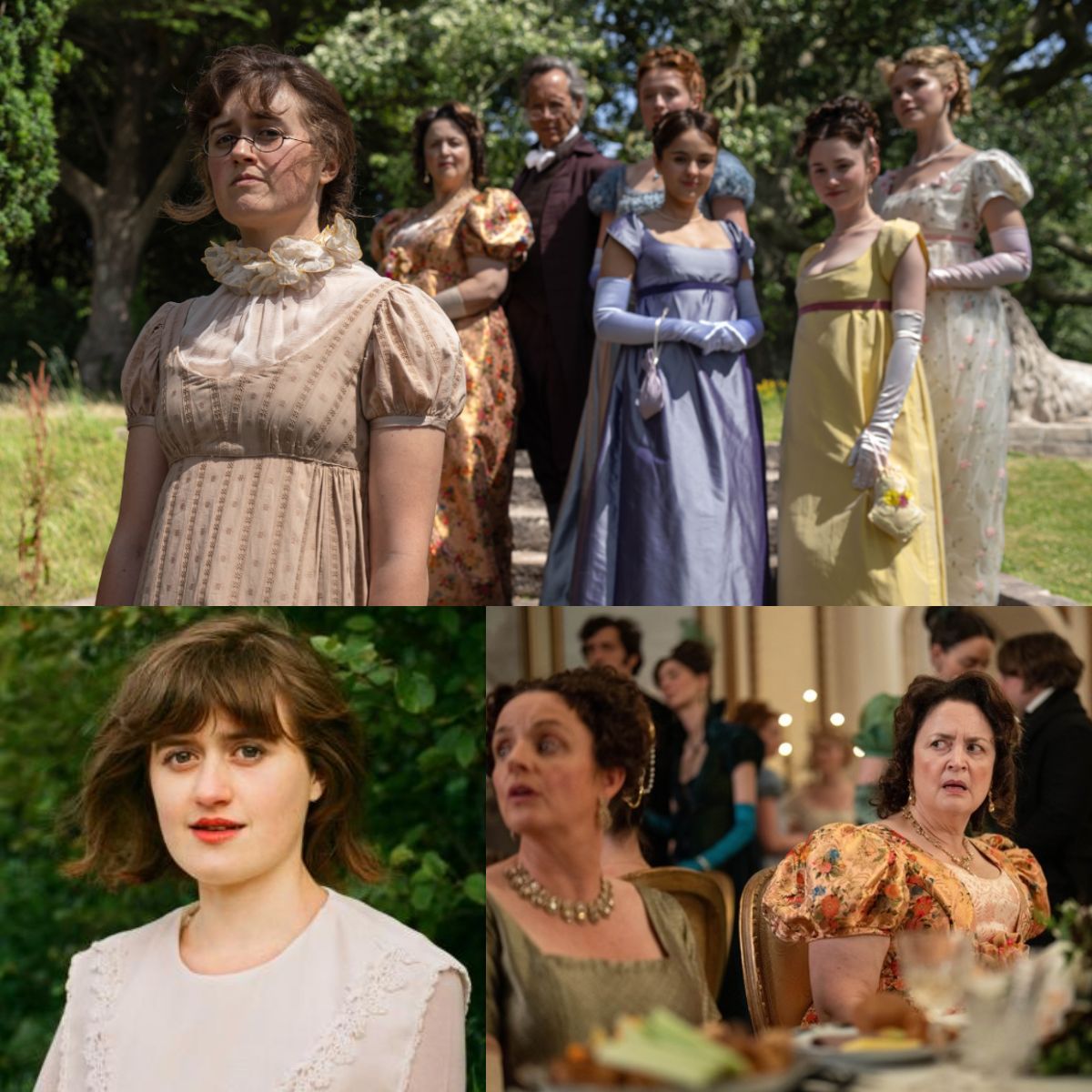
“SHE WAS ALWAYS THERE… BUT NO ONE EVER LISTENED” — Pride and Prejudice’s quietest character is finally stepping into the spotlight.
FOR SO LONG, MARY BENNET EXISTED AS A PRESENCE RATHER THAN A VOICE — someone defined by the space she didn’t occupy in the glittering world of Pride and Prejudice. But now, in a stunning new BBC/BritBox drama that has Austen fans utterly captivated, The Other Bennet Sister changes all that with surprising delicacy, allowing her long-overlooked story to unfold not through flashy dramatic reinvention, but through something far more intimate: a slow, emotional awakening that feels deeply human and painfully real.
What makes this series stand out isn’t just its bold shift in perspective from the beloved Elizabeth and Darcy romance. It’s the way it builds its central character with exquisite care, giving Mary room to breathe, to observe, to grow — until her quiet strength becomes impossible to ignore. In that masterful restraint, the performance carries a weight that lingers long after the credits roll, turning small, seemingly insignificant moments into something quietly heartbreaking.
This isn’t a story about Mary becoming someone else. It’s about finally being seen for who she’s always been.
The plain sister no one ever noticed — until now
In Jane Austen’s timeless 1813 masterpiece Pride and Prejudice, Mary Bennet was the middle daughter who barely registered. While beautiful Jane captured hearts with her sweetness, sharp-witted Elizabeth sparred with the proud Mr Darcy, flighty Kitty and wild Lydia chased officers, and anxious Mrs Bennet fretted over marriages, Mary sat at the piano, delivering moral lectures in a voice that often fell flat. She was the awkward one. The bookish one. The sister whose earnest attempts at accomplishment only highlighted her lack of charm in a society that prized wit, beauty, and social grace above all.
Fans of the countless adaptations — from the iconic 1995 Colin Firth version to the 2005 Keira Knightley film — barely gave her a second thought. She was background noise in the Bennet household chaos at Longbourn. A footnote in the grand romance unfolding around her.
But in The Other Bennet Sister, that all changes. Adapted from Janice Hadlow’s bestselling 2020 novel of the same name, this lush 10-part period drama (which premiered on BBC One and iPlayer in March 2026 and hits BritBox in the US and Canada on May 6) dares to put Mary front and centre. And the result is a revelation that has critics and fans alike declaring it one of the most poignant Austen-inspired stories in years.
At the heart of it all is rising star Ella Bruccoleri (Call the Midwife, Bridgerton, Paddington in Peru) as Mary. In a performance already tipped for awards buzz, Bruccoleri brings heartbreaking vulnerability and subtle fire to a character traditionally played for laughs or ignored entirely. Gone is the caricature of the sanctimonious plain Jane. In her place is a young woman of quiet intelligence, stifled potential, and a deep yearning to be truly seen — not just by her family, but by herself.
From Longbourn shadows to London awakening
The series begins where Austen left off, but viewed entirely through Mary’s eyes. We revisit the familiar events of Pride and Prejudice — the balls, the proposals, the scandals involving Lydia’s elopement — but this time they feel distant, almost secondary. Mary watches from the sidelines as her sisters’ lives transform through love and marriage, while she remains the unchanging, unremarkable one.
Her mother, played with delicious nervous energy by Ruth Jones (Gavin & Stacey), barely hides her disappointment in her middle daughter. Richard E. Grant brings warmth and quiet regret to Mr Bennet, whose intellectual detachment has left Mary craving approval she rarely receives. The lively household at Longbourn feels suffocating rather than lively when seen from Mary’s perspective — a place where she is tolerated but never celebrated.
Then comes the turning point. With her sisters settled (or scandalously entangled), Mary leaves the confines of Longbourn for the bustling streets of Regency London, finding refuge and gentle guidance with her sensible Aunt and Uncle Gardiner (Indira Varma and Richard Coyle). Here, away from the constant comparisons to her more sparkling siblings, Mary begins her slow, tentative journey of self-discovery.
It’s not the stuff of grand ballrooms and dramatic declarations. Instead, the drama unfolds in intimate, beautifully observed moments: Mary daring to wear glasses in public (horrifying her mother, who declares no man will want a woman who can actually see), losing herself in books and music on her own terms, forming tentative friendships, and — most poignantly — allowing herself to hope for love and belonging.
The supporting cast is stellar. Laurie Davidson and Dónal Finn step in as potential suitors who see beyond Mary’s plain exterior — one a thoughtful intellectual, the other bringing unexpected warmth. Lucy Briers, who famously played Mary in the 1995 Pride and Prejudice, makes a clever cameo as the Bennet family’s housekeeper Mrs Hill, adding a delightful meta layer for longtime fans. Other notables include Tanya Reynolds as the snooty Caroline Bingley and a host of fresh faces rounding out the Bennet sisters: Poppy Gilbert as Elizabeth, Maddie Close as Jane, Molly Wright as Kitty, and Grace Hogg-Robinson as the irrepressible Lydia.
The quiet power of restraint: Why this Mary feels so achingly real
What sets The Other Bennet Sister apart from flashier Austen retellings is its deliberate restraint. There are no zombies, no modern anachronisms, no over-the-top melodrama. Instead, screenwriter Sarah Quintrell (adapting Hadlow’s novel with sensitivity) and the creative team trust the audience to feel the weight of small gestures — a hesitant smile, a book clutched like a shield, the way Mary’s shoulders straighten just a fraction when someone truly listens to her.
Ella Bruccoleri’s performance is a masterclass in subtlety. In early episodes, her Mary is almost painfully withdrawn, her voice soft and uncertain as she navigates a world that has already decided she doesn’t matter. But as the series progresses, viewers witness a transformation that feels earned and profoundly moving. It’s not that Mary suddenly becomes beautiful or witty in the conventional sense. Rather, she learns to value her own strengths: her thoughtful mind, her moral compass, her capacity for genuine kindness without seeking the spotlight.
One particularly devastating scene sees Mary confronting the family dynamics that have shaped her. In a quiet conversation with her father, she articulates the loneliness of being the “other” sister — the one whose accomplishments are mocked rather than praised, whose seriousness is dismissed as dullness. The emotion doesn’t explode; it simmers, making the moment all the more powerful.
Director and producers have spoken about wanting to champion women like Mary — those who don’t fit the romantic heroine mould but still deserve their own story of growth and fulfilment. Executive producer Jane Tranter of Bad Wolf called it a chance to explore “women who never sit at the heart of our dramas,” giving voice to the overlooked in a genre often dominated by the bold and beautiful.
Fans have been quick to embrace this new Mary. Social media is flooded with emotional reactions: “Finally, the sister we needed all along,” one viewer posted after the BBC drop. “Ella Bruccoleri makes you feel every ounce of Mary’s quiet pain and then her quiet triumph. It’s devastating in the best way.”
Others praise how the series humanises the entire Bennet family. Mrs Bennet’s frantic matchmaking isn’t just comic relief here — it’s rooted in genuine fear for her daughters’ futures in a harsh Regency world. Mr Bennet’s detachment carries real consequences. Even Elizabeth’s wit takes on new shades when filtered through Mary’s envious yet loving gaze.
A love story on Mary’s own terms
Of course, no Austen-inspired tale would be complete without romance — but The Other Bennet Sister handles it with the same delicate touch. Mary’s potential courtships aren’t about whirlwind passion or societal triumph. They’re about being seen and accepted for who she is: a woman of substance who has spent years hiding her light.
The chemistry between Bruccoleri and her suitors crackles with understated intensity. One relationship in particular explores intellectual equality and mutual respect, while another brings unexpected joy and lightness to Mary’s life. These arcs feel refreshing in a genre sometimes criticised for rushing heroines toward marriage as the only happy ending. Here, love is part of Mary’s awakening, not the sole destination.
The production design enhances every emotional beat. Costumes reflect Mary’s gradual shift from dowdy practicality to quiet elegance that suits her personality. The London settings — from the Gardiners’ comfortable home to elegant drawing rooms and book-lined libraries — provide a vivid contrast to the more provincial Longbourn, symbolising Mary’s expanding world.
Filming took place in Wales and other historic locations, capturing the lush yet restrained beauty of the period with cinematography that lingers on faces and small details rather than sweeping landscapes alone.
Why this adaptation matters in 2026
As Jane Austen’s 250th birthday celebrations continue (she was born in 1775), The Other Bennet Sister arrives at the perfect cultural moment. In an era when audiences crave stories that challenge traditional notions of heroine material, Mary’s tale resonates deeply. She represents anyone who has ever felt invisible in their own family, overlooked in a world that rewards extroversion and conventional attractiveness.
The series also cleverly comments on Austen’s own themes of perception and prejudice. Just as Elizabeth misjudges Darcy, society — and even her own family — misjudges Mary. The drama invites us to question our own snap judgments about “plain” or “serious” characters.
Early reviews have been glowing. Critics call it “a thoughtful, moving companion piece to Pride and Prejudice that stands proudly on its own” and praise Bruccoleri for delivering “one of the most quietly commanding performances of the year.”
For longtime Austen devotees, there’s added delight in seeing familiar events reframed. The Netherfield ball, Lydia’s scandal, even Mr Collins’ proposal — all take on new emotional layers when experienced through Mary’s observant, often pained viewpoint.
A lingering legacy that touches the heart
As the 10 episodes unfold (with the first batch dropping on BBC iPlayer and weekly airings on BBC One, followed by the full rollout on BritBox), The Other Bennet Sister proves that sometimes the most powerful stories are the quietest ones. Mary doesn’t need to slay dragons or deliver cutting one-liners to earn her happy ending. She simply needs space to become fully herself.
In the end, this isn’t just another Austen adaptation chasing nostalgia or modern twists. It’s a tender, deeply felt exploration of self-worth, family dynamics, and the courage it takes to step out of the shadows — even when those shadows have defined you for so long.
Ella Bruccoleri’s Mary Bennet doesn’t demand your attention. She earns it, moment by gentle moment, until you can’t look away. And in that quiet triumph, The Other Bennet Sister delivers something truly special: a story about finally being seen for who you’ve always been.
For fans who once dismissed Mary as the dull middle sister, prepare to have your heart quietly, beautifully broken — and then gently put back together.
The Bennet family will never look quite the same again.