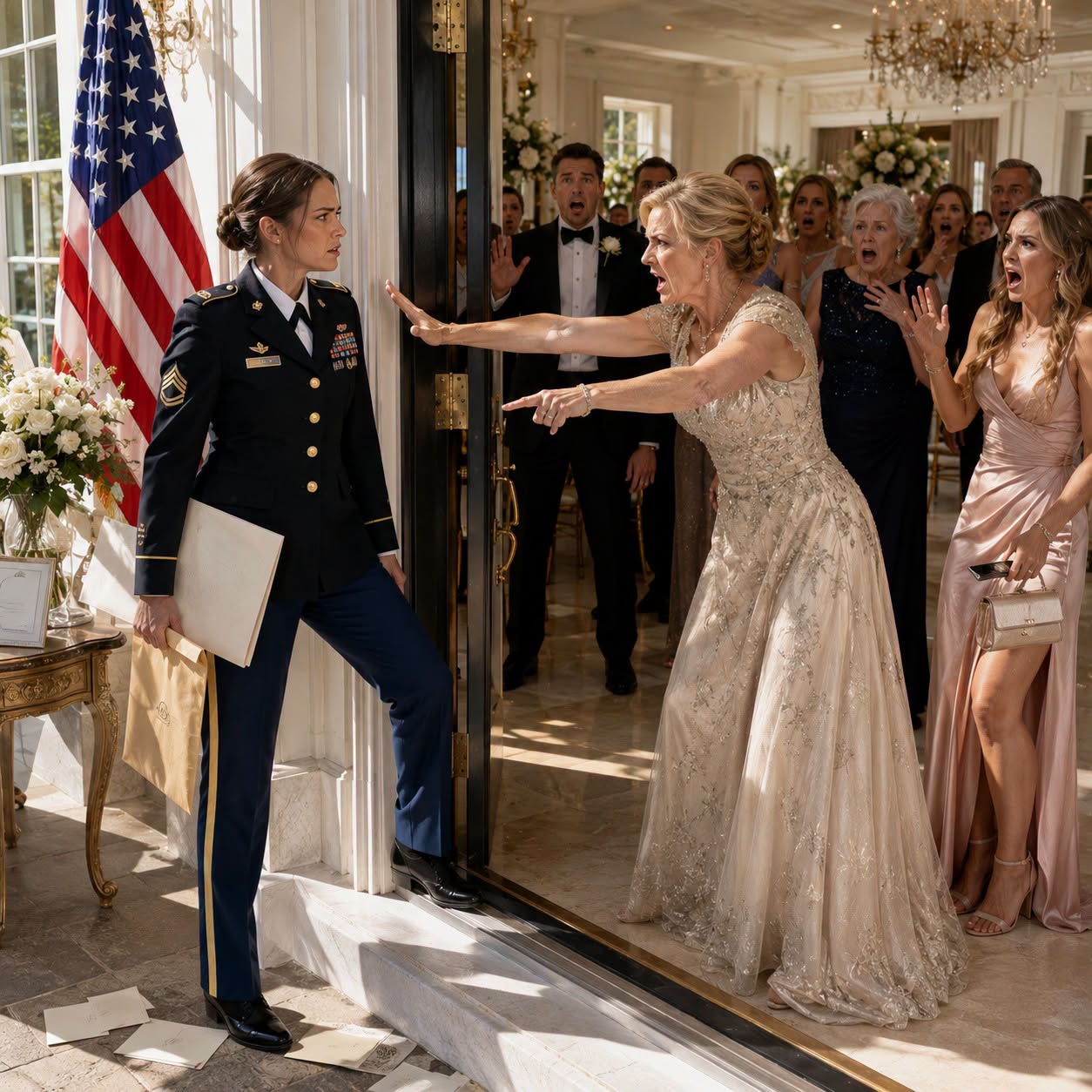
The marble driveway of the Whitfield estate gleamed like polished bone under the summer twilight, every veined slab radiating the quiet arrogance of old money. My combat boots—still carrying the faint, stubborn dust of another continent—left ghostly prints behind me. Each step felt like a small desecration
Fourteen months in a forward surgical unit had taught me to walk through rubble, through the acrid smoke of burning oil fields, and through the kind of silence that follows a mortar strike. Yet here, on the threshold of my childhood home in Briar Glen, Massachusetts, I hesitated, ashamed of the marks I left on stone that had never known hardship.
The house rose before me, unchanged: white limestone walls glowing softly in the golden hour, black shutters framing windows that looked out on a world of curated perfection. Through the tall glass doors, the engagement party spilled light and laughter like champagne from an overturned flute. Towers of crystal flutes, cascades of white roses and orchids, and a towering golden sign that proclaimed the union to come—Lillian Whitfield & Blake Harrow.
My sister. The golden child. The one who had never left.
I had called my mother three times before the long flight home. Sent two careful messages after landing at Logan. Silence had answered, but I had clung to the fragile fiction that they were simply busy with preparations—that my return would be the surprise that bridged the widening chasm between us. Hope, I was learning, dies more quietly than soldiers do.
The door opened before I could knock.
Celeste Whitfield stood beneath the crystal chandelier like a queen in exile from warmth. Her black sheath dress hugged a figure kept mercilessly elegant by private trainers and quiet disdain. Silver-blond hair swept into a flawless chignon, diamonds at her wrist catching the light like frozen accusations. Her eyes—pale blue, the same shade I had inherited but never quite earned—moved over me with clinical precision: my face, still carrying the hollows of too many night shifts and rationed sleep; the Army dress uniform that had once made me feel proud; the scuffed boots that had marched through dust and blood.
For a heartbeat, something almost like surprise flickered across her features. Then it hardened into the familiar mask.
“What are you doing here, Mara?”
The words landed like a scalpel. Not Welcome home. Not even You’re back.
“I came home,” I said, my voice steadier than I felt. “I told you I was trying to make it for the party.”
“Tonight?” She stepped onto the portico and pulled the heavy door nearly shut behind her, sealing away the string quartet, the clink of glasses, the glittering world inside. The music became a distant murmur, like a dream I was no longer allowed to share.
I looked down at myself. The uniform was clean—pressed in a cramped airport lounge—but it carried the unmistakable aura of duty, of places far from Briar Glen’s manicured lawns. “I came straight from the airport. There wasn’t time—”
“You look like staff,” she cut in, voice low but sharp enough to draw blood. “Maintenance, perhaps. Lillian’s guests are important people, Mara. Investors. Board members. Families who matter in this city.”
The air between us thickened. I had heard worse in war zones—from terrified patients clawing at my sleeves, from exhausted officers issuing impossible orders, from boys who knew they were dying and wanted someone to blame. Their words had never lodged in my chest like this one did. You don’t belong here. She hadn’t said it yet, but the shape of it hung between us, heavy and inevitable.
“And I’m what, exactly?” I asked quietly.
Her mouth tightened into a thin line. For a moment, I saw the mother who had once read me bedtime stories in this very house, the woman whose laughter used to fill these halls before ambition and appearances had calcified around her heart. That woman was gone.
“Do not create a scene,” she whispered. “Use the service entrance. If you must.”
The door closed.
The soft, decisive click of the latch echoed louder than any explosion I had endured overseas. Through the glass, I watched my sister, radiant in ivory silk, tilt her head back in laughter beneath a canopy of flowers. Blake Harrow—polished, confident, heir to another empire—rested a possessive hand at the small of her back while he shook hands with men whose names moved markets. Neither of them glanced toward the shadowed figure on the wrong side of the glass.
I stood there, duffel bag heavy on my shoulder, the weight of every mile I had traveled pressing down on me. The driveway stretched behind me, inviting retreat. The service entrance waited somewhere around the side, a humiliation I could still choose to accept.
I could have left.
I almost did.
But as I turned, something caught my eye—a faint gleam near the foundation where the landscaping met the house. A small metal box, half-hidden beneath a trimmed boxwood, its lock glinting dully in the fading light. It looked out of place. Deliberately concealed. The kind of thing no one in this perfect family would want found.
My hand moved before my mind could stop it.
PART 2
The service entrance loomed at the side of the house like a servant’s confession—unlit, half-hidden by climbing ivy that had been trained to look accidental. I could have swallowed my pride and slipped inside, accepted the role they had already cast me in: the prodigal daughter who arrived inconveniently, dressed for the wrong life. But the small metal box beneath the boxwood held me in place. It was no larger than a field medic’s kit, its edges weathered, the lock simple yet stubborn. Someone had tucked it there hastily, trusting the estate’s perfection to conceal imperfection.
My fingers, callused from years of sutures and rifle slings, worked the latch. It gave way with a reluctant snap.
Inside lay a thick manila envelope, sealed with tape that had yellowed at the edges, and a smaller black leather journal. The faint scent of my father’s old cologne—sandalwood and cedar—rose from the papers like a ghost refusing to rest. My heart stuttered. Father had been gone for six years, lost to the heart attack the doctors called “sudden but not unexpected.” Or so the family narrative went.
I crouched in the shadows, the distant laughter from the party a cruel soundtrack, and opened the envelope first.
The documents were crisp, official, dated only months after my enlistment. A letter from my mother to a private investigator. Another from a law firm in Boston. And at the bottom, a copy of a revised will—my father’s signature, shaky but unmistakable.
“…Mara has chosen a path incompatible with the Whitfield legacy. Her continued association risks exposure of the circumstances surrounding her birth. For the protection of Lillian and the firm, she is to receive only the minimum stipulated by law, disbursed anonymously through the trust. Under no circumstances is she to learn the truth.”
The truth.
My hands trembled as I unfolded the next page—a paternity test from fifteen years ago. The results were clinical, merciless. The man I had called Father was not my biological father. My mother’s affair with a junior associate at the firm—a man long since paid off and disappeared—had produced me. The scandal had been buried deep, my enlistment quietly encouraged not out of patriotism, but as a convenient removal. “She thrives under structure,” my mother had written in the journal. “Let the military give her purpose while we secure Lillian’s future.”
Page after page revealed the architecture of my exile: bonuses funneled into Lillian’s trust from “anonymous donors,” my overseas tours celebrated publicly while privately toasted as relief. Even my father’s final letter to me—never sent—admitted his love but confessed his weakness. “You were never a mistake to me, but the world we built cannot afford you.”
The journal slipped from my fingers. A single loose photograph fluttered out: me at eight, smiling gap-toothed beside my father on the same driveway, his arm around my shoulders. On the back, in my mother’s elegant script: “Handle with care until she’s gone.”
The music swelled inside the house. Someone proposed a toast to Lillian and Blake’s perfect future. Through the window, I saw my mother smiling serenely, diamonds flashing, as if the daughter bleeding in the shadows outside had never existed.
Rage and grief collided in my chest, hot and blinding. All the nights I had stitched soldiers back together, all the times I had whispered survival into dying ears—none of it had prepared me for this wound. This was the one thing they had hidden from me: the knowledge that I had never truly belonged. Not because of my uniform, but because my very existence was the family’s original sin.
I rose slowly, the papers clutched in white-knuckled fists. The service entrance was no longer an option. The front door, with its gleaming brass and judgmental glass, called to me now like a dare.
My boots left fresh prints as I marched back toward the light.
PART 3
The front door swung open under my hand before anyone could stop me. The chandelier’s light poured over me like judgment, and for the first time in my life, I did not shrink from it. Conversations faltered. Heads turned. Crystal glasses paused halfway to painted lips. In my dust-streaked uniform, with the manila envelope clutched like a live grenade, I must have looked like a ghost from a war they had only read about in newspapers.
My mother’s face drained of color. Lillian’s perfect smile froze mid-laugh, her hand still resting on Blake’s arm. The string quartet played one uncertain note before falling silent.
“Mara—” Celeste began, stepping forward with the practiced grace of damage control.
“No.” My voice carried across the room, quiet but forged in places where whispers meant life or death. “Not this time.”
I held up the envelope, letting the paternity test and the damning pages catch the light. Gasps rippled through the crowd like wind through dry grass. “You built this entire empire on a lie. On me. The inconvenient daughter. The living proof of your mistake. You shipped me off to war hoping I’d disappear into it. And when I came back whole, you still tried to shove me through the servants’ door.”
Lillian’s eyes widened, flicking between me and our mother. For a flicker, I saw something human break through her polished facade—shock, perhaps even a shard of guilt—but it was quickly buried beneath years of careful grooming.
Blake shifted uncomfortably, the golden boy suddenly confronted with tarnished roots.
Celeste recovered with arctic precision. “This is neither the time nor the place. We will discuss this privately.”
“Privately?” I laughed, a sound raw and unfamiliar even to me. “Like you discussed my father’s letters? Like you discussed the trust that funneled every penny away from me while I was stitching boys back together in tents that smelled of blood and antiseptic? You told me I didn’t belong here. You were right. I never did. Because belonging to this family meant accepting a cage made of marble and silence.”
I stepped closer, the papers trembling only slightly in my grip. The weight of fourteen months overseas, of lost friends and hard-won purpose, steadied me. “I came home looking for family. Instead, I found the truth. And the truth is the only thing worth keeping.”
For a long moment, the grand ballroom was suspended in silence. My mother’s diamonds suddenly looked like chains. Lillian’s engagement ring caught the light like a pretty lie.
I placed the envelope on the nearest table, right beside the towering display of white roses. “Consider this my wedding gift, Lillian. The real family history. Burn it, hide it, or face it. I no longer care.”
Turning on my heel, I walked back through the doors I had entered with such hesitant hope. The dust from my boots marked the marble once more, but this time it felt like a signature rather than an apology. Behind me, voices erupted—questions, accusations, the fragile shattering of carefully constructed illusions.
The night air welcomed me as I descended the driveway. My duffel bag felt lighter now. The stars above Briar Glen were the same ones I had looked up at from desert sands and mountain outposts. They had never asked me to be anything other than what I was.
I didn’t know where I was going next. But for the first time, the road belonged entirely to me.
And that was enough.
THE END