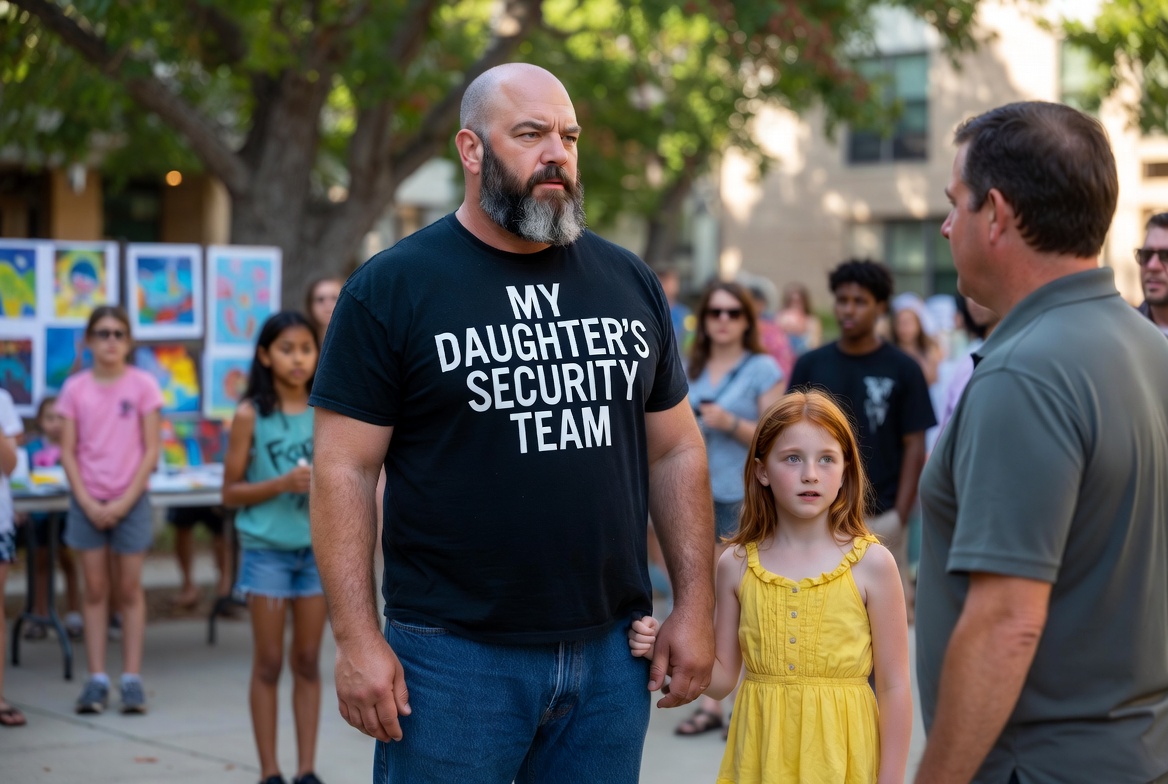
The courtyard of Willow Creek Elementary hummed with the fragile energy of Parent Day—the scent of cheap coffee, the rustle of construction-paper projects, and the bright, anxious laughter of children who still believed the world could be tamed by gold stars and parent signatures. Amid the pastel chaos, Raymond “Brick” Dawson stood like a monument carved from another, harder life
At fifty-three, he was a giant among ordinary men: six-foot-five, nearly three hundred pounds of weathered muscle and quiet resolve. His shaved head gleamed under the afternoon sun, and his massive salt-and-pepper beard framed a face that had seen too many roads and not enough mercy. Faded tattoos snaked from the scarred knuckles of his hands up his thick forearms and disappeared beneath the collar of his plain black T-shirt. Heavy motorcycle boots, scuffed from a thousand miles of asphalt, anchored him to the pavement. His Harley-Davidson waited patiently by the gate like a loyal hound, engine silent, chrome subdued.
Yet it was not the ink or the size that made strangers reach for their phones. It was the way he stood—perfectly still, one massive hand resting lightly on the narrow shoulder of his nine-year-old daughter, Lily. She wore a simple yellow sundress, her strawberry-blonde hair caught in two uneven braids. One small hand remained hooked through the belt loop of his jeans, as if letting go might mean drifting into a sea of judgment.
From a distance, Brick looked like a threat waiting for permission to become real.
The bullying had started months earlier, whispered like poison in the hallways. Her dad’s a criminal. Bikers hurt people. The police will take him away one day. Children could be cruel in their innocence, repeating the fears of their parents. Lily had tried to defend him at first—He fixes my bike and reads to me every night—but words bounced off closed hearts. On Wednesday, a girl had snipped a lock of her hair during recess. The school called it “horseplay.” Lily had stopped correcting them.
Brick had not.
He came alone today, refusing to bring the brotherhood that might have turned the event into a spectacle. No club vest. No chain wallet. No roaring engines. Just a father, determined to prove that love could wear any face. The shirt had been Lily’s idea, painstakingly lettered in black marker on one of his old tees: MY DAUGHTER’S SECURITY TEAM. He had laughed when she presented it, a rare, rumbling sound that softened the edges of his granite features. He wore it now, believing it would make her smile.
It did not.
Parents stared. Phones rose like periscopes. One father muttered about calling security. A mother steered her son away as if Brick’s shadow might bruise the boy. The air thickened with unspoken accusations.
I watched it all from the edge of the courtyard, clipboard in hand, heart tightening in my chest. My name is Amanda Pierce, school counselor. In my eight years here, I had mediated playground wars and teenage heartbreaks, but nothing had prepared me for the quiet storm that was Raymond Dawson. I expected rage from him—raw, predictable, easy to label. What I received instead was something far more dangerous: restraint.
When three boys drifted too close to Lily, their whispers sharp as paper cuts, Brick’s jaw tightened. His fists curled slowly at his sides, veins standing out like ropes beneath the tattoos. The courtyard seemed to hold its breath. For a moment, the old stories felt true—the biker, the criminal, the man one wrong word from violence.
Lily’s small fingers brushed his wrist.
The fists opened. The tension bled away like rain off leather.
“Do you want to leave, sweetheart?” His voice was low, gravel wrapped in velvet.
She shook her head, eyes shining with determination and fear.
“Then we stay.”
No threats. No raised voice. Just a father choosing his daughter’s courage over his own comfort.
I followed them as Lily presented her science project on ecosystems—a carefully drawn poster board depicting fragile webs of life. Her voice trembled on the first sentence, cracking like thin ice. Brick stood behind her, a silent mountain. By the final words, her tone had steadied, strengthened by the knowledge that the largest shadow in the room belonged to her.
Afterward, Principal Warren pulled Brick aside, his expression carefully neutral. “Mr. Dawson, we take these matters seriously. What kind of… consequences do you feel are appropriate?”
Brick’s gaze drifted across the courtyard to the cluster of children who had mocked his daughter. A long pause stretched between them, heavy with the weight of thirteen years spent trying to outrun his past.
“I don’t need anyone scared of me,” he said at last, each word measured, deliberate. “I need her to know she doesn’t stand alone.”
The confession that followed cracked the facade of the afternoon. A boy near the refreshment table began to cry—soft, broken sounds that drew his mother forward. She spoke of hidden bruises on school supplies, of weeks spent watching her son shrink. Two other parents joined her, their stories tumbling out like stones long held beneath the surface. What the school had dismissed as isolated incidents was revealed as a pattern, a quiet epidemic wearing the innocent faces of children.
Then Lily reached into her backpack and pulled out a folded sheet of paper, creased from careful hiding. She handed it to her father without a word.
Brick unfolded it slowly. Twelve names. Twelve children. Beside each, in Lily’s neat, childish handwriting, were the places they had learned to hide during recess: behind the dumpsters, under the slide, in the far corner of the library where the shelves blocked the light. At the bottom, underlined twice, was the name of an adult volunteer who had watched it all. Who had warned the children not to “cause trouble.” Who had told them that no one would believe accusations against respectable families.
Brick read the name twice. His massive shoulders tensed, not with rage, but with the slow, crushing recognition of consequence.
The man was a former member of the Iron Hounds—expelled six years earlier in a storm of betrayal and blood. He knew the secret behind Brick’s old prison record. He knew the darkness Brick had buried deep so that Lily could walk through these gates without carrying his sins.
To protect his daughter and the others, Brick would have to drag that darkness into the light.
The courtyard lights flickered on as evening approached. Parents began to gather their children, but the real story was only beginning to unfold. Brick looked down at Lily, then at me, his eyes holding a depth of regret, resolve, and something almost like hope.
He had come here to stand beside his daughter.
Now, the past was standing beside him.
PART 2
The name on Lily’s paper burned in Brick’s mind like a brand from the old days—Marcus “Reaper” Hale. Once a brother in the Iron Hounds, now a volunteer hiding behind a respectable smile and a clipboard. Six years had not erased the stench of his betrayal: the deal gone wrong, the blood on the warehouse floor, the lies that had sent Brick to prison for thirteen months while Reaper walked away cleaner than he deserved.
Brick folded the paper with deliberate care, his scarred fingers steady despite the storm gathering behind his eyes. He looked at me, Amanda Pierce, as if weighing whether a school counselor could handle the truth of a man who had once ridden the thin line between outlaw and protector.
“Ms. Pierce,” he said, voice low enough that only I and Lily could hear, “this ends tonight. Not with fists. With facts.”
Principal Warren hovered nearby, sensing the shift in the air like an approaching storm. Parents lingered, drawn by the undercurrent of unease, their earlier fear now laced with reluctant curiosity. Lily stayed close to her father, her small frame radiating a courage far beyond her nine years.
I led them toward the volunteer station near the art display, where Reaper—now calling himself Mark Hale, community pillar and youth mentor—stood organizing leftover name tags. He was slimmer than Brick, silver threading his dark hair, his smile polished and practiced. But when his gaze locked on Brick, recognition hit like a freight train. The color drained from his face.
“Brick,” he muttered, forcing a chuckle that rang hollow. “Didn’t expect to see you playing family man at a school gig.”
The courtyard had grown quieter. A few parents lingered within earshot, pretending to admire children’s drawings while their phones remained ready.
Brick didn’t raise his voice. He didn’t need to. His presence filled the space like gathering thunder. “You’ve been watching kids hide, Mark. Telling them no one would listen. Using this place as your new hunting ground.”
Reaper’s eyes flicked to Lily, then to the growing circle of onlookers. “Careful, old friend. Some secrets don’t belong in daylight. Especially not yours. Remember what they pinned on you back then? The contraband that conveniently vanished after your testimony dried up? I still have the copies. One call, and your little princess learns exactly what kind of man her daddy really is.”
The words landed like blows. I saw the flicker in Brick’s massive frame—not fear, but a profound, aching sorrow. Thirteen years of building a life beyond the club, of late-night rides turned into bedtime stories, of tattoos that told stories he no longer wanted to live. All of it threatened by a ghost from the past.
Lily’s hand tightened on his belt loop. “Dad?”
He knelt then, bringing his formidable height down to her level, his voice softening into something raw and sacred. “Baby, there are things I did before you. Things I’m not proud of. I went to prison so the club could clean house. But I never hurt kids. Never looked away while they suffered. That’s not me. That’s him.”
Tears welled in her eyes, but she didn’t run. Instead, she turned toward Reaper with a defiance that shattered every adult heart watching. “You made us hide. You told me Daddy was bad. But he’s here. He stayed.”
The tension snapped.
Reaper stepped forward, his mask slipping into a sneer. “You think this changes anything, Brick? The Hounds cast me out, but I know where the bodies are buried—literally. One word from me, and the school board, the cops, every parent here will see you for the criminal you are. Your record. The deals. The night we lost Tommy on that run. Walk away now, and your past stays buried. Stay, and I burn it all down in front of your daughter.”
Brick rose slowly, towering once more. The air crackled. Parents whispered furiously. Principal Warren reached for his phone. My own pulse thundered in my ears—this was no longer a schoolyard issue. It was a collision of two lives, two versions of justice, with children caught in the crossfire.
For the first time, Brick’s fists clenched with visible restraint. “You always were a coward, Reaper. Hiding behind kids. Behind lies. I spent years proving I could be more than my mistakes. For her.” His voice dropped to a lethal whisper. “But if you think I’ll let you poison another generation to save yourself… you’re wrong. Dead wrong.”
Reaper’s hand twitched toward his pocket—phone or something worse? The crowd pressed closer. Lily stepped slightly in front of her father, a tiny shield against the gathering darkness.
In that frozen moment, the truth hovered on the edge of explosion. Secrets about the club, the real reason Brick took the fall, the hidden rot inside this “respectable” school—all of it ready to detonate.
And then Reaper smiled, cold and certain.
PART 3
The smile on Reaper’s face died the moment Brick took one deliberate step forward. Not in rage, but in unyielding clarity. The giant did not swing. He did not roar. Instead, he spoke the kind of truth that cuts deeper than any blade.
“I took the fall for the club because I believed it would protect the brothers,” Brick said, his voice carrying across the courtyard now hushed into absolute silence. “Thirteen months inside so the rest could walk clean. But you… you sold the route to the rivals, pocketed the money, and let Tommy bleed out on that rain-slick road. I have the old logs. The messages you thought you deleted. I kept them—not for revenge, but as proof I could choose better. For her.”
Reaper’s hand froze in his pocket. The polished volunteer facade crumbled completely, revealing the cornered man beneath. “You’re bluffing. No one will believe a biker over—”
“They already do,” I interrupted, stepping forward with a steadiness I didn’t know I possessed. My years of counseling had taught me to read the space between words, and the parents around us were no longer spectators. They were witnesses. Phones that had once recorded Brick in suspicion now captured Reaper’s unraveling.
One mother, the same one whose son had cried earlier, raised her voice. “My boy said Mr. Hale told him to stop complaining. That real men don’t tattle.” Others joined in—quiet confessions turning into a chorus of long-suppressed anger. The pattern of bullying, the dismissed reports, the adult who had enabled it all while hiding behind community service hours. It spilled out like floodwaters breaching a dam.
Principal Warren finally moved, signaling security who had been called discreetly. Reaper’s eyes darted wildly, searching for an exit that no longer existed. “This isn’t over, Brick. Your record—”
“My record is mine,” Brick cut in, his tone heavy with the weight of hard-won wisdom. “I did time. I lost friends. I rode through nights wondering if the road would ever let me come home clean. But every mile since Lily was born has been a choice to be the man she deserves. Not perfect. Not innocent. Just present.”
He turned away from Reaper then, kneeling once more before his daughter. The giant and the girl, framed against the fading light of Parent Day. Lily’s tears fell freely now, but they were not tears of shame. They were release.
“You’re not bad, Daddy,” she whispered, wrapping her arms around his thick neck as far as they could reach. “You’re my security team.”
Brick’s massive shoulders trembled—just once—as he held her close. The salt-and-pepper beard brushed her hair, and for the first time that afternoon, the threat he had seemed to embody transformed entirely into something sacred: a father’s unconditional shelter.
In the days that followed, the school launched a full investigation. Reaper—Marcus Hale—was removed and later charged not only with enabling harassment but with deeper connections to old crimes that Brick’s evidence helped reopen. The Iron Hounds, to their quiet credit, provided anonymous statements that protected the innocent while ensuring the guilty could not hide again. Parents who had once feared Brick now thanked him. Children who had hidden began to stand taller.
As for me, Amanda Pierce, I learned that night that strength is not the absence of a shadowed past, but the courage to carry it without letting it define the future. Brick Dawson taught an entire community that lesson without ever raising his voice.
Weeks later, on a quiet Saturday, I saw them again. Brick’s Harley gleamed in the school parking lot during a community safety event—engine off, as always. Lily rode on his shoulders, laughing as he pointed out constellations in the early evening sky. The shirt she had made still hung in their home, a badge of honor now rather than a plea.
The largest father at Parent Day no longer stood like a threat waiting for permission.
He stood like proof that even the hardest roads can lead home.
THE END