Thirteen Languages of Betrayal: The Silence I Finally Shattered
PART 1: The Weight of Silence
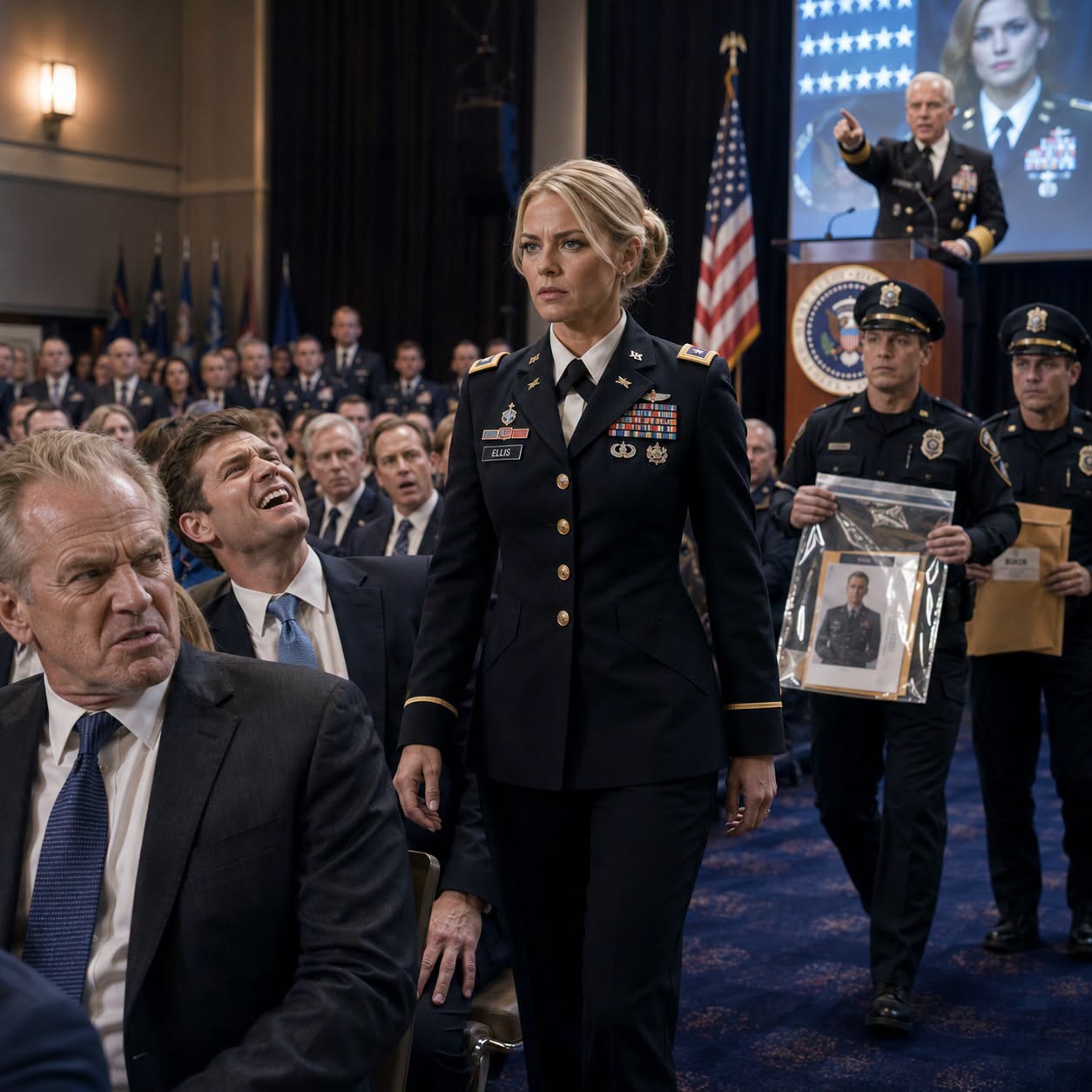
The auditorium hummed with the low rustle of programs and murmured respect, but in the third row, contempt cut through the air like a blade.
“Thirteen languages?” My father’s voice carried, sharp and unyielding. “That doesn’t make you a soldier, Danielle. That’s just hiding behind a headset while real men bleed.”
The room stilled. A single program slipped from someone’s lap and whispered against the floor.
Behind him, my brother Evan let out a soft, delighted laugh—one meant for me to hear. Not nerves. Satisfaction.
I stood three rows back, eyes fixed on the American flag hanging beside the stage, its folds sharp under the lights. I had counted this moment in breaths for years: four in, four held, four out. The rhythm that had kept me alive in windowless rooms where voices from half a world away decided who lived and who vanished into dust.
Dad wasn’t finished. “Arabic, Farsi, Pashto—doesn’t matter. A rifle only speaks one language.”
A captain across the aisle studied his boots. Evan leaned closer to our father, his whisper loud enough to travel. “They probably invited her just to translate the lunch menu.”
Laughter rippled in a few places—polite, uncertain. But I had heard the same words before: at the scarred kitchen table in Georgia, in the church parking lot where gossip clung like humidity, at my high school graduation, and worst of all, beside Mom’s hospital bed as her voice faded into nothing.
I didn’t turn. I simply breathed.
Onstage, Admiral Grayson stood like a man carved from duty itself, the blurred map behind him a ghost of secrets no civilian would ever touch. The master of ceremonies cleared his throat.
“There are operations we cannot discuss,” he began. “Missions that never made headlines. Units that returned home because one person heard what the rest of the world missed.”
Dad snorted.
The admiral’s gaze drifted to the third row, then found me. Something shifted in his expression—recognition, perhaps even gratitude.
He stepped forward. “We need Aquila Seven in the room.”
Chairs creaked. Heads turned. The air thickened.
Dad’s breath caught. Evan’s smirk faltered.
I walked down the aisle with measured steps, the polished wood echoing beneath my boots like a heartbeat finally allowed to speak. As I passed my father, the familiar cheap cedar of his aftershave hit me—the same scent that had filled our house every Thanksgiving while he praised Evan’s “real service” and dismissed mine as “support.”
Evan’s face drained of color.
Admiral Grayson waited until I reached the stage. Then he offered a full, crisp salute. Every officer in the auditorium rose as one. Dad stood last, as though the weight of the world had suddenly settled on his shoulders.
The admiral turned to the crowd, his voice steady and resonant.
“This officer spoke when silence was costing lives,” he said. “Every time Aquila Seven broke that silence, a unit came home.”
My throat tightened, but my face remained a mask of composure. Years of training had taught me that control was its own weapon.
“Captain Danielle Harlo identified thirteen regional dialects in real time, exposed fabricated translations, and unraveled three coordinated attacks before they could ignite. Her work saved countless lives in Ramadi, in Syria, and along the western corridor.”
A murmur swept the room, growing into something like awe. Evan stared at the floor. Dad looked at me as though I had stolen something precious from him—importance, perhaps. Legacy.
They had no idea.
The true reckoning wasn’t the medal that would soon rest against my chest. The real surprise waited just beyond the lobby doors: two military police officers standing sentinel beside Special Agent Marla Keene. In her hands was a folder heavy with server logs, timestamped camera feeds, altered documents, and the buried report of a soldier who had died carrying a lie.
But the roots of this moment stretched far deeper than any auditorium or battlefield.
They began in a small Georgia town where everyone knew your truck before they knew your soul. Our house crouched along a county road, its porch sagging like tired shoulders, shaded by two ancient pecan trees and watched over by a faded American flag. Inside, the kitchen carried the perpetual ghosts of bacon grease and church casseroles.
Mom lost her voice when I was six. A cruel neurological illness stole it in fragments—first her lullabies, then full sentences, finally even my name. Afterward, she spoke through index cards, small rectangles of love and survival: Milk. Doctor at 3. Proud of you.
Dad hated silence. He filled every void with commands: Shoes off. Dishes done. No foreign garbage at my table.
I discovered languages in the margins of detergent boxes, dog-eared library books, and the faint crackle of an old shortwave radio. Long after midnight, I would huddle under the porch light, copying unfamiliar sounds into a spiral notebook while the screen door banged in the wind like a restless spirit.
Mom noticed. She began leaving thrift-store newspapers and battered language primers beneath my pillow. One dawn, beside my cereal bowl, she placed a single card: Keep listening.
Dad found it. He crushed the card in his fist and dropped it by the sink.
“You’re filling her head with nonsense,” he told her.
Mom simply looked at him. The silence stretched until he turned away.
That was the day I learned silence could be a victory.
By thirteen, I was translating Yemeni weather broadcasts in my head. At eighteen, I won a full scholarship for my ability to detect fabricated regional accents in audio recordings. I brought the acceptance letter home like a fragile treasure, sliding it beside Dad’s coffee as he scratched out a grocery list.
He glanced at the government seal, folded the envelope in half without opening it, and slid it back.
“Don’t forget the milk,” he said.
Evan snatched it up, fanning himself theatrically. “All that studying just so you can whisper into a microphone?”
Mom stood in the doorway, gripping the counter, her eyes shining with unshed tears. Mine stayed dry. I taped the letter inside my closet door like a hidden map to another world.
That night, I overheard Dad telling an Army buddy that I had “no spine for the field.” I wrote the words down in my notebook, underlining them until the pen nearly tore the page.
Years unfolded in disciplined chaos: West Point, deployments, encrypted late-night calls, missions whose names would never be spoken aloud. Still, Dad introduced Evan as “my soldier” and me as “the translator.” Even after Mom died. Especially after Mom died.
At her funeral, amid the scent of ham biscuits and quiet condolences in the church basement, Dad pressed a manila envelope into my hands.
“Sign these,” he said flatly.
Quitclaim deeds. Bank authorizations. Documents that would hand Mom’s modest trust to Evan.
I stared at the signature line, then at him. “What is this?”
“Family business,” he replied.
Evan smiled over his paper cup of coffee. “Don’t make it dramatic, Danny.”
I didn’t sign. Dad’s jaw tightened.
“You think those languages make you smarter than us?”
“No,” I answered quietly. “Your paperwork does.”
I slipped the envelope into my purse. Neither of them noticed the tiny red light glowing above the church office door—the security camera that had captured every word.
Three weeks later, Mom’s lawyer called with a revelation that would fracture our family forever.
“Danielle,” she said, her voice grave, “your father just tried to conceal the real will.”
I listened, the old familiar rhythm returning to my breath—four in, four held, four out—as the first threads of betrayal began to unravel into something far darker.
PART 2: The Reckoning
The applause died slowly, like distant thunder fading over the Georgia hills I had once called home. Admiral Grayson pinned the medal to my uniform with steady hands, his eyes conveying what words could not: respect earned in shadows most would never see. I saluted crisply, then stepped back, the weight of the metal both lighter and heavier than I had imagined.
But the true ceremony was only beginning.
As the audience began to rise, two military police officers moved with quiet purpose through the side doors. Their presence rippled through the crowd like a chill wind. Special Agent Marla Keene followed, her expression unreadable, the thick folder in her grip a silent verdict.
I descended the stage steps without hurry. My father and Evan were already pushing toward the aisle, eager to escape the unfamiliar sting of being overshadowed. They didn’t make it far.
“Captain Harlo,” Agent Keene called, her voice carrying with practiced authority. “A moment, please.”
Heads turned again. Dad froze mid-step. Evan’s shoulders tensed, the easy confidence he had worn like armor cracking at the edges.
I joined them in the open space between rows, the polished floor suddenly feeling like contested ground. Close enough to smell Dad’s aftershave again, to see the faint tremor in Evan’s jaw.
“What the hell is this?” Dad demanded, his voice low but edged with the same bark he had used to command our household for decades.
Agent Keene didn’t flinch. She opened the folder with deliberate calm, revealing printed logs, grainy stills from security feeds, and documents marked with red stamps of classification.
“Mr. Harlo, Mr. Harlo,” she addressed them both, “we’re here regarding the death of Sergeant Elias Moreau in the western corridor operation two years ago. Evidence has come to light that his after-action report was falsified. Translated incorrectly. Deliberately.”
The air grew thick, almost unbreathable.
Evan laughed—a brittle sound this time. “This is ridiculous. Danny’s little award went to her head.”
I met his eyes for the first time in what felt like years. “You always did like rewriting stories, Evan.”
Dad stepped forward, chest puffed with the old righteous fury. “My son served honorably. Whatever mess you’re trying to pin—”
“Enough.” My voice cut through his like a blade I had long kept sheathed. The auditorium had gone deathly quiet once more. “You taught me silence, Dad. But silence has limits.”
Agent Keene laid out the first image: a timestamped server log showing access from Evan’s secure terminal—access he should never have had. “Captain Harlo’s original translation flagged anomalies in local dialects indicating an imminent ambush. Someone altered it. Changed key warnings. Sergeant Moreau’s unit walked into it blind.”
Another document. Camera footage from a forward operating base, showing Evan in civilian contractor gear, lingering near the comms station the night before the operation.
I watched my father’s face as the pieces assembled. The man who had demanded loyalty above all else, who had crushed Mom’s quiet acts of rebellion, who had tried to erase my future with a folded envelope. Now, the same man was watching his golden son unravel.
“You buried him,” I said softly, the words carrying the weight of every ignored index card, every crumpled note, every time my voice had been dismissed as “foreign garbage.” “You stole my work, fed it through your connections, and when it didn’t fit your narrative of what a ‘real soldier’ looked like, you twisted it. A good man died for your pride.”
Evan’s face flushed crimson. “You have no proof that—”
“The proof is here,” Agent Keene interjected, producing the final page—the original will Mom had hidden, the one Dad had tried to suppress. “And more is coming. This isn’t just about one soldier anymore. It’s about a pattern. About using family access to classified systems. About betrayal that runs deeper than any battlefield.”
Dad turned to me, his eyes wild with something I had never seen there before: fear. Not of the MPs closing in, but of the daughter he had spent a lifetime diminishing now standing taller than he ever had.
“Danielle…” His voice cracked on my name, the same name Mom could no longer speak. “This is family business.”
I felt the old rhythm in my chest—four in, four held, four out—but this time, it wasn’t survival. It was preparation.
“No, Dad,” I replied, stepping closer so only they could hear the final truth I had carried like a live coal. “This is justice. And it starts with what you tried to bury with Mom’s memory.”
Evan lunged forward, desperation stripping away his smirk. “You bitch—you think your fancy languages can destroy us?”
The MPs moved in.
PART 3: The Voice That Remains
Chaos did not erupt in shouts or flying fists. It unfolded in the devastating quiet of truths too long suppressed.
Evan’s lunge was stopped cold by the MPs, their grips firm and professional. He twisted against them, face twisted in disbelief. “She’s lying! She’s always been jealous—hiding in her little dark rooms while I was out there!”
Dad stood rooted, the color draining from his face as the full weight of Agent Keene’s evidence settled over him like a shroud. The altered reports. The unauthorized access routed through family connections he had once bragged about at church barbecues. The quiet payments to keep inconvenient voices silent. And worst of all, the suppressed will that would have left Mom’s modest legacy—her final act of defiance—to the daughter who had learned to listen when the world tried to mute her.
I watched them both, not with triumph, but with a profound, aching sadness. This was the house I had grown up in: a place where love was conditional on obedience, where languages other than English were threats, and where a woman’s fading voice had been met with louder commands rather than deeper listening.
“You chose this,” I said, my voice steady, carrying the resonance of every dialect I had mastered, every life I had helped save. “You taught Evan that real strength meant erasing anything that didn’t look like you. But strength is hearing the voices no one else bothers to understand. Mom knew that. She kept listening even when she couldn’t speak.”
Agent Keene stepped forward with quiet authority. “Mr. Harlo, you’re under investigation for conspiracy to defraud the United States, tampering with official records, and complicity in the circumstances surrounding Sergeant Moreau’s death. Your son will face charges as well.”
The auditorium, once filled with applause for Aquila Seven, now witnessed the fall of a different kind of illusion. Officers who had risen in my honor remained standing, their silence a form of solidarity I had never received at home.
Dad looked at me one last time, his mouth opening and closing without sound. For the first time in my life, he had nothing to bark, no orders to give. In that moment, I saw the boy he must have been before hardness claimed him—a boy who had perhaps feared silence more than anything. But fear had calcified into cruelty, and cruelty had finally met its limit.
As they were led away, Evan spat one final insult over his shoulder. “You’re still just the translator.”
I smiled faintly, the first genuine expression I had allowed myself all day. “No, Evan. I’m the one who heard what you tried to bury. And now, everyone else will too.”
Later, in the quiet of a small briefing room, Admiral Grayson offered me a cup of coffee and a choice. I could fade back into the shadows of intelligence work, or step forward into the light of reform—training the next generation to value listening as much as shooting. I chose both. Some battles are won with rifles. Others, with voices that refuse to be silenced.
Years from that auditorium, I returned to the old Georgia house one final time. The pecan trees still stood, though the porch sagged deeper. I placed a single index card on the kitchen counter where Mom once left her quiet messages: I kept listening.
Beneath it, I left the unopened envelope Dad had once tried to force on me—now irrelevant, the trust dissolved and redistributed in Mom’s true spirit. Then I walked away, the American flag on the porch fluttering softly in the breeze.
Silence no longer frightened me. I had learned its power, and I had learned when to break it.
The war inside our family was over. The one that mattered—the one for truth, for memory, for the unseen and unheard—continued. And I would speak for it, in thirteen languages and more, for as long as breath remained.
THE END