The rain had not stopped since the moment they lowered my father’s casket into the ground. By the time the last of the mourners left Highland Hills, the storm had turned the estate into something gray and drowning
I still wore black. The scent of white lilies clung to every room like a second skin. I had not slept. I had not eaten. I had only stood at the tall windows of the library and watched water sheet down the glass while the house, for the first time in my life, felt empty of him.
Ross Albright had built Summit Enterprises from nothing into a three-billion-dollar empire. He had also raised a daughter who believed, until the night of his funeral, that blood and love were stronger than ambition.
I was wrong.
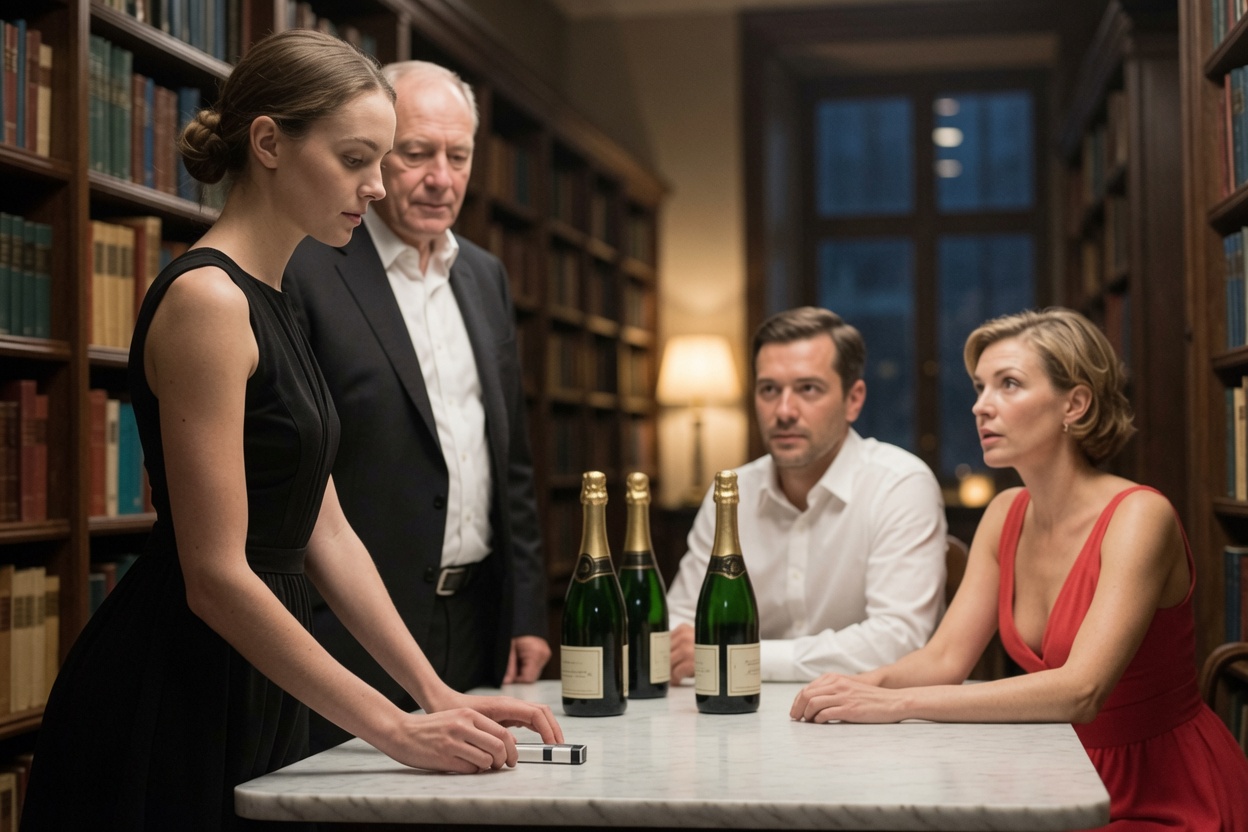
Gavin found me in the library just after midnight. He no longer bothered with the soft voice he had used for three days while accepting condolences and promising the board he would “protect the legacy.” The kindness had been peeled off like a mask. Beside him stood his mother, Celina, already changed out of mourning black into a deep-red dress that looked almost celebratory under the low lights. The pearl necklace I had given her last Christmas rested against her throat like a trophy.
On the marble table between us lay a single folder.
“Your father left the company drowning in debt,” Gavin said, almost gently. “Sixty percent of the shares are still in your name. If you don’t sign them over tonight, the banks will carve Summit into pieces by Monday. I’m doing what has to be done.”
I opened the folder. My signature was already on the final page—tilted, slightly shaky, the way it looked whenever I had been running a fever.
Two weeks earlier. A night of illness. Gavin bringing tea, holding my hand, murmuring about urgent bank documents that could not wait until morning. I had signed because I trusted him. Because I was too weak to read.
They had not been bank documents.
They had been the complete transfer of my shares—and divorce papers.
“You tricked me,” I said. The words came out quieter than I expected.
Gavin smiled the way a man smiles when the game is already over. “I made the decision you never would have had the courage to make. Your father took me in when I was nothing. He gave me a title, a seat at the table, his daughter. And still he treated me like the help. Four years of smiling at his spoiled little princess was the price of admission. Stupidity, Naomi, can be fatal too.”
Something inside my chest tore.
I slapped him.
Celina moved faster than I thought possible. Her fingers locked in my hair; the side of my face met the sharp corner of the table with a wet crack. Pain bloomed white. Blood ran warm down my temple. Gavin did not stop her. He only called for security.
“Throw her out,” he said. “No phone. No cards. No suitcase. This house is no longer hers.”
“My father bought this house—”
“Your father is dead.”
They dragged me across the foyer while Celina’s voice followed, bright with contempt: that I had never been capable of running anything more complicated than a kitchen. The iron gates of Highland Hills closed behind me with a sound like a judgment. Barefoot, bleeding, soaked through in seconds by the storm, I stood on the dark road and watched the lights of the only home I had ever known glow indifferent against the rain.
From the second-floor balcony, Gavin raised a glass.
“Let’s see how long a princess lasts without money.”
I wiped blood from my lip with the back of my hand and tasted iron and rain. Somewhere in the cold clarity that follows the worst kind of betrayal, a single thought cut through everything else:
Gavin had prepared those documents before the accident that killed my father.
Which meant he might have prepared the accident as well.
I turned my face up to the storm and spoke the words so quietly the wind almost stole them.
“Enjoy the night. You still have no idea who you’ve just woken.”
I walked until the estate lights vanished behind the trees. Then I did the only thing left that still belonged to me.
I called the family lawyer.
The sealed envelope my father had left with him was waiting in a downtown office that smelled of old paper and raincoats. The lawyer’s hands shook slightly as he placed it on the desk between us. The wax seal was unbroken—Ross Albright’s personal crest pressed deep into dark red.
I broke it.
Inside was a single sheet of paper and a small black key.
And then, from the empty chair in the corner of the room that neither of us had noticed until that exact second, a voice spoke—low, familiar, impossible.
A voice that had been buried less than twenty-four hours ago.
“You always were too trusting with the wrong people, little bird.”
PART 2
The voice did not come from any recording.
It came from the chair in the shadowed corner of the lawyer’s office—the one that had been empty when we entered. The man sitting there looked exactly as he had the last time I saw him alive: silver hair still thick, the same sharp-cut suit he preferred for board meetings, the faint scar along his left eyebrow from a sailing accident twenty years earlier. Only the eyes were different. They held no fever, no pain, no farewell. They held something colder. Something that had been waiting.
Ross Albright—my father—watched me without blinking.
The lawyer made a small, strangled sound and staggered backward until his shoulders hit the wall. I could not move. The black key in my hand felt suddenly heavy, as if it had absorbed the weight of every lie that had brought me to this room.
“You’re dead,” I whispered. The words scraped my throat raw. “I watched them lower the casket. I put the white roses on the lid myself.”
My father tilted his head the way he used to when I was a child and had just told him something foolish. “You watched them lower a casket, Naomi. That is not the same thing.”
He rose. The movement was quiet, deliberate. No limp. No weakness. Whatever injury the world believed had killed him had never touched the man standing in front of me now.
“The accident was staged,” he said. “I needed the world—and certain people inside it—to believe I was gone. Gavin Barrett was never meant to inherit anything. He was meant to reveal himself.” A thin, humorless smile. “He did so faster than even I expected.”
I looked down at the single sheet of paper that had been inside the envelope. My father’s handwriting, sharp and unmistakable:
If you are reading this, the transfer has already happened. Do not confront him. Do not warn the board. Take the key. Go to the old shipyard warehouse on Pier 17. The truth is waiting there—and so am I.
The key in my palm was cold.
Outside, thunder rolled across the city like a warning.
My father stepped closer. The scent of his cologne—cedar and something darker—was real. Living. Impossible.
“Everything he took from you,” he said quietly, “was never his to take. The shares. The house. The name. All of it was bait. And tonight, while he and his mother are celebrating inside a house that still belongs to us, we are going to burn their victory down to the foundations.”
He held out his hand.
I stared at it. At the man the world had already buried. At the daughter who had been thrown into the rain like refuse.
Somewhere across the city, in a marble house that still smelled of funeral lilies, Gavin Barrett was raising another glass.
He had no idea the dead were already walking.
I took my father’s hand.
The black key bit into my skin as we stepped into the storm together—
—and the first lights of Highland Hills began to go out, one by one, as if the estate itself had just realized what was coming for it.
The old shipyard warehouse on Pier 17 smelled of salt, rust, and secrets that had waited too long to surface.
My father moved through the darkness as if he had never left it. The black key turned in a lock hidden behind a false panel of corrugated steel. Inside, cold blue light flickered to life across rows of monitors, filing cabinets, and a single steel table. On the table lay a second envelope—thicker this time—and a thin silver drive.
“Everything is here,” he said. “The real ledgers. The offshore accounts Gavin siphoned into his mother’s name. The forged medical reports that declared me dead. Even the payment records to the men who staged the car accident.” He looked at me, and for the first time the coldness in his eyes softened. “I needed him to believe he had won. Greed makes people careless. And carelessness leaves evidence.”
I inserted the drive into the laptop waiting on the table. Files opened like wounds. Contracts. Wire transfers. Audio recordings of Gavin and Celina discussing how long they would wait after the funeral before forcing me to sign. One recording, timestamped two nights before the “accident,” made my stomach turn: Gavin’s voice, low and almost tender, telling his mother that once Ross Albright was gone, the daughter would be easy.
I closed the laptop.
“What now?” I asked.
My father’s smile was the one he reserved for boardrooms when he already knew the outcome of a vote. “Now we go home.”
Highland Hills was quiet when we arrived.
The storm had passed, leaving the air sharp and clean. Most of the lights were still dark—cut, I would later learn, by a single remote command my father had prepared months in advance. Only the library windows glowed. Inside, Gavin and Celina were still celebrating. Empty champagne bottles glittered on the marble table. The folder containing my stolen shares lay open between them like a trophy.
We did not knock.
The front doors opened under my father’s hand as if the house itself recognized its true owner. Security never appeared. The men who had dragged me into the rain the night before were already gone—paid off and vanished the moment the first lights died.
Gavin turned at the sound of footsteps. The glass in his hand froze halfway to his mouth. Celina’s red dress looked suddenly garish under the low light. Color drained from both their faces as my father stepped into the room beside me—alive, upright, and wearing the same quiet authority that had built an empire.
For a long moment, no one spoke.
Then Gavin laughed—a thin, broken sound. “This is impossible.”
“No,” my father said. “This is overdue.”
I placed the silver drive on the table between the champagne bottles. The laptop screen lit up with the first of the files. Wire transfers. Forged death certificates. The recording of Gavin’s voice planning my father’s murder as casually as he might plan a weekend in the Hamptons.
Celina’s hand flew to her throat, fingers closing around the pearl necklace I had once given her in good faith. Gavin’s face went gray.
“You used my illness,” I said quietly. “You used my grief. You used the name of a man who treated you like a son.” I looked at my father, then back at the man who had thrown me into the storm. “You told me that without him, I was nobody.”
I stepped closer.
“You were wrong about that too.”
By dawn the house was full of different voices—federal agents, corporate lawyers, the quiet men from the board who had once shaken Gavin’s hand and called him the future of Summit Enterprises. Celina was led out in handcuffs, still wearing the red dress. Gavin did not look at me as they took him. He only stared at the floor, as if the marble itself had betrayed him.
When the last car left Highland Hills, the sun was rising over the wet gardens. My father stood beside me on the front steps, the same place where the gates had closed on me the night before.
“The company is yours if you want it,” he said. “Or we burn it down and build something cleaner. Your choice.”
I looked at the house. At the sky clearing above it. At the man the world had already buried, standing alive in the morning light.
“We keep it,” I said. “But we keep it on our terms.”
He nodded once. Then he put his arm around my shoulders—the first real embrace since the night the world decided he was gone—and together we walked back inside a house that finally felt like it belonged to the living again.
The princess, it turned out, had never needed rescuing.
She had only needed the truth.