André Rieu: The King of Waltz Who Conquered the World One Smile at a Time
In an age dominated by electronic beats, stadium rock spectacles, and viral pop anthems, one man continues to fill the world’s largest arenas with the gentle, swirling rhythms of the waltz. André Rieu, the Dutch violinist and conductor known affectionately as the “King of Waltz,” has achieved what few classical musicians in history have managed: he has made the three-quarter time of Strauss and the romantic flourishes of Viennese salon music into a global, emotionally charged entertainment phenomenon. With more than 40 million albums sold, over 500 platinum awards, and a career box-office total that places him among the highest-grossing classical artists of all time, Rieu has rewritten the rules of what classical music can be.
His concerts are not quiet, respectful affairs. They are joyful explosions of color, movement, and shared emotion. Audiences of tens of thousands rise to their feet, dance in the aisles, laugh, cry, and leave feeling as if they have been part of something larger than themselves. In a career spanning nearly four decades, André Rieu has proven that classical music does not have to be solemn to be profound — it only has to be alive.
From Maastricht to the World Stage
André Léon Marie Nicolas Rieu was born on 1 October 1949 in Maastricht, a picturesque city in the southern Netherlands near the borders of Belgium and Germany. He was the third of six children in a household steeped in music. His father, Andries Antonie Rieu, conducted the Maastricht Symphony Orchestra, and the young André grew up surrounded by the sounds of rehearsals, scores, and the quiet intensity of professional musicians.
At the age of five, André picked up the violin. The instrument became his lifelong companion. He studied at the Conservatoire Royal in Liège and the Conservatorium Maastricht under teachers including Jo Juda and Herman Krebbers. Later, he refined his craft at the Royal Conservatory of Brussels with André Gertler, graduating with the prestigious Premier Prix. Yet even as he trained in the rigorous classical tradition, something inside him resisted the formality and emotional restraint he often encountered in traditional orchestras.
He played for years in his father’s ensemble and later in the Limburg Symphony Orchestra, but the experience left him restless. Musicians talked more about working conditions than about the music itself. Rieu wanted something different — a music that connected directly with people’s hearts.
In the late 1970s, encouraged by his wife Marjorie, he formed the Maastricht Salon Orchestra. The small ensemble played at weddings, nursing homes, and local events. The repertoire leaned toward lighter classics, waltzes, and melodies that invited people to smile rather than sit in solemn silence. The response was immediate. Audiences responded with warmth and enthusiasm that the formal concert hall rarely delivered.
The real turning point came in 1987. Rieu founded the Johann Strauss Orchestra, named after his musical idol. It began with just twelve musicians. The first concert took place on 1 January 1988. What started as a modest experiment would eventually grow into the largest privately owned orchestra in the world, regularly numbering between 50 and 60 players, with a total team of more than 200 people supporting the tours.
The Breakthrough That Changed Everything
Success did not arrive overnight. For years Rieu and his orchestra performed to growing but still limited audiences. Then came a stroke of brilliant, slightly cheeky marketing. In the mid-1990s, Rieu bought sixty seconds of live television time during the halftime of a major football match between Ajax and Bayern Munich. He performed Shostakovich’s Waltz No. 2. Ajax scored just before the break, ensuring maximum attention. The following week, CD sales exploded. Hundreds of thousands of copies moved in a matter of days.
That single performance opened the floodgates. Albums such as From Holland with Love and Strauss & Co. climbed the charts across Europe. Suddenly the waltz was no longer a dusty relic of the 19th century — it was popular again. Rieu had found his formula: beautiful music, theatrical presentation, and an unapologetic desire to make people happy.
The Spectacle of the Show
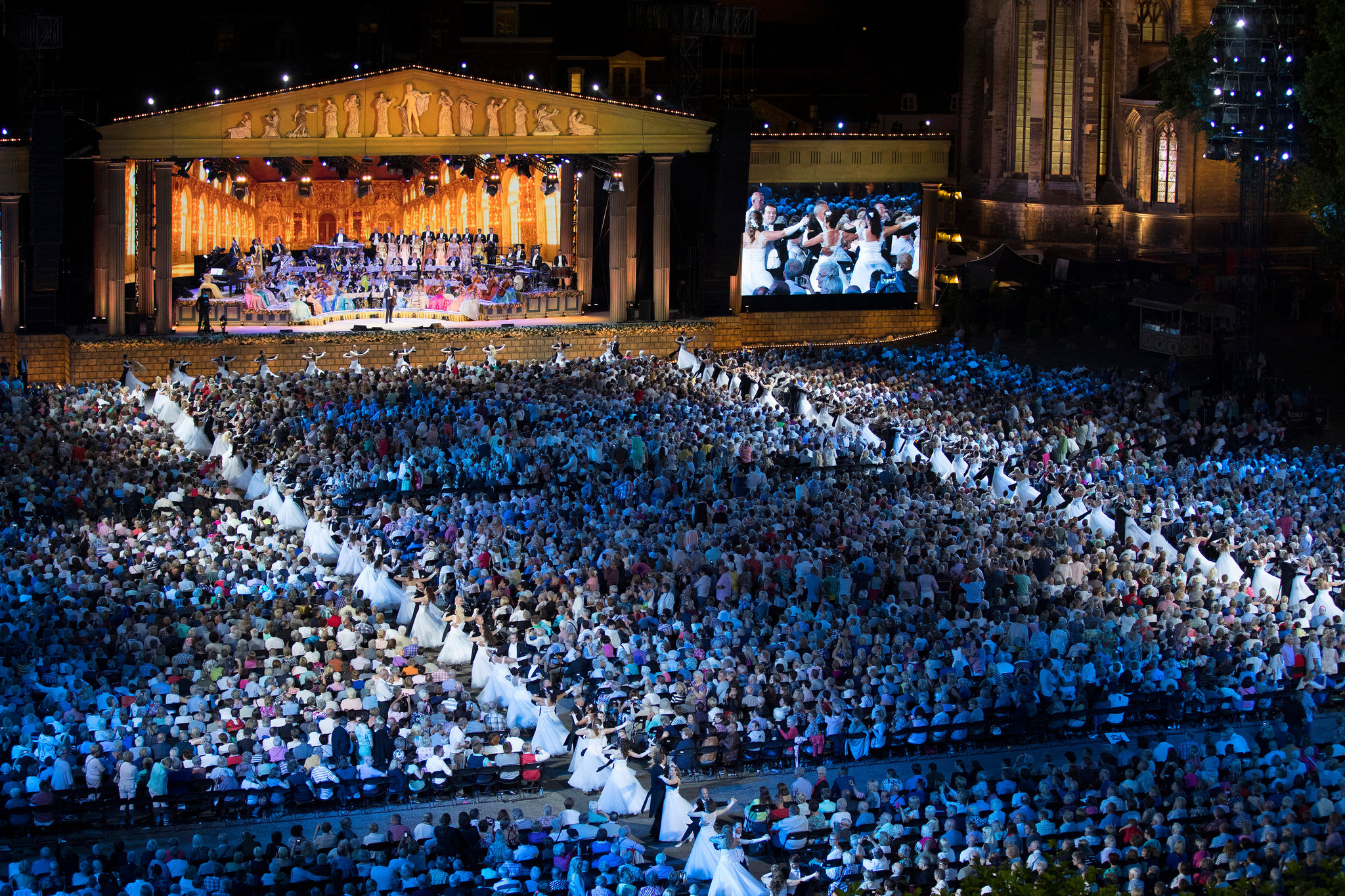
To understand André Rieu’s appeal, one must experience one of his concerts. The stage is rarely a simple platform. Over the years it has featured full-scale replicas of Viennese palaces, including a life-sized version of Schönbrunn Palace complete with fountains, carriages, and dancers. Musicians appear in elegant formal wear and colorful ball gowns. Soloists emerge from the orchestra to deliver soaring arias or playful solos. Dancers swirl across the stage during the waltzes. Fireworks, confetti, and spectacular lighting turn the evening into a multi-sensory celebration.
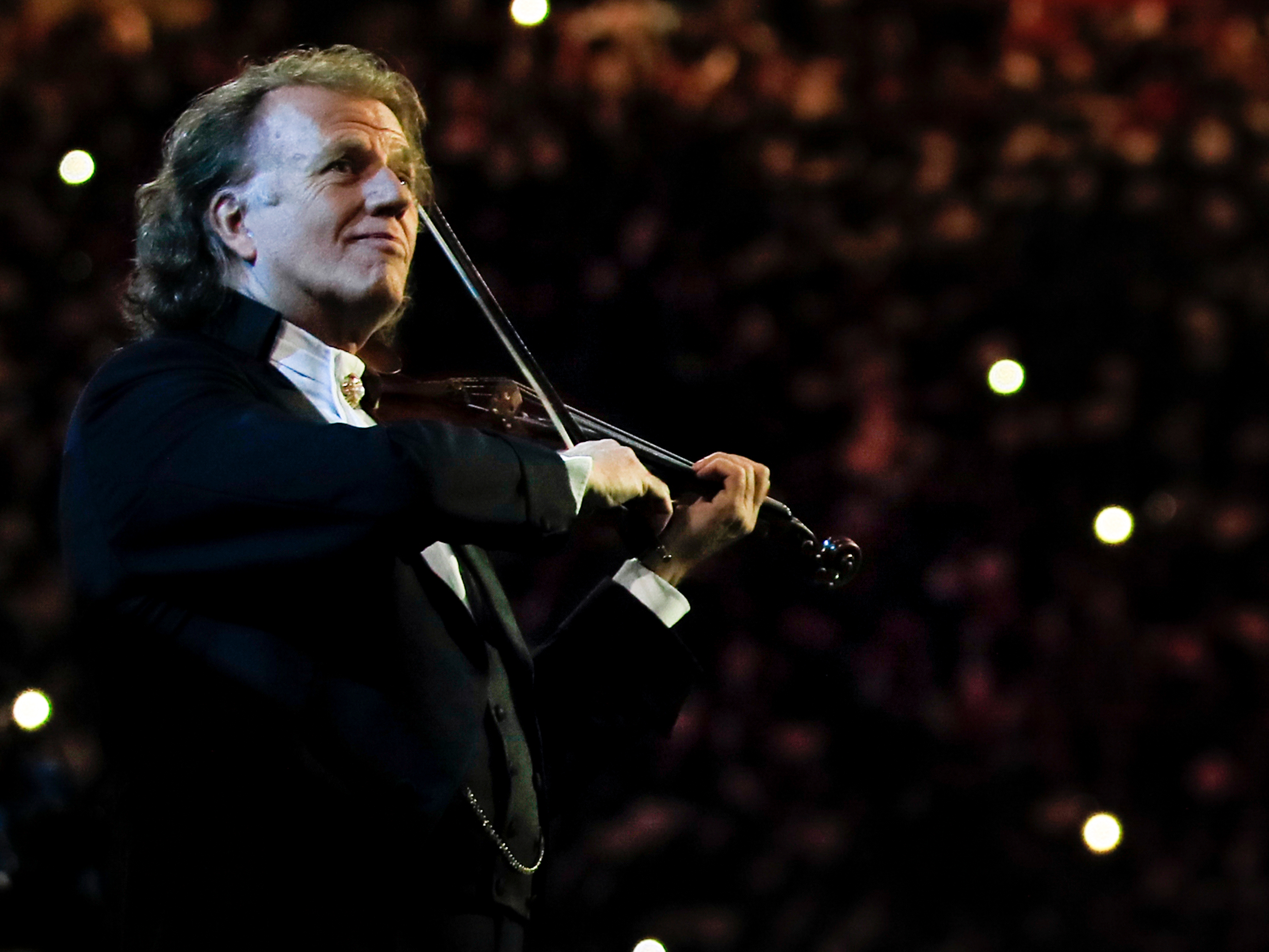
Rieu himself stands at the center, playing his 1667 Stradivarius violin while conducting with his body, his bow, and his infectious energy. He does not turn his back on the audience. He faces them, smiles at them, speaks to them, and invites them into the music. The repertoire ranges widely: pure Strauss waltzes, film themes, opera excerpts, folk melodies, and the occasional unexpected pop arrangement. The goal is never purity for its own sake. The goal is joy.
Critics have sometimes dismissed the shows as “schmaltz” or overly commercial. Rieu’s answer has always been consistent: the audience decides. And the audience has voted with its feet and its wallets for decades. In Australia, he once filled Melbourne’s Telstra Dome with nearly 39,000 people for a single classical concert — a record. In Maastricht, his annual summer series on the Vrijthof square draws fans from more than 80 countries. In 2018 alone, he performed 93 concerts across five continents for roughly 700,000 people.

Numbers That Defy Expectation
The commercial achievements are staggering for any classical artist. More than 40 million albums and DVDs sold worldwide. Over 500 platinum and 270 gold awards. Multiple number-one chart positions across Europe and beyond. Billboard has recognized him as the highest-grossing classical artist in its Boxscore history, with career earnings from live performances exceeding half a billion dollars. His YouTube videos have collectively surpassed a billion views. Social media followings run into the millions.
Yet the numbers only tell part of the story. What truly sets Rieu apart is the emotional connection. People do not merely attend his concerts — they experience them. Tears flow freely during tender melodies. Laughter erupts during humorous interludes. Couples dance in the aisles. Strangers hug. For many, a Rieu concert becomes a shared memory that lasts a lifetime.
Life Beyond the Stage
Despite the global fame, André Rieu remains deeply rooted in Maastricht. He lives with his wife Marjorie in a 15th-century castle that he restored after dreaming of owning it since childhood. The couple married in 1975 and have two sons, Marc and Pierre, both of whom have been involved in aspects of the family business. Marjorie has long served as a key creative and organizational partner.
Rieu speaks six languages and maintains a surprisingly down-to-earth demeanor for a man who commands stadiums. He has spoken openly about a somewhat strict upbringing and the way music became his path toward happiness and connection. Making people happy, he has said, remains his central purpose — a purpose shaped by the emotional distance he sometimes felt in his early years.
His orchestra functions more like an extended family than a traditional ensemble. Many musicians have stayed with him for decades. The production company employs a large permanent staff, and the logistics of touring — multiple sets of instruments, elaborate costumes, and enormous stages — require military-level precision. Rieu finances much of the spectacle himself, sometimes at considerable risk. The 2008 stadium tour with the Schönbrunn Palace replica was famously expensive, yet it generated enormous publicity and remains one of the most memorable chapters in his career.

Why the World Still Needs André Rieu
In a fragmented cultural landscape, André Rieu offers something increasingly rare: a shared, communal experience of beauty and emotion that transcends age, nationality, and musical snobbery. Grandparents bring grandchildren. Couples celebrate anniversaries. People who would never set foot in a traditional concert hall find themselves moved by a waltz.
He has never pretended that his music is the most intellectually rigorous or historically pure interpretation of the classical canon. Instead, he has insisted that classical music belongs to everyone — that it can be glamorous, fun, romantic, and emotionally direct without losing its soul. In doing so, he has introduced millions of people to melodies they might otherwise never have encountered.
As he continues to tour well into his seventies, filling arenas from Europe to the Middle East, Australia, and the Americas, André Rieu shows no sign of slowing down. The formula remains the same: beautiful music, heartfelt performance, and an open invitation to feel something together.
In the end, that may be his greatest achievement. In a world that often feels divided and distracted, André Rieu still manages to gather thousands of strangers under one roof, raise a violin, and remind them — for a few magical hours — that joy is still possible, and that the simplest melody, played with sincerity, can still make the whole world dance.

Whether you call him the King of Waltz, a populist showman, or simply a man who refuses to let classical music become a museum piece, one truth remains undeniable: André Rieu has changed the way the world experiences the power of a violin and the enduring magic of three-quarter time. And as long as there are people who need to smile, cry, and hold each other while the music plays, the King of Waltz will keep playing.