NETFLIX PRESENTS AN INTENSE ESCAPE THRILLER: PHILIP GLENISTER AND MYANNA BURING LOCKED IN DEADLY CONFLICT!
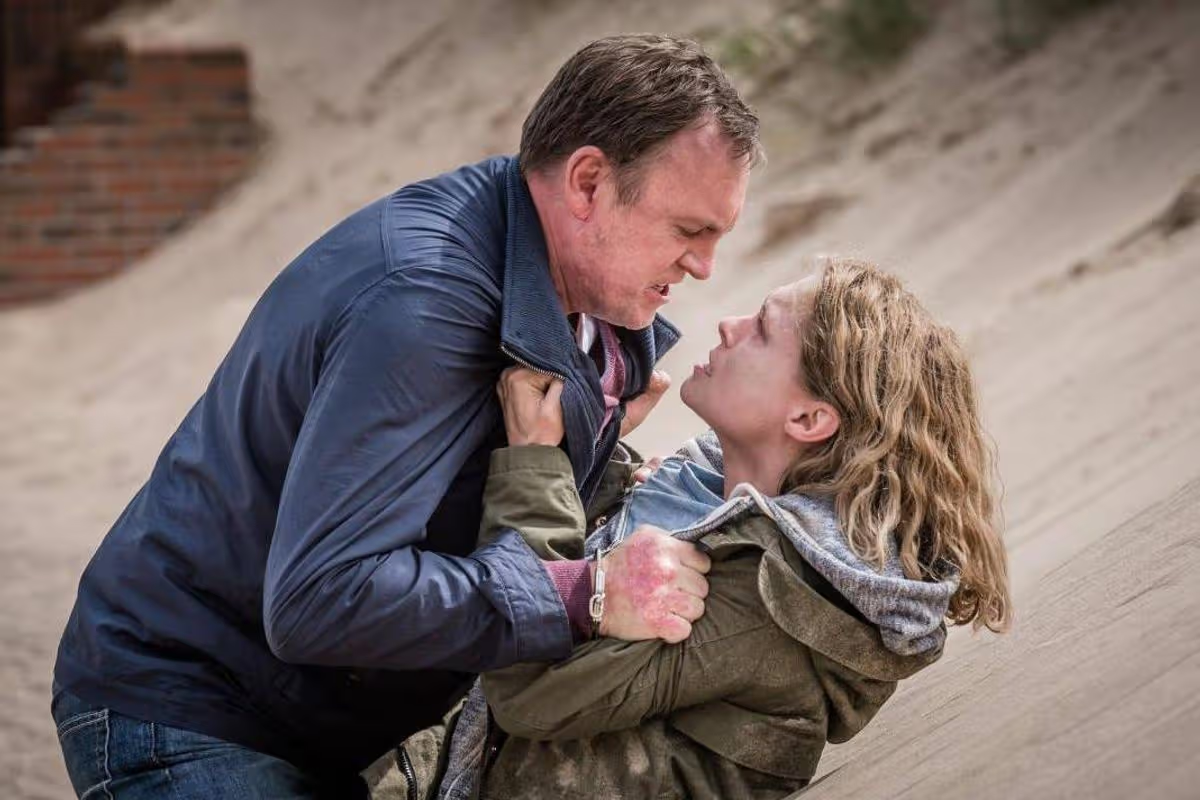
Handcuffed together, hunted by the law, and driven to the edge of madness. In this heart-pounding frame on NETFLIX, prison officer David Murdoch (Philip Glenister) violently confronts inmate Jules Hope (MyAnna Buring) on the sand dunes. But the terrifying reason why he refuses to unlock her cuffs is…
In an era when streaming platforms are flooded with polished procedurals and glossy crime dramas, few series cut as deep or hit as hard as the British anthology thriller Prey. Now available on Netflix, the second series of this ITV gem delivers a taut, emotionally raw three-part story that ranks among the most gripping escape thrillers of the last decade. At its center are two powerhouse performances from Philip Glenister and MyAnna Buring, locked in a desperate, high-stakes alliance that feels both visceral and heartbreakingly human.
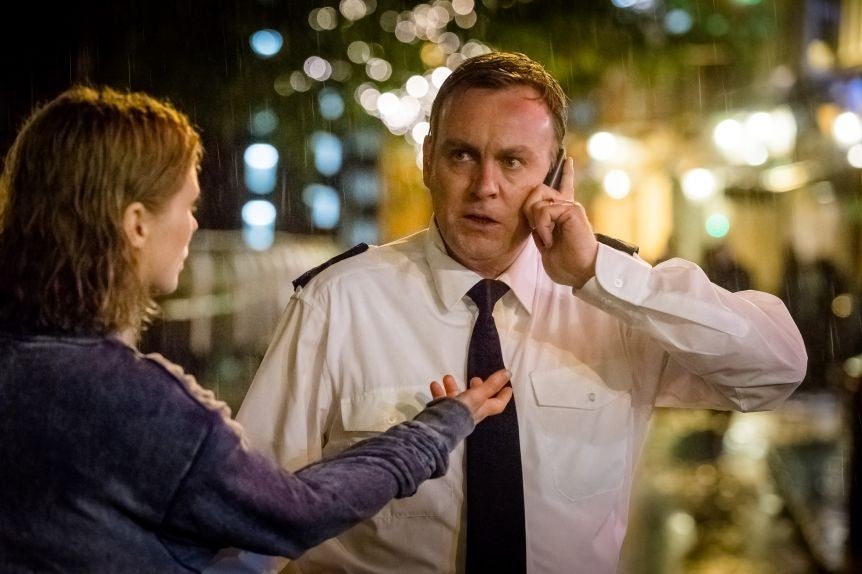
The premise is deceptively simple yet ruthlessly effective. David Murdoch is an ordinary prison officer — a recent widower, a protective father, a man who keeps his head down and does his job. One routine hospital escort with a female inmate, Jules Hope, shatters his carefully ordered world. A phone call arrives. His heavily pregnant daughter Lucy has been kidnapped. The demand is clear and non-negotiable: get Jules out of custody and deliver her to a specific location, or Lucy dies. In that single moment, the line between lawman and outlaw vanishes. Murdoch makes the only choice a father can. He becomes a fugitive.
What follows is a relentless cat-and-mouse chase across Manchester’s underbelly and beyond. Handcuffed to the very woman he is supposed to be transporting, Murdoch is forced into an uneasy partnership with Jules — a sharp, resourceful, and deeply unpredictable prisoner whose own family ties to the criminal underworld make her both a liability and the only key to his daughter’s survival. The police, led by the determined DS Susan Reinhardt (Rosie Cavaliero), close in with helicopters, dogs, and roadblocks. Every decision carries catastrophic weight. Every moment of trust is fragile.

The chemistry between Glenister and Buring is the engine that drives the entire series. Glenister, long celebrated for his larger-than-life roles (most famously Gene Hunt in Life on Mars), here dials the bluster down and delivers something far more intimate and damaged. His David Murdoch is a man of quiet strength who finds himself unraveling under impossible pressure. You see the physical toll in the set of his shoulders, the moral anguish in his eyes, the desperate calculation behind every risk he takes. When he turns on Jules in moments of pure rage or terror, the intensity is startling. This is not the swaggering anti-hero; this is a father who will burn the world down to save his child — and who may not survive the fire himself.
MyAnna Buring matches him beat for beat. As Jules Hope, she refuses to play the simple victim or the cartoonish criminal. Jules is layered: tough and opportunistic one moment, vulnerable and scared the next, always calculating the angles. Their forced proximity creates a fascinating power dynamic. Handcuffed together, they argue, scheme, protect, and betray in equal measure. The physical constraint of the cuffs becomes a brilliant storytelling device — every movement restricted, every escape attempt complicated, every confrontation made more claustrophobic by the metal binding them.
One of the most striking sequences finds the pair on windswept sand dunes, far from the urban sprawl of Manchester. The open landscape offers no cover, only exposure. In this bleak, elemental setting, Murdoch confronts Jules with raw, barely controlled fury. The camera lingers on the tension in their linked wrists, the wind whipping sand around them, the exhaustion etched into both faces. It is here that the series crystallizes its central question: why does he refuse to unlock the cuffs? The answer is not simple heroism or stubborn principle. It is something darker, more primal, and far more terrifying — a decision rooted in the knowledge that letting her go could cost him everything he has left.
What elevates Prey beyond standard thriller territory is its refusal to romanticize the situation. There are no sleek car chases or witty banter. The violence is sudden and ugly. The moral compromises are ugly too. Murdoch is not a natural criminal; every illegal act chips away at his sense of self. Jules is not a noble outlaw; she is a survivor who has learned that trust is a luxury she cannot afford. Their relationship evolves not into friendship or romance, but into a grim, hard-won mutual dependence forged in shared desperation.
Supporting performances add further texture. Rosie Cavaliero’s DS Reinhardt returns from the first series as a dogged, complex investigator who is neither purely heroic nor purely antagonistic. Nathan Stewart-Jarrett brings sharp energy as a young detective navigating the case. The script, written by series creator Chris Lunt, keeps the focus tight and the stakes personal. At just three episodes, the story never overstays its welcome. Every scene advances the plot or deepens character. There is no filler, no unnecessary subplot, no moment of false hope that feels unearned.
The Manchester setting is another quiet strength. The series makes brilliant use of the city’s industrial edges, canals, and overlooked corners. When the action moves to more open terrain, including those desolate sand dunes, the contrast heightens the sense of exposure. You feel the cold, the wind, the sheer exhaustion of running with nowhere left to hide. The direction by Lewis Arnold is precise and unshowy, letting the performances and the mounting dread carry the weight.
For viewers discovering Prey on Netflix, the second series stands strongly on its own while rewarding those who watched the first. The anthology format means new protagonists and a self-contained story, yet the world feels consistent — a place where ordinary people can be forced into extraordinary moral gray zones with terrifying speed. In an age of endless franchises and multi-season sagas, there is something refreshing about a thriller that knows exactly how long it needs to tell its story and then stops.
The real reason to watch, however, remains those two central performances. Glenister and Buring create a pressure-cooker partnership that feels authentic and dangerous. Their confrontations crackle with genuine threat. Their moments of reluctant cooperation land with surprising emotional force. And that pivotal scene on the dunes — the violent confrontation, the refusal to unlock the cuffs, the unspoken terror behind the decision — encapsulates everything the series does so well. It is physical, psychological, and moral all at once.
Prey is not comfort viewing. It is tense, often bleak, and occasionally brutal. But it is also deeply compelling, anchored by two actors operating at the top of their game. In a crowded Netflix library of crime dramas, this one stands out for its lean storytelling, its emotional honesty, and its unflinching look at how far a parent will go — and what they might become — when their child’s life is on the line.
The cuffs stay locked for a reason. Once you understand why, you will not forget it. Stream it, lock the doors, and prepare to be held captive until the final frame.