YOU CAN’T AFFORD A LAWYER WHO CAN BEAT MY SON. Richard Porter delivered the line the way some men deliver weather reports—certain, mildly amused, already bored by the outcome. He stirred an eight-dollar latte with a silver spoon and smiled as if he had just explained gravity to a child who still believed things fell upward
I looked at him across the small marble table and said, “You’re right.”
That was the first mistake Richard made that morning. Believing me was the second.
My name is Cassidy Porter. Forty-two years old. Major, United States Army. Eighteen years married to Ethan Porter. We lived outside Richmond in a white colonial with porch columns that needed paint, a cracked basketball hoop over the garage, and an American flag Ethan kept forgetting to bring in when the storms came. From the road we looked ordinary. Two cars. Hydrangeas. A kitchen island buried under unopened mail and the coffee stain Ethan always swore he would wipe away tomorrow.
Inside, the marriage had already stopped breathing.
I learned about Melissa Grant on a Tuesday in March because Ethan sent a text meant for her to me instead.
Still thinking about the hotel. Wear the black dress again.
Six words. That was all it took.
I stood barefoot on cold kitchen tile holding a paper plate with half a turkey sandwich. The refrigerator hummed. Somewhere near Route 360 a siren rose and fell. Mustard had begun its slow slide toward the edge of the bread while I read the message three times. I did not scream. I set the plate down carefully, as if noise itself might shatter something. Then I took screenshots.
Ethan came home twenty minutes later carrying dry cleaning and wearing the careful face of a man who already knew the ground had shifted. “Cass,” he said. I turned the phone toward him. His eyes dropped to the screen—not long, just long enough. Then came the sigh.
“You weren’t supposed to see that.”
That sentence cut deeper than the text.
He sat at the island and rubbed both hands over his face. Melissa was young, he said. Uncomplicated. She admired him. Our marriage had become “too structured.” My Army career made him feel judged. Then he blamed the silence between us, as if silence were something I had invented alone.
“You’re always watching,” he said. “You never need anyone.”
I almost laughed. Instead I watched him unlock his phone and text his father. That was the moment I understood Richard already knew.
Ethan’s sister confirmed it two days later in a diner near Stony Point. She stirred artificial sweetener into her coffee and said, almost absently, “Dad told him successful men have needs. He just said Ethan should be smarter about it.” The spoon froze halfway to her mouth when she realized what she had admitted. Her face answered before her lips did.
I left cash under the mug and walked out. On the sidewalk I did not cry. I memorized every word.
Three weeks later I found the divorce folder in Ethan’s home office. He usually locked the bottom drawer. That morning he had left it open because Melissa had called while he was rushing out. The papers were already drafted. He wanted the house. The cars. The investment accounts. The furniture, except for “personal military effects belonging exclusively to the respondent.”
That was me. The respondent.
Eighteen years reduced to a label and a proposed monthly payment barely large enough to rent a one-bedroom near base. His petition claimed the house belonged to Porter Logistics because the company had funded the down payment. It claimed the investment accounts were protected family assets. It claimed I had “contributed minimally” to the marital estate because my income had gone primarily to household expenses—groceries, utilities, insurance, repairs, Thanksgiving dinners for twenty people. Apparently those did not count.
I photographed every page and returned the folder exactly as I had found it. Then I went to work. At the base I reviewed transport reports, corrected a captain’s planning error, and ate vending-machine pretzels at my desk. No one knew my life was being divided by men in expensive suits.
That night Richard called and asked me to meet him at a coffee shop near his office. “I think we should discuss your future,” he said. Not the marriage. My future.
He arrived in a charcoal overcoat and placed a leather folder between us. Rain streaked the windows. The espresso machine screamed every few minutes as if it objected to the conversation. Richard did not ask how I was. He said Ethan had filed. He said the house was protected. He said his legal team had handled cases involving professional athletes, company founders, and people with real money. Then he leaned forward.
“Let’s stop pretending, Cassidy. You came into this family with a uniform and a used Honda. You’ll leave with both. You can’t afford a lawyer who can beat my son.”
He smiled the same smile he had worn at every Thanksgiving table while delivering quiet insults over carved turkey. The same smile he used at church fundraisers when he introduced me as “Ethan’s military wife” instead of using my rank. The same smile that appeared at graduation dinners when he praised Ethan’s career and somehow forgot I had earned another promotion.
I thought about the hidden folder. The affair. The bank transfers I had noticed for months and never questioned. Then I said again, “You’re right.”
Richard relaxed so quickly it was almost embarrassing. He slid an acknowledgment form across the table. I signed only the receipt confirming I had been served. Nothing else. He did not notice the difference. Men like Richard rarely read the small print when they believe the whole room already belongs to them.
That night I sat in my car in the driveway while rain ticked against the windshield. The porch light flickered above the front door. Ethan’s silhouette moved behind the kitchen blinds. I made one phone call. A man answered on the second ring.
“Well,” he said. “Took you long enough.”
My throat tightened, but my voice stayed steady.
“Daniel. I need my brother.”
PART 2
The weeks that followed moved with the slow, deliberate precision of a military operation.
I did not confront Ethan again. I did not cry in front of him. I did not beg. I simply continued living inside the house that no longer felt like mine, answering his careful questions with even more careful silence. He mistook that silence for surrender. Richard mistook it for fear. Melissa, from whatever hotel room or borrowed apartment she occupied, mistook it for irrelevance.
They were all wrong.
Daniel arrived three days after my call. He did not come to the house. He never does when the situation requires discretion. We met at a quiet park on the edge of the city, the kind of place where people walk dogs and pretend not to notice each other. He looked the same as he always had—taller than memory allowed, quieter than most people expected, with the same dark eyes that missed nothing.
He listened while I told him everything. The text. The folder. The coffee shop. The way Richard had smiled when he told me I could not afford a lawyer who could touch his son.
When I finished, Daniel was silent for a long time. Then he said, almost gently, “They think you’re alone.”
“I am,” I answered.
He looked at me the way he used to when we were children and I had just been underestimated by someone who should have known better.
“No,” he said. “You’re not.”
I did not ask what that meant. I already knew better than to press him when his voice went that quiet.
The court date arrived on a bright morning in late spring. The sky was the kind of blue that makes people believe in fresh starts. I wore a dark navy suit I had kept for official hearings, hair pulled back, no jewelry except the simple watch that had survived three deployments. I carried the divorce papers in a plain folder. Nothing dramatic. Nothing that would give them the satisfaction of seeing me arrive armed for war.
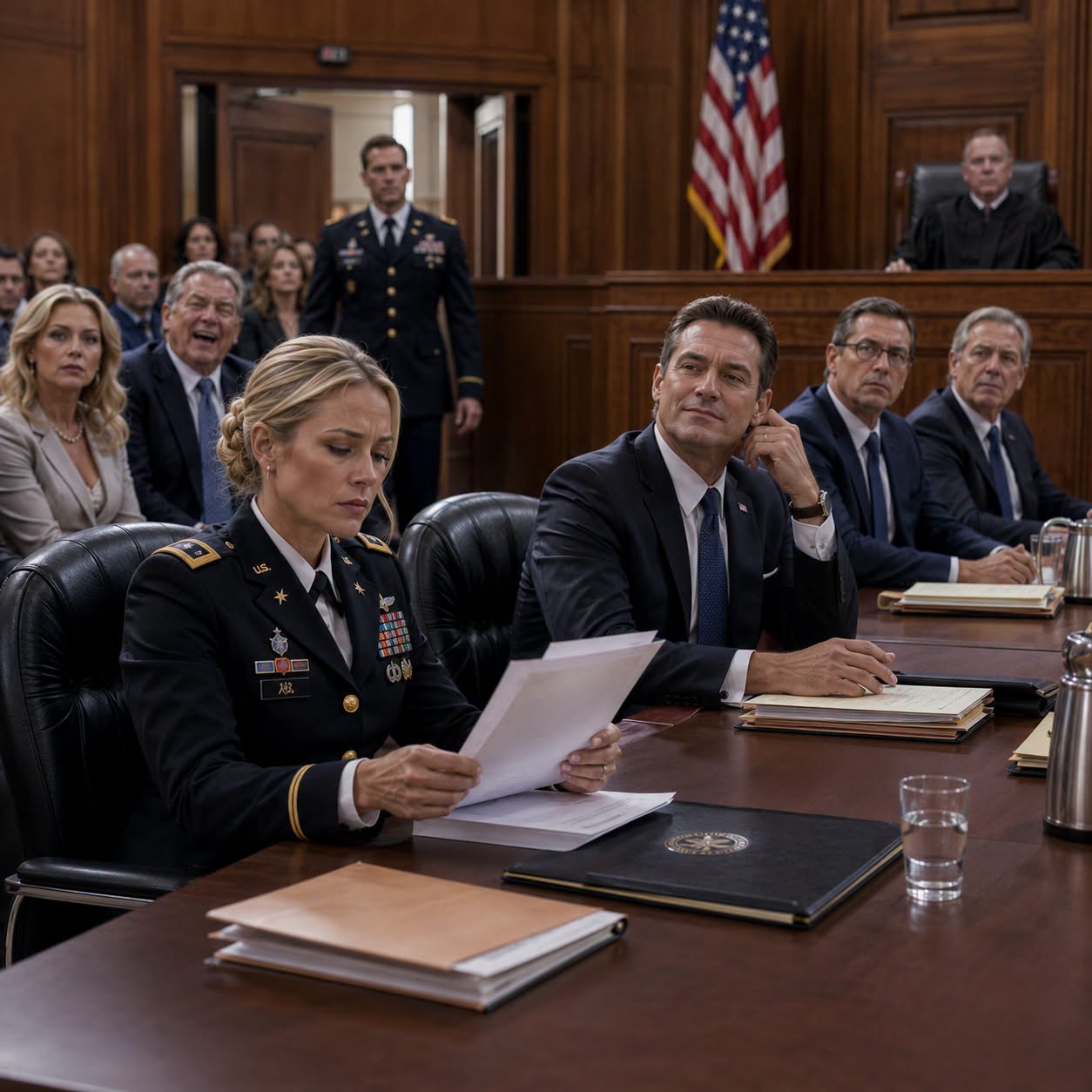
The courtroom smelled of polished wood and expensive cologne. Ethan sat at the far table with his father and two attorneys whose cufflinks alone could have paid three months of my rent. Melissa sat in the second row of the gallery, legs crossed, expression carefully neutral, as if she were merely an interested observer rather than the reason we were all there.
Richard caught my eye as I took my seat alone at the opposing table. He leaned toward Ethan and murmured something. Ethan’s mouth curved into a small, private smile. One of the attorneys glanced at the empty chairs beside me and then at his notes, already bored.
The judge had not yet entered.
Richard rose slightly in his seat, just enough to make sure his voice carried.
“You can’t afford a lawyer who can beat my son,” he said, soft enough to sound almost kind. The same line. The same smile. As if repeating it made it truer.
Ethan smirked without looking at me. Melissa watched from the gallery with the calm interest of someone who believed the ending had already been written.
I kept my hands folded on the table. The folder of papers sat in front of me like a quiet accusation. Eighteen years reduced to typed paragraphs and signatures I had not yet given.
The double doors at the back of the courtroom opened.
A man in a charcoal suit walked in with the unhurried confidence of someone who had never once needed to announce himself. He carried a single slim briefcase. No entourage. No raised voice. Just the soft click of expensive shoes on polished floor.
Every head at the Porter table turned.
The lead attorney’s pen stopped mid-note. The second attorney’s expression went carefully blank. Ethan’s smirk vanished as if someone had wiped it clean. Richard’s face, for the first time in all the years I had known him, lost its certainty.
Daniel did not look at them. He walked straight to my table, set the briefcase down with quiet precision, and took the empty chair beside me.
Only then did he glance across the aisle.
Richard’s smile was gone.
The expensive attorneys had fallen completely silent.
PART 3
The silence that followed Daniel’s arrival was not ordinary courtroom quiet. It was the kind of silence that arrives when people suddenly realize the ground beneath them has shifted and they do not yet know how far they will fall.
Richard recovered first, because men like Richard always try. He straightened his tie and forced a thin smile that never reached his eyes.
“This is a family matter,” he said, voice carefully controlled. “My son’s counsel is more than capable—”
Daniel did not raise his voice. He simply opened the slim briefcase, removed a single document, and placed it on the table in front of me with quiet precision. Then he looked at Richard.
“You told my sister she could not afford a lawyer who could beat your son,” he said. “You were correct about the cost. You were incorrect about everything else.”
One of the Porter attorneys leaned forward, professional mask firmly in place. “And you are?”
Daniel gave his name. The attorney’s pen stopped moving. The second attorney’s face drained of color. Ethan’s hands tightened on the edge of the table until the knuckles went white. Melissa, still watching from the gallery, sat a little straighter, no longer pretending to be uninvolved.
Richard’s voice lost its polish. “You’re the one from New York.”
“I am the one,” Daniel answered, “who does not lose.”
He turned slightly toward the judge’s empty bench, then back to the opposing table, speaking with the calm of a man who had already seen the end of the game.
“My client was prepared to walk away with almost nothing because she believed the law would protect the stronger party. She was wrong about that, too. The house was never funded solely by Porter Logistics. The down payment came from a joint account that included eighteen years of my sister’s military pay, combat bonuses, and the life insurance settlement she received after our father’s death. The investment accounts you claim as protected family assets contain deposits made exclusively from her income during the years your son’s company was bleeding money. The transfers you attempted to disguise as ‘family support’ are already documented. The hotel receipts, the joint credit card charges under Melissa Grant’s name, and the private messages discussing the timing of the divorce filing are also documented.”
He paused, letting the weight of each word settle.
“And the petition’s claim that Major Porter ‘contributed minimally’ to the marital estate will not survive five minutes of cross-examination. Neither will the character of the man who wrote it.”
Ethan looked as if he had been struck. Richard’s face had gone the color of old paper. The lead attorney closed his notebook without a sound.
Daniel continued, still quiet, still devastating.
“My sister will keep the house. She will keep the accounts that are rightfully hers. She will receive the equity that was built with her labor and her silence. And she will leave this marriage with every scrap of dignity your family tried to strip from her.”
He glanced once at Melissa, then back to Richard.
“You told her she came into this family with a uniform and a used Honda. She is leaving with far more than that. She is leaving with the truth. And the truth, Mr. Porter, is expensive.”
The judge entered a moment later. The formal proceedings began. They did not last long. By the time the gavel fell, the agreement had been rewritten in language that left no room for interpretation or appeal.
Outside the courthouse the late spring light was sharp and clean. Ethan stood on the steps with his father, both of them speaking in low, urgent tones that no longer mattered. Melissa had already disappeared into a waiting car.
I stood with Daniel beneath the wide stone columns. For a long moment neither of us spoke. The noise of the city moved around us like something distant and unimportant.
“You didn’t have to come,” I said at last.
He looked at me the way he had in the park weeks earlier, the same quiet certainty in his eyes.
“Yes,” he answered. “I did.”
I exhaled, and for the first time in months the breath did not catch in my chest. The weight of eighteen years—every careful silence, every swallowed insult, every night I had lain awake calculating what I could afford to lose—began to loosen its hold.
I was still Major Cassidy Porter. I still carried the same rank, the same scars, the same stubborn refusal to break. But I was no longer the woman who had sat alone at a kitchen island reading a text that was never meant for her. I was no longer the respondent in someone else’s carefully drafted petition.
I was free.
Daniel offered his arm. I took it. Together we walked down the courthouse steps into the ordinary, ordinary light of an ordinary afternoon that, for the first time in a very long time, belonged entirely to me.
THE END