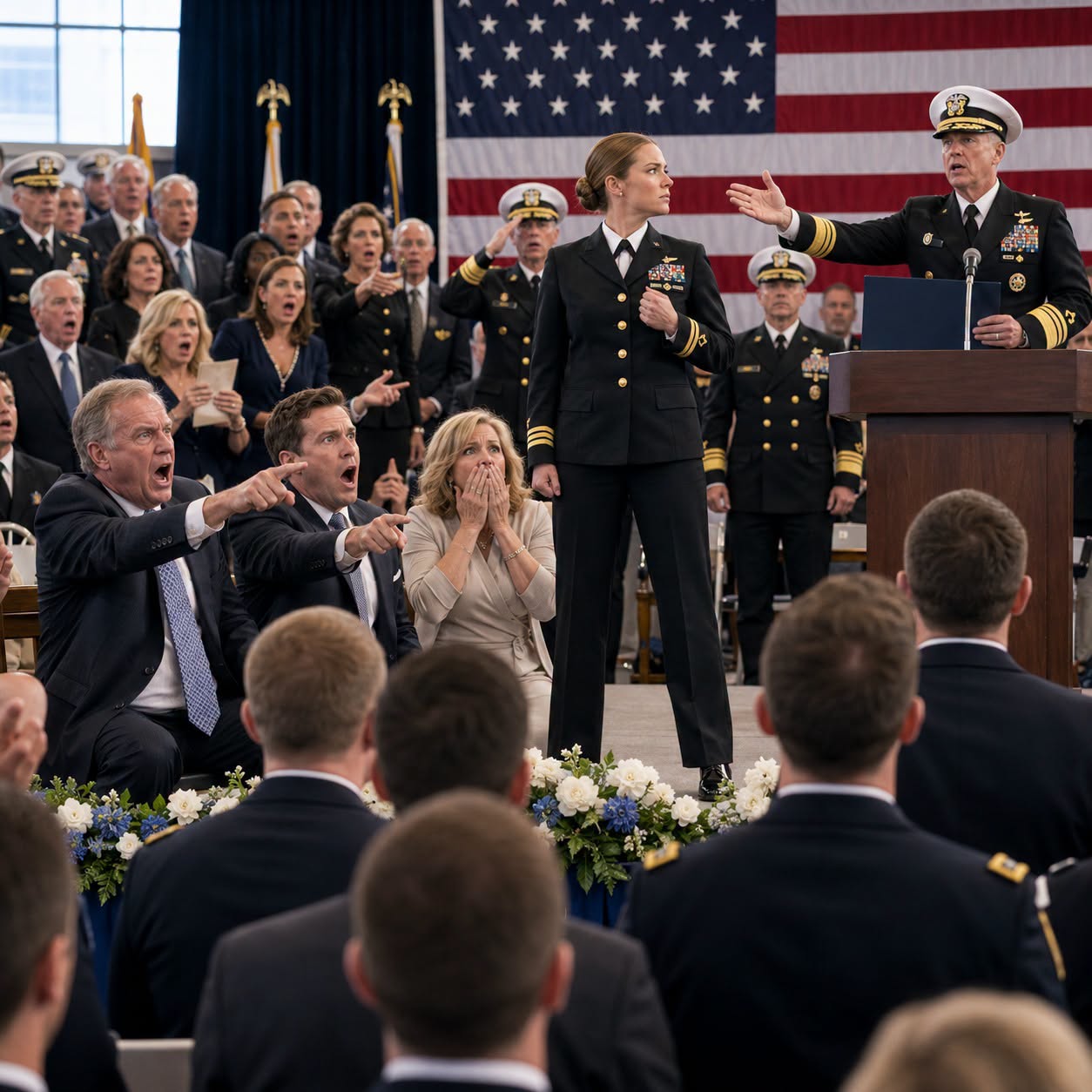
The Woman Who Spoke Thirteen Wars. The auditorium smelled of floor wax, starched wool, and the particular silence that settles over people who believe they already know who the heroes are
Every polished shoe caught the overhead lights. Rows of officers sat rigid beneath the banners of the Joint Strategic Intelligence Command, programs folded with military precision on their knees. Families occupied the rear section, leaning forward whenever another name was called, another medal pinned, another story of visible courage told for the record.
I stood three rows behind my father.
He had no idea I was there.
At thirty-six I had perfected the art of entering a room without disturbing its air. My dress uniform carried rank and little else. Most of my citations lived behind classification stamps. Official records described my assignments as temporary duty, communications support, regional analysis—language soft enough to disappear inside.
The work that mattered had always been done under another name.
My father, Walter Ellison, leaned toward my older brother as the master of ceremonies began speaking about linguistic intelligence. His voice carried the way it always had in every room he occupied: certain, large, and completely uninterested in contradiction.
“No soldier needs Arabic, Pashto, or Farsi,” he said, loud enough for the people two seats away to hear. “That’s what translators are for.”
Several officers shifted. One woman in the row ahead turned her head a fraction, then thought better of it.
My brother Grant gave the same dismissive laugh I had known since childhood—the sound of a boy who had decided early that anything quiet was weak.
“Middle Eastern dialects are pointless,” he murmured, stretching his legs. “Real soldiers don’t hide behind headphones.”
Their voices traveled farther than they realized.
Mine always had to.
I watched the side of my father’s face—the gray at his temples, the rigid set of his jaw, the old habit of tapping one finger against his knee whenever he believed himself the most important person present. Twenty-two years in uniform had taught him that service looked a certain way: boots in dirt, weapons on shoulders, medals heavy enough to be counted from across a room. He had never understood the kind of war that lived inside a seven-second recording. He had never asked why I vanished overseas for months at a time. He had never wondered why officers twice my age sometimes stopped mid-sentence when I entered a secure compartment.
To him I was still the strange daughter who used to pull foreign newspapers from recycling bins and practice the sounds under her breath until the syllables stopped feeling like strangers.
The lights dimmed.
Admiral Thomas Mercer approached the podium. He was a tall man with silver hair and a face that looked less aged than carved by decisions no one else had been allowed to make. Conversations died before his hand touched the microphone.
“We have recognized service that can be described publicly,” he said. His voice was quiet and absolute. “We will now recognize service that, until very recently, could not.”
A screen descended behind him.
It showed no photograph. No name. Only a dark map crossed by thirteen thin, luminous lines.
Each line was a language.
My languages.
My pulse tightened once, hard, then settled. My posture did not change.
My father glanced at the screen and smirked.
“Thirteen?” he muttered. “Someone wasted a lot of time.”
Grant leaned back, already bored.
Admiral Mercer did not look at the audience. He looked at the map.
“The individual we honor tonight,” he said, “never fired a weapon in anger. Never led a platoon. Never appeared on any casualty list. Yet thirteen times in the last eight years, an operation that should have ended in body bags came home instead. Thirteen times the difference between a successful extraction and a massacre was a voice on a frequency no one else could understand in time.”
He paused.
The room had gone very still.
“Her code name,” the Admiral said, and for the first time he turned toward the audience, “was—”
He spoke it.
And every officer in the auditorium stood up.
PART 2
The sound of chairs scraping back filled the auditorium like a single held breath finally released.
Every officer rose.
Not the polite, scattered standing of ceremony. This was instinctive. Unified. The kind of movement that happens when a room full of people who have lived through classified briefings suddenly recognize a name they were never supposed to say out loud.
Admiral Mercer did not smile. He simply waited until the last chair was empty and the silence had settled into something heavier.
“Her code name,” he repeated, voice carrying cleanly, “was Echo Thirteen.”
A low murmur moved through the ranks. Somewhere near the front, a colonel closed his eyes for half a second. Another officer’s hand tightened on the program until the paper creased.
I remained seated.
Three rows behind my father.
My father had not stood.
Neither had Grant.
Walter Ellison’s face had gone the particular shade of red that used to appear when someone challenged him at the dinner table. His finger had stopped tapping. Grant sat frozen, legs no longer stretched, mouth slightly open as if the air had changed density.
Admiral Mercer continued.
“Echo Thirteen never requested recognition. She refused three previous attempts to bring her into the light. The operations she supported remain partially sealed. What I am authorized to say is this: thirteen times in eight years, a voice speaking Arabic, Pashto, Dari, Farsi, or one of the rarer dialects she carried, intercepted or clarified intelligence that altered the outcome of a mission. Thirteen times, men and women who should have come home in flag-draped boxes walked off the aircraft instead.”
He turned slightly, looking toward the dark map still glowing behind him.
“In one case, a seven-second fragment of conversation recorded near the Pakistani border. In another, a whispered correction during a live hostage negotiation in which the official translator had already frozen. In a third, the quiet identification of a double agent whose accent had fooled every other linguist in the room. She did not carry a rifle. She carried the difference between life and the alternative.”
The Admiral’s gaze swept the audience and, for the first time, seemed to land somewhere near the back.
“She is present tonight.”
A second wave of movement passed through the room. Heads turned. Officers scanned the rows. Families in the rear section shifted, whispering.
My father’s spine had gone rigid. He turned his head slowly, searching the seats behind him with the same expression he used to wear when he realized one of his children had lied by omission.
Grant’s voice was barely audible.
“No way.”
I did not move.
Admiral Mercer lifted one hand.
“Echo Thirteen. Please stand.”
The lights felt suddenly brighter. The air thinner. I rose in a single, controlled motion, the way I had been trained to rise when a secure room required it. My uniform was plain. My ribbons were few. Nothing about me announced the thirteen lines on the map.
But the room already knew.
The standing officers did not sit. Some of them turned fully toward me. A few offered the smallest of nods—the kind exchanged between people who have shared a silence that could never be spoken in public.
My father’s face had drained of color. He was staring at me as if the daughter he thought he knew had been replaced by a stranger wearing her skin. Grant looked younger suddenly, stripped of the easy arrogance he had carried since boyhood.
Admiral Mercer’s voice softened by a fraction, though it lost none of its authority.
“Captain Ellison has spent her career in the spaces between languages. She has listened to men plan deaths in dialects most of us will never hear. She has spoken back in voices that kept our people breathing. Tonight we acknowledge what classification could not permanently hide.”
He paused.
Then he said the words that turned the air electric.
“Captain Ellison. Front and center.”
I stepped into the aisle.
Every eye followed.
My father’s chair scraped as he half-rose, one hand gripping the seat in front of him, mouth opening as if he intended to speak—perhaps to demand an explanation, perhaps to deny what he was seeing.
He never got the chance.
Because the Admiral was not finished.
And the next thing he said would change the temperature of the entire room.
PART 3
Admiral Mercer’s next words fell into the silence like a blade finding its mark.
“Before Captain Ellison takes her place,” he said, “there is one final detail the classification review has released. Of the thirteen operations she altered, four involved the direct protection of joint special operations teams. One of those teams included the son of a sitting member of this command. Another included three men who are present in this room tonight.”
A controlled ripple moved through the standing officers. Somewhere near the front, a major’s jaw tightened. Another man looked down at the floor as if the weight of an old debt had just been named aloud.
The Admiral’s gaze did not waver.
“She never sought acknowledgment. She never asked for medals. She simply did the work that kept people breathing when the difference between life and death was a single correctly interpreted syllable. Tonight, the silence ends.”
I walked the aisle.
The sound of my heels against the polished floor felt unnaturally loud. Every face turned as I passed. Some held open respect. Others held the complicated expression of people who had only just realized how many times their own survival had depended on a voice they would never hear.
I did not look at my father until I reached the open space before the stage.
He was standing now. Fully. Grant beside him, pale and still. Walter Ellison’s face had lost its usual certainty. The rigid jaw had slackened. The finger that used to tap out his importance had gone motionless against his thigh. For the first time in my life, I watched my father struggle to rearrange the world into a shape that still made sense to him.
Admiral Mercer waited until I stopped in front of the podium. Then he stepped aside and gestured toward the space beside him.
“Captain Ellison.”
I took my place.
The room remained standing.
Mercer did not offer a long speech. He simply turned to the audience and said, “The Joint Strategic Intelligence Command recognizes Captain Avery Ellison, known in operational channels as Echo Thirteen, for extraordinary service conducted under the highest levels of classification. Her work saved lives that classification will never fully allow us to name. We name her now.”
A single pair of hands began to clap.
Then another.
Within seconds the applause became something denser, heavier—the sound of a room full of people who understood exactly what those thirteen lines on the map had cost.
I did not smile. I did not cry. I stood with my hands at my sides and let the sound wash over the years of silence I had carried like a second uniform.
When it finally began to fade, Admiral Mercer leaned slightly toward me and spoke in a voice meant only for the two of us.
“Your father is watching,” he said quietly. “Whatever happens next is yours to decide.”
I turned.
Walter Ellison was still standing in the third row. Grant had sat back down, staring at his hands. My father’s eyes met mine across the distance that had always existed between us—the distance between visible sacrifice and the kind that leaves no photographs.
For a long moment neither of us moved.
Then, slowly, as if the motion cost him something essential, my father brought his hands together.
Once.
Twice.
The third time, the sound was clearer.
He did not smile. He did not cross the aisle. He did not speak the apology that might have softened the years between us. But he clapped. And in that single, delayed act of recognition, something old and tightly wound inside my chest finally loosened.
Admiral Mercer dismissed the formation. Officers began to file out, some pausing to offer quiet nods as they passed. A few stopped long enough to meet my eyes and say nothing at all—the purest form of gratitude the classified world allows.
I remained on the stage until the auditorium had mostly emptied.
Only then did I step down.
My father was waiting near the side exit, alone. Grant had already gone. The older man looked smaller somehow, stripped of the certainty that had always filled the rooms he occupied.
He opened his mouth.
Closed it.
Tried again.
“I didn’t know,” he said at last. The words were rough, almost resentful, as if the truth itself had offended him by existing outside his understanding.
“I know,” I answered.
He searched my face the way he used to search after-action reports, looking for the part that would let him reassert control. Finding nothing, he simply nodded once—a sharp, abbreviated motion—and turned toward the doors.
I watched him leave.
Outside, the evening air was cool against my face. The city lights blurred slightly as I walked toward the parking lot, the weight of thirteen languages still resting quietly behind my ribs. For the first time in years, none of them felt like a secret I had to carry alone.
Somewhere behind me, the last of the officers’ voices faded.
Ahead of me, the night remained open.
And for the first time, so did I.