NETFLIX PRESENTS A MASTERCLASS IN BRITISH MYSTERY AND SOCIAL SATIRE
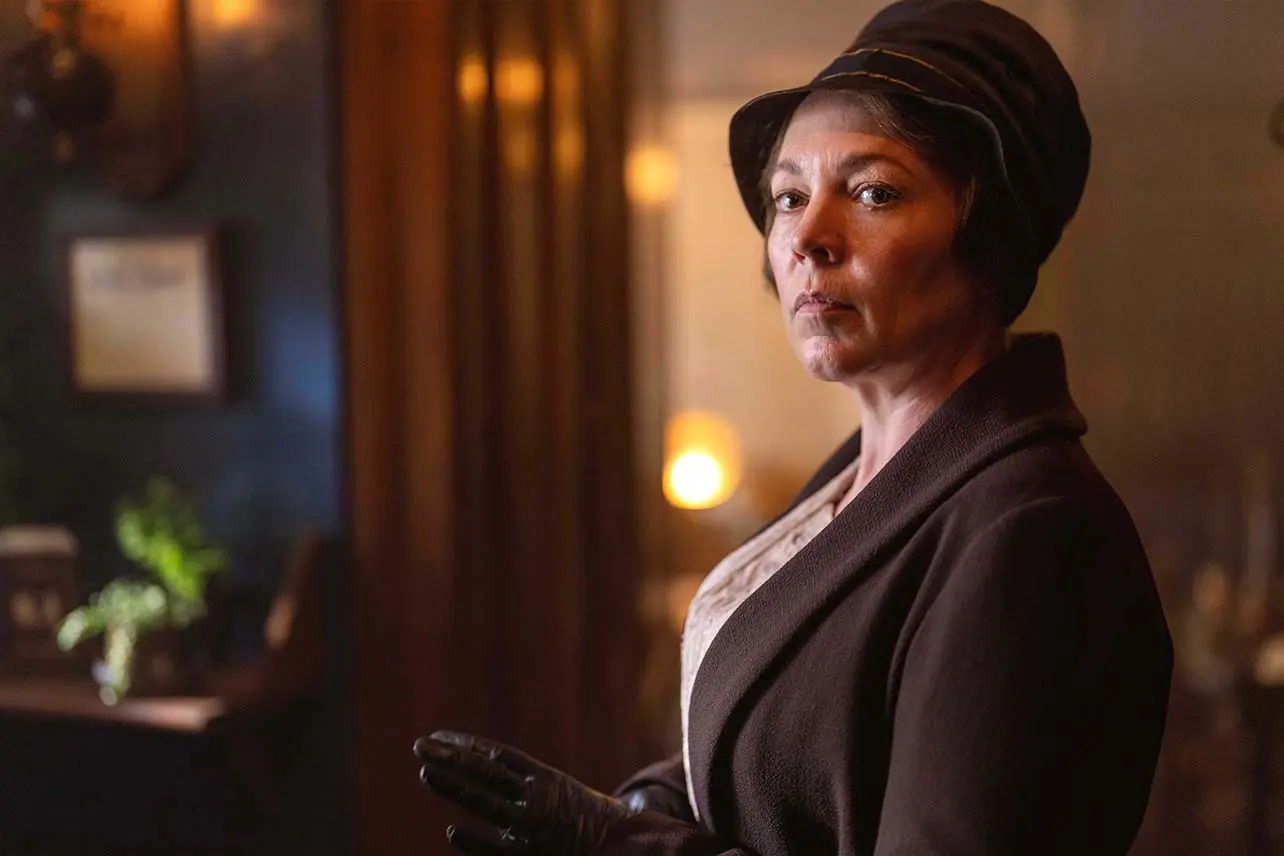
Scandalous headlines. A local witch hunt. A quiet investigation that turns a respectable seaside town upside down. On Netflix, Olivia Colman spotlights the dark underbelly of a 1920s community as Edith Swan. Her calculating, stoic posture — hands folded, eyes unblinking, mouth set in a line that could cut glass — captured in that now-famous still proves something far more unsettling than piety. It proves that the most dangerous person in Littlehampton was never the woman everyone suspected.
Wicked Little Letters (2023) arrives on the streamer looking like a genteel period comedy and then quietly detonates. Directed by Thea Sharrock from a screenplay by Jonny Sweet, the film takes a true scandal so bizarre that contemporary newspapers dubbed it “the Seaside Mystery” and turns it into a razor-edged portrait of repression, class snobbery, and the particular cruelty of respectable women.
The year is 1920. Littlehampton, a tidy West Sussex resort still shaking off the Great War, is the kind of place where church attendance is noted and a raised voice is an event. Edith Swan lives with her tyrannical father Edward (Timothy Spall, magnificent in his petty tyranny) and gentle mother Victoria (Gemma Jones). Edith is unmarried, devout, and apparently content to fold linen and recite scripture. Next door lives Rose Gooding (Jessie Buckley), an Irish migrant, a widow, a single mother, and a woman who swears the way other people breathe. The two women were once friends. Then they were not.
The letters begin.
They are obscene. They are hilarious. They are addressed to Edith and soon to half the town. Words that no “nice” woman of 1920 would ever admit to knowing appear in looping handwriting on cheap paper. Edith reports them. The police, led by a well-meaning but dim constable, look no further than the neighbour who already has a reputation for filthy language. Rose is arrested. The press arrives. Parliament takes notice. A witch hunt is born, and it wears a Sunday hat.
What Wicked Little Letters understands — and what Colman’s performance makes impossible to ignore — is that the real scandal is not the language. It is the silence that preceded it. Edith has spent her entire adult life under her father’s roof, her desires folded away like unused linen. The film never lectures. It simply lets Colman sit in frame after frame with that same unreadable composure the caption describes, and the audience begins to feel the pressure building behind her eyes. When the letters keep coming even after Rose is locked up, the town’s women — led by the only female police officer, Gladys Moss (Anjana Vasan, quietly excellent) — start asking the questions the men refuse to ask.
The investigation that follows is both farce and feminist procedural. Gladys and a small circle of local women (Joanna Scanlan and Lolly Adefope among them) do the work the official force will not. They notice handwriting. They notice timing. They notice that the most pious woman in the street seems oddly energised by the attention. The film’s greatest pleasure is watching these women slowly, almost reluctantly, accept that the monster they are hunting lives among them and wears a cross.
The true story behind Wicked Little Letters is, if anything, even stranger. The real Edith Swan did send the letters. She sent them to herself. She sent them to neighbours. She framed Rose so thoroughly that the Irish woman served two prison sentences before the trap was sprung with marked postage stamps and a post-office clerk who finally paid attention. The film compresses years of legal farce into a taut 100 minutes, but it keeps the essential cruelty intact: a respectable Englishwoman used society’s prejudices — against the Irish, against single mothers, against women who swore — as a weapon.
Colman has built a career on playing women whose surfaces deceive. Here she gives Edith a stillness that is almost frightening. There is no big speech, no breakdown in the rain. There is only that posture: shoulders slightly hunched, chin lifted, eyes that miss nothing. Buckley, by contrast, is all motion and volume — a woman who has already paid the social price for honesty and therefore has nothing left to lose. Their scenes together crackle with the particular electricity of two people who once liked each other and now cannot afford to.
The satire is social rather than political in the modern sense. Wicked Little Letters is not interested in grand statements about the patriarchy so much as the thousand small suffocations of a community that congratulates itself on its morals. The men are pompous or useless. The church is a stage for hypocrisy. The newspapers are hungry for a story that confirms what they already believe about “that sort of woman.” When the truth finally surfaces, it does not produce catharsis so much as a grim, almost comic recognition: of course it was her. Who else had so much rage and so few outlets?
Netflix has packaged the film as a prestige British curiosity, and that is both accurate and insufficient. Wicked Little Letters is funnier than most comedies and colder than most thrillers. It understands that the most shocking letters are the ones people write to themselves when they can no longer bear the person they have been forced to become. Edith’s stoic posture in that promotional still is not an acting choice. It is the entire thesis. Behind the folded hands and the closed mouth is a woman who discovered that the only language left to her was the language everyone else was too polite to use.
The film does not ask you to forgive her. It simply asks you to look again at the quiet woman in the corner of the photograph — the one who never raised her voice, the one who always knew the right hymn, the one whose calculating stillness the camera cannot quite explain — and wonder what she has been writing all these years when no one was watching.
That is the masterclass. That is the mystery. And that is why, more than a century after the last wicked little letter was posted in Littlehampton, the town still feels like it has something to hide.