STREAMING NOW ON NETFLIX: OLIVIA COLMAN DELIVERS A MASTERCLASS IN PSYCHOLOGICAL HYPOCRISY AND REPRESSION
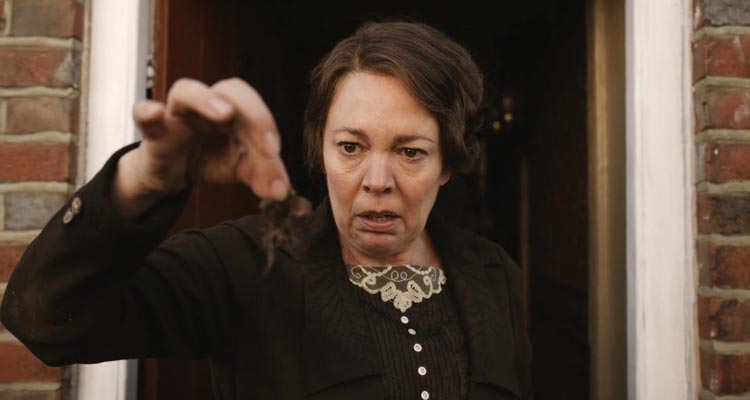
That single image — a pious woman in a modest dress, standing on her own doorstep, staring at a piece of paper as if it were a live grenade — is the perfect entry point into Wicked Little Letters (2023). Directed by Thea Sharrock and written by Jonny Sweet, the film takes a stranger-than-fiction scandal from 1920s Littlehampton and turns it into a darkly funny, quietly savage study of what happens when a woman who has spent her entire life swallowing her own voice finally finds a way to scream.
Littlehampton, shortly after the Great War, is the kind of place that prides itself on decency. Church on Sunday. Clean doorsteps. Neighbours who know one another’s business but pretend they do not. Edith Swan, played by Colman with terrifying precision, is the living embodiment of that code. Unmarried, still living with her parents, she recites scripture, serves tea, and submits to a father, Edward (Timothy Spall), whose control is so complete it feels like a second skin. Her mother, Victoria, is gentle and fading. Edith’s life is small, ordered, and suffocating.
Then the letters start arriving.
They are not polite complaints. They are filthy. Inventive. Hilariously, shockingly obscene. Words that a woman like Edith is not supposed to know, let alone read on her own porch. The film opens with letter number nineteen. Edith holds it as if the paper itself might stain her fingers. Colman’s face does the rest: a flicker of genuine disgust, then something more complicated — recognition, almost, as if the language has reached a part of her she has spent decades locking away.
Suspicion falls, almost immediately, on the neighbour from hell. Rose Gooding (Jessie Buckley) is everything Edith is not: Irish, loud, unmarried with a child, given to swearing in the street and refusing to lower her voice for anyone. The two women were once, improbably, friends. That friendship collapsed. In a town this small, a collapsed friendship is enough to convict.
Rose is arrested. The case becomes a national sensation. Newspapers call it the Seaside Mystery. Parliament discusses it. Respectable England is appalled that such language could exist, let alone be posted through letterboxes in a respectable town. And yet the letters keep coming.
What Wicked Little Letters understands — and what Colman plays with surgical control — is that the real subject is not the letters themselves. It is the machinery of repression that made them necessary. Edith has been trained since childhood to be good. Good daughters do not shout. Good daughters do not leave. Good daughters copy out Bible verses two hundred times when their father demands it. The only place left for the rage is the page.
Colman never overplays it. That is the masterclass. She does not give you a cartoon hypocrite. She gives you a woman who believes her own performance so completely that the performance has become her personality. Watch her inspect the mail. Watch the way her mouth tightens, the way her eyes flick toward the neighbouring house, the way she steps back inside as if the porch itself has become unsafe. Then watch her later, in private, and you begin to understand that the shock on her face is not only at the words. It is at the fact that someone — anyone — has finally said them out loud.
The film is based on the real Littlehampton libels, a case that dragged on for years, sent an innocent woman to prison more than once, and ended only when a female police officer, Gladys Moss (Anjana Vasan), refused to accept the official story. In the movie, as in life, it is the women of the town who start asking the questions the men will not. They notice the handwriting. They notice the timing. They notice that Rose, for all her colourful vocabulary, has no particular reason to waste paper on Edith when she can simply shout the same words across the garden fence.
The comedy is filthy and precise. The tragedy sits underneath it like a bruise. Edith’s father is not a cartoon villain; he is worse. He is ordinary. He is the kind of man who believes he is protecting his daughter by never letting her grow up. The letters become Edith’s only private room. They are also her only weapon.
Wicked Little Letters never pretends the story is simple. Rose is not a saint. Edith is not a monster in the usual sense. The film is interested in the space between the two: the space where a woman who has been told she has no right to anger invents an entire second self on paper and then watches that self destroy the neighbour she once liked. Colman makes you feel the cost of that invention in every tight smile and every trembling hand.
Streaming now on Netflix, the film arrives at a moment when anonymous cruelty feels newly familiar. The delivery method has changed — a letterbox in 1920, a comment section in 2026 — but the psychology has not. Someone wants to wound without being seen. Someone else wants to believe they are too good to have written those words. Colman holds both truths in the same face, often in the same shot.
The porch scene the caption describes is only the beginning. What follows is a small-town inquisition, a trial that becomes a public spectacle, and a slow, delicious unravelling of the woman who insisted she was the victim. By the time Edith finally speaks the words she has been posting for months, the moment lands like a confession and a liberation at once.
That is the real shock of Wicked Little Letters. Not the swear words. Not even the twist, which history already recorded a century ago. The shock is watching a woman who has spent her life performing goodness discover that the performance was the cage — and that the only way out was to become, on paper, the very thing she claimed to despise.
Olivia Colman does not ask for your sympathy. She asks you to look. On Netflix, that look lasts one hundred minutes, and it is impossible to look away.