STREAMING NOW: THE TRUE HISTORICAL THRILLER DRAMA THAT EXPOSED ATROCITIES TO THE ENTIRE WORLD
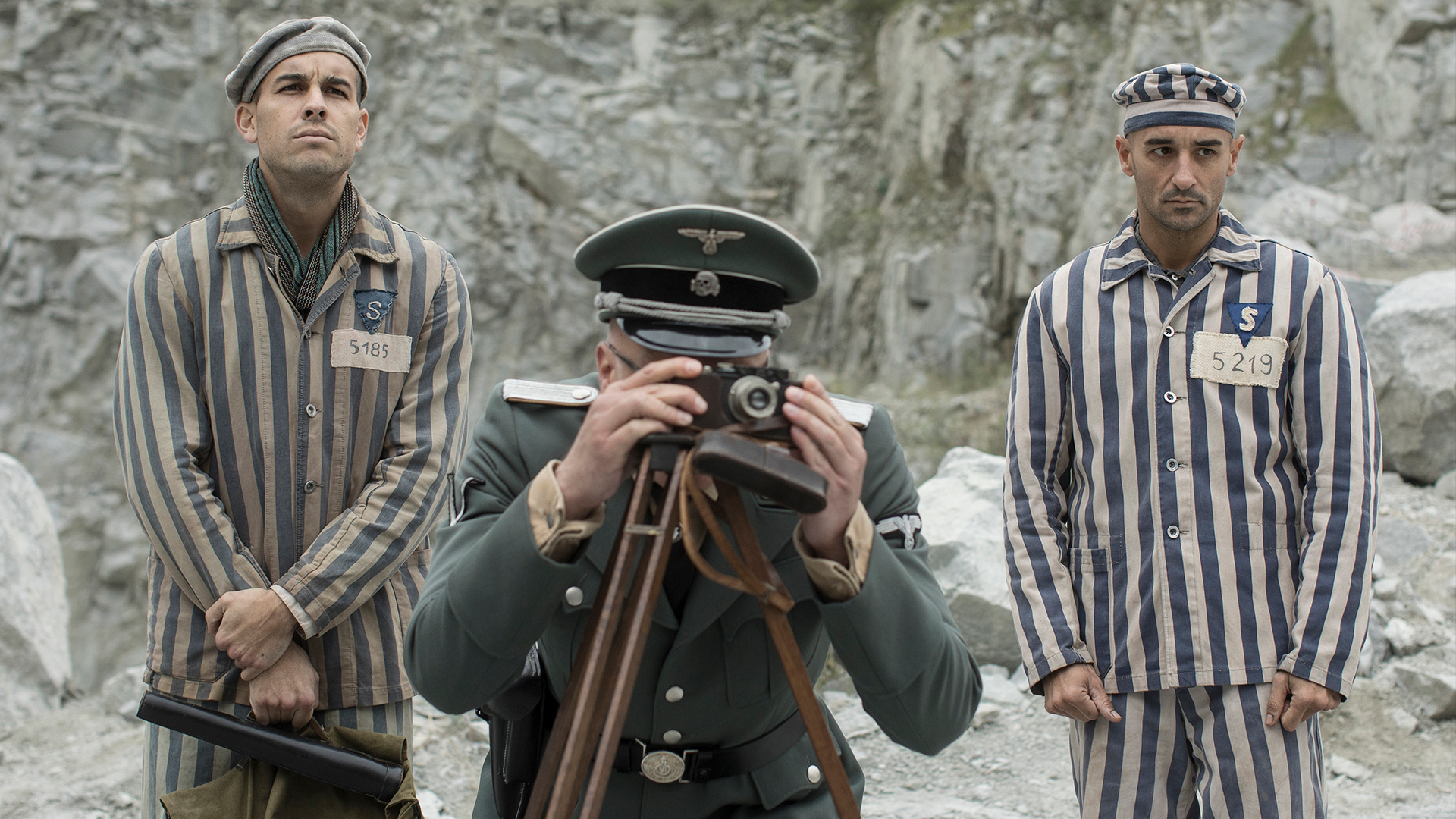
Trapped inside a brutal WWII concentration camp, a Spanish prisoner is forced to photograph horrifying acts for the Nazi guards. When standing silent meant survival, but speaking up through pictures meant justice, on Netflix, Mario Casas delivers a gripping performance as Francesc Boix, a man risking execution every second to secretly smuggle out photo negatives. Standing rigidly beside his fellow inmate Alain Hernández right after this frame proves that some images were never meant to stay buried.
The Photographer of Mauthausen is not another polished war epic. It is a 2018 Spanish historical thriller that arrived quietly on Netflix and has since left viewers staring at the screen long after the credits. Directed by Mar Targarona, the film follows the real Francesc Boix — Catalan Republican, amateur photographer, exile — who arrived at Mauthausen in January 1941 at the age of twenty and did not leave until the Americans did.
Boix had already lost one war. After fighting for the Republic in Spain, he crossed into France, was captured when the Germans overran the country, and was handed over as a stateless “red.” The Nazis sent thousands of Spanish Republicans to Mauthausen-Gusen. Of the roughly 7,500 who entered, more than 4,800 never came out. Those who survived carried the blue triangle that marked them as men without a country.
Inside the camp, talent became a death sentence and a lifeline at the same time. Because Boix knew cameras, the SS put him in the Erkennungsdienst — the identification service — under officer Paul Ricken. His job was to develop, file, and print the photographs the regime took of itself: new arrivals shaved and numbered, official visits by Himmler and Speer, corpses arranged after “escape attempts,” the quarry that swallowed men by the dozen. The Nazis documented everything. They believed the paper trail would never leave the barbed wire.
Then Stalingrad fell. Berlin sent the order: destroy the archive. The pictures that proved the machinery of the camp were to vanish before the Allies arrived. That was the moment Boix stopped being a technician and became a thief.
He and a small circle of Spanish prisoners began hiding negatives. Some were cut into strips and wrapped in newspaper. Some were sewn into the shoulder seams of prison jackets. Some were passed to men who worked the Poschacher quarry outside the walls. Those men, in turn, handed packets to an Austrian woman named Anna Pointner, who bricked them into the wall of her garden. One wrong glance from a kapo, one search of a bunk, and the entire chain would have ended in the same quarry.
The film does not invent the terror. It compresses four years of it into 110 minutes of muted color, sudden violence, and faces that look as if they have already been photographed for the dead file. Mario Casas lost twelve kilos to play Boix. The performance is not showy. It is the look of a man who has decided that dying with the evidence is better than living without it. Beside him, Alain Hernández as Valbuena — the senior prisoner in the lab — carries the weight of someone who has already calculated the odds and chosen to stay anyway. The caption’s frozen frame of the two of them standing together is not decoration. It is the film’s thesis: survival was never enough. Someone had to keep the pictures.
The operation was collective, not cinematic lone-wolf heroism. Historian Benito Bermejo’s research, on which the screenplay draws, shows a network of Republicans who understood that the camera the SS trusted would become the camera that condemned them. After liberation in May 1945, Boix retrieved the hidden negatives, printed them, wrote notes on the backs, and handed copies to American soldiers and journalists before the ink was dry. In January 1946 he walked into the Nuremberg courtroom — the only Spanish witness — and identified faces the defense claimed had never been there. Photographs of Himmler, Kaltenbrunner, and Speer at the quarry did what speeches could not. Kaltenbrunner was hanged. Speer went to prison.
Boix himself died in Paris in 1951, only thirty years old, lungs ruined by the camp. The pictures outlived him.
What The Photographer of Mauthausen understands, and what makes it sit heavier than many bigger-budget Holocaust dramas, is the specific cruelty of being forced to look. Boix is not a bystander who stumbles on evidence. He is the man the system hired to manufacture its own alibi, then ordered to burn the alibi when the war turned. Every print he saved was an act of mutiny performed under the lights of the people who would have shot him for it.
Netflix has a habit of dropping these films without fanfare and letting word of mouth do the rest. Viewers who click expecting another prestige war picture find something closer to a prison-break thriller shot in the register of a crime scene. The smuggling sequences — a box, a performance, a wall, a garden — have the tautness of a heist movie because that is what they were: a heist against oblivion.
The film does not pretend that photographs ended the camps. It shows that photographs made denial harder. That is a colder, more useful kind of justice than most stories are willing to settle for.
If you watch it, watch it knowing the man in the lab coat was real, the negatives were real, the woman who hid them in her wall was real, and the testimony in Nuremberg was real. Standing silent kept you alive until the next roll of film. Speaking through the pictures was the only way the dead would ever be counted.
The Photographer of Mauthausen is streaming now.