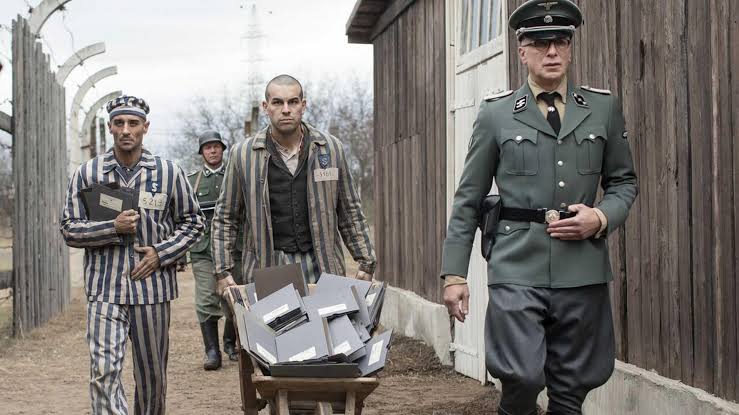
NETFLIX PRESENTS A MASTERCLASS IN SUSPENSE, SECRET MISSIONS, AND HISTORICAL JUSTICE!
Towering barbed wire fences, relentless forced labor, and an unspeakable secret mission ready to expose an entire tyrannical regime to the Nuremberg trials. On NETFLIX, this critically acclaimed historical thriller spotlights Mario Casas navigating a deadly maze of military surveillance, betrayal, and extreme risk. The cold, calculating stare captured in this shot proves that survival inside Mauthausen was never enough. Someone had to steal the evidence.
The Photographer of Mauthausen does not ask you to watch another Holocaust drama. It asks you to sit inside the darkroom of a Nazi identification office and wait for the moment a prisoner decides the photographs themselves can become a weapon.
The 2018 Spanish film, directed by Mar Targarona and now streaming on Netflix, is based on the true story of Francisco Boix — often called Francesc Boix — a young Catalan Republican photographer who fought in the Spanish Civil War, fled into France, and was handed over to the Germans. In January 1941, at twenty years old, he arrived at Mauthausen-Gusen in Austria wearing the red triangle of a political prisoner. Of the more than 7,000 Spaniards sent to that complex, fewer than 3,000 would leave alive.
Mauthausen was not built for mercy. Quarry work, the infamous Stairs of Death, starvation, executions dressed up as “escapes,” and a bureaucracy so meticulous it photographed its own crimes. The SS Identification Service — the Erkennungsdienst — documented arrivals, deaths, visits by Heinrich Himmler and Albert Speer, and the bodies piled after “incidents.” The regime wanted a record. It also wanted the option to burn that record if the war turned.
Boix spoke German. He knew cameras. Those two facts kept him from the quarry and placed him in the laboratory of SS officer Paul Ricken, the camp photographer. Mario Casas plays Boix as a man who understands the bargain immediately: develop the pictures, stay useful, stay alive. The cost is complicity. Every print he makes is another official lie about how prisoners “died.” Every negative he handles is proof that the lie can be reversed.
Casas lost twelve kilograms for the role. The weight loss is visible, but the performance is not just physical. His Boix watches. He calculates. He does not speechify. The cold stare the promotional stills freeze is the look of a man who has already accepted that one wrong glance at the wrong negative will get him hanged on the Appellplatz. Richard van Weyden’s Ricken is the other half of that tension: cultured, precise, almost paternal toward his gifted prisoner assistant, and utterly loyal to the machine. Their scenes together feel like a chess match played over developing trays and hanging film strips.
The plot turns when the war begins to collapse. Orders arrive to destroy the archive. The photographs that were once propaganda must vanish before Allied troops arrive. That is the moment The Photographer of Mauthausen stops being a portrait of endurance and becomes a heist film staged inside a slaughterhouse.
Boix and a network of Spanish prisoners — among them the characters played by Alain Hernández and Adrià Salazar — begin hiding negatives. They conceal them in laundry, in window frames, in the lining of clothes. Younger prisoners who work outside the wire, the so-called Poschacher boys, carry packets out of the camp. An Austrian woman, Anna Pointner, hides material in her garden. The film compresses years of risk into a tightening sequence of near-discoveries. New York Times critic Jason Bailey compared the smuggling passages to The Great Escape rather than Schindler’s List: deceptions, diversions, a Hitchcockian beat involving a hidden strip of film. Then Targarona slams the audience back into the reality the genre thrill cannot soften. Sudden brutality is not decoration. It is the price of being caught.
Historically, Boix later said he and his comrades saved around 20,000 negatives — roughly a third of the camp’s photographic archive. Only about a thousand survived the chaos of liberation and the years that followed. Those images were enough. In 1946 Boix became the only Spaniard to testify at the Nuremberg trials. The photographs helped place senior Nazis in the dock. Albert Speer and Ernst Kaltenbrunner were among those confronted with visual proof they could not talk away. The same pictures appeared at the Dachau trials of Mauthausen staff. “Nobody will believe it if they do not see it,” Boix’s line in the film is not a screenwriter’s invention. It is the logic that kept him stealing film while the SS still held the keys.
Targarona, working from the research of historian Benito Bermejo and a screenplay by Roger Danès and Alfred Pérez Fargas, shot interiors in Barcelona and used Hungarian sets that had already served other wartime productions. The result is not a lavish epic. It is a 110-minute Spanish-language thriller with English subtitles, Goya nominations for makeup, art direction, costumes and production supervision, and a growing second life on Netflix. British tabloids have recently rediscovered it as a “devastating” and “harrowing” title viewers cannot stop thinking about days later. That reaction is the point. The film is designed to leave the afterimage of the real photographs that roll during the end credits — the actual negatives Boix refused to burn.
What The Photographer of Mauthausen understands better than many bigger-budget camp dramas is the peculiar horror of documentation. The Nazis photographed everything because they believed they would win and because bureaucracy is a form of control. A prisoner who works in that bureaucracy occupies the most dangerous room in the camp: the room where the regime’s memory is stored. Steal the memory and you steal the future trial. Fail and you become another numbered corpse in a file that will never be opened.
Casas never plays Boix as a saint. He plays a man who used the system that was killing his friends, then turned the system’s own camera against it. That moral gray is what gives the film its suspense. Every time Boix slides a negative into a hidden place, the audience knows the SS could open the same drawer. Every time a young prisoner walks toward the gate with film under his shirt, the watchtowers are still manned.
Netflix did not invent this story. Francisco Boix lived it, testified to it, and died in 1951 in Paris, still unable to return to Franco’s Spain. The streaming platform simply put the film where millions of people who have never heard of the Spanish prisoners of Mauthausen can find it. The caption that circulates with the still of Casas’s stare is not exaggeration. The fences were real. The labor was real. The secret mission was real. The photographs reached Nuremberg.
Watch The Photographer of Mauthausen for the thriller construction if you must. Stay for the moment the credits give way to the original images. That is when the cold stare stops being an actor’s choice and becomes the last expression of a man who decided the world would see what the wire was built to hide.