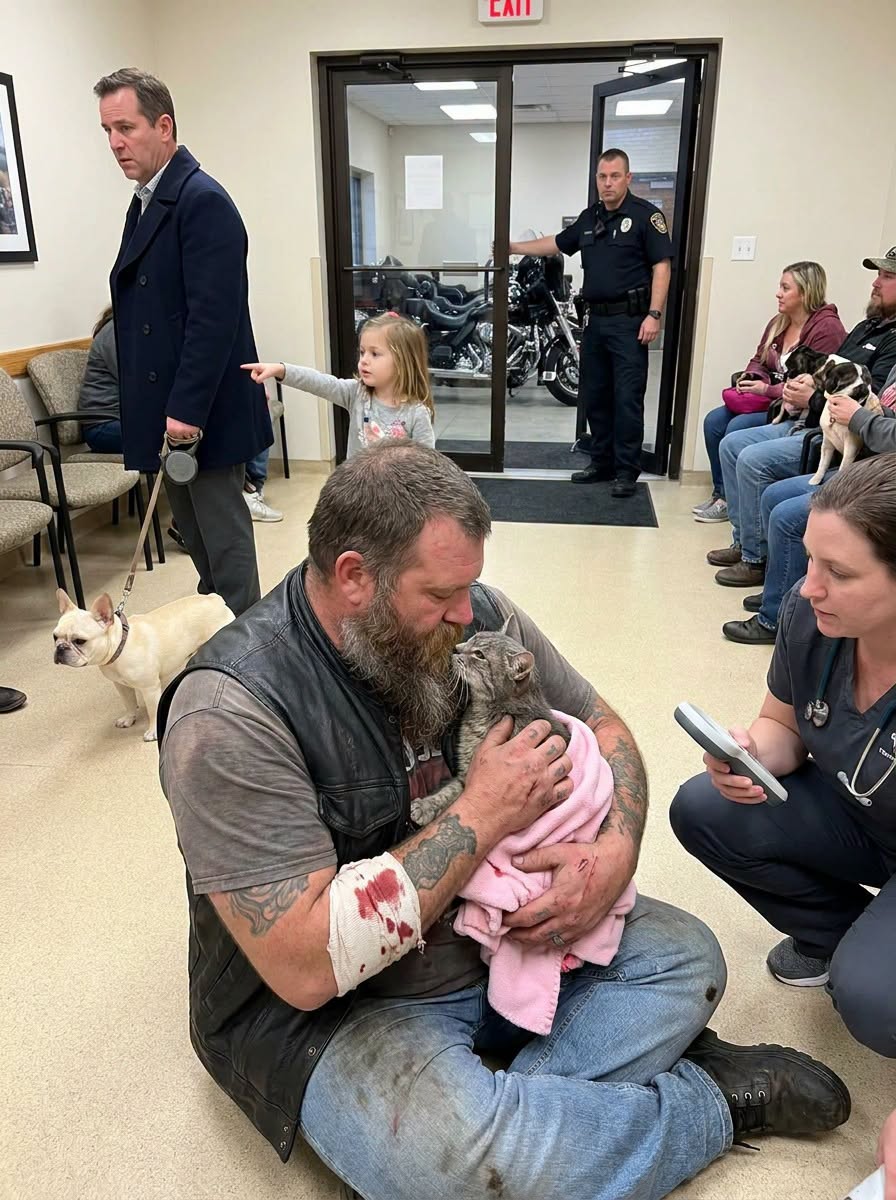
PART 2 – The Biker They Put at the Bottom of the List Was Bleeding Around a Stray Cat. The Richest Man in the Waiting Room Recognized Her — and His Daughter Said the Words That Destroyed Him: “That Was Great-Grandma’s Cat.”
PART 2 – The Address on the Tag
Graham did not leave.
He sat back down with Winston’s leash looped around his wrist like a claim. The French bulldog panted against his shoe, oblivious to the temperature of the room. Graham’s daughter looked from the tabby to her father and then at the floor, the way children do when they have spoken a true thing and been told it was noise.
I had the technician take the cat to the treatment bay.
Hammer followed as far as the swinging door and stopped, blood still seeping through the rag. He would not surrender her until I said, quietly, that I would be the one to hold the leg.
He nodded once.
The Iron Saints remained outside. The helmet on the seat of the nearest Harley was heavier than it had been twenty minutes earlier. No one in the waiting room thanked them. That was not why they had come.
In the bay the tabby’s pulse was thin. The injured hind limb was worse than the first look suggested: old trauma layered under new, a fracture that had begun to knit wrong and then been asked to run. There were abrasions at the neck consistent with a collar pulled, held, released. There was dirt in the coat that did not belong to a house with a surgical wing named after a living man.
I sedated her just enough.
Hammer stood in the doorway with his ruined wrist and watched her eyes glaze and did not look away.
“What’s her name?” I asked.
He shook his head.
“Eleanor called her something,” he said. “I only ever heard the engine answer.”
Graham’s voice reached us from the hall.
He was already on the phone. Not to animal control. To someone who handled problems that arrived with cameras and daughters who remembered the wrong animals.
I left Hammer with a tech and walked back out.
“Mr. Avery,” I said. “The chip is registered. The tag has an address. Your daughter recognized her. You will stay until I finish the exam.”
He smiled the smile of a man who has named buildings.
“Doctor, that animal was rehomed. My grandmother’s estate was complicated. I’m not going to be lectured in a lobby because a biker walked in off the street with a stray.”
“She isn’t a stray if the chip still speaks Eleanor’s name.”
The smile thinned.
“Eleanor was sentimental. She fed anyone who stood still long enough. That doesn’t make a motorcycle club next of kin.”
Behind him, the little girl had picked up the pink blanket from the chair where Hammer had been sitting. She folded it with the concentration of a person performing a rite she had not been taught.
“Great-Grandma said the loud bike was the only one Mallow would sleep through,” she whispered, not quite to me.
Mallow.
The name entered the room the way a key enters a lock that has been waiting.
Hammer, still in the doorway of the bay, heard it.
He closed his eyes.
Graham told his daughter, again, to be quiet.
I had the front desk pull Eleanor’s old file. Nineteen years of December envelopes. Lists in a hand that never quite stayed on the line. At the back of the folder, clipped to a photocopy of a paid invoice from last winter, was a sealed envelope I had never opened.
It was addressed, in Eleanor’s writing, to the clinic.
Not to Graham.
Not to any executor.
To Mesa Vista Animal Hospital.
If I am gone and she is not where she should be.
My hands were steady when I broke the seal. They had been steady for worse things. A crashing chest. A femur like wet wood. A child asking if the dog would wake up.
The letter was one page.
I read the first three lines and stopped.
Not because I did not understand them.
Because I understood them too well, and the waiting room still contained the man whose name was on our wall.
Hammer’s phone buzzed in his jacket. He ignored it. Then it buzzed again. A rider from outside held up his own screen through the glass: a still from a doorbell camera, timestamped two nights earlier, an SUV at a dark curb, a passenger door, a gray body placed on concrete with the care of a man disposing of a problem he intended to call a misunderstanding.
The plate was readable.
I looked at Graham.
He had seen the rider’s screen too.
For the first time that afternoon the developer looked like a person who had miscalculated the distance between a sold house and a living witness.
I folded Eleanor’s letter without finishing it in front of him.
“You’re going to sit down,” I said. “Winston can wait. Mallow cannot. And when I open this page the rest of the way, you will not be the first person in the room who hears whose name she wrote.”
Graham’s daughter clutched the pink blanket.
Hammer’s blood had reached his boot.
Outside, one Harley turned over, low and even, and in the treatment bay the old cat’s ear twitched toward a sound she had trusted longer than she had trusted any of us.
TO BE CONTINUE…