PART 3 – The Biker They Put at the Bottom of the List Was Bleeding Around a Stray Cat. The Richest Man in the Waiting Room Recognized Her — and His Daughter Said the Words That Destroyed Him: “That Was Great-Grandma’s Cat.”
PART 3 – The Name on the Page
I did not read the rest of the letter in the lobby.
I took Graham, Hammer, and the clinic manager into the small consult room that still smelled of the morning’s disinfectant. Winston remained with a technician. Graham’s daughter stayed in the hall with the pink blanket and the old dachshund, close enough to hear if anyone began to shout, far enough that she would not have to watch a grown man invent a softer story.
I opened Eleanor’s page.
Her hand had shaken, but the sentences were clean.
If I am gone and she is not where she should be, you will not give her to the house that sold the rooms she knew.
You will give her to the man who rebuilt a motorcycle in my garage in 1998 and never once asked me for the deed to anything.
His name is Ray Dawson. The cat will know the engine. That is how you will be sure.
If there is a bill, strike it. I have already paid what kindness costs in this building. Do not make him pay it twice.
I set the letter on the table.
Hammer did not reach for it. He looked at his ruined wrist as if the blood might explain him to himself.
“She didn’t tell me,” he said.
“She told the building,” I said. “She knew which one of you would still be standing when the other one sold the house.”
Graham laughed once, a dry sound with no audience left inside it.
“A homeless drunk from an overpass. That’s her witness. That’s her heir. You can’t be serious.”
“She fed you too,” I said. “She just stopped being useful to you when she stopped writing checks you could stand beside at fundraisers.”
Color moved through his face.
“I didn’t dump a cat. I relocated an animal the estate couldn’t keep. There was a misunderstanding about timing.”
I turned my phone on the table. The neighbor’s stills were already in an email from the rider outside. Plate. Curb. Door. Gray coat on concrete. Two nights ago. After midnight. No leash. No carrier. No second person getting out to make the act look like care.
“Animal welfare is on the way,” I said. “You can call it relocation when they arrive. They have their own words.”
Graham stood.
The clinic manager did not move from the door.
“Winston is stable,” I told him. “You may wait for his discharge in the lobby like everyone else. You will not take Mallow. You will not speak to my staff as if this hospital is an annex of your development. And you will not tell that child again that she imagined her great-grandmother’s cat.”
He looked at Hammer.
Hammer looked back and did not offer the performance Graham needed: rage, threat, the myth of the dangerous man. He only held his bleeding wrist against his ribs and waited, as he had waited under an overpass in 1998 for a woman who brought food and did not ask him to become smaller in order to deserve it.
Graham left the consult room first.
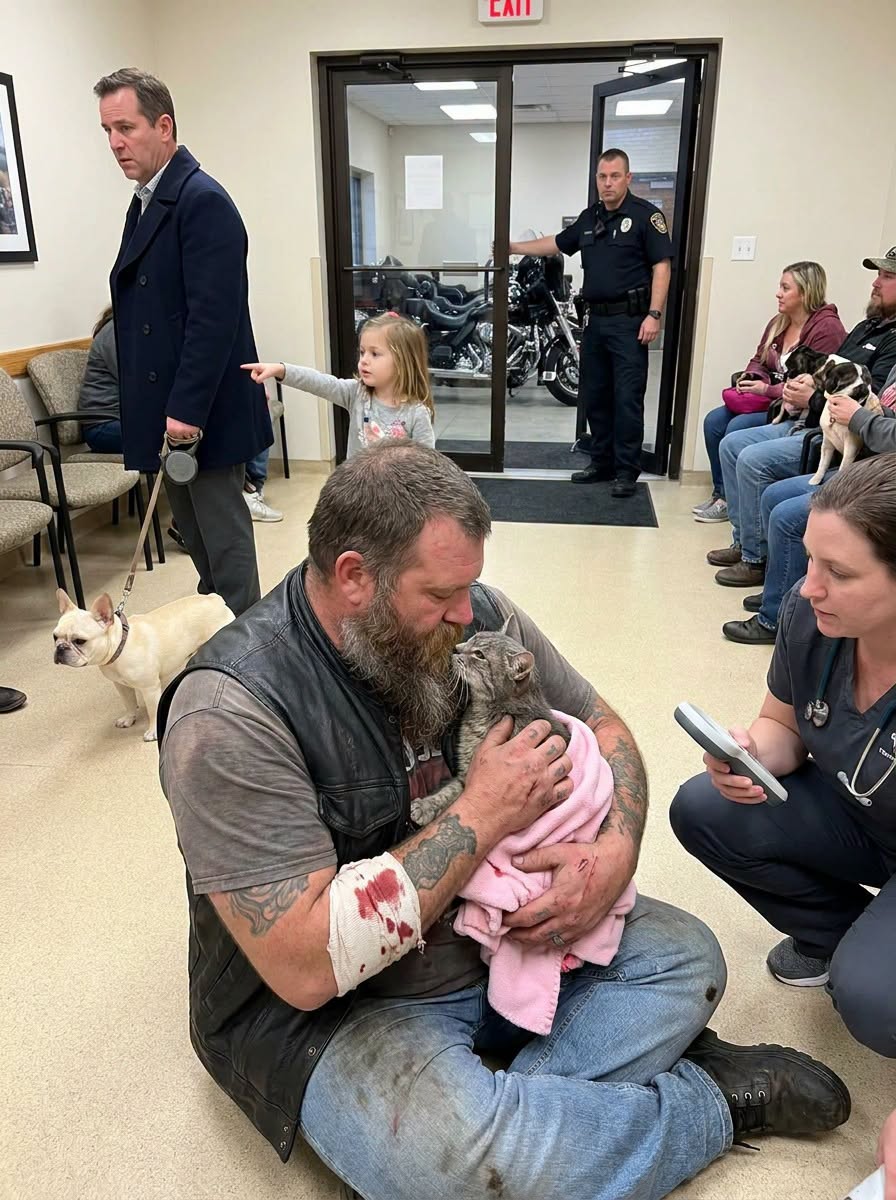
In the hall his daughter held out the pink blanket without being asked. She did not give it to her father. She gave it to Hammer.
“Mallow likes this color,” she said.
Hammer took it with the hand that was still clean.
“I’ll keep it on the seat,” he said. “So she knows.”
Animal control came. Statements were taken. The chip, the tag, the footage, the letter. Graham’s attorney arrived late and found that steel on a surgical wing does not outrank a microchip and a doorbell camera.
Mallow came through surgery after midnight. The old break would never be perfect. She would limp. She would live. When I brought her out, wrapped and slow, the waiting room was empty except for Hammer and one rider who had stayed because someone had to keep a helmet from blowing off a seat.
I started the Harley myself.
The engine turned. Low. Even.
Mallow’s ear twitched. She pressed her face into the beard she had already chosen in the fluorescent dark.
I walked to the desk and drew a line through the account.
Not because Hammer had become a story.
Because Eleanor had already paid, in envelopes and in a garage and in the particular attention of a woman who understood that some animals, and some men, only sleep when the right noise is near.
Hammer tried to argue the bill.
I turned the letter around so he could see the line that mentioned him by name.
He read it twice.
Then he folded the pink blanket around the cat as if folding were a skill he had practiced on engines and on winters and on the rare kindness that does not ask for a title in return.
“I ain’t her owner,” he said.
“No,” I said. “You’re the person she trusted when ownership failed.”
He nodded once.
Outside, the last Saint kicked his bike alive. The windows trembled. Mallow purred into leather and blood and the long gray beard of a man the waiting room had ranked below a French bulldog with a steak problem.
Graham’s name remained on the surgical wing.
It would.
Buildings keep the names of men who pay for walls.
The cat kept the engine.
That was the ledger Eleanor had been keeping all along.
THE END