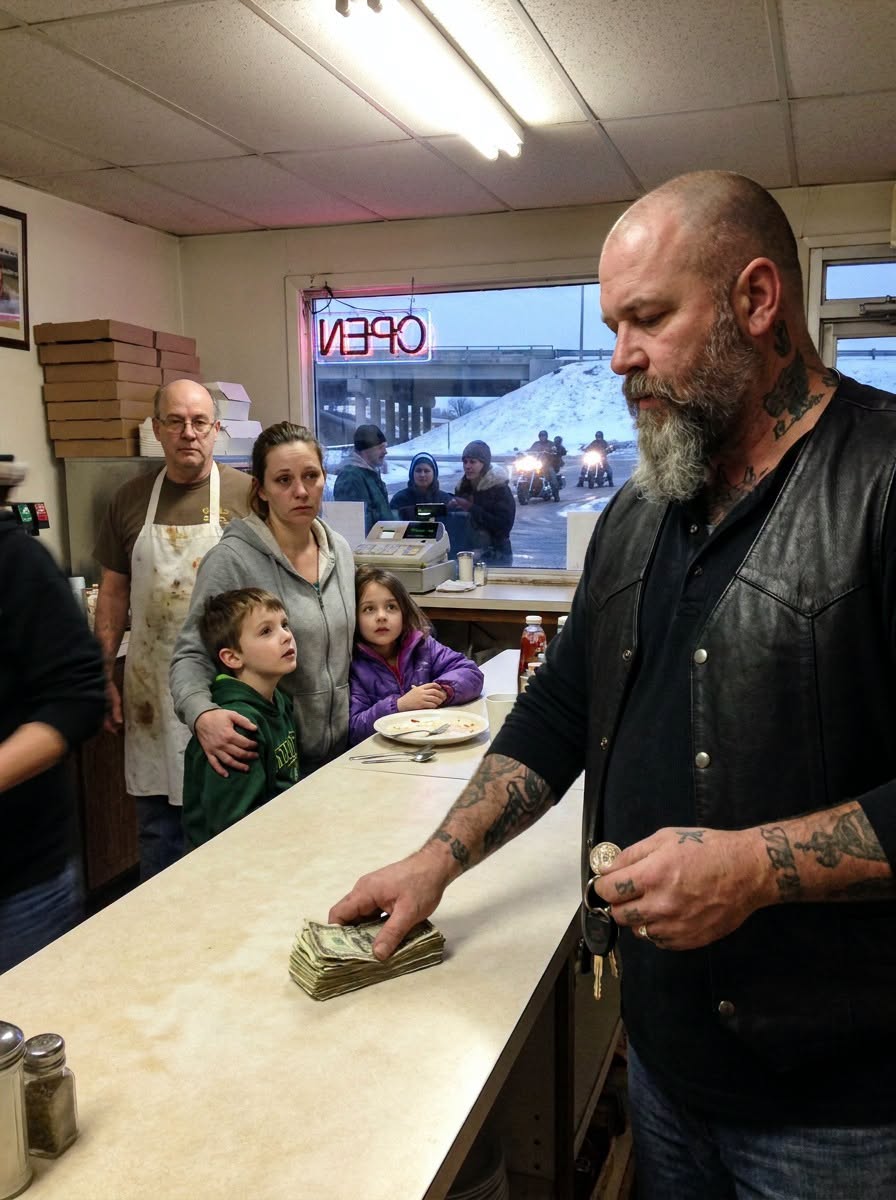
The Owner Shouted That His Diner Wasn’t a Charity While Two Children Stared at Empty Plates—Then a Biker Ordered Thirty Dinners and Set a Forty-Six-Year-Old Dime on the Counter.
The Desert Lantern still pretended it was a place people came to rest.
Neon in the window. Coffee that had been brave that morning and given up by dusk. Booth vinyl repaired with tape the color of old bandages. Outside, Route 66 ran toward the dark as if it had somewhere warmer to be. Inside, my children were trying to make one plate of chicken strips last like it was a strategy.
I was Jenna Hart. Thirty-four. Noah nine, Emily six. Their father had left the state the way some men leave a room: without taking the part that costs. Rent still spoke. School still spoke. He did not.
Until that Thursday I thought humiliation preferred quiet rooms. Declined cards. Notices folded small enough to live in a purse. The grocery pause when you put the cereal back because the milk has already won.
I was wrong.
Humiliation can use a voice.
The check arrived. I counted what I had under the table, twice, as if arithmetic might grow kinder the second time.
Six dollars and forty cents short.
I asked the owner if I could wash the dishes, mop, do the restrooms. Housekeeping had been my work for six years. I was not asking him to bless me. I was asking to finish what I had started.
He looked at me as if the register itself had been insulted.
“You should have counted your money before you fed your kids.”
The diner heard him. Forks hesitated. A trucker two booths over found his coffee suddenly fascinating.
I lowered my voice. I apologized, which is what women are trained to do when a room turns toward them. He did not meet me there. He lifted the bill like evidence.
“This is not a charity,” he said, louder now, feeding on the silence he had made. “People come in here every week with stories. Take your kids and go.”
Noah stopped chewing.
Emily folded her napkin into disappearing squares until there was nothing left to fold, only a fist. Then both of them looked down. Not guilty. Trained. Children learn quickly which parts of hunger are allowed to be seen.
The door opened on cold air and road dust and the last of an engine settling outside.
He was a large man in a plain black vest, shaved head, beard salted with gray, ink running down into his sleeves like a map he had stopped explaining. Grease on the jeans. Boots that spoke when the room would not. Fifty-something, maybe. The age at which a life has already decided what it will and will not watch happen twice.
He looked at my children first.
Then at me.
“What’s the total?”
“I can handle it,” I said, which was a lie the whole diner had already audited.
He did not argue with a lie that size. He set a hundred beside the check.
The owner reached.
The biker left one scarred finger on the bill.
“That covers her table.”
A breath moved through the room, the small relief people feel when a scene appears to be ending.
It was not ending.
“Now ring up thirty more dinners.”
The owner blinked as if the number had arrived in a language he did not stock.
“Thirty.”
“Hot meals. Full plates. What the kids had, and vegetables, and water.”
“For who?”
The biker turned his head toward the window. Beyond the glass, under the railroad overpass and along the block that leaned toward the mission, figures in old coats were arranging themselves for another desert night that did not care what a man charged for chicken.
“For them.”
The owner laughed once. No one helped him.
“You planning to walk thirty people through my door?”
“No. You box them. My brothers and I will take them where they’re sitting.”
He drew more bills from his wallet and laid them in a line across the laminate, neat as a wager. Among the larger notes, absurd and dull, lay a single worn dime. Thin. Darkened. Kept as if it were not money at all.
The owner stared at the line of cash.
The biker looked back at my children.
Emily, who had not lifted her face since the shouting, finally did.
He spoke then so softly that the diner, for all its appetite, did not get to keep the sentence.
“My mother,” he said, “once sat where yours is sitting.”
He did not move his finger from the hundred.
And the owner, who had been so certain the room belonged to him, had not yet understood that the night had just changed hands.
TO BE CONTINUE…