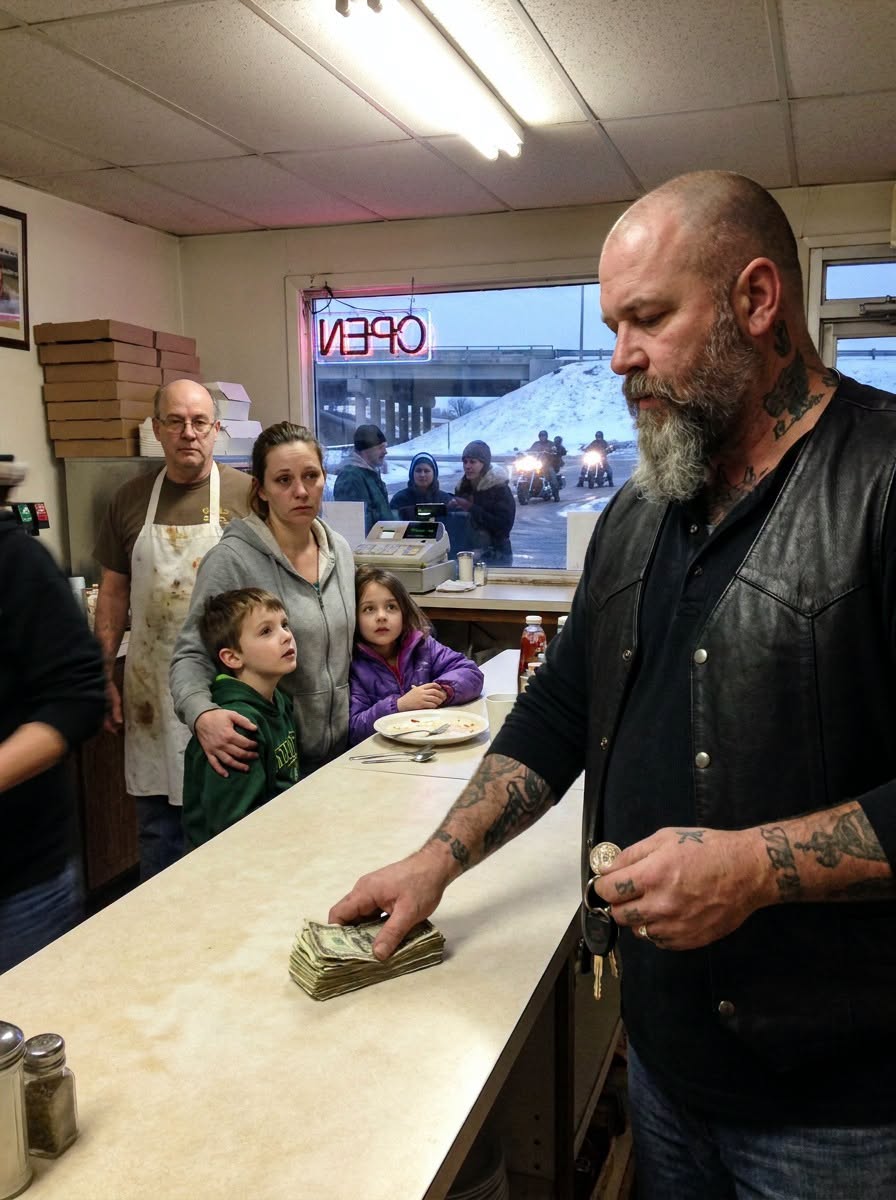
PART 2 – The Owner Shouted That His Diner Wasn’t a Charity While Two Children Stared at Empty Plates—Then a Biker Ordered Thirty Dinners and Set a Forty-Six-Year-Old Dime on the Counter.
The owner did not pick up the money.
He looked at it the way men look at a rule that has arrived without their signature. Behind him the kitchen window framed a cook who had stopped pretending not to listen. Noah’s hand found the edge of the table. Emily had opened her fist enough for the ruined napkin to breathe.
“I decide what this place does,” the owner said.
The biker nodded, as if that were a fact worth respecting and not a throne.
“You do. You decided it wasn’t charity. Fine. This isn’t charity. It’s an order. Thirty boxed dinners. Paid in front of you. You can fill it, or you can explain to a full room why hot food is a problem when the money is already on the wood.”
A trucker in the corner set his mug down too carefully. Someone near the pie case made a small sound that might have been a laugh if it had been braver.
The owner’s jaw worked.
Then he turned and snapped the ticket into the kitchen with more force than paper needs.
Pans answered. Oil woke. The diner, which had been a courtroom two minutes earlier, became a kitchen again because kitchens understand numbers better than pride does.
The biker took his finger off the hundred.
“Eat,” he told my children, not unkind. “Food don’t keep well once shame has sat in it.”
Noah looked at me first. I nodded. Permission, in our house, had become a language of glances. He ate. Emily took a smaller bite, watching the man as if he might vanish if she chewed too loudly.
I found my voice and wished it were better.
“You don’t have to do the rest. The check was enough. Too much.”
He shook his head once.
“The check was the part this room could see. The rest is the part it pretended not to.”
Through the window the overpass held its still figures. A woman in a coat too thin for the boast of Arizona nights. A man with a cardboard square that had given up its message to the wind. Two more settling against the concrete as if the desert had assigned them a shift.
The door opened again. Cold came in with it, and then two men built like the first—leather, dust, the same unadvertised quiet. They did not ask what was happening. They looked at the counter, at the bills, at my children, and one of them said, “Thirty?”
“Thirty.”
“We’ll take the first run when the boxes start.”
They went back out to the bikes as if waiting were work they already knew.
The owner returned with a stack of clamshells and a face that had not yet chosen its final expression. He began packing because the money had left him fewer speeches. Chicken. Fries. A concession of green beans, as if vegetables were a moral he could still control.
Emily spoke without raising her hand, which was how she spoke when the world had already broken the rule about waiting.
“Is that your lucky dime?”
The biker glanced at the thin coin still lying among the larger bills, dull as a stone that had outlived its river.
“No,” he said. “Lucky things get spent. That one don’t.”
“Why?”
The owner’s hands paused in the box. The cook’s spatula hung in the pass-through. Even Noah stopped, a nine-year-old learning that some questions change the temperature of a room.
The biker turned the dime over with one finger, not picking it up, as if lifting it required a permission he would not grant himself in public.
“Because the night my mother sat where yours is sitting,” he said, “this was what she had left after a man like him finished talking.”
He did not look at the owner when he said him. He did not need to. The diner did the looking for him.
Then he slid the dime out of the line of bills and set it nearer to Emily than to the register, a small dark planet arriving in her orbit.
“When the boxes are ready,” he said, quieter still, “you can decide if it stays on the counter—or if it goes with the first meal into the cold.”
Emily’s fingers hovered above it.
The owner’s voice, when it came back, had lost the volume it had used on me and found something thinner underneath.
“You don’t know those people out there.”
The biker finally looked at him.
“I know what an empty plate sounds like when a child tries not to hear it.”
Outside, one of the bikes grumbled awake.
And Emily’s hand, small and certain, closed around the dime.
TO BE CONTINUE…