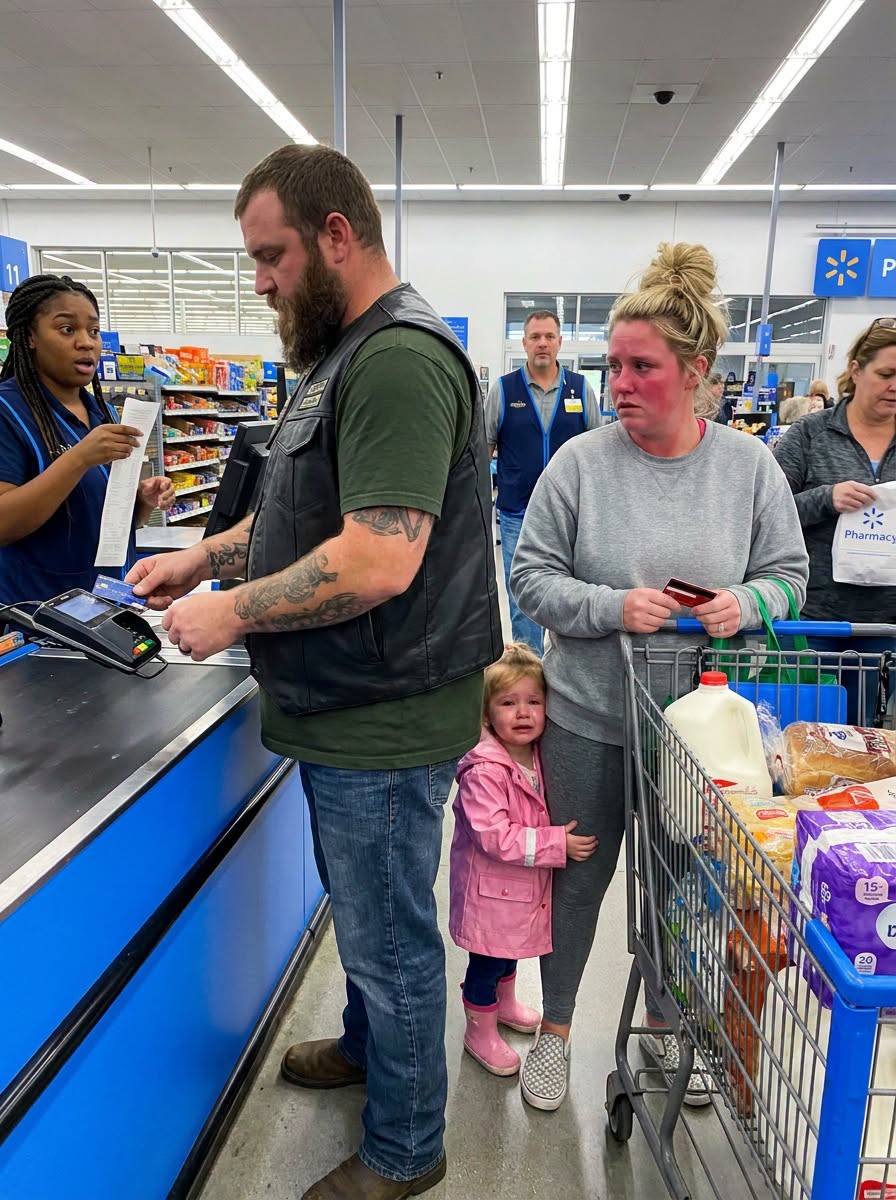
PART 3 – People Judged the Biker for Offering Candy to a Crying Child. They Went Silent When He Paid for the Groceries Her Mother Couldn’t—and Walked Out With Almost Nothing Left of His Own.
He did not answer it.
The screen lit his face for a second longer, a name I was not meant to keep, then he turned the phone against his thigh and let it buzz itself out. Whatever waited on the other end had already waited through one kindness. It could wait through another thirty seconds.
Mia reached him first.
Light-up sneakers, raincoat shining under the lot lamps, the fierce aim of a child who has decided a person is no longer a stranger. Emily came after, cart rattling, pride and gratitude fighting for the same narrow exit.
“I—wait. Please.”
He looked at her the way he had in the aisle. Careful. Not close.
“You don’t owe me a speech.”
“I owe you a hundred and eighty-seven dollars.”
“No.”
The word was the same one she had given him over candy. He used it without sharpness, as if returning a tool he had borrowed.
Emily’s hands were on the cart handle so tight the knuckles had gone pale. Mia stared up at him, then at the bags, then back at her mother, assembling the evening in four-year-old pieces.
“You bought the food,” Mia said, not accusing, just naming the miracle.
“Your mama bought the food,” he said. “I only kept the machine from being rude.”
Emily let out a sound that might have been a laugh if it had not arrived so late and so tired.
“At least your name.”
He hesitated. Names make kindness collectible. He seemed to know that.
“Luke,” he said at last. “That’s enough.”
“Luke.” She swallowed. “If you ever—”
“If I ever need a two-dollar bag of gummy bears, I’ll cry in the right aisle.” The corner of his mouth moved. Not quite a smile. “Don’t teach her that. You were right the first time.”
Mia frowned, betrayed by the universe on principle.
“I still wanted them.”
“I know,” he said. “Wanting doesn’t make your mama wrong.”
The phone buzzed once more against his leg. This time he glanced at it, and the stillness came back, thinner now, like a wire pulled tight. He answered with his back half-turned, voice low.
“I know what it says.” A pause. “No. Tonight’s short.” Another pause. “I’ll figure it. I always do.”
He hung up before the other voice could spend him further.
When he faced us again, the leather and the height and the ink were all still there. So was the man who had accepted a no in an aisle and then paid for the part a child could not count.
“You should get her home,” he told Emily. “Milk’s going to remember the weather.”
He set the bread and oil into a worn side bag, swung a leg over the bike, and the engine woke the way his voice had not: low, certain, finished with the lot. He did not salute. He did not wait to be blessed for it. He rolled toward the dark at the edge of the lights, and the rain that had been deciding all evening finally chose to fall.
Emily stood with her cart and her daughter and a receipt that had someone else’s mercy printed on it. Mia took her mother’s hand without asking for sugar.
I went back inside because the store was still a store, and register seven did not stop being register seven because a man in a blank vest had taught a checkout line the difference between a gift that flatters and a gift that costs.
Later, when the lot was mostly empty, I found a two-dollar bag of gummy bears sitting on the hood of no one’s car, unopened, held down by a wet receipt from another register. Paid in cash. No note.
He had not bought them for the crying.
He had bought them for after the lesson, when the child was asleep and the mother would need, for one small minute, to believe the night had not taken everything.
I left them there.
Some kindnesses are not for the people who watched.
THE END