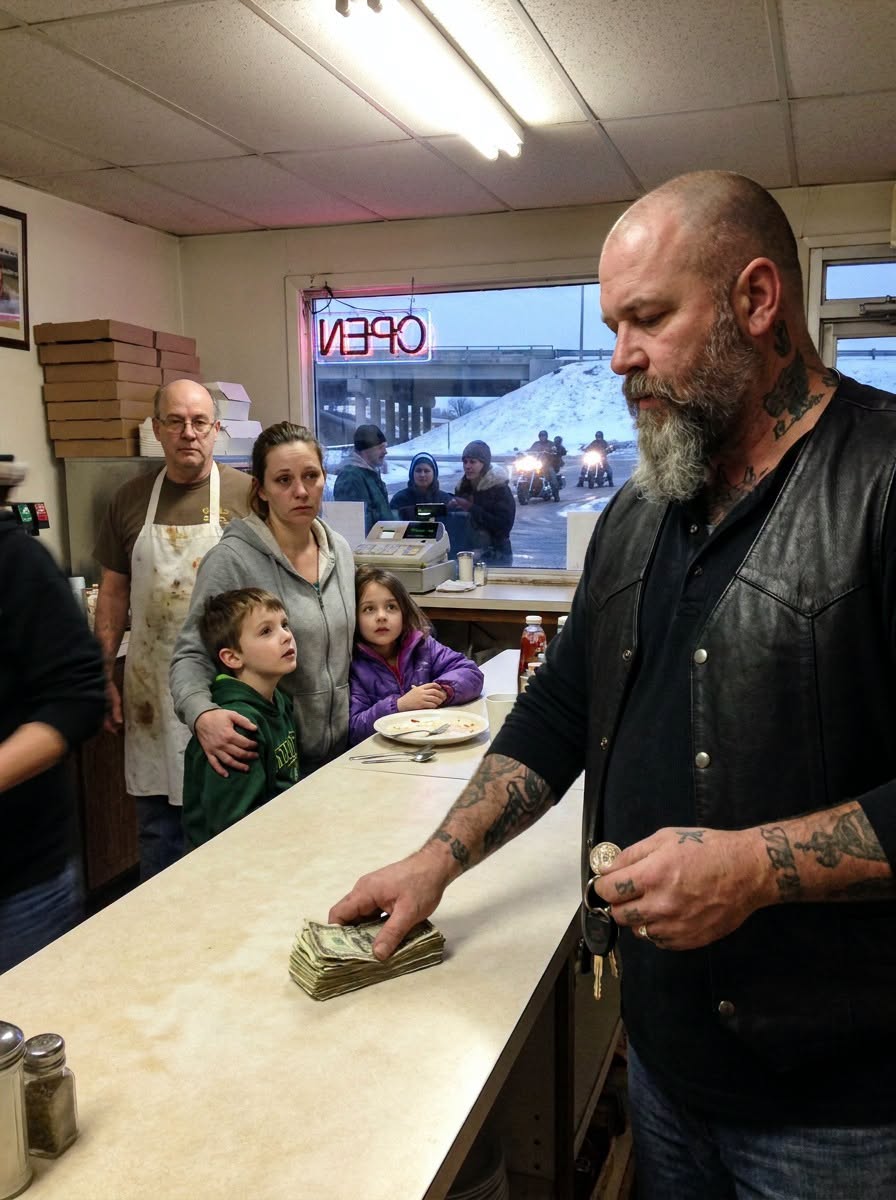
PART 3 – The Owner Shouted That His Diner Wasn’t a Charity While Two Children Stared at Empty Plates—Then a Biker Ordered Thirty Dinners and Set a Forty-Six-Year-Old Dime on the Counter.
Emily did not put the dime in her pocket.
She held it the way my children held anything that might still be taken from them: not tight enough to look greedy, tight enough to mean mine for this minute. The first boxes came through the pass-through smelling like a Thursday that had decided, late, to become decent. The two men outside took them without ceremony, four, then four more, engines low, tail-lights cutting the lot like brief red underlining.
Noah watched the window.
“They’re really taking it over there.”
“They are.”
“Will those people think it’s a trick?”
The biker—still unnamed, still larger than the room wanted him to be—answered before I could invent something gentle.
“Hungry people know food from a trick. Tricks talk more.”
The owner packed in silence now. Pride makes noise. Work, once it has been cornered by cash and witnesses, usually does not. A woman in a booth began folding paper napkins and sliding them into the boxes. No one asked her to. Kindness, when it finally moves, often looks like extra napkins.
I stood because sitting had begun to feel like hiding.
“At least tell me what to call you.”
He wiped his hand on his jeans as if a name were something you should offer clean.
“Ray Dawson. People who’ve known me too long say Hammer. You can use Ray.”
Noah repeated it under his breath, filing it where boys keep the names of men who do not shout.
Emily opened her palm and showed him the dime as if he might have forgotten he had given a child a piece of his history.
“You said I could decide.”
“I did.”
She looked at the window, at the dark stitching of coats beneath the overpass, then at the remaining boxes.
“It should go with the food,” she said. “So they know it isn’t only dinner. It’s… remembered.”
Ray’s mouth changed, not into a smile so much as into the shape a face makes when a child has understood more than the adults budgeted for.
He took the dime from her, walked it to the first open box of the next run, and set it on the napkin inside as if placing a stone on a grave that had waited forty-six years for a warmer marker.
“The night my mother sat here,” he said, and this time the diner was allowed to hear it, “the man behind the counter told her a kitchen wasn’t a church. She paid what she could. He kept the rest of his voice. We walked out with this dime and a girl too proud to cry in the lot. I was nine. I thought the shame was the meal we didn’t finish. Took me years to understand the shame was the room that watched and called it business.”
He closed the lid.
“I kept the coin so I wouldn’t get good at watching.”
The owner’s hands had gone still on the counter. Whatever speech he had left was the wrong size for the air. He looked at my children, then at the window, then at the line of bills that had turned his register into a witness.
“I didn’t know,” he said.
Ray did not offer him comfort. He did not take the apology and polish it.
“Now you do. Finish the boxes.”
They did.
Thirty. Counted, stacked, carried into a cold that had no opinion about Route 66 or leather or a woman who had been six dollars short. I went as far as the door and no farther. Some deliveries are not yours to complete. From the threshold I saw a man accept a box with both hands, as if heat were a thing that could be dropped. I saw the woman in the thin coat look at the dime when the lid lifted, confused, then very still. I did not hear what was said to her. I did not need to.
When Ray came back, the counter was empty of money and full of the ordinary wreckage of a diner that would open again tomorrow and pretend it had always known how to feed people.
Emily tugged his vest, once.
“Are you somebody’s dad?”
He thought about that longer than the question seemed to require.
“Not the way I should’ve been, for a while. Trying anyway.”
Noah, practical as rent, asked the question I would not.
“Will that man be nicer now?”
Ray glanced at the owner, who was wiping a clean counter as if cleanliness could pass for repair.
“Maybe. Maybe he just learned how loud he sounds. Either one is a start.”
He nodded to me the way men nod when they will not survive a thank-you.
“You counted your money,” he said. “The shortfall wasn’t your character. Don’t let a room talk you out of that.”
Then he was gone: engine, dust, the road taking back what it had briefly loaned us.
We finished what was on the plate because wasting it would have been another kind of listening to the wrong voice. Emily drew a dime on the back of a paper placemat and put wings on it that no coin has ever earned. Noah said Ray’s name once more, quietly, like a fact he intended to keep.
Outside, under the overpass, steam lifted from open boxes into the Arizona night.
Inside, the Desert Lantern remembered—against its will, and then perhaps not against it—that a kitchen can be a church if the people in it decide the hungry are not a story to shout down.
I paid nothing extra. I owed everything extra.
Some debts you do not settle at a register.
You settle them the next time a room goes quiet, and you are the one with a voice.
THE END