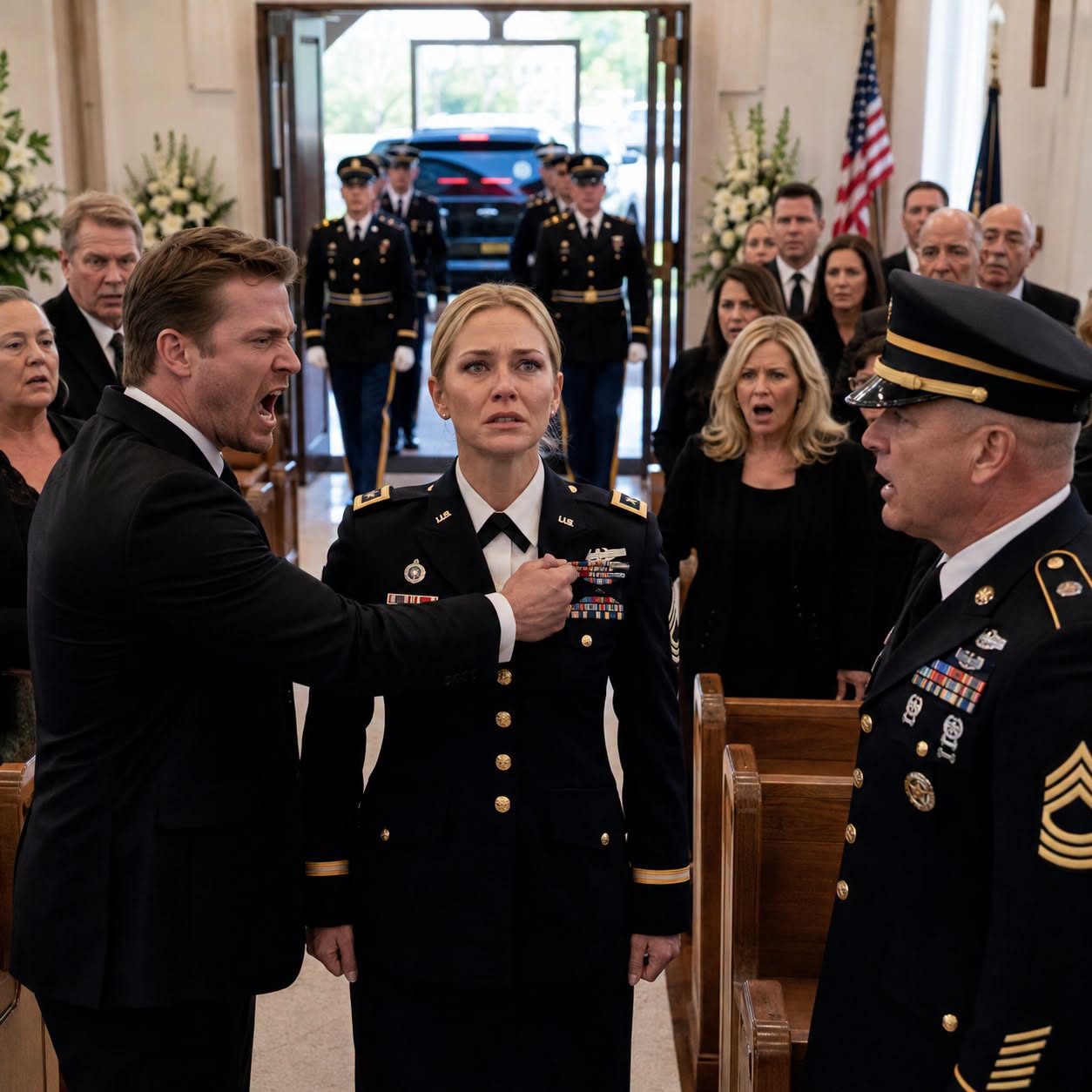
PART 3 – “Take Off That Costume—Grandpa’s Dead.” My Brother Ripped the Silver Star Off My Uniform in Front of Two Hundred Mourners. Then a Black Suburban Arrived, and a Sergeant Major Asked Who Touched Me.
Reyes did not perform it.
There was no extra breath for the room to enjoy. He turned the case, and the Distinguished Service Cross lay on dark velvet the way certain truths lie when they have waited too long for an honest table: unornamented, official, finished with other people’s opinions.
A few people knew the shape. Most only knew that it was not a thing you ordered online between shifts. Uncle Ray sat down without looking for a chair first. Jenna’s phone lowered an inch, then stayed where it was, because some records are not for triumph. They are for accuracy.
Derek stared as if the metal might confess a trick if he watched hard enough.
Reyes took out the citation and read it the way men read orders: without decorating the dead or the living.
He did not give the hall a movie. He gave it the necessary bones. A vehicle down. Wounded who would not last the wait. A medic who went back when going back had already been priced. A shoulder that would never again pretend it had not been asked too much. Names I still would not spend in a fellowship hall over ham and sheet cake.
When he finished, the quiet was different from the quiet Derek had made. That one had been spectacle. This one had weight.
Reyes lifted the Cross.
“The Army does not ask your brother whether this happened,” he said, not unkindly, which made it final. “It happened. The paperwork happened. Your grandfather asked only that the naming happen here, among people who had been given years to ask her themselves and chose a smaller story instead.”
He stepped toward me.
I could have let him pin it over the torn threads and give the camera a perfect frame. I didn’t. I took it in my hands. The jacket could be repaired. Some repairs are better done without an audience.
“Thank you, Sergeant Major.”
Reyes nodded once.
“Your grandfather called my office after your last deployment. He said he was proud, and that pride in his family had become a noisy household. He asked if the Army could spare one afternoon when he was gone, so the noise would have to stand next to the record. I told him we could.”
He looked then at my mother.
“Ma’am. He also asked me to say he never was embarrassed by her. He was embarrassed by the rooms that required her to shrink so a louder child could stay comfortable.”
Mother’s mouth opened. For a long second I thought she would choose the old peace, the one that had cost me years.
“Walter told me,” she whispered. “I didn’t want a war in my house. So I let the wrong one keep talking.”
It was late. It was still a sentence. I did not hand her a full pardon in front of two hundred people. I also did not use the Cross as a blade. Grandpa had not asked for that.
Derek’s voice came back small.
“You could have said. All those years. You let me look like—”
“You looked like yourself,” I said. “I let you. That was my mistake. It is not the same as a lie.”
Susan Bell closed her folder an inch, enough to remind the air that there was still an estate, and that it would not be conducted by the man who had made a medal into theater.
“Walter named Maya executor,” she said, level. “He named her because she paid the store’s taxes the year he was in the hospital and did not advertise it. The meeting is this afternoon. You may attend. You will not preside.”
Derek looked at the camera. At Jenna. At the ribbon he had dropped. The smile he needed did not return. Bourbon and peppermint are a poor rank structure.
Reyes shut the empty case.
“Staff Sergeant. The torn Silver Star will be replaced through channels. Keep both. One is the work. One is the afternoon the work had to be defended in a church.”
He glanced at Derek a last time.
“If I were you, I would spend the rest of this memorial remembering the man in the casket, not the argument you lost to a citation.”
The Suburban took him back as cleanly as it had arrived. The hall did not recover into chatter so much as leak into it, shame finding corners, cake being eaten because people need their hands busy after they have been seen.
I pinned nothing on in that room. I put the Cross in the case’s memory and the torn star in my pocket, against the invoice in my jacket where Grandpa had written that people can survive the truth.
Jenna bumped my good shoulder.
“Still want syrup on him?”
“No,” I said. “He’s already sticky.”
Mother came to stand near me and did not ask to hold the medal. That, too, was a kind of beginning.
Noah would have asked if the loud man would be nicer now. I did not have a nephew in that hall. I had a brother who had been given a record he could not tear. Whether he became better was no longer work I would do for him.
Outside, the gravel remembered the Suburban. Inside, the camera kept its red eye a little longer, then went dark.
I finished the afternoon the way Grandpa would have wanted it finished: by speaking his name, not mine, and by leaving the hardware-store flag in the slideshow where it belonged.
The costume, as Derek had called it, went home on my back.
It had always been the only honest thing I wore in that family.
THE END