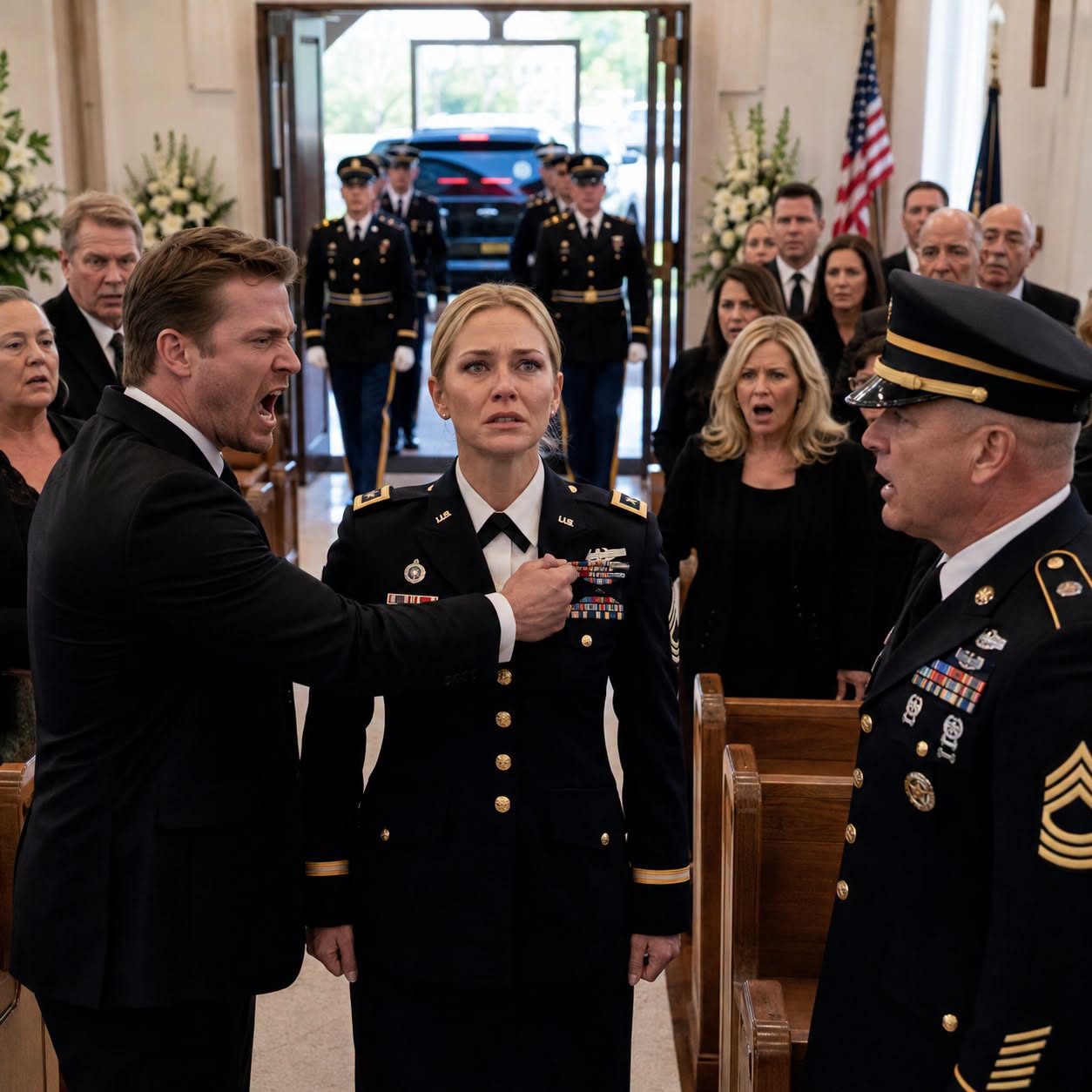
PART 2 – “Take Off That Costume—Grandpa’s Dead.” My Brother Ripped the Silver Star Off My Uniform in Front of Two Hundred Mourners. Then a Black Suburban Arrived, and a Sergeant Major Asked Who Touched Me.
Reyes did not repeat the question.
He did not need to. Rank has a way of making silence do the work. The fellowship hall, which had been so willing to host my brother’s voice, discovered it had a ceiling after all.
Derek still held the torn ribbon as if letting go would constitute a confession. Mustard shone on a paper plate behind him. The coffee stain on the tablecloth had dried into the shape of a continent no one would claim.
“I asked,” Reyes said, milder now, which was worse, “who put hands on that decoration.”
Jenna’s phone stayed up. The church camera’s red light, small as a wound, kept its vigil. My mother had not moved from the chair she was using as a shield.
Derek found a laugh. It came out thinner than the one he had used on me.
“This is a family matter.”
Reyes looked at the torn threads on my jacket, then at the medal in my hand, then at Derek’s navy sleeve, where no service lived.
“A Silver Star is not a family souvenir. It is a federal decoration. You removed it from a soldier in uniform at a memorial service. That is not a disagreement over cake.”
Uncle Ray made a sound and swallowed it. Someone near the kitchen door whispered sergeant major as if the words themselves might restore order.
I could have ended it there. I had ended worse rooms with less. Instead I set the medal on the table beside the stained cloth, face up, so the room would have to keep looking at what it had allowed.
“He pulled it off me,” I said. “In front of everyone. After he called my service a costume.”
Derek’s face flushed in patches.
“She’s been playing soldier since she left. Grandpa knew it. He was embarrassed—”
“Do not,” I said, and the quiet in my voice was the one I used when a wound was still deciding whether to bleed, “put words in a dead man’s mouth to make yourself taller.”
Mother flinched. Still no sentence. Grief had taken her voice and given it, for years, to the louder child.
Reyes stepped closer to the table. The presentation case in his left hand was dark leather, closed, official in a way my brother’s accusations had never been. He did not open it yet. He let the weight of it exist.
“Staff Sergeant Whitfield,” he said, using the rank Derek had spent a decade sanding down to a joke, “you were not informed we were coming. That was by design. Your grandfather requested the timing. He wanted it done among the people who knew him—and, I was told, among the people who had not always known you.”
Derek blinked.
“Grandpa requested—?”
Susan Bell, who had been standing near the coat rack with the composure of a woman who files truths for a living, spoke for the first time.
“Walter amended his arrangements three months ago. The Army’s piece was meant to follow the eulogy. The legal piece was meant to follow that. Nobody asked you to handle either, Derek. You appointed yourself.”
The smile he had worn like a second suit came apart at a seam.
He turned on me.
“You and the lawyer. Of course. The good daughter. The hero. You couldn’t let me have one day.”
“You tore a medal off my chest in a church,” I said. “You had the day. You spent it.”
Reyes set the case on the table. The sound it made was softer than the Silver Star hitting marble and somehow louder. Two hundred people leaned without admitting they were leaning.
“I did not drive here to referee an inheritance,” Reyes said. “I drove here because the Army does not leave a citation in a drawer when the man who asked for the reading has been buried. And because a command sergeant major does not watch a soldier’s decoration thrown on a floor and call it family business.”
He looked at Derek.
“You will put the ribbon down.”
Derek’s fingers tightened, a child’s reflex in a grown man’s hand.
“Or what? You’ll arrest me at a funeral?”
Reyes’s gaze did not rise in heat. It settled.
“I will finish what I came to finish. After that, what happens to you is a matter of record, cameras, and whether this congregation prefers a scene or a standard.”
Jenna, without lowering the phone, said, “There are three records already.”
Derek glanced up then. Found the church camera. Found Jenna. Found, too late, that rooms keep receipts.
His hand opened.
The torn ribbon dropped beside the star.
Reyes unlatched the case.
The lid lifted.
Whatever was inside caught the fellowship-hall light and sent it back changed. My mother made a sound then, small and late. Derek stared as if the contents had arrived from a country he had refused to believe in.
Reyes did not look at him.
He looked at me.
“Staff Sergeant Maya Whitfield,” he said, and the hall, at last, arranged itself around the correct name, “your grandfather asked that this not wait for a parade ground you would never request. He asked that the people who doubted the work be present when the work was named.”
He turned the open case so the room could see.
And even Derek, who had never learned how to be quiet when a truth entered, found that he had no language left for what was lying there.
TO BE CONTINUE…