“Take Off That Costume—Grandpa’s Dead.” My Brother Ripped the Silver Star Off My Uniform in Front of Two Hundred Mourners. Then a Black Suburban Arrived, and a Sergeant Major Asked Who Touched Me.
The medal made a small sound when it hit the floor.
That was the part I would remember later with a kind of professional clarity: not the shout, not the two hundred faces turning as if grief had become a spectator sport, but the single metallic click against church marble. A Silver Star is not heavy. Shame is. The room chose the wrong one to flinch from.
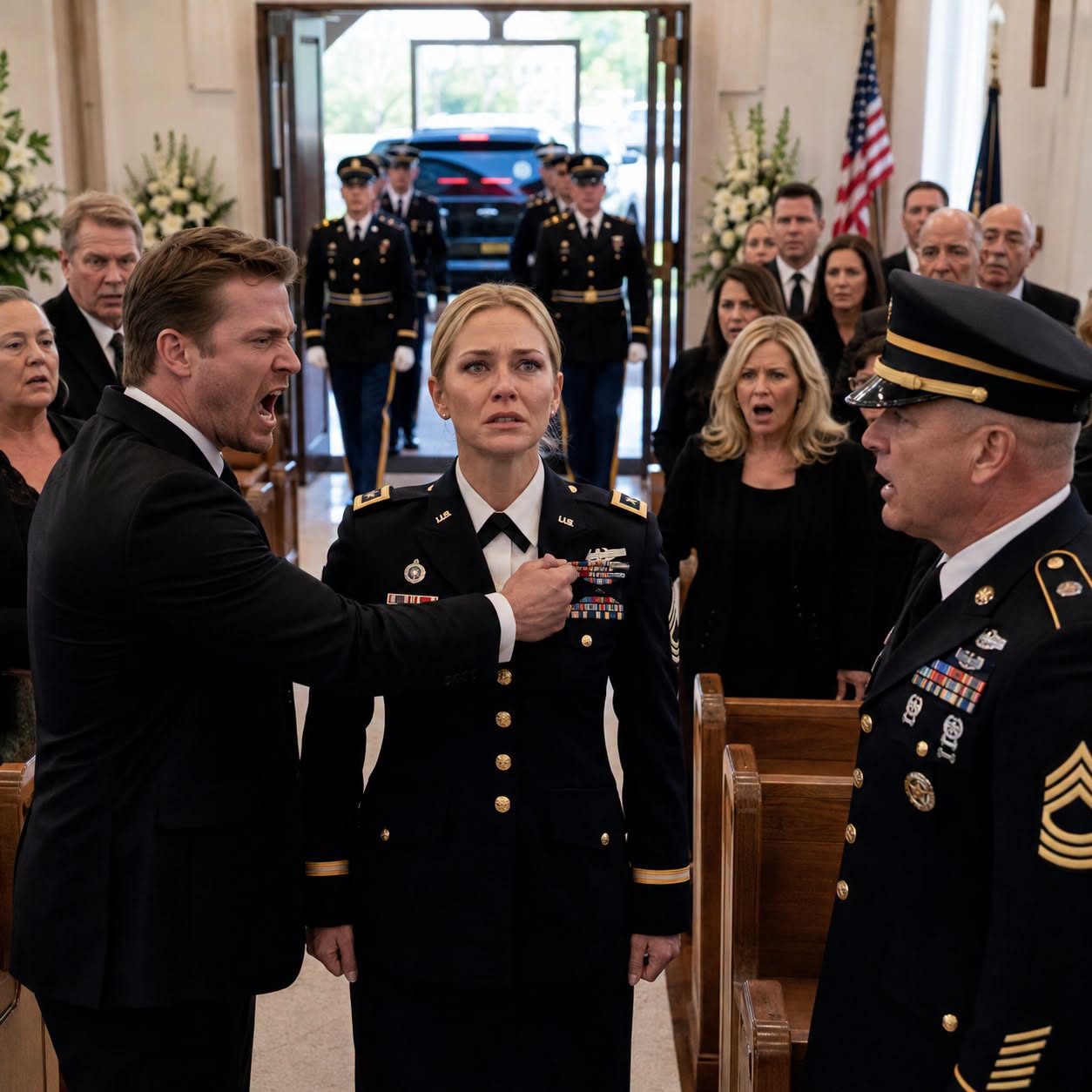
“Take off that costume, Maya. Grandpa’s dead. You can stop performing now.”
Derek said it by the coffee urn, loud enough to colonize the fellowship hall. Then his hand was on my jacket, and the thread gave with a sound too intimate for an audience. He held the torn ribbon up the way men hold evidence when they have already written the verdict.
“This thing is fake. She’s been lying to all of you for twelve years.”
A few relatives offered those thin laughs people use when they hope a scene will remain entertainment.
My mother whispered his name.
She did not tell him to stop.
That was the quieter tear.
I had worn the uniform for Walter Whitfield, who sold screws and furnace filters on Fifth Street for forty-one years and swept his own sidewalk as if dignity were a daily inventory. He had been the only person at our kitchen table who stood when I said I was enlisting. Mother cried into a dish towel. Father found the meatloaf suddenly complex. Derek leaned back and promised I would not last eight weeks.
Grandpa came around the table and put his hardware-store arms around me.
“Do the work,” he said. “Let loud people spend themselves.”
I did the work.
Fourteen years. Two deployments. Combat medic. Staff sergeant. A shoulder rebuilt by hands kinder than the blast that made the work necessary. Scars I kept under cloth. A Silver Star I treated like a private document.
Derek had spent those years arranging rooms around a smaller story: that I stocked shelves on a base, that I invented danger because I liked the shape of attention. I let him. Not from weakness. From a belief that certain truths are not owed to men who would only use them as furniture.
Jenna Cho never accepted that math. She flew in without being invited, appeared in my doorway with coffee, looked at the jacket, and said the thing friends say when they are tired of watching you absorb the weather.
“Derek starts things. You keep finishing them with your silence.”
I almost wore a black dress.
Then I found Grandpa’s last note, written on the back of a yellow invoice from the store.
Wear what you earned. People can survive the truth.
So I wore it.
The service was hymns and folding fans and a slideshow of a man holding trout, mending porch rails, standing under a flag that had faded the honest way. I gave the eulogy and kept Korea out of it. Some rooms are not built for the whole inventory of a life. I made it through. Then the reception began, and people told my mother he was in a better place, as if death were a change of address with better parking.
Derek arrived late, navy suit tight across the shoulders, bourbon keeping a secret under peppermint. He had spent the week telling anyone who would listen that he was handling the estate. He was not. Susan Bell, Grandpa’s attorney, had already called me twice and asked me not to mention it. Secrets make reckless men louder.
He started at the dessert table. Medals bought online. Then Uncle Ray and the claim that Grandpa had been embarrassed by me.
I set down my coffee.
“Stop using him to insult me.”
He turned, pleased, a man who had finally received the order he placed.
“Or what?”
“Or this room learns why he stopped letting you into the store office.”
The smile slipped. Only a fraction. Then he tapped the star on my chest as if it were a dare I had pinned there for him.
“You really want to do this?”
“No,” I said. “You do.”
The rip.
The freeze.
Training does odd work in a body. Mine goes quiet. I saw his thumb on the ribbon. My mother’s hand on a chair back. The small red eye of the church camera, recording without opinion. Derek had not noticed it.
Jenna had. Her phone was already up.
He held the medal toward the hall.
“Tell them where you bought it.”
I picked it up. My hands were steady. That, too, was training.
“You just put your hands on a soldier at a veteran’s memorial,” Jenna said.
Derek laughed. “Call the Pentagon.”
Tires on gravel answered before I could.
A black Suburban settled beside the church steps as if it had been given the address by someone who did not misspeak. Two soldiers first. Then Command Sergeant Major Otis Reyes, dress blues, silver at the temples, a sealed presentation case in his hands. I had not seen him in three years. Derek had never seen him at all.
Reyes took in the torn threads on my jacket. The medal in my palm. The room that had chosen a brother’s voice over a dead man’s request.
When he spoke, the fellowship hall learned what volume sounded like when it did not need to shout.
“Which one of you,” he said, “put hands on Staff Sergeant Whitfield’s Silver Star?”
No one moved.
Reyes did not look at the torn ribbon as if it were the end of the matter.
He looked at it as if it were only the first thing that would have to be answered.
TO BE CONTINUE…