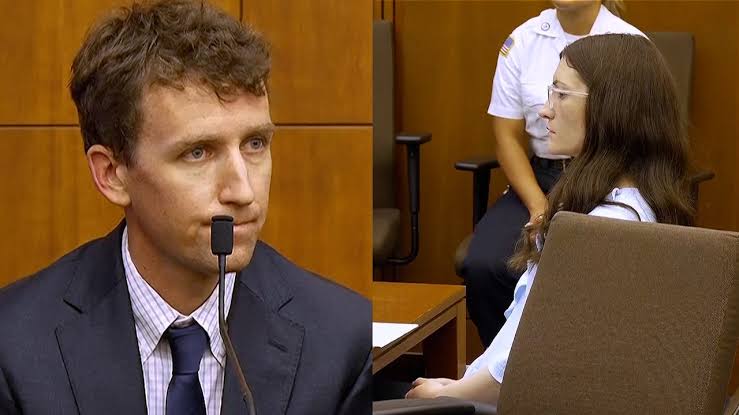
Dissecting the “Lurking Stranger” Myth in the Lindsay Clancy Case
In the digital landscape surrounding high-profile criminal trials, the boundary between journalistic reporting and online exploitation frequently collapses. Few recent cases illustrate this breakdown as starkly as the legal proceedings against Lindsay Clancy, the former Duxbury, Massachusetts nurse charged in connection with the January 2023 deaths of her three young children, Cora, Dawson, and Callan. While Plymouth Superior Court remains focused on complex psychiatric evaluations and the statutory parameters of legal sanity, a parallel ecosystem of sensationalized clickbait continues to churn out fabricated narratives. Among the most pervasive of these hoaxes are viral posts alleging that newly restored surveillance footage revealed a “creepy silhouette” or “lurking stranger” watching the children moments before the tragedy.
These claims, usually paired with urgent prompts directing users to click external links for “leaked video reveals,” are entirely baseless. A systematic review of court filings, state police forensic extractions, and sworn evidentiary testimony confirms that no third-party intruder ever existed. Examining how this specific myth was manufactured offers a sobering look at how bad-actor digital networks monetize human tragedy by distorting routine legal proceedings into sensationalized internet fiction.
The Verifiable Evidentiary Record vs. Digital Invention
The argument that a hidden figure or third-party actor was present at the Clancy residence on Summer Street contradicts the foundational facts established by state and local law enforcement. On January 24, 2023, the timeline of events was meticulously documented through physical evidence, digital telemetry, and business surveillance systems across Duxbury and neighboring municipalities.
According to unsealed court records and evidentiary hearings:
-
Outdoor Activity: In the early afternoon, Lindsay Clancy took her children outside to play in the snow, capturing ordinary family photographs on her mobile device and transmitting them to relatives.
-
Routine Errands: Later that afternoon, she arranged for her husband, Patrick Clancy, to leave the home briefly to pick up dinner from a local restaurant in Plymouth and prescription medication from a pharmacy in Kingston.
-
Location Verification: Commercial security cameras at both retail establishments, combined with GPS tracking data from Patrick’s vehicle and cell tower handoffs, verified his exact route and confirmed he was away from the home for approximately fifty minutes.
-
Scene Discovery: Upon returning at approximately 6:09 PM, Patrick discovered his wife outside following a severe fall from a second-story window and immediately dialled 911, bringing emergency responders to the scene within minutes.
Massachusetts State Police crime scene analysts and digital forensics units conducted exhaustive sweeps of the property. Neighboring security cameras, including Ring doorbell units on Summer Street, were fully audited. Forensic extractions of all household laptops, mobile devices, and cloud storage accounts yielded no evidence of unauthorized security cameras, compromised video feeds, or third-party presence. The legal record is absolute: the house was secure, and no external intruder played any role in the event.
Deconstructing the Clickbait Funnel
If the physical and digital evidence definitively disproves the presence of a “lurking stranger,” why do these headlines continue to circulate across social media feeds? The answer lies in the economic architecture of modern clickbait publishing.
Viral content networks operate by identifying high-volume search topics—such as the Lindsay Clancy trial—and generating sensational headlines designed to bypass critical thinking and trigger emotional curiosity. These posts rely on a predictable set of stylistic tactics:
-
Dramatic Suspense: Using words like “CHILLING,” “CREEPY SILHOUETTE,” and “SAVAGE BREAKDOWN” to create a false sense of horror-movie intrigue.
-
The Unfinished Narrative: Ending the headline on a cliffhanger (“was actually…”) to compel the reader to take an action.
-
Deceptive Call-to-Action: Directing users to a link that promises exclusive, leaked, or restored footage.
When a user clicks the link, they are rarely presented with legitimate reporting. Instead, the URL redirects through multiple domain hops designed to maximize programmatic advertising revenue, harvest personal user data, or prompt the download of potentially harmful software. The “lurking stranger” is simply a narrative hook—a phantom created solely to drive traffic to ad-monetized landing pages.
The Legal and Human Costs of Viral Misinformation
While clickbait operators view these headlines as harmless engagement tools, their real-world consequences are severe. Within the judicial system, the saturation of public discourse with fake evidence undermines the integrity of trial proceedings and complicates jury selection.
When prospective jurors are exposed to persistent rumors regarding “suppressed footage” or “hidden intruders,” it creates a skewed perception of the case that judges must painstakingly filter out during voir dire. Under Massachusetts law, the trial of Lindsay Clancy hinges entirely on the standard of criminal irresponsibility established in Commonwealth v. McHoul. The central question before the court is whether the defendant was suffering from severe postpartum psychosis that deprived her of the substantial capacity to appreciate the wrongfulness of her actions or conform her conduct to the law. Fabricated intruder stories distract from the genuine, highly complex medical and legal evaluations at the heart of the prosecution.
Furthermore, the human cost inflicted upon surviving family members is profound. For Patrick Clancy and his extended family, the process of grieving the loss of three young children is repeatedly disrupted by viral campaigns that invent sinister conspiracies about their home. By turning a profound family tragedy into sensationalized entertainment, online networks inflict ongoing distress on those left behind.
Reclaiming Fact in the Age of Digital Noise
The prosecution of Lindsay Clancy represents one of the most painful and complex legal matters in recent Massachusetts history, raising crucial questions about maternal mental health, clinical diagnostics, and statutory accountability. These solemn issues require careful, fact-based reporting grounded in authentic courtroom submissions and verified scientific evidence.