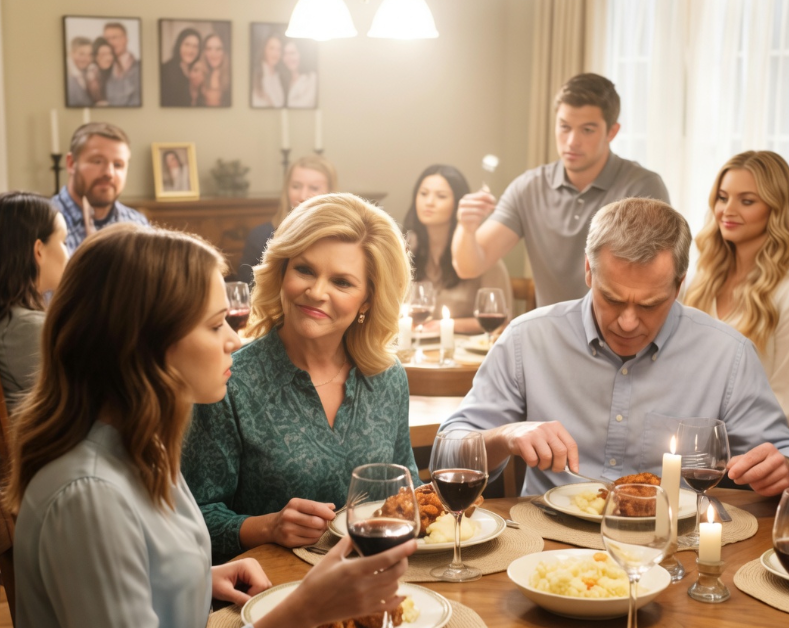
Mom—Denise, though I’ve called her “mom” since I was eight years old—let a quiet laugh slide into her wine glass and said, “You’re not part of this family.” “
The air in the dining room in Carmel, Indiana, usually smelled of expensive beeswax candles and Denise’s signature pot roast, but tonight it smelled of fried chicken and an impending storm. Twenty relatives sat around the mahogany table, a sea of cousins, aunts, and family friends who had gathered to celebrate my father’s sixty-fifth birthday. But as the plates were cleared and the Chardonnay continued to flow, the celebration shifted.
Tyler, my younger half-brother, leaned back in his chair with the practiced ease of a man who had never known a day of true financial precarity. His fiancée, Rachel, sat beside him, already practicing the serene smile of a woman who had just married into “good stock.”
Then Denise, my stepmother—though she had been “Mom” to me since I was eight—reached for a blue folder she had tucked beside her chair. Her eyes were bright, polished by the wine and the intoxicating power of being the center of attention.
“Before we have dessert,” Denise announced, her voice ringing with a melodic authority, “Howard and I have an announcement. We’ve decided that for Tyler and Rachel’s wedding gift, we are officially transferring the title of the lake cabin to them. We want to ensure the estate stays within the next generation of this family.”
The room erupted in applause. The cabin on Lake Wawasee was the crown jewel of the family’s modest “legacy”—a place of summer memories, motorboats, and golden sunsets.
I didn’t clap. I sat with my hands folded in my lap, feeling a cold, hard knot form in my stomach. I looked at my father, Howard. He looked tired. Not just sixty-five-years-old tired, but a deep, structural fatigue that seemed to pull at the corners of his eyes.
I put down my fork. The silver clattered against the china, a sharp, dissonant note in the harmony.
“Do you really think it’s the right time to give Tyler the cabin?” I asked. My voice was quiet, but it sliced through the cheering like a razor. “The mortgage on this house is still three years from being paid off, and Dad’s rehab bills from the bypass last year haven’t been settled. Shouldn’t we be looking at liquidity before we start gifting real estate?”
The silence that followed was vacuum-sealed. Rachel’s smile vanished. Tyler rolled his eyes, a theatrical gesture of sibling annoyance.
“Oh, for God’s sake, Emma,” Tyler groaned. “Don’t be such a bean counter. The cabin is family owned. It stays in the family.”
“Use family money to keep it, then,” I countered, my gaze fixed on him.
Denise folded her napkin with deliberate, terrifying accuracy. She smoothed the linen against the table, her rings catching the light. She looked at me not with anger, but with a condescending pity that was far worse. She let a quiet, sharp laugh slide into her wine glass.
“Oh, my darling,” Denise said, her voice dropping into a register of silk and steel. “You’re not part of this family.”
The room went into a state of suspended animation. A fork hovered over mashed potatoes. A cousin stopped mid-sip. The words hung in the air, radioactive and undeniable.
At thirty-two, I was suddenly fourteen again. I was the “extra” child from Dad’s first marriage, the girl whose mother had died young and whose father had remarried a woman who viewed me as a structural necessity rather than a daughter. Denise had been “kind” for twenty-four years, but it was the kindness of a landlord toward a long-term tenant. You are welcome as long as you pay your way and don’t rearrange the furniture.
But the irony—the burning, white-hot irony—was that I had been paying the rent.
For nineteen months, I had been the invisible pillar holding up this house. Three thousand dollars a month, sometimes four. When Tyler’s custom woodworking shop collapsed due to “market fluctuations” (which was code for him buying a new truck instead of paying his suppliers), I sent the money to Denise. When Dad’s medications spiked after his surgery and the insurance company balked, I sent the money. Denise’s emails were always urgent, always punctuated with “Don’t tell your father, Emma. His pride couldn’t handle knowing he can’t provide. You know how he is.”
I looked at Denise. The mask was off. She had finally said the thing she had been thinking since she walked down the aisle with my father.
I raised my glass of water. My hand was perfectly steady.
“Perfect,” I said. “Don’t ask me for money then.”
Dad’s brow furrowed. He looked between us, his face a map of confusion. “What money? Emma, what are you talking about?”
Denise’s face went the color of unbaked dough. She tried to reach for the blue folder, to reclaim the narrative, but she was too slow.
I pulled out my phone. My thumb moved with clinical efficiency. I opened my banking app, pulled up the recurring transfers, and turned the screen toward the table.
“The three thousand dollars I’ve been sending to Denise every month,” I said, my voice echoing in the dead air. “For this house. For your cardiac rehab. For Tyler’s ‘business expenses.’ Since I’m not part of the family, I assume the family has its own resources. I’m cancelling the transfer for next month. Starting now.”
The silence wasn’t just quiet; it was a physical weight.
“Emma,” Dad whispered. He wasn’t looking at me. He was looking at Denise. The way he looked at her… I knew the scariest part of the night wasn’t what she had said to me. It was the realization that he had never known. He thought he was solvent. He thought he was a patriarch. He didn’t know his wife had been running a shadow economy on the back of the daughter she just disowned.
I didn’t stay for dessert. I walked out of that house in Carmel, drove back to my apartment in the city, and slept for twelve hours. It was the best sleep of my life.
The next morning, at 7:00 AM, the knocking began. It wasn’t the frantic pounding of Denise or the entitled thud of Tyler. It was a slow, heavy rhythm.
I opened the door to find my father. He held two coffees from the supermarket in cardboard sleeves. He looked like he had aged ten years in the last ten hours. The crispness of his birthday suit from the night before was gone; he was in a wrinkled flannel shirt and jeans.
“I need the truth,” he said, before I could even say hello. “I need the whole truth, Emma. Every cent.”
I stepped aside and let him in. We sat at my small kitchen table, and I pulled up the spreadsheets. I am a CPA by trade; I don’t do anything without a paper trail. I showed him the emails from Denise.
Emma, the property tax bill came in higher than expected. Please, I don’t want to worry Howard. Emma, Tyler needs a bridge loan for his rent. He’s so close to a breakthrough. Family helps family, right? Emma, the pharmacy bill was $900 this month. Just this once?
My father read them in silence. His hands shook slightly as he scrolled through two years of manipulation. He saw the dates. He saw the amounts. He saw how I had spent my entire bonus from the previous year to pay off a lien Denise had hidden from him.
“She told me we were fine,” Howard whispered. “She told me the investments had rebounded. She said Tyler was finally standing on his own feet.”
“He isn’t,” I said gently. “And you weren’t. But you could have been, Dad. If we had sold the cabin two years ago like I suggested, you would have been debt-free. But Denise wouldn’t hear of it. She wanted the image. The legacy.”
Dad looked up at me, his eyes red-rimmed. “Why didn’t you tell me? Why did you let her do this?”
“Because I wanted to belong,” I admitted. The words tasted like ash. “I thought if I was the one who saved everything, I would finally be ‘real.’ I thought if I carried the weight, I wouldn’t be the ‘extra’ child anymore. I was buying my way into a family that didn’t exist.”
He reached across the table and took my hand. His grip was rough and calloused. “You were never the extra, Emma. Not to me. I was just… I was a fool. I let her handle the books because I was tired of failing.”
“You didn’t fail, Dad. You got sick. Life happened. But Denise turned your life into a stage play where I was the stagehand and Tyler was the lead actor.”
He stood up, his coffee untouched and cold. “I’m going back to the house. I’m taking the blue folder. And I’m calling a realtor.”
“What about Tyler?” I asked.
“Tyler can learn what a mortgage feels like,” Dad said. He paused at the door, looking back at my apartment—a small, clean space that I owned, entirely on my own. “I’m sorry, Emma. For everything. For the last twenty years of quiet ‘kindness’ that wasn’t kindness at all.”
The fallout was a slow-motion demolition.
The cabin was listed three days later. Denise threw a tantrum that reportedly involved throwing a Waterford crystal vase at the fireplace, but my father didn’t budge. For the first time in their marriage, he took the checkbook back.
Tyler called me once, screaming. He called me a “traitor,” a “cold-hearted bitch,” and claimed I was ruining his life just as it was starting. I listened to him for exactly thirty seconds before I spoke.
“Tyler,” I said, my voice as flat as a Midwestern highway. “The ‘life’ you were starting was built on my labor. If you want a cabin, go buy one. Oh wait, you can’t, because you don’t have a job. Maybe focus on that.”
I hung up and blocked his number.
Rachel broke off the engagement two weeks later. It turned out she wasn’t interested in marrying into a “good family” that lived in a house with a looming foreclosure and no lake house to retreat to in July.
Denise stayed, mostly because she had nowhere else to go and no money of her own. But the dynamic had shifted. My father moved into the guest room. They live in a polite, frigid silence. He pays the bills now. He sees the numbers.
As for me, I stopped sending the money.
With the extra three thousand dollars a month, I started a college fund for my cousin’s kids—the ones who had actually been kind to me. I took a trip to Italy. I bought a car that didn’t make a grinding noise when I hit sixty.
But the real change was internal. The “fourteen-year-old girl” who lived inside my chest, the one who was always looking for a seat at the table, finally grew up. She realized that the table was crowded, the food was mediocre, and the company was toxic.
Six months after the birthday party, my father invited me to dinner. Just the two of us. At a small diner halfway between Carmel and my apartment.
We ate burgers and drank bad coffee. We talked about his physical therapy, about a book I was reading, about the weather. We didn’t talk about Denise. We didn’t talk about Tyler.
When the bill came, I reached for it out of habit.
My father took it out of my hand. He smiled, a genuine, weary, but honest smile.
“I’ve got this, Emma,” he said. “I’m taking care of my family.”
I looked at him, and for the first time in my life, I didn’t feel like a “grateful addition.” I felt like a daughter. And I realized that “belonging” isn’t something you can buy, and it certainly isn’t something someone else can grant you. It’s the peace you feel when you finally stop paying for a love that was never for sale.
I walked out of the diner into the cool Indiana night, my pockets heavy with my own money and my heart light with the truth. I wasn’t part of that family—the one of folders and legacies and Chardonnay-soaked lies.
I was part of something better. I was finally part of my own life.