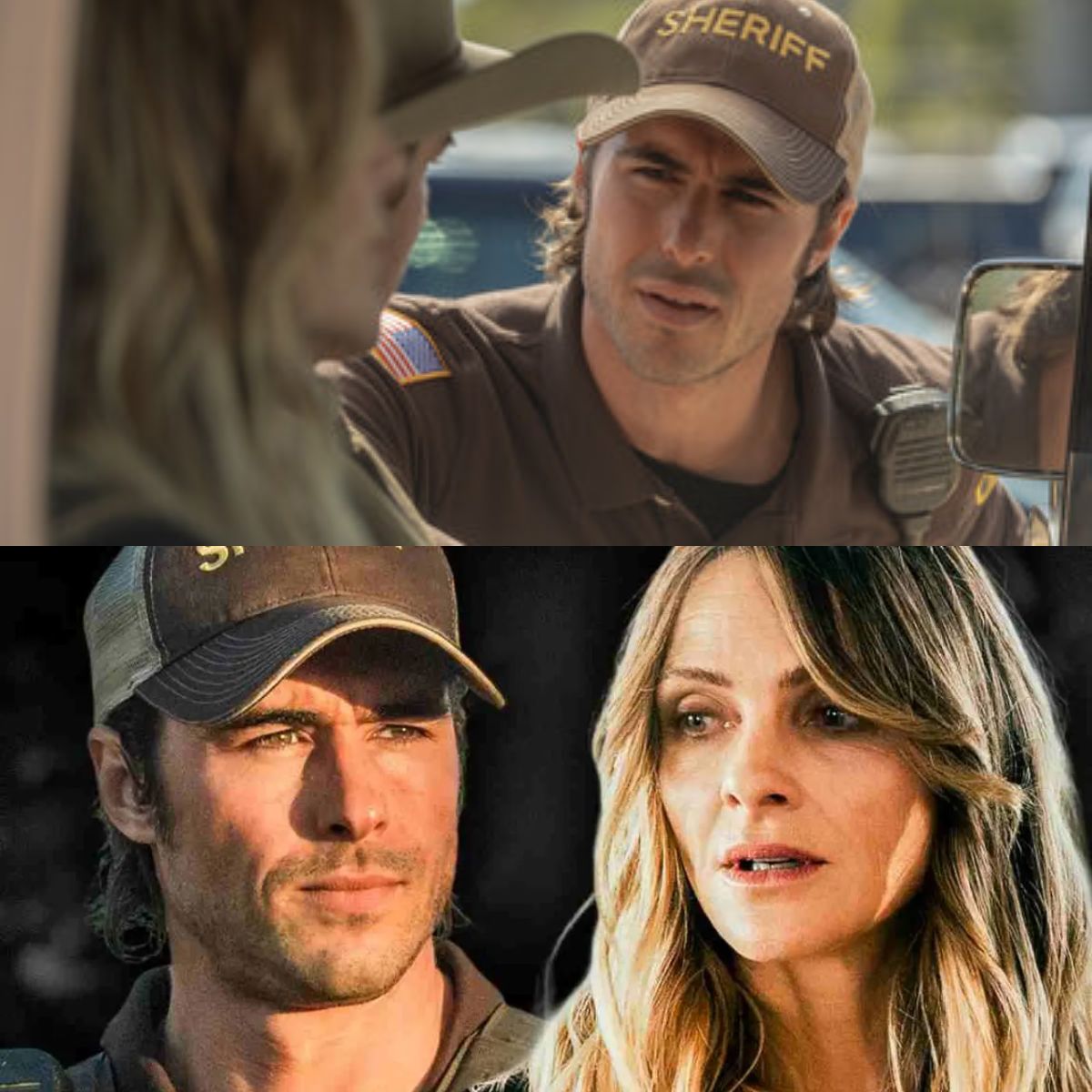
“IT DIDN’T SOUND WRONG… UNTIL IT WAS TOO LATE” Viewers can’t shake the eerie calm in Ben Schnetzer’s Van Davis—every word measured, every pause too perfect, every line delivered like it’s hiding something just beneath the surface. What first feels controlled slowly turns unsettling… like the voice was never meant to comfort, only to convince.
In the vast, windswept landscapes of Taylor Sheridan’s latest Paramount+ neo-Western drama The Madison, where grief-stricken New Yorkers clash with the rugged realities of Montana life, one performance has quietly – almost imperceptibly – begun to dominate fan discussions.
It’s not the star power of Michelle Pfeiffer or Kurt Russell. It’s not the sweeping cinematography of the Madison River Valley or the raw emotional turmoil of a family shattered by tragedy.
It’s the voice.
Specifically, the voice of Ben Schnetzer as Deputy Sheriff Van Davis – a measured, controlled, slightly off-kilter drawl that doesn’t shout for attention but lingers in your mind long after the credits roll. Fans are calling it “subtle genius,” “intentionally eerie,” and even “a masterclass in restrained menace.”
And now, with Schnetzer opening up about his painstaking process, the internet is exploding with a single chilling realization: that voice wasn’t an accident. It was engineered, layer by layer, to hint at something buried deep beneath the surface of this seemingly steady, salt-of-the-earth lawman.
“It didn’t sound wrong… until you realized it was never meant to sound right,” one viral fan post declared – a caption that has since sparked thousands of comments, rewatches, and conspiracy-style breakdowns across Reddit, TikTok, and X.
The more you listen, the more it feels… intentional. Not forced. Not exaggerated. Just held back in a way that keeps you slightly on edge, like something is being deliberately withheld. And in the world of Taylor Sheridan – where silence often speaks louder than dialogue and every character carries hidden scars – that restraint is proving to be pure storytelling gold.
From British Actor to Montana Deputy: The Making of Van Davis
Ben Schnetzer, the 36-year-old British-American actor known for chameleon-like transformations in projects like The Book Thief, Pride, Warcraft, Y: The Last Man, and 3 Body Problem, was an unexpected but brilliant choice for Van Davis, the local sheriff’s deputy in the fictional Madison County, Montana.
In The Madison, which premiered in March 2026, the Clyburn family – led by matriarch Stacy (Michelle Pfeiffer) and featuring Kurt Russell as the patriarch Preston who dies in a plane crash – flees the chaos of Manhattan to grieve and reconnect in the wilds of Montana. There, they encounter Van Davis, a widowed father of two sons (Colt and Aiden), whose quiet authority and unexpected romance with the eldest Clyburn daughter, Abby Reese (Beau Garrett), becomes one of the series’ emotional anchors.
On paper, Van seems like the quintessential Taylor Sheridan hero: stoic, capable, rooted in the land, a man who has known loss (his wife died in a tragic ATV accident) yet still offers stability to outsiders navigating their own pain.
But Schnetzer didn’t want to play the archetype. He wanted to inhabit something deeper – something that felt authentically Montanan without slipping into caricature.
In an exclusive interview with People, the actor revealed he went on “a bit of a journey” to nail the voice. He didn’t simply adopt a generic cowboy drawl. He tested multiple tones, rhythms, and cadences, searching for a sound that would subtly unsettle without ever breaking character.
He drew inspiration from Brady Jandreau’s performance in Chloé Zhao’s 2017 film The Rider – a raw, authentic portrayal of a modern-day rodeo cowboy. “It’s a very, very different sound,” Schnetzer explained, using Jandreau as an anchor while reshaping the delivery to fit Van’s guarded personality.
The result? A quieter, colder, more controlled voice – one that production insiders say Schnetzer rebuilt “from the inside out.” Every subtle shift, every measured pause, every slight flattening of emotion was deliberate. It doesn’t scream “troubled past.” It whispers it.
And once fans noticed, they couldn’t un-hear it.
The Viral Awakening: Why Fans Are Obsessed With “That Voice”
Social media has been flooded with rewatches focused solely on Van’s scenes. TikToks slow down his dialogue. Reddit threads dissect every inflection. One popular post captured the collective shiver: “It didn’t sound wrong at first. It just felt… off. Like he’s always holding something back. And now that I know Ben built it that way on purpose? Chills.”
Another fan wrote: “Not forced. Not exaggerated. Just controlled in a way that keeps you slightly on edge – like something is being held back.”
That “something” is exactly what Sheridan’s storytelling thrives on. In Yellowstone and its spin-offs, characters rarely wear their trauma on their sleeves. They bury it under duty, land, and laconic speech. Van Davis appears as the obliging public servant, the neighborly figure who helps the grieving Clyburns find their footing in unfamiliar territory. Yet his voice – that careful, restrained delivery – suggests layers the script hasn’t fully peeled back yet.
Is it the grief of losing his wife? The weight of raising two boys alone while wearing a badge? Or is there something darker simmering beneath the surface – a secret, a regret, a hint of the moral gray areas that Sheridan loves to explore in his Montana-set worlds?
Schnetzer himself has been coy in interviews, but he has confirmed the voice work was obsessive. He experimented relentlessly before cameras rolled, tweaking until it felt right for a man who “doesn’t meet a lot of people at their best moments,” as Van says in one episode.
The actor, who also attended “cowboy camp” with co-star Kevin Zegers (who plays neighbor Cade Harris) to learn riding and ranch skills, treated the voice as the foundation of the character. It wasn’t just an accent. It was the key to Van’s interior world – a man who has learned to contain his emotions because the land and the job demand it.
A Performance That Changes How You See the Show
What started as appreciation for strong acting has evolved into something more profound. Fans now argue that Schnetzer’s voice work isn’t merely characterization – it’s storytelling in its purest form.
Every subtle shift signals that there is more to Van Davis than what we’ve been shown. In a series about processing grief, reconnecting across cultural divides, and the ties that bind (or break) families, Van serves as both guide and mirror. His controlled delivery mirrors the emotional restraint many characters exhibit – but with an undercurrent that suggests his own wounds run deeper than he lets on.
Viewers point to specific scenes: the quiet intensity when Van first interacts with the Clyburn women; the measured way he offers support to Abby; the way his voice drops even lower during moments of vulnerability. It never feels theatrical. It feels lived-in… and slightly haunted.
One fan theory gaining traction suggests Van’s voice is a deliberate narrative device from Sheridan – a way to plant seeds for future seasons (Season 2 has already been filmed). Is Van hiding a secret from his past? Does his widowhood carry complications not yet revealed? Or is the voice simply a brilliant actor elevating a supporting role into something unforgettable?
Schnetzer’s background makes the transformation even more impressive. Born in London to actor parents, trained at the Guildhall School of Music and Drama, he has spent his career shapeshifting across genres and accents. From a young Jewish boy in Nazi Germany in The Book Thief to a conflicted figure in 3 Body Problem, he brings intellectual depth to every role.
In The Madison, that depth manifests in restraint. Where flashier performances might demand big monologues or dramatic outbursts, Schnetzer lets the voice do the heavy lifting – a quiet power that aligns perfectly with Sheridan’s signature style of letting the land and subtext speak volumes.
The Taylor Sheridan Touch: Where Voice Meets Mythology
Taylor Sheridan has built an empire on authentic-feeling characters who carry the weight of the American West. From Yellowstone’s Dutton family to the interconnected stories of 1883 and 1923, his protagonists are rarely simple heroes or villains. They are products of their environment – flawed, resilient, often silently suffering.
Van Davis fits squarely in that tradition. As sheriff of the Madison River valley, he represents law and order in a place where nature and personal demons often override both. His budding romance with Abby – a divorced New Yorker navigating her own family fractures – adds romantic tension, but Schnetzer’s voice keeps it grounded and slightly ominous, as if warning that even connection comes with complications in this world.
Co-star Beau Garrett, who plays Abby, has praised the chemistry, noting that their first kiss was actually the very first scene they filmed together. That instant connection on set translated to screen, amplified by Van’s understated delivery.
Other cast members, including Rebecca Spence as Liliana Weeks (a friend to Stacy Clyburn), have highlighted how Schnetzer’s presence anchors the emotional chaos of the Clyburns. His character offers steadiness – but that voice reminds us that steadiness can mask turbulence.
Fans Demand More: Is a Van Davis Spin-Off Next?
The online buzz has grown so intense that some are already campaigning for a spin-off centered on Van. “Give us the Van Davis backstory,” one viral comment read. “That voice deserves its own series.”
Others are rewatching the entire season with the new lens: “Once you hear it as intentional, every line hits differently. It’s not just a performance anymore – it’s a signal.”
Social media is full of side-by-side comparisons: Schnetzer’s natural speaking voice versus the flattened, controlled cadence he crafted for Van. The difference is striking – proof of the actor’s dedication.
In interviews, Schnetzer has spoken humbly about the process, crediting the Montana setting, the wranglers, and his co-stars for helping him disappear into the role. He even learned to ride horses more deeply for the part, though fans lament we don’t see enough of him on horseback.
Yet it’s the voice that lingers. That quiet, almost unnoticeable detail has become the show’s stealth MVP – changing how audiences perceive not just Van, but the entire narrative.
What The Madison Is Quietly Trying to Tell Us
At its core, The Madison explores grief, displacement, and human connection in two vastly different worlds: the high-energy hustle of Manhattan and the stark beauty (and harshness) of rural Montana.
Van Davis, through Schnetzer’s nuanced portrayal, embodies the bridge between them. His voice – carefully constructed to feel both authentic and slightly “off” – mirrors the show’s themes of hidden pain and restrained emotion. It suggests that everyone, no matter how steady they appear, carries burdens they don’t fully voice.
The real question isn’t just about Schnetzer’s brilliant acting anymore. It’s about what the series is quietly signaling through him: that healing isn’t loud or neat. It’s measured, sometimes uneasy, and often requires holding back more than you let out.
In Sheridan’s universe, that kind of storytelling resonates deeply. Fans who once tuned in for the drama and scenery are now obsessing over vocal inflections – a testament to how layered the show has become.
As Season 1 concluded with more questions than answers for the Clyburn family – and hints of evolving relationships – many are left wondering how Van’s story will unfold in Season 2. Will his controlled facade crack? Will that voice finally reveal what it’s been holding back?
For now, the internet is content to rewatch, analyze, and marvel at the subtlety.
Ben Schnetzer didn’t just find a voice for Van Davis. He built one that feels like a character in its own right – a subtle, haunting instrument that elevates the entire series.
And in doing so, he reminded us why great acting matters: sometimes the most powerful performances aren’t the loudest. They’re the ones that make you lean in, listen closer, and realize something was never meant to sound quite right… because the truth beneath it is far more complex.
In the wide-open spaces of The Madison, that quiet unease speaks volumes.
The voice was never just sound.
It was the truth, trying – ever so carefully – to escape.