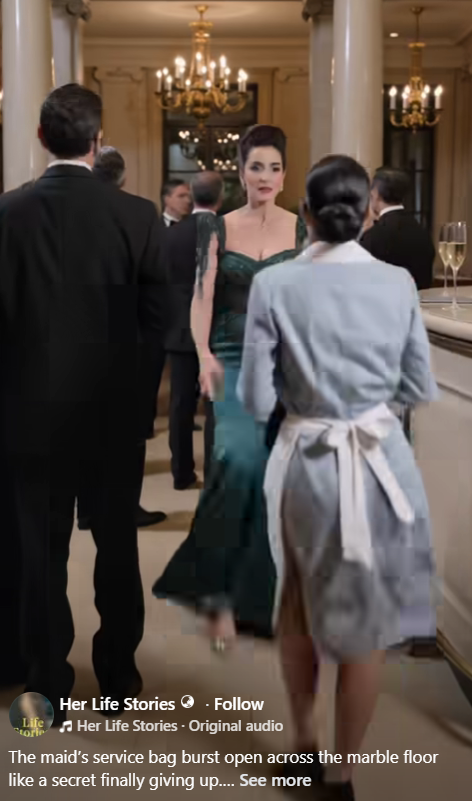
The maid’s service bag burst open across the marble floor like a secret finally giving up.
The grand lobby of the Celestial Aethelgard was a cathedral of excess. Gold-leafed pillars stretched toward a ceiling painted with frescoes of ancient deities, and the air smelled of expensive lilies and the metallic tang of chilled Bollinger. It was a night of high stakes and higher society—the Annual Diamond Gala.
Elara’s hands were raw from the industrial citrus cleaner she had been using since five in the morning. At twenty-two, her life was measured in the distance between the service elevator and the heavy oak doors of the VIP suites. She was a ghost in a black-and-white uniform, moving through the periphery of lives that cost more in a weekend than she would earn in a decade.
Then came the sound that shattered the evening’s curated perfection.
It started with a scream—sharp, jagged, and filled with the kind of entitlement that only comes from generations of unearned wealth. Lady Genevieve Vane, draped in a dark emerald couture gown that shimmered like a serpent’s scales, had Elara pinned against the polished marble of the reception desk.
“You disgusting liar!” Genevieve’s voice tore through the ambient jazz. “You stole it! My grandmother’s marquise-cut diamond brooch. It was on the vanity in the Imperial Suite!”
Elara’s breath broke in her chest. The pressure of Genevieve’s hand against her collarbone was bruising. Half the lobby had stopped. Champagne glasses froze in midair; the elite, usually too bored to look at the staff, were now captivated by the spectacle.
“I didn’t take anything,” Elara pleaded, her voice thick with tears. “Madam, please… I was only turning down the bed.”
“Liar!” Genevieve’s eyes were wild. She grabbed Elara’s heavy canvas service bag—a worn thing filled with the tools of her invisibility—and ripped it from her shoulder.
The bag burst open across the marble floor like a secret finally giving up.
It was a violent spill. Cleaning cloths slid beneath the mahogany reception desk like white flags of surrender. A room key sleeve spun toward a gold-leafed pillar. A cheap plastic makeup compact, Elara’s only luxury, hit the floor and cracked open under a guest’s heel, spilling beige powder like dust.
And then, a tiny, silver-edged photograph slipped free. It didn’t fall; it seemed to glide through the golden light of the chandeliers, dancing on a draft before settling near the feet of an older gentleman.
Elara was already crying, her one hand trapped against the wood by Genevieve’s grip, the other trembling uselessly. The socialite dumped the rest of the bag’s contents—miniature shampoos, a half-eaten granola bar, a sewing kit—and gestured to the mess with a sneer.
“Look at this,” Genevieve snapped to the surrounding guests, her lip curling. “This is what happens when girls like her think they can touch things above them. They see a spark of real beauty and think they can just tuck it away in their filthy rags.”
It was no longer about a brooch. It was a public ritual of making someone smaller. It was the crushing weight of class, the contempt of the sun for the soil.
Then, Arthur Sterling—the hotel’s oldest and most enigmatic permanent resident—bent down. His hand, liver-spotted but steady, reached for the photograph.
At first, he only frowned, squinting through his spectacles. Then he pulled it closer to his eyes.
Every ounce of color left his face.
The phones that had been recording the “servant’s shame” lowered slightly. The music seemed to die on its own as a strange, heavy tension radiated from the old man.
“Arthur?” Genevieve asked, her voice losing some of its edge. “What is it? Is it a pawn ticket? Proof of her thievery?”
Arthur didn’t look at Genevieve. He didn’t look at the crowd. He stared at the tiny, faded image in his hand, then up at Elara’s tear-streaked face, then back at the image again. He looked as if the forty years between the present and the past had just collapsed into a singular, terrifying moment.
“This…” he whispered. The word carried across the still lobby like a gunshot.
He lifted the photograph with visibly unsteady fingers. It showed a woman in a tattered white silk dress, her face glowing with a haunting, ethereal beauty, holding a swaddled infant.
“This was taken the night the hotel owner’s bride disappeared,” Arthur said, his voice cracking.
A hush rolled across the marble, deeper than any silence Elara had ever known. The story of the Vanished Bride was the Aethelgard’s most famous ghost story. In 1984, Julian Aethelgard’s young wife, Isabella, had vanished from the hotel on their first anniversary. No ransom note. No body. Just an empty suite and a missing child that the public had been told never existed.
Arthur looked directly at Elara, his eyes searching hers with a desperate, fearful intensity. “Why are you in her arms as a baby?”
Genevieve slowly stepped back, her hand dropping from Elara’s collar. The emerald of her dress suddenly looked like the scales of a trapped animal rather than a queen.
Elara’s lips parted. Her heart was hammering against her ribs so hard it hurt. The fear was still there, but beneath it, a cold, sharp iron was beginning to form. She remembered her mother’s voice—not the woman in the photo, but the tired, kind woman who had raised her in a basement apartment three miles from the hotel. The woman who had died three months ago, leaving her only this job and a warning.
“Because,” Elara whispered, her voice gaining a strange, rhythmic clarity through the tears. “My mother said… she said if they ever humiliated me here… if they ever tried to crush me under their heels…”
She looked at the photograph in Arthur’s hand, then up toward the shadowed balconies of the fourth floor.
“…I should finally ask what happened in room 417.”
Silence didn’t just fall; it crashed over the lobby.
Arthur’s expression shifted from shock to a visceral, bone-deep dread. He looked toward the gold elevator bank—the private line that led only to the executive suites—and then back at the maid.
“Room 417,” Arthur whispered, his voice barely audible. “The storage room. The one Julian ordered welded shut thirty-five years ago.”
“My mother wasn’t a thief,” Elara said, her voice rising now, echoing off the frescoes. “She was a maid, just like me. She was the one who found the bride. She was the one who was told to take the ‘mistake’ and run, or neither of us would see the sun again.”
The guests were no longer filming for scandal. They were filming history.
“Because,” Arthur said, looking at Elara with a dawning horror, “if your mother told you that number… then someone in this hotel has been lying since the night a bride vanished with a child no one was ever supposed to see. Julian Aethelgard didn’t lose a wife to a kidnapper.”
The grand doors at the back of the lobby opened. A tall, silver-haired man in a bespoke tuxedo stepped out—Julian Aethelgard himself, drawn by the silence. He looked down at the chaos, his eyes landing on the spilled cleaning supplies, the crying girl, and the photograph in Arthur’s hand.
For a second, the mask of the billionaire patriarch slipped, revealing a monster beneath.
“Arthur,” Julian said, his voice like dry ice. “Give me that.”
“No,” Arthur said, stepping toward Elara. “I think it’s time we opened the door to 417, Julian. I think your daughter has some questions about her mother’s grave.”
Elara stood tall, the cleaning rags at her feet no longer feeling like a badge of shame, but like the evidence of a long-delayed justice. The diamond brooch Genevieve had claimed was stolen was suddenly visible—glinting from the folds of the socialite’s own silk clutch, where she had tucked it herself to frame the girl.
But no one was looking at the diamond. They were looking at the maid.
The golden light of the Aethelgard had never seemed so dim, and the secrets of Room 417 were finally, violently, coming to light.