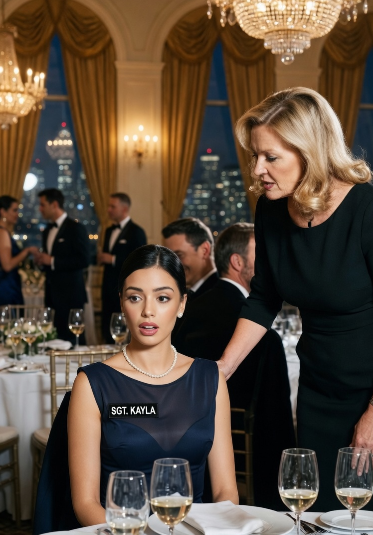
“Nice dress,” my mother said with a tight smile that never touched her eyes, her gaze drifting to the plastic name tag pinned to my chest. “Too bad you couldn’t upgrade that as well.” A few people around her let out polite chuckles—the kind reserved for mild embarrassments.
“Nice dress,” my mother said with a tight smile that never touched her eyes, her gaze drifting to the plastic name tag pinned to my chest. “Too bad you couldn’t upgrade that as well.”
A few people around her let out polite chuckles—the kind reserved for mild embarrassments. My name is Madeline Carter, and I walked into our twenty-year high school reunion wearing a simple navy dress from a department store clearance rack. Within five minutes of arrival, I was brutally reminded that in their eyes—in the eyes of former classmates who’d once known me as valedictorian and debate champion—I had never amounted to anything worth remembering.
The valet barely glanced at me as I handed him my modest sedan keys—a stark contrast to the Mercedes, BMWs, and Teslas gleaming in the circular drive. I murmured a polite thank you, tucked my simple clutch under my arm, and stepped through the grand double doors into the opulent lobby of Aspen Grove Resort. The chandelier above glimmered with calculated brightness—just gaudy enough to remind you that you didn’t quite belong here, that this level of luxury was reserved for people who’d “made it” in ways that could be measured, displayed, and envied.
Everyone was already inside the ballroom. I could hear the hum of animated conversation, the swell of applause for achievements being announced, the sophisticated clink of wine glasses, even before the professionally dressed concierge offered me a name tag printed in generic serif font. It read simply “Madeline Carter”—no title, no distinction, no professional weight. Just a name floating in a sea of “Dr.” this and “CEO” that and “Senator” something else.
I still wore my West Point ring concealed under my sleeve, the heavy gold pressing against my wrist like a secret. But no one saw it. No one looked closely enough. That was exactly how I’d planned it—for now.
The Ballroom
The main ballroom opened before me like a theatrical stage designed for maximum impact. Long tables draped in ivory silk linens. Elaborate floral arrangements studded with crystals that caught the light. A six-tier celebration cake glittering on a pedestal like a monument to achievement.
At the front of the room, a massive screen cycled through a nostalgic slideshow: prom photographs, debate club victories, cheerleading championships, the memorable class trip to Washington D.C. My sister Olivia appeared in at least half of them—always at the center, always commanding attention. I appeared in maybe three photographs, usually at the edge of the frame.
Olivia Carter—my younger sister by two years—was already on stage when I entered, commanding the room’s attention with practiced ease. She wore a red designer sheath dress that practically shouted power and success. Her voice was perfectly tuned to the room’s acoustics.
“….. And after fifteen years of dedicated service at the Department of Justice, I’m extremely proud to announce that I’ve recently been appointed Deputy Director for Western Cyber Oversight,” she said, tossing her perfectly styled hair with a practiced laugh that suggested both humility and confidence. “But I’ll never forget where it all started—right here at Jefferson High, with teachers and classmates who believed in excellence.”
Then, with a calculated glint in her eye, she added: “And of course, I absolutely have to thank my older sister Madeline, who is with us tonight, for always being so uniquely herself and choosing her own unconventional path.”
The spotlight didn’t find me, but a hundred pairs of eyes did. The “unconventional path” was Olivia’s code for disappointment. To this crowd, I was the girl who went to West Point and then seemingly vanished into the beige background of “government work.” In the family newsletters my mother sent out, Olivia’s promotions were detailed in bullet points; my life was usually summarized as “Madeline is still serving and traveling frequently.”
I found a seat at a back table, next to a man named David who had been the drummer in a garage band back in the day. He looked at my name tag and then at my clearance-rack dress.
“Madeline,” he said, nodding. “What’ve you been up to? I heard you were in the Army or something?”
“Something like that,” I said, taking a sip of the room-temperature Chardonnay. “I move around a lot.”
“Tough gig,” David said, his eyes already drifting back to the stage where Olivia was now being presented with a ‘Distinguished Alumna’ award. “Not like Olivia. She’s really hit the big leagues. Deputy Director. That’s some serious security clearance stuff, right?”
“Very serious,” I agreed quietly.
The Interruption
The evening progressed as a parade of self-congratulation. One by one, the “successes” of the Class of 2004 took the microphone. There was Marcus, the hedge fund manager who made sure to mention his second home in the Hamptons. There was Sarah, the influencer with four million followers who spoke about “the burden of visibility.”
My mother sat at the head table, beaming at Olivia, her “successful” daughter. When she finally made her way over to my table during the dessert course, it wasn’t to catch up. It was to manage the optics.
“Madeline, darling,” she whispered, leaning in so only I could hear. “If anyone asks what you’re doing, just say you’re a ‘Consultant.’ It sounds much more substantial than… whatever it is you do in those dusty overseas offices. And please, pull your sleeve down. That ring looks so masculine.”
I looked at the heavy gold ring on my finger. The Class of ’08. United States Military Academy. It was the only thing I wore that had any real value, though not the kind my mother understood.
“I’m proud of this ring, Mom.”
She sighed, a sound of weary martyrdom. “We just want you to be happy, Maddie. But you must admit, seeing Olivia up there… it makes one wonder what happened to that fire you had in high school. You were going to be a Senator. Now, you’re just… here.”
Before I could respond, the heavy double doors at the back of the ballroom swung open. This wasn’t the rhythmic entry of a late guest. This was the measured, synchronized footfalls of men in dark suits. Four of them. They didn’t look at the flowers or the cake. Their eyes scanned the room with a predatory efficiency I recognized instantly.
The room went silent. The music faded. Olivia, still holding her award, stepped to the edge of the stage, her face pale.
“Can we help you?” the reunion organizer asked, stepping forward.
The lead man, tall with a salt-and-pepper buzz cut and a jawline that could crack granite, didn’t answer him. He pulled a badge from his breast pocket—not a local police badge, but something with a silver eagle and a deep blue seal.
“We are looking for the Deputy Director of Western Cyber Oversight,” the man said. His voice was like a low-frequency hum that vibrated in my chest.
Olivia stepped forward, her voice trembling slightly but trying to maintain her “Director” persona. “I… I am Olivia Carter. I was recently appointed. What is the meaning of this? Is there a security breach?”
The man looked at Olivia. He didn’t smile. He didn’t show respect. He looked through her. “Ma’am, you are a Deputy Director Nominee. Your vetting is currently under review. We are not here for you.”
A murmur rippled through the room. My mother looked confused. Olivia looked humiliated.
“Then who are you looking for?” my mother snapped, regaining her social courage. “This is a private event.”
The lead agent turned his head slightly, his eyes finally locking onto the back table. To me.
He didn’t walk; he moved with a tactical grace that cleared a path through the tables. The other three agents followed, forming a perimeter around our table. The “polite” guests shrank back.
The lead agent stopped three feet from me. He snapped his heels together and stood at a rigid attention that seemed to suck the air out of the room.
“General,” he said.
The word hit the room like a physical shock.
“Sir?” I said, standing up slowly. I let the navy sleeve of my dress slide back, revealing the West Point ring. I didn’t need to hide it anymore.
“Ma’am,” the agent corrected himself, his voice echoing in the silent ballroom. “The situation in the Levant has escalated. The Joint Chiefs are in the tank. The transport is waiting at the helipad. We have a secure uplink in the suburban.”
I looked at my mother. Her mouth was open, but no sound was coming out. I looked at Olivia, who was clutching her ‘Distinguished Alumna’ award so hard her knuckles were white.
“Now?” I asked.
“Immediate departure, General Carter. We have your go-bag and the football is already in transit.”
I took a final look at my name tag. Madeline Carter. No title. No distinction. Just a name. I unpinned it and laid it on the ivory silk tablecloth next to my half-eaten cheesecake.
“David,” I said to the drummer, who was staring at me as if I’d just sprouted wings. “The band was better when you were on the double-bass. Stick with it.”
I walked toward the exit. I didn’t look at the crystals or the six-tier cake. I walked past the “CEOs” and the “Influencers.” As I passed the head table, I stopped in front of my mother.
“It’s a nice dress, Mom,” I said softly. “But you were right. It was time for an upgrade.”
I didn’t wait for her response. I walked through the double doors, the agents flanking me in a diamond formation. Outside, the “modest sedan” was being blocked by a blacked-out SUV with government plates. Two more men stood by the open door.
In the distance, the rhythmic thwack-thwack-thwack of a Black Hawk helicopter echoed off the hills of Aspen Grove, its searchlight cutting through the night.
As I stepped into the vehicle, I caught a glimpse of the reunion guests crowding the windows of the ballroom, their faces pressed against the glass. They were looking at me—really looking at me—for the first time in twenty years.
But as the door closed and the sirens began to wail, I realized I didn’t care what they saw. The gold ring on my finger felt lighter than it ever had before. I had a world to save, and finally, I didn’t have to apologize for how I was going to do it.
The Aftermath
The news broke forty-eight hours later, though not in the way my classmates expected. There were no photos of me in the paper. There was only a brief, terse statement from the Pentagon regarding a “successful stabilization operation” led by an unnamed commander from the Special Operations Command.
Back at the Aspen Grove Resort, the reunion had ended in a strange, hushed vacuum. Olivia’s nomination for the Deputy Director position was quietly rescinded two weeks later—not because of any crime, but because the vetting process had revealed she had “inflated her proximity to high-level intelligence.”
My mother called me a month later. Her voice was different—small, hesitant.
“Maddie?” she asked. “I saw a woman on the news… in the background of a briefing. She was wearing a uniform with so many stars. It looked like you.”
“It might have been, Mom.”
“Why didn’t you tell us? All those years… we thought you were just… a clerk. Or a low-level officer.”
I looked out the window of my office in the E-Ring of the Pentagon, looking at the Potomac. “Because in my world, Mom, if people know who you are, it means you aren’t doing your job right. Success isn’t measured in applause. It’s measured in the things that don’t happen because you were there to stop them.”
“We’re having a small dinner for Olivia’s birthday,” she said, her voice hopeful. “Would you… could you come? We could tell people—”
“No, Mom,” I interrupted gently. “Don’t tell people anything. Let them keep their stories. I prefer it that way.”
I hung up and looked at the plastic name tag I had kept in my pocket. Madeline Carter. I dropped it into the shredder.
I didn’t need a tag to know who I was. I was the girl in the navy dress. I was the valedictorian. I was the General. And for the first time in my life, I was exactly where I belonged.