She Thought My Uniform Was a Costume. The Scanner Told Her I Had Been Protecting Her Son for Years.
Part 1
The moment Sybil Harrington pointed at me in the middle of the ballroom and said, “That woman is pretending to be someone she’s not,” I felt seven years of silence sharpen into one clean, gleaming blade.
Every chandelier in the room seemed to pause above us. Every glass lowered. Every conversation died before it could become a whisper. The annual military ball at Naval Station Mayport had been beautiful only seconds earlier—white linen, polished brass, gold light spilling over dress uniforms and evening gowns—but now the air felt cold enough to crack.
Sybil stood beside a young military police officer, her manicured hand still gripping his sleeve as if she had personally drafted him into her private war. She was sixty-two, elegant in a dark emerald gown that shimmered like money, her silver-blond hair swept into a flawless twist. Even in panic, Sybil looked expensive. Even while destroying herself, she looked rehearsed.
Her finger remained aimed at my chest.
At my full dress whites.
At my rank.
At the life she had spent years pretending did not exist.
Beside her, my husband Preston looked as if someone had drained the blood from his body. His lips parted, but no words came out. That was the thing about Preston—he loved me, I knew he did, but he had spent too many years trying to survive his mother by sanding down every sharp edge before she cut herself on it.
“Mom,” he said finally, voice low and strangled, “stop.”
But Sybil did not stop.
She had never stopped.
For seven years, she had introduced me with that same polished little sentence, dressed up in courtesy and dipped in poison.
“This is Preston’s wife. She has a small administrative role in the Navy.”
At our wedding reception, she said it to a senator’s wife while I stood close enough to hear every syllable. At Thanksgiving, she said it to her neighbors over wine and roast turkey. At her charity lunches, she said it as if my work was a hobby I had stubbornly refused to outgrow. Whenever someone asked about my career, Sybil answered before I could.
“Government work,” she would say, smiling. “Very steady, I suppose.”
The first time, I corrected her gently.
“I’m in naval intelligence.”
Her smile held. “Yes, dear. Administration can be very important.”
The second time, I tried humor.
“I promise they don’t send me overseas to file papers.”
She laughed as if I had made a charming joke.
By the third year, I understood. Sybil was not confused. She was committed. She had created a version of me small enough to fit beneath her expectations, and she would rather humiliate herself than admit I had outgrown the frame.
I was raised differently.
My father, Captain Daniel Reeves, taught me that rank was not jewelry. It was responsibility. He taught me to polish my shoes before I spoke, to listen before I answered, and to never waste breath proving myself to people who had already decided not to see me.
“Your work speaks long before you do, Evelyn,” he used to say while maps covered our kitchen table and the smell of black coffee filled the morning air. “Let fools talk. Let records answer.”
So I let Sybil talk.
I let her call my deployments “unfortunate timing.” I let her ask whether Preston felt lonely “while I played soldier overseas.” I let her tell guests I would eventually leave the Navy once I “settled into marriage properly.” I let her imply my promotion to captain was some diversity experiment she did not understand but felt too polite to name.
And Preston, sweet Preston, always tried to smooth it over.
“She doesn’t mean it like that.”
“She’s from another generation.”
“She’s just protective of me.”
But protection was not what Sybil offered him. Control was.
She controlled the stories told in her home. She controlled who mattered, who belonged, who rose, who shrank. Preston had grown up beneath that control, and I had married him hoping love would teach him to stand upright inside it.
Sometimes it did.
Sometimes it didn’t.
When the invitation arrived for the annual military ball, Preston looked surprised when I told him Sybil had asked to come.
“She asked you directly?”
“She called my office.”
He winced. “That sounds ominous.”
“It sounded like Sybil.”
He studied me across the kitchen table, worry pinching his brow. “Evie, you don’t have to say yes.”
“I already did.”
“Why?”
I looked at the invitation lying between us, embossed in navy and gold. My name was on the organizing committee. My briefings had shaped the security protocols. My hands had touched almost every detail of the event, from seating senior officers to coordinating interagency guests.
And Sybil thought she was attending as Preston’s distinguished mother while I hovered somewhere at the edge, useful but unimportant.
I was tired of the edge.
“Because,” I said quietly, “your mother has spent seven years in a room with a closed door. Tonight, I’m opening it.”
Preston reached for my hand. “Just promise me you won’t let her hurt you.”
I smiled, but it felt older than my face. “She can embarrass me. She can disappoint me. But she cannot reduce me.”
That evening, the ballroom glowed as if someone had poured sunlight into crystal. Officers in dress uniforms moved beneath chandeliers. Spouses in satin and velvet clustered near champagne towers. The air smelled faintly of roses, cologne, polished wood, and sea wind drifting in from the coast.
I arrived early in formal civilian attire, a deep navy evening suit, because there were still details to manage before the ceremony. I checked table placements, confirmed the admiral’s entrance timing, settled a last-minute seating issue, and reviewed a security update with the MPs assigned to the event.
Sybil arrived on Preston’s arm wearing emerald sequins and a smile that said she expected to be admired.
For nearly an hour, she watched people come to me.
A rear admiral leaned in to ask my opinion on a briefing scheduled for Monday. A Marine colonel crossed the room to shake my hand. Two commanders greeted me with the easy respect of colleagues who knew exactly where I stood. Each interaction landed on Sybil’s face like a pebble dropped into still water.
Confusion.
Irritation.
Denial.
When Preston finally said, “Mom, Evelyn helped organize all of this,” Sybil gave a soft laugh.
“How nice,” she replied. “I’m sure they appreciate reliable administrative help.”
Preston’s jaw tightened. “That is not what she does.”
Sybil patted his sleeve. “Of course, dear.”
I watched them from across the room, calm on the outside, something colder moving beneath my ribs.
Then my aide approached. “Captain Reeves, they’re ready for you.”
Sybil heard it.
Her eyes snapped toward us.
Captain.
For the first time that night, her smile faltered completely.
I held her gaze for one second longer than courtesy required, then turned and left to change.
When I returned in full dress whites, the room altered.
Not loudly. Not theatrically. But unmistakably.
People who knew what they were looking at straightened. Conversations softened. Eyes moved to the gold stripes on my sleeves, the ribbons on my chest, the insignia that carried years of service Sybil had spent trimming down to nothing.
Fourteen years became visible.
Every deployment. Every midnight call. Every classified room. Every missed birthday. Every decision made while the world slept.
I saw Sybil staring.
Not at me.
At the truth.
And then, because truth had cornered her, she attacked it.
Part 2
Sybil crossed the ballroom with the terrifying focus of a woman who had mistaken pride for survival. Preston reached for her, but she slipped past him, her emerald gown flashing beneath the chandeliers like something venomous.
She seized the arm of a young MP officer standing near the entrance.
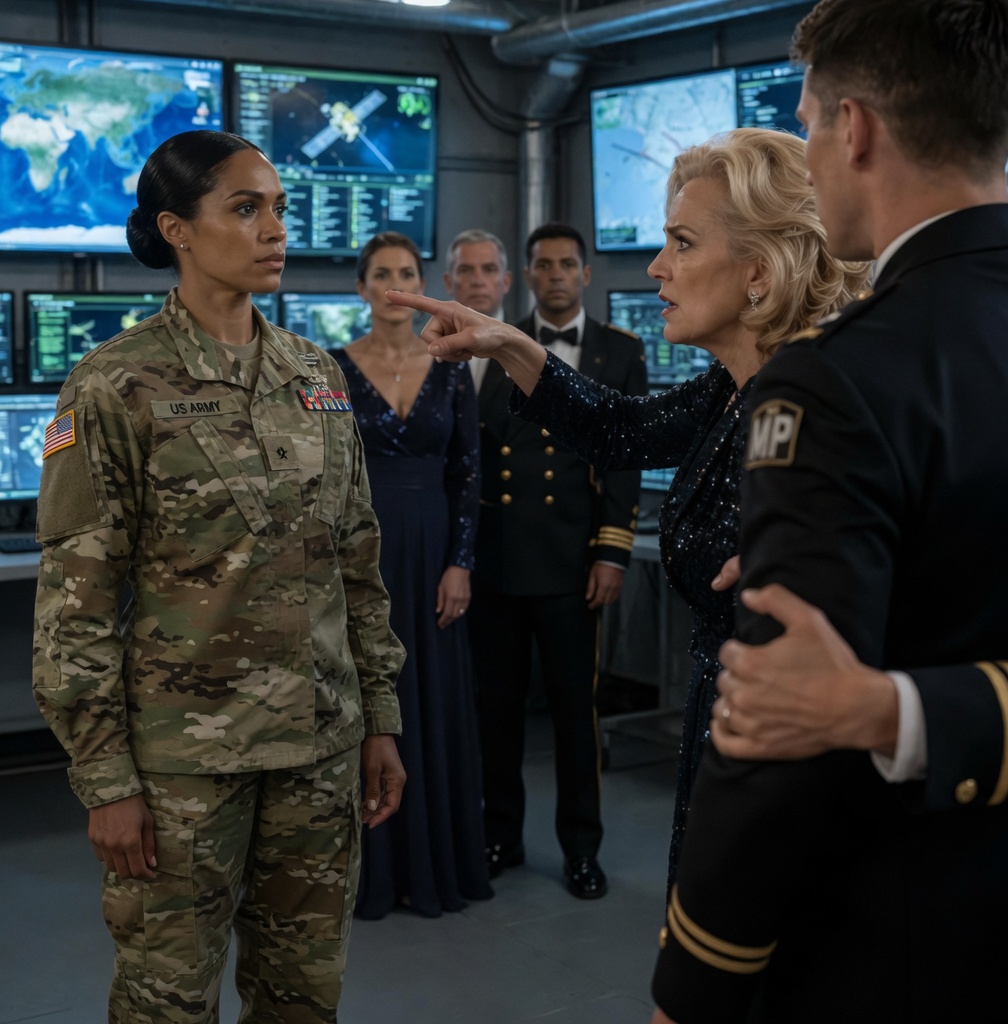
“Officer,” she said sharply, loud enough for nearby guests to turn, “there is a woman here impersonating Navy personnel.”
The officer stiffened. “Ma’am?”
Sybil pointed straight at me.
“That woman in white doesn’t belong here. Remove her. Arrest her if you have to.”
The words did not explode.
They spread.
A ripple of silence moved through the ballroom, swallowing laughter, music, silverware, breath.
Preston looked horrified. “Mom, no.”
But Sybil’s eyes stayed locked on mine, bright with the desperate triumph of someone waiting to see a lie collapse.
Only I was not the lie.
The MP officer approached me carefully. He was young, maybe twenty-six, with neat dark hair and the composed expression of someone trained to remain professional when civilians became unpredictable.
“Ma’am,” he said, his voice respectful but tense, “I apologize. I need to verify your credentials.”
I did not blame him. He had a job. Security protocol did not bend because someone had made a fool of herself in public.
“Of course,” I said.
Sybil stepped closer, unable to resist.
“Check carefully,” she snapped. “People like her are very good at pretending.”
Something moved through the crowd then—not agreement, not amusement, but disgust. It tightened the faces around us. A captain’s wife near the front lowered her champagne glass. The Marine colonel who had greeted me earlier folded his arms. The rear admiral stood still, watching.
Preston came to my side. “Evelyn—”
I lifted one hand slightly. Not now.
He stopped.
I reached into my jacket and withdrew my military ID.
Sybil’s eyes followed the card like a predator tracking blood.
The officer took it with both hands. “Thank you, ma’am.”
His fingers were steady, but I noticed the way his throat moved when he swallowed. He knew enough now to suspect this was no ordinary verification. He stepped to the scanner near the ballroom entrance, and the crowd shifted with him, bodies angling toward the small machine as if it had become an altar.
Sybil stood just behind him, face flushed, lips pressed into a thin, satisfied line.
Preston whispered, “Mom, you need to apologize before this gets worse.”
She did not even look at him.
“It will be over in a moment,” she said. “Then you’ll thank me.”
He stared at her as if he had never seen her before.
The officer slid the ID beneath the scanner.
A blue-white light flickered.
The machine hummed.
For half a second, nothing happened.
Then the screen lit up.
The officer’s posture changed.
It was subtle, but everyone trained in command could read it. His shoulders squared. His chin lifted. His expression shifted from procedural caution to stunned recognition.
He looked from the screen to me.
Then back to the screen.
Sybil leaned forward. “Well?”
The officer did not answer her.
Instead, he turned fully toward me and gave a crisp salute.
“Captain Reeves,” he said, voice carrying through the silence, “credentials verified. My apologies, ma’am.”
A sound moved through the ballroom—not a gasp exactly, not applause, but something sharper. The sound of judgment reversing direction.
Sybil’s face emptied.
The pink in her cheeks drained so quickly she looked almost ill.
“That can’t be right,” she whispered.
The officer lowered his salute but not his respect. “It is right, ma’am.”
“No.” Sybil shook her head once. “No, she’s Preston’s wife. She works in an office.”
Someone behind her muttered, “My God.”
The rear admiral stepped forward then, tall and calm, his presence making the room even quieter.
“Captain Reeves,” he said to me, “is one of the reasons tonight’s event is secure, organized, and possible.”
Sybil flinched as though each word struck her physically.
“She has served this country with distinction,” he continued. “And she has my full confidence.”
The ballroom remained silent, but now the silence belonged to me.
Preston turned to his mother. His voice was low, broken open.
“You knew, didn’t you?”
Sybil’s mouth trembled. “I knew she exaggerated.”
“No,” Preston said. “You knew enough. You just hated it.”
Her eyes flashed. “I hated watching you disappear behind her life.”
“My life?” I asked quietly.
For the first time, I spoke not as a daughter-in-law, not as a wife trying to preserve peace, but as myself.
Sybil looked at me, and I saw the old reflex return—the urge to dismiss, to shrink, to place me back beneath her polished heel.
But the room had changed.
There was nowhere left to put me.
“You thought if you called my career small enough times, it would become small,” I said. “You thought if you introduced me as less than I am, everyone else would believe you. Maybe even Preston. Maybe even me.”
Her lips parted, but no answer came.
I stepped closer, close enough that only the nearest guests could hear the softness of my voice, though the room remained so still I knew every word carried.
“But what you never understood is this: I did not stay silent because you were winning. I stayed silent because I was never on trial.”
Sybil’s eyes filled with tears—not sorrow, not yet. Rage first. Humiliation first.
“You made me look like a fool,” she whispered.
“No,” Preston said, and his voice cracked. “You did that yourself.”
Something in Sybil broke then. Not loudly. Not with a dramatic sob. Her face simply loosened, and for one brief second I saw the woman beneath the performance: terrified, aging, losing control of the son she had mistaken for property.
Then she said the sentence that changed everything.
“I gave up everything to keep him alive, and this is how you repay me?”
Preston went still.
I felt the air shift again.
This was not pride. Not anymore.
This was something buried.
“What does that mean?” Preston asked.
Sybil pressed her lips shut as if she had not meant to speak.
But the damage was done.
My instincts sharpened.
Naval intelligence had trained me to notice what people tried to pull back after saying. The body reveals where the secret is before the mouth confesses it.
Sybil looked not at Preston.
Not at me.
At the rear admiral.
And the rear admiral’s expression changed.
Barely.
But enough.
A cold thread slid down my spine.
“Admiral?” I said.
He looked at Sybil, then at Preston, then at me.
“I think,” he said slowly, “this conversation should continue somewhere private.”
Sybil laughed once, high and brittle. “No. Absolutely not.”
Preston stepped toward her. “Mom. What did you mean?”
She clutched her evening bag against her stomach. “Nothing. I was upset.”
But I was already moving through memory—through old inconsistencies, sealed records, Preston’s strange lack of childhood photos before age five, Sybil’s refusal to discuss his father’s service, the way she had always become icy when my work involved classified archives.
Preston had told me his father died in a training accident.
Sybil had told that story so often it had become family scripture.
But now the admiral looked like a man standing beside a locked door.
And I realized the scanner had verified more than my ID.
It had opened something else entirely.
Part 3
We moved into a private anteroom off the ballroom, though “private” was a generous word for a space separated from a hundred stunned guests by two carved wooden doors and a century of military etiquette. The chandeliers outside still glowed. The music had resumed in a wounded, hesitant way. But inside the anteroom, the air was tight, and every breath felt borrowed.
Sybil stood near a velvet chair but did not sit. Preston remained by the door, pale and rigid. The rear admiral—Admiral Hayes—closed the door behind us and turned with the grave expression of a man who knew silence had finally expired.
“Admiral,” I said, “what is going on?”
Sybil’s voice sliced through the room. “You have no right.”
Hayes looked at her. “Mrs. Harrington, with respect, you lost the privilege of deciding that when you accused a decorated officer of fraud in a public military event.”
Her chin trembled. “I was protecting my son.”
Preston stared at her. “From my wife?”
She did not answer.
Admiral Hayes exhaled slowly. “Captain Reeves has current clearance sufficient for what I’m about to say. Preston, you have a right to know what concerns your own history.”
“My history?” Preston repeated.
Sybil closed her eyes.
Hayes looked at him. “Your father, Lieutenant Commander Marcus Harrington, did not die in a training accident.”
The room seemed to tilt.
Preston gave a small, confused laugh, the kind people make when reality arrives wearing the wrong face. “What?”
“He died during a classified counterintelligence operation,” Hayes said. “One involving a compromised naval communications network.”
Preston looked at his mother. “You told me it was a mechanical failure.”
Sybil whispered, “You were four.”
“I’m thirty-eight now.”
“I was trying to keep you safe.”
Hayes continued, voice measured. “After your father’s death, there was concern that the people responsible might target surviving family members. Your mother was advised to relocate, change routines, and avoid public connection to certain military circles.”
Preston’s hands curled into fists. “So why lie forever?”
Sybil opened her eyes then, and the tears finally came—not pretty tears, not the controlled shimmer she used at charity luncheons, but raw, frightened tears that made her look suddenly old.
“Because once you stop telling a lie, everyone asks what else was hidden behind it.”
My stomach tightened.
There it was.
Not the whole truth.
The doorway to it.
Hayes looked at me, and something in his silence told me he knew only part of the story.
I stepped toward Sybil. “What else?”
She shook her head. “No.”
“Sybil.”
“No.”
Preston’s voice came out softer than I had ever heard it. “Mom. Please.”
That broke her more than anger could have.
She sank into the velvet chair, emerald sequins catching the light like broken glass.
“Your father was not the only one under threat,” she said. “There was a young intelligence officer working with him. Brilliant. Stubborn. Too brave for her own good.”
I went still.
Sybil looked at me.
My pulse slowed.
Not from calm.
From recognition.
“My mother,” I said.
Sybil nodded once.
The room narrowed until all I could hear was my heartbeat.
My mother, Naomi Reeves, had died when I was eight. Officially, complications from a sudden aneurysm. My father never spoke of it without his eyes changing. He had raised me with discipline, tenderness, and a grief so controlled it became part of the furniture of our home.
“She worked with Marcus,” Sybil said. “Your father too, later. They were trying to expose someone inside the network. Someone selling information.”
“My mother was a school counselor,” I said, though even as I spoke, old memories cracked open—late-night phone calls, whispered arguments, my mother burning papers in the fireplace while smiling at me like nothing was wrong.
Sybil looked at me with a grief I had never seen in her before. “That was her cover.”
The sentence landed with such force I almost stepped back.
Admiral Hayes lowered his gaze.
Preston whispered, “Mom, what did you do?”
Sybil’s hands twisted together. “I was scared. Marcus was dead. People were watching the house. I had a child. Naomi came to me and said she could finish what they started, but she needed access to Marcus’s personal files.”
Her voice broke.
“I gave them to her.”
The room held its breath.
“Two weeks later,” Sybil said, “Naomi was dead.”
My skin went cold.
For years, Sybil had treated me like an intruder. Like a woman unworthy of the family name. Like someone pretending to belong near service, sacrifice, command.
But now I understood the look beneath her disdain.
It had never been only arrogance.
It was guilt wearing pearls.
“You knew who I was,” I said.
She looked up, ruined. “Not at first. When Preston brought you home, you were Evelyn Reeves, Navy. I thought it was coincidence. Then I saw your father at the wedding.”
My father had stood stiffly through that entire reception, polite but distant from Sybil. I had assumed he disliked wealthy people who performed grief for attention.
Now I remembered the way his hand tightened around his glass when Sybil entered.
“You recognized him,” I said.
She nodded. “And he recognized me.”
“Did he know you blamed yourself?”
“Yes.”
“Did he blame you?”
Her mouth folded inward. “He said my fear did not kill Naomi. The traitor did.”
I felt my throat burn.
Preston took one step back as if trying to see his mother from a distance large enough to understand her. “So you spent seven years humiliating Evelyn because her mother died helping Dad?”
Sybil flinched. “No.”
“Yes,” he said. “You couldn’t face her, so you made her small.”
Sybil covered her mouth.
The pieces arranged themselves with cruel clarity. Sybil had not dismissed my service because she knew nothing about it. She dismissed it because she knew too much. Every stripe on my sleeve reminded her of Naomi. Every deployment echoed Marcus. Every promotion proved that the world she had run from had found its way back to her dinner table and married her son.
I should have hated her then.
A part of me did.
But another part, the daughter of a dead woman with secrets, understood something more complicated. Sybil had built a life out of denial, and denial had demanded offerings. My dignity had been one of them.
I walked to the window. Beyond the glass, the ballroom shimmered, full of uniforms and music and people pretending not to wonder what was happening behind the doors.
“Who was the traitor?” I asked.
Hayes answered this time. “We never confirmed it.”
I turned slowly.
Sybil looked up.
And then I saw it in her face—the final secret, the one she had protected even from herself.
“You know,” I said.
Her tears stopped.
Preston whispered, “Mom?”
Sybil’s voice was almost inaudible. “I suspected.”
“Who?” I asked.
She shook her head, trembling violently now.
The door opened before she could answer.
My father stood there.
Captain Daniel Reeves, retired, seventy-one years old, back straight despite the cane in his left hand, eyes fixed not on me, but on Sybil.
The shock stole every sound from the room.
“Dad?” I breathed.
He should not have been there. He had told me he was too tired for ceremonies, too old for polished shoes and political speeches.
But he wore his dress uniform.
And in his right hand, he held a sealed envelope.
“I was hoping,” he said quietly, “that Sybil would tell you herself.”
Sybil rose unsteadily. “Daniel…”
He looked at her with ancient sorrow. “Enough.”
He handed me the envelope.
My name was written across it in my mother’s handwriting.
My knees nearly failed.
Evelyn, when you are ready.
I opened it with fingers that did not feel like mine.
Inside was a letter, a photograph, and a small storage drive sealed in an evidence sleeve.
My mother’s letter was brief.
Not because she had little to say.
Because she had known she might not have time.
She wrote that if I was reading it, then the truth had outlived fear. She wrote that Marcus Harrington had died protecting evidence. She wrote that Sybil had helped without understanding the danger. She wrote that Daniel—my father—had promised to keep me safe until I chose my own path.
Then came the line that stopped my heart.
The person who betrayed us was not Sybil. It was Preston’s grandfather, Charles Harrington.
Preston made a sound like something inside him tearing.
Sybil collapsed back into the chair.
“My father?” she whispered.
My father nodded once. “He used his political contracts to access naval communications. Marcus discovered it. Naomi proved it. Charles buried them both.”
The room blurred.
All those years, Sybil had defended a family legacy built over graves. She had polished silver under portraits of a man who had sold secrets and ordered deaths. She had belittled me because admitting my worth would mean facing the woman her father helped kill.
Preston crossed the room to me, eyes wet. “Evie…”
I handed him the photograph.
It showed four young adults standing on a pier: my mother, radiant and laughing; my father, solemn even then; Marcus Harrington with one arm around Naomi’s shoulder; and a younger Sybil standing slightly apart, holding baby Preston.
On the back, in my mother’s handwriting, were five words.
Tell our children the truth.
No one spoke for a long time.
Then Sybil fell to her knees in front of me.
Not elegantly.
Not dramatically.
Heavily, as if the weight of seven years, thirty-four years, an entire inherited lie, had finally broken her spine.
“I am sorry,” she whispered. “Not because I was embarrassed tonight. Not because they saw me. I am sorry because I looked at you and saw the woman I failed, and instead of asking forgiveness, I punished you for surviving her.”
The apology did not heal everything.
Real apologies rarely do.
They are not magic. They are doors.
I looked down at her, this woman who had tried to erase me in a ballroom and accidentally resurrected my mother.
Then I said the only thing that felt true.
“Stand up, Sybil. My mother did not die so either of us could spend our lives on our knees.”
She sobbed once.
Preston helped her rise.
Outside, the music swelled again, uncertain but alive.
When we returned to the ballroom, every eye turned toward us. Sybil’s makeup was ruined. Preston held my hand. My father walked beside me, and Admiral Hayes followed with the solemnity of a man escorting history back into the light.
Sybil stopped at the center of the room.
For once, she did not smile.
For once, she did not perform.
She faced the guests, voice shaking but clear.
“I owe Captain Evelyn Reeves an apology,” she said. “I accused her falsely. I diminished her service. I dishonored this room and every person who serves by pretending my pride was truth.”
Then she turned to me.
“And I dishonored her mother.”
A murmur moved through the ballroom, but I barely heard it.
Because my father had taken my hand.
Because Preston was crying openly.
Because somewhere beneath the chandeliers, beneath the polished brass and white linen, the ghosts of Naomi Reeves and Marcus Harrington had finally been invited into the room.
Later that night, after the speeches resumed and the scandal began its quiet journey through every powerful circle Sybil had once ruled, Preston and I stood outside under the humid Florida sky. The sea wind moved through the palms. The stars looked sharp enough to cut.
“I should have defended you sooner,” he said.
“Yes,” I answered.
He swallowed. “Do you think you can forgive me?”
I looked at him for a long moment.
“I can begin,” I said. “But beginning is not the same as forgetting.”
He nodded, accepting the mercy and the warning together.
Behind us, Sybil stood alone near the ballroom doors, no longer queen of anything, watching my father speak with Admiral Hayes. She looked smaller than I had ever seen her.
But not because I had made her small.
Because truth had removed everything false.
And strangely, impossibly, that meant she had room to become something else.
The next morning, the storage drive from my mother’s envelope reopened a case that powerful people had spent decades burying. Charles Harrington’s name was stripped from two foundations. Contracts were investigated. Files were unsealed. My mother’s service record was corrected, then honored.
At the ceremony months later, Sybil sat in the front row.
No emerald gown. No perfect smile.
Just a black dress, bare trembling hands, and eyes full of grief that had finally learned how to bow.
When I stepped to the podium in full dress whites, I carried my mother’s photograph inside my jacket.
And when I began to speak, I did not look at Sybil.
I looked at Preston.
I looked at my father.
I looked at the young officers standing in the back, watching the future take notes.
“My mother once wrote,” I said, voice steady, “Tell our children the truth.”
Then I paused, feeling the room lean toward me.
“So I will.”
And for the first time in my life, the silence that followed was not disbelief, not humiliation, not judgment.
It was honor.