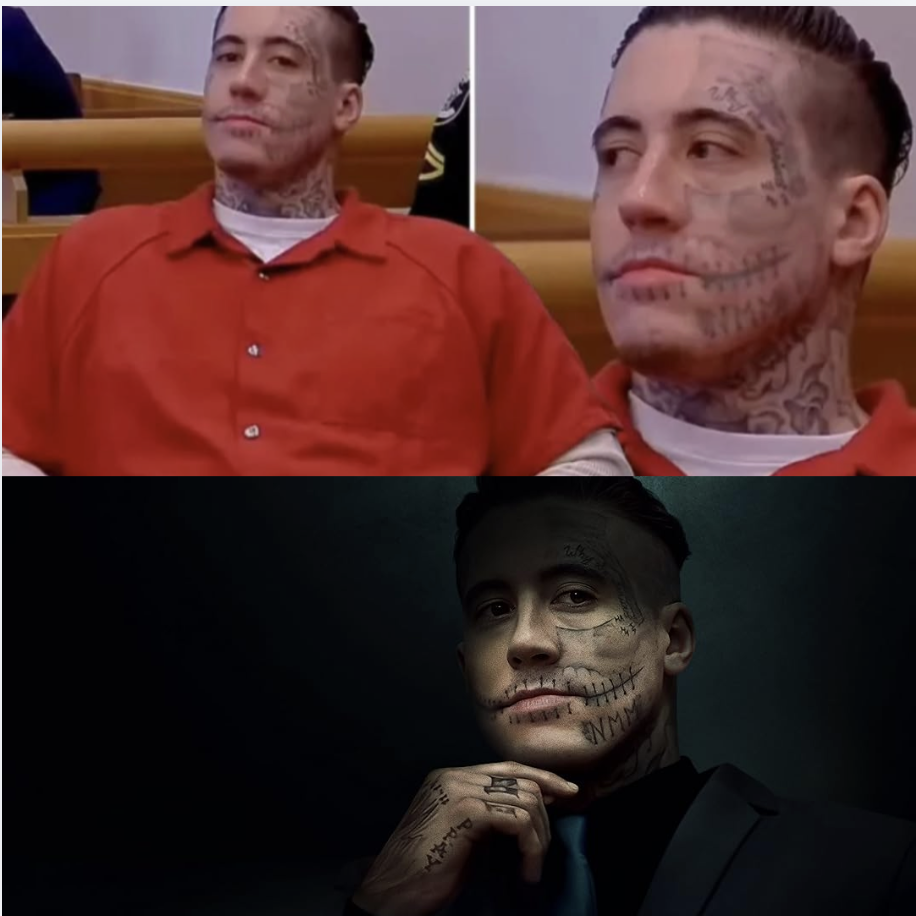
THE FACE TATTOOS OF CONVICTED KILLER WADE WILSON ARE NOW AT THE CENTER OF A CHILLING QUESTION INVESTIGATORS SAY CANNOT BE IGNORED. “HA HA HA.” “BRED FOR WAR.” AND SYMBOLS THEY BELIEVE WERE MEANT TO SEND A MESSAGE LONG BEFORE THE MURDERS EVER HAPPENED.
Long before a Florida jury recommended the death penalty for Wade Wilson, investigators say there were warning signs written directly across his face.
Not metaphorically.
Literally.
The tattoos covering Wilson’s skin — especially the ones spread across his face, neck, and scalp — have become some of the most recognizable and disturbing images associated with a modern American murder case. To many observers, they initially appeared chaotic, impulsive, or designed purely for intimidation.
But investigators and criminal behavior analysts say the markings were not random at all.
Each one projected identity.
Control.
Violence.
And, according to prosecutors, a worldview built around cruelty, nihilism, and domination.
Wilson was convicted in connection with the murders of two women in Cape Coral, Florida, killed within hours of each other during a horrifying sequence of events that stunned the community and drew national attention.
As the case unfolded, public fascination increasingly focused not only on the brutality of the crimes but on Wilson himself — particularly the face tattoos that transformed him into one of the most visually unsettling defendants seen in an American courtroom in years.
Among the most discussed markings were the phrases “BRED FOR WAR” and “HA HA HA,” both tattooed prominently across his face.
To many people, the words looked theatrical.
Investigators saw something more concerning.
According to behavioral experts who reviewed the case, “BRED FOR WAR” reflected an identity built around aggression and conflict — a self-image rooted in violence as purpose rather than impulse. Prosecutors reportedly viewed the phrase as part of a broader pattern suggesting Wilson intentionally cultivated an image of chaos and fear long before the murders occurred.
The “HA HA HA” tattoo carried its own disturbing implications.
The phrase has often been associated in popular culture with instability, mockery, and emotional detachment. But investigators examining Wilson’s behavior reportedly believed the tattoo represented something more personal: enjoyment of emotional destruction and a fascination with intimidation.
One former criminal profiler described the combination of tattoos as “a curated psychological performance.”
“He wanted people uncomfortable before he ever spoke,” the profiler reportedly explained.
The most alarming symbol, however, may have been the swastika imagery connected to Wilson’s tattoos and reported associations.
Authorities never suggested the symbols alone explained the murders. But investigators noted that extremist imagery, violent rhetoric, and identity-based symbolism frequently appeared together in Wilson’s social media presence, recorded statements, and personal presentation.
To prosecutors, the tattoos helped establish something critical during sentencing:
This was not someone trying to hide darkness.
This was someone displaying it openly.
And perhaps that is what unsettled the public most.
Because unlike many violent offenders who appear outwardly ordinary before their crimes become known, Wilson projected menace visibly and deliberately.
Courtroom observers repeatedly described the atmosphere surrounding his appearances as deeply unnerving. The tattoos dominated every image. Jurors reportedly struggled at times not to focus on them during testimony.
And yet prosecutors argued the visual impact itself mattered.
Why?
Because they believed Wilson intentionally built that image to provoke fear and establish psychological dominance over people around him.
The murders themselves shocked even experienced investigators.
Authorities said the two women were killed within an extremely short timeframe during a violent spree that left detectives trying to piece together not only the sequence of events but the mindset driving them.
As evidence mounted, prosecutors portrayed Wilson as someone fueled by impulsivity, rage, manipulation, and an almost complete absence of empathy.
The tattoos became part of that larger narrative.
Not because tattoos themselves indicate criminality — investigators repeatedly emphasized that body art alone means nothing about a person’s character — but because Wilson’s specific symbols, phrases, and imagery appeared closely tied to the violent persona he intentionally cultivated.
Behavioral analysts reviewing the case pointed to another disturbing detail:
Many of the tattoos appeared designed not simply for expression, but for permanent transformation of identity.
Face tattoos carry unique psychological significance because they eliminate anonymity. They reshape how the world responds to you permanently. In Wilson’s case, experts say the markings may have reflected someone intentionally severing himself from conventional social identity and embracing notoriety instead.
That interpretation became even more pronounced once the trial began drawing national attention online.
Images of Wilson spread rapidly across social media, where public fascination often focused as heavily on his appearance as the crimes themselves. Some observers compared the reaction to society’s long history of becoming fixated on criminals who appear visually shocking or symbolically extreme.
But legal experts warned against reducing the case to spectacle.
Because beneath the viral photographs were two murdered women, grieving families, and a prosecution that argued the crimes reflected profound brutality rather than internet mythology.
Ultimately, the jury recommended death.
And while legal proceedings connected to sentencing continue drawing attention, investigators say the tattoos remain important for one reason above all others:
They reveal how openly Wilson appeared to embrace the image he wanted the world to fear.
Not hidden.
Not concealed.
Displayed deliberately across his skin for everyone to see.
Now those markings have become permanently tied to one of Florida’s most disturbing recent murder cases — symbols that investigators say were never meaningless decoration, but pieces of a violent identity he wanted the world to recognize long before he ever entered a courtroom.