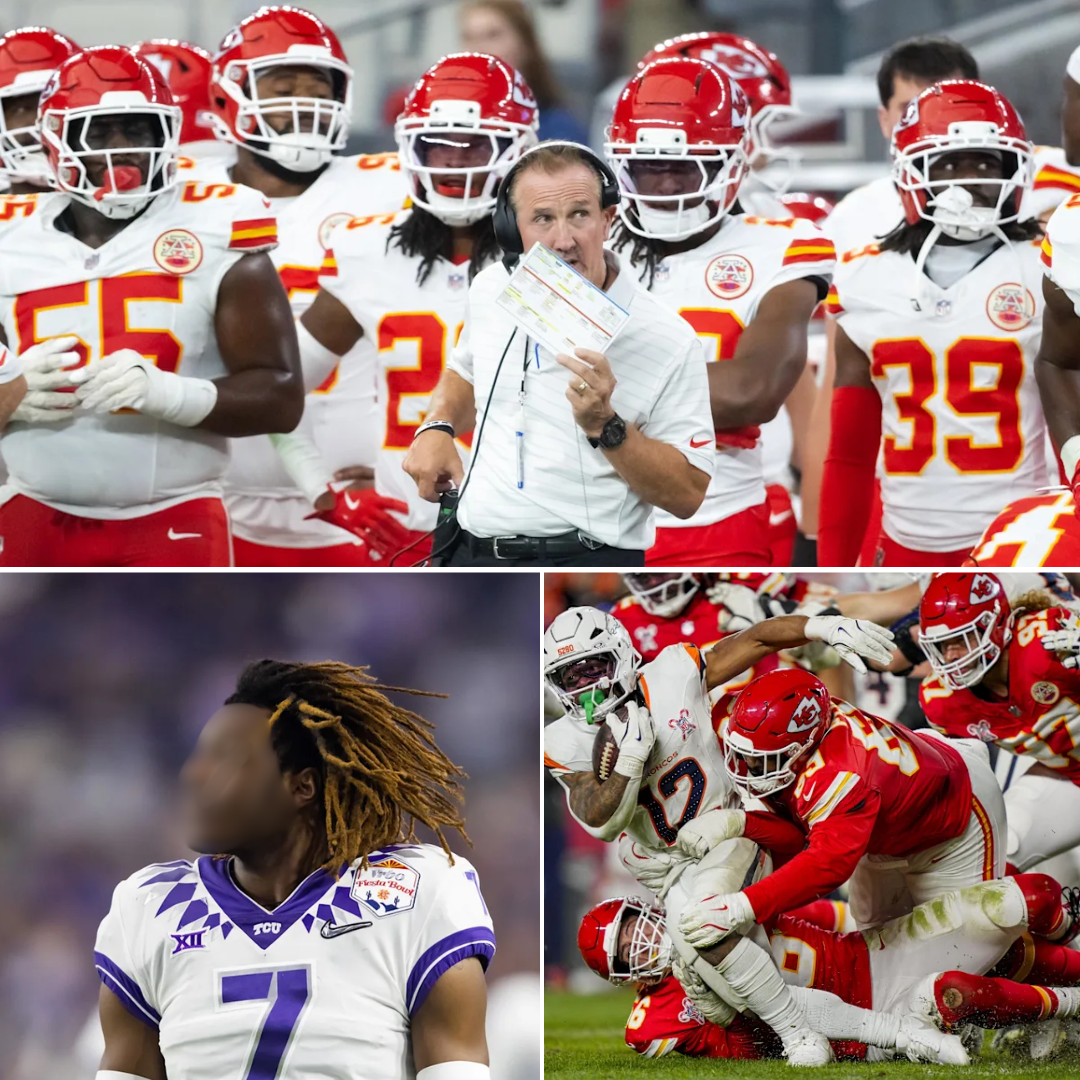
While most of the attention around the Kansas City Chiefs has stayed focused on the usual stars, one quiet roster move is suddenly starting to attract unexpected interest behind the scenes.
The battle brewing inside the Kansas City Chiefs secondary may look quiet from the outside — but behind the scenes, one of the strangest and most unpredictable roster fights of the offseason is already beginning to take shape.
And buried beneath the headlines surrounding stars, draft picks, and returning veterans is a name almost nobody saw coming.
D’Arco Perkins-McAllister.
For now, even many diehard Kansas City Chiefs supporters would struggle to recognize him. He was not selected during the NFL Draft. He did not arrive with national attention. There were no viral highlight reels dominating social media after his signing, no massive reactions from analysts, and no dramatic television breakdowns celebrating his upside.
Instead, he slipped into Kansas City almost unnoticed — another undrafted rookie fighting for survival in one of football’s most ruthless environments.
But sometimes, that is exactly where the most dangerous stories begin.
Because while the Chiefs continue chasing another Super Bowl with superstar quarterback Patrick Mahomes leading the dynasty, a very different kind of competition is unfolding elsewhere on the roster.
The secondary is suddenly wide open.
Opportunities exist.
Spots can be stolen.
And for fringe players desperate to change their lives, the timing could not be better.
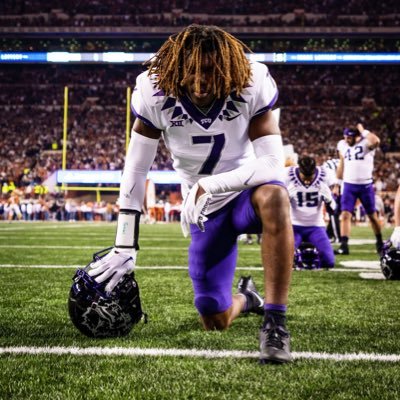
That is where Perkins-McAllister enters the picture.
At first glance, his football journey almost feels impossible to track. Over the past five seasons alone, the defensive back has worn uniforms for four separate programs, bouncing across the college football landscape in a career filled with transfers, uncertainty, reinvention, and constant adaptation.
For some NFL evaluators, that kind of path raises concerns.
For others, it reveals resilience.
And somewhere inside the Chiefs organization, someone clearly saw enough to give him a chance.
The former four-star recruit originally emerged from Tennessee carrying significant expectations. Back then, Perkins-McAllister was viewed as a promising young athlete with the size and physicality to become a major defensive weapon at the next level.
His first stop came at TCU, where he spent the 2021 and 2022 seasons attempting to carve out a role inside one of college football’s increasingly competitive defensive systems.
But like countless young players entering major programs, consistency proved elusive.
The flashes were there.
The long-term breakthrough never fully arrived.
Eventually, Perkins-McAllister transferred to University of New Mexico, where his journey took another unexpected turn. Instead of becoming an immediate breakout contributor, he spent time redshirting — effectively disappearing from mainstream attention altogether.
For many players, that would have marked the beginning of the end.
Football moves quickly. Attention spans are short. Once a player falls out of the spotlight, climbing back into relevance becomes brutally difficult.
But Perkins-McAllister kept moving.
And that persistence may ultimately become the very trait that saves his NFL dream.
After New Mexico, he landed at University of Tennessee at Chattanooga, where something suddenly clicked.
In just six games during the 2024 season, Perkins-McAllister exploded onto the radar with four interceptions, displaying the kind of ball-hawking instincts that defensive coordinators obsess over. Opposing quarterbacks began discovering that throwing near him carried risks.
For the first time in years, momentum started building.
Then came another transfer.
Another new defense.
Another unfamiliar locker room.
Another uphill battle.
His final college stop brought him to University of Louisiana at Monroe, and strangely enough, it may have been the most important move of his career.
Because at Louisiana-Monroe, Perkins-McAllister finally began looking like someone capable of forcing NFL scouts to pay attention.
His numbers jumped off the page.
Thirty-three tackles.
Four tackles for loss.
Four sacks.
Seven pass deflections.
A blocked field goal.
Suddenly, this overlooked defensive back was making impact plays all over the field.
Even more intriguing was the versatility behind those statistics. Perkins-McAllister was not simply sitting back in coverage waiting for passes to come his way. He attacked quarterbacks. Pressured the line of scrimmage. Contributed on special teams. Played with visible aggression.
That kind of versatility matters enormously for fringe NFL players.
Because undrafted free agents rarely survive by doing only one thing.
To earn a roster spot in Kansas City — especially on a championship contender — Perkins-McAllister will likely need to prove he can contribute everywhere.
Defense.
Kick coverage.
Special teams chaos.
Emergency depth.
Anything.
Everything.
And that is precisely why some inside league circles are quietly fascinated by him.
Physically, Perkins-McAllister stands apart from many defensive backs entering the NFL. At 5-foot-11 and roughly 200 pounds, he carries a thicker, more muscular build than the leaner cornerbacks teams often prefer in modern pass-heavy systems.
That extra size gives him advantages.
He can deliver harder hits.
He can battle physically at the line.
He can survive special teams collisions more effectively.
But the added weight also creates concerns.
Speed testing reportedly left scouts underwhelmed, particularly during shorter burst measurements like the 10-yard split. In a league obsessed with elite acceleration and fluid movement, those numbers matter — sometimes more than players want to admit.
And unfortunately for Perkins-McAllister, the NFL has become merciless about athletic metrics.
Every fraction of a second gets dissected.
Every weakness gets magnified.
Especially for players coming from smaller programs.
Some evaluators also remain cautious about the level of competition he faced during portions of his college career. Dominating weaker opponents can create inflated expectations, and NFL teams constantly wrestle with how much value to place on standout performances against lower-tier schools.
A big game against St. Francis, for example, does not automatically translate into success against NFL receivers running 4.3-second forty-yard dashes.

Still, the Chiefs clearly saw enough to move forward.
And that matters.
Because rookie minicamps are overflowing with hopeful players fighting for microscopic opportunities. Every year, dozens upon dozens of undrafted athletes arrive hoping to survive just long enough to earn another phone call, another practice rep, another preseason appearance.
Most vanish almost immediately.
Perkins-McAllister did not.
Somehow, amid the chaos, he caught Kansas City’s attention.
That alone separates him from countless others who never make it past the first round of evaluations.
And there may be a deeper reason why.
Special teams.
Inside the Chiefs organization, special teams coordinator Dave Toub remains one of the franchise’s most influential evaluators when it comes to back-end roster decisions. Toub has built a reputation across the NFL for identifying overlooked players capable of contributing in hidden areas most fans barely notice.
Kick coverage.
Punt blocking.
Field position battles.
Roster survival often begins there.
For undrafted defensive backs especially, special teams can become the fastest route onto an NFL roster. Coaches love defensive backs who tackle aggressively, adapt quickly, and embrace physical assignments without hesitation.
Perkins-McAllister appears to fit that mold.
His college experience on special teams likely played a major role in Kansas City’s interest, particularly when combined with his unusual wingspan and physical style of play.
And there is another subtle detail that may work heavily in his favor.
Experience learning different systems.
Most prospects spend their college careers inside one or two defensive structures. Perkins-McAllister has been forced to adapt repeatedly — TCU, New Mexico, Chattanooga, Louisiana-Monroe — each stop bringing new terminology, responsibilities, coaching philosophies, and expectations.
That constant transition can exhaust some players.
But it can also sharpen football intelligence.
NFL coaches value players capable of absorbing schemes quickly, especially when injuries force constant adjustments during the season. The mental flexibility developed through Perkins-McAllister’s chaotic college path could quietly become one of his biggest advantages in training camp.
Even so, the odds remain steep.
Kansas City’s secondary competition is becoming increasingly crowded, and several younger defensive backs have already generated more buzz entering the offseason. Names like DeShon Singleton and Xavier Nwankpa have attracted earlier excitement from fans and analysts eager to identify the next hidden gem.
That reality pushes Perkins-McAllister even further into the shadows.
For now.
But NFL history is filled with forgotten players who suddenly forced their way into relevance once pads came on.
Especially in Kansas City.
The Chiefs under head coach Andy Reid have repeatedly demonstrated a willingness to reward overlooked talent if players prove themselves consistently in camp. Draft status matters less once preseason performances begin stacking up.
Production wins.
Effort matters.
Versatility survives.
And sometimes, hunger changes everything.
Perkins-McAllister certainly has reason to be hungry.
His football life has been built almost entirely on uncertainty. Transfers, depth chart battles, disappearing momentum, rebuilding confidence — very little about his path has been stable.
Now he finds himself inside one of the NFL’s most demanding environments, competing for a roster spot on a team chasing championships instead of rebuilding patiently.
The margin for error could not be smaller.
One missed tackle might matter.
One blown assignment might matter.
One special teams mistake could erase weeks of progress.
That pressure crushes many players.
But occasionally, it creates unlikely breakthroughs.
There is also something strangely fitting about a player like Perkins-McAllister arriving in Kansas City at this exact moment.
The Chiefs dynasty has become synonymous with stars — Mahomes, Travis Kelce, sold-out stadiums, primetime drama, Super Bowl expectations. The spotlight rarely drifts toward the anonymous players buried deep on the roster.
Yet championship teams are often built on those exact individuals.
The hidden contributors.
The emergency replacements.
The special teams grinders nobody notices until suddenly they become essential.
Kansas City understands this better than most franchises.
Every season, the NFL’s elite teams uncover overlooked talent capable of changing games in subtle ways. A blocked punt. A clutch interception. A surprise defensive stop during a critical stretch.
Those moments frequently come from players casual fans barely recognize.
Could Perkins-McAllister eventually become one of them?
Right now, nobody truly knows.
His athletic limitations remain real.
The competition level questions remain real.
The roster battle remains brutal.
But the opportunity itself is equally real.
And that is sometimes all a player needs.
Perhaps the most remarkable part of Perkins-McAllister’s story is not his statistics or measurables — it is the simple fact that he refused to disappear.
Many players transfer once and fade away.
He transferred repeatedly and kept fighting.
Many players lose momentum after redshirt seasons.
He rebuilt his career anyway.
Many players never recover after slipping off major recruiting radars.

He kept chasing the NFL regardless.
That persistence alone deserves recognition.
Because the hardest step for most undrafted players is not making the roster.
It is getting someone to notice them at all.
Kansas City noticed.
Now comes the impossible part.
Training camp will expose every weakness. Preseason games will magnify every mistake. Coaches will search relentlessly for reasons to cut players as they trim the roster toward the regular season.
Nothing will be handed to him.
Not reps.
Not praise.
Not patience.
But buried beneath the noise surrounding Kansas City’s latest championship pursuit, Perkins-McAllister suddenly possesses something thousands of football players never receive.
A real shot.
Maybe it lasts only weeks.
Maybe it ends quietly before September.
Or maybe, somewhere between special teams drills and preseason snaps, an overlooked defensive back from Louisiana-Monroe begins forcing the Chiefs to reconsider everything they thought they knew about their secondary depth chart.
Right now, almost nobody is watching him.
That may not last much longer.