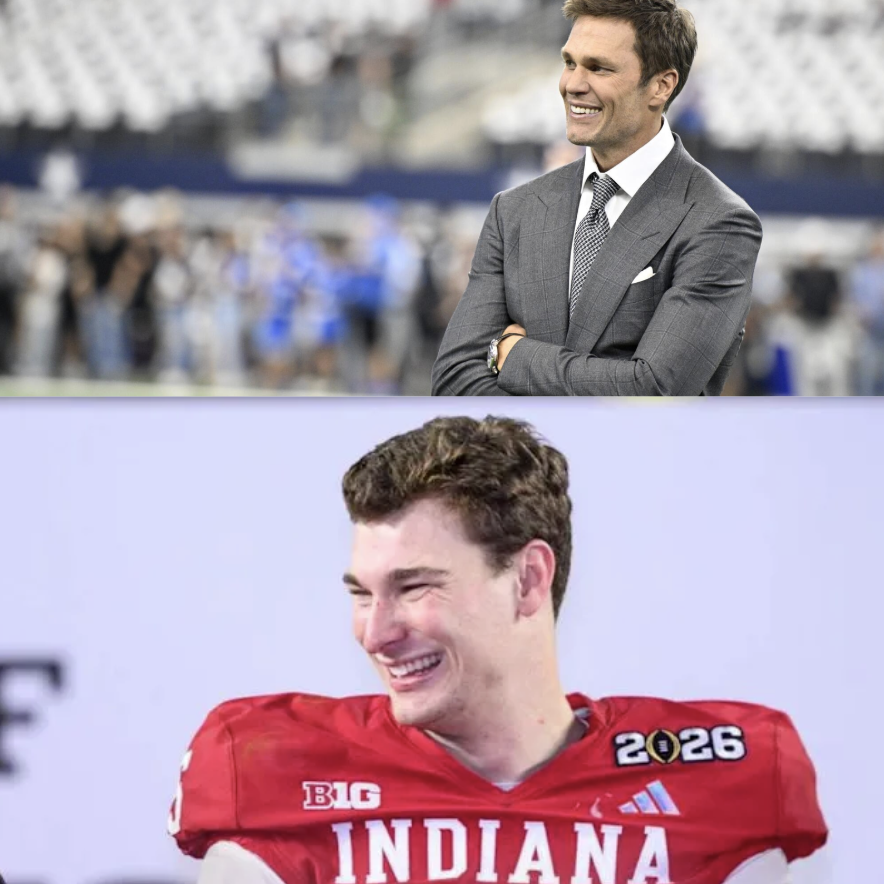
TOM BRADY’S “CODE”: CAN FERNANDO MENDOZA MASTER THE MENTAL SIDE OF PRO FOOTBALL?
Few names in football carry more weight than Tom Brady.
For more than two decades, Brady built a reputation not merely as a physically gifted quarterback, but as one of the most mentally disciplined players the sport has ever seen. While fans often remember the championships, comeback victories, and record-breaking performances, coaches throughout the league frequently point to something less visible as the true foundation of his success: his ability to process information faster than almost anyone else on the field.
That reality has fueled growing discussion around one of football’s most intriguing young quarterbacks, Fernando Mendoza.
As Mendoza continues his rise through the football world, many analysts believe the biggest question surrounding his future is not arm strength, athleticism, or leadership.
It is whether he can master the intellectual demands of a professional offense.
The comparison to Brady is inevitable.
Not because Mendoza plays exactly like the legendary quarterback, but because modern NFL offenses increasingly demand the same skills that helped Brady dominate the league for years.
The ability to identify defensive disguises.
The discipline to make correct decisions under pressure.
The patience to take short gains instead of forcing spectacular plays.
And perhaps most importantly, the willingness to treat football as a year-round mental challenge rather than a seasonal sport.
Former coaches often describe elite quarterbacking as a language.
Learning formations is vocabulary.
Learning coverages is grammar.
Learning how defenses adjust to specific situations is advanced literature.
The best quarterbacks eventually become fluent.
The rest spend years trying to catch up.
That is why so many evaluators remain fascinated by Mendoza’s development.
Physically, few question his talent.
He possesses the arm strength necessary for professional football.
He has demonstrated mobility inside and outside the pocket.
His accuracy and confidence have improved dramatically throughout his career.
Yet at the highest levels of football, physical talent rarely separates great players from merely good ones.
Mental processing does.
Brady became the ultimate example of that principle.
Throughout his career, opponents often remarked that it felt as though he knew what they planned to do before the snap.
Whether that perception was entirely accurate hardly mattered.
The reputation itself reflected the extraordinary preparation that became synonymous with his name.
Film study.
Situational awareness.
Relentless attention to detail.
Those qualities transformed Brady from an overlooked prospect into one of the most successful athletes in sports history.
For Mendoza, that standard creates both opportunity and pressure.
Every young quarterback dreams of becoming a franchise cornerstone.
Very few are asked whether they can reach the mental level associated with the greatest quarterback of all time.
The challenge facing Mendoza extends beyond memorizing playbooks.
Modern NFL offenses contain hundreds of concepts, adjustments, protections, and situational variations.
Quarterbacks must process all of it while facing defensive coordinators whose full-time job is creating confusion.
One missed coverage adjustment can result in an interception.
One incorrect protection call can lead to a game-changing sack.
One hesitation can completely alter the outcome of a season.
That reality explains why organizations increasingly evaluate quarterbacks based on decision-making rather than raw physical traits.
The league has learned that powerful arms alone do not guarantee success.
Processing speed matters.
Football intelligence matters.
Adaptability matters.
In many ways, those qualities have become the sport’s ultimate competitive advantage.
Several analysts believe Mendoza possesses the foundation necessary to thrive in that environment.
Supporters point to his calm demeanor under pressure.
His willingness to learn.
His reputation as a student of the game.
Those characteristics often prove just as valuable as any measurable athletic attribute.
Critics, however, note that transitioning to the professional level remains one of the most difficult challenges in sports.
College football presents complex defenses.
The NFL presents something entirely different.
Every defender is faster.
Every coordinator is smarter.
Every mistake becomes more costly.
History is filled with highly successful college quarterbacks who struggled to adapt to the professional game’s mental demands.
For that reason, patience may become Mendoza’s most important asset.
Brady’s legendary football intelligence did not emerge overnight.
It developed through years of preparation, repetition, mistakes, and experience.
The version of Brady that fans remember from championship runs was the result of a process measured in decades.
Young quarterbacks often face unrealistic expectations because observers compare them to finished legends rather than developing players.
Mendoza’s journey will likely require the same gradual progression.
Learning protections.
Understanding tendencies.
Developing chemistry with receivers.
Recognizing defensive patterns before they fully develop.
Those skills are rarely mastered immediately.
They are built through thousands of repetitions.
What makes the discussion so fascinating is that Mendoza appears to embrace that challenge.
By all accounts, he understands that physical ability alone will not determine his future.
The next generation of elite quarterbacks must become strategic thinkers as much as athletes.
That expectation continues growing every season.
As offensive systems become more sophisticated, the mental burden placed on quarterbacks increases accordingly.
Success increasingly belongs to players capable of processing enormous amounts of information in real time.
Brady represented the gold standard of that approach.
His career became proof that preparation and intelligence can elevate talent to historic levels.
Whether Mendoza eventually reaches that standard remains impossible to predict.
Few players ever do.
But the question itself speaks volumes about the expectations surrounding his future.
Fans are no longer asking whether he can throw the football.
They are asking whether he can think the game at the highest possible level.
That distinction may ultimately determine everything.
The next chapter of Mendoza’s career will not be written solely through highlight-reel passes or impressive statistics.
It will be written in meeting rooms.
Film sessions.
Practice fields.
And countless hours spent learning the invisible details that separate good quarterbacks from great ones.
Because in today’s NFL, the most valuable weapon is not always found in a player’s arm.
Sometimes it is found in the space between his ears.
And if Fernando Mendoza hopes to follow the path blazed by Tom Brady, mastering that part of the game may be the biggest challenge—and opportunity—of all.