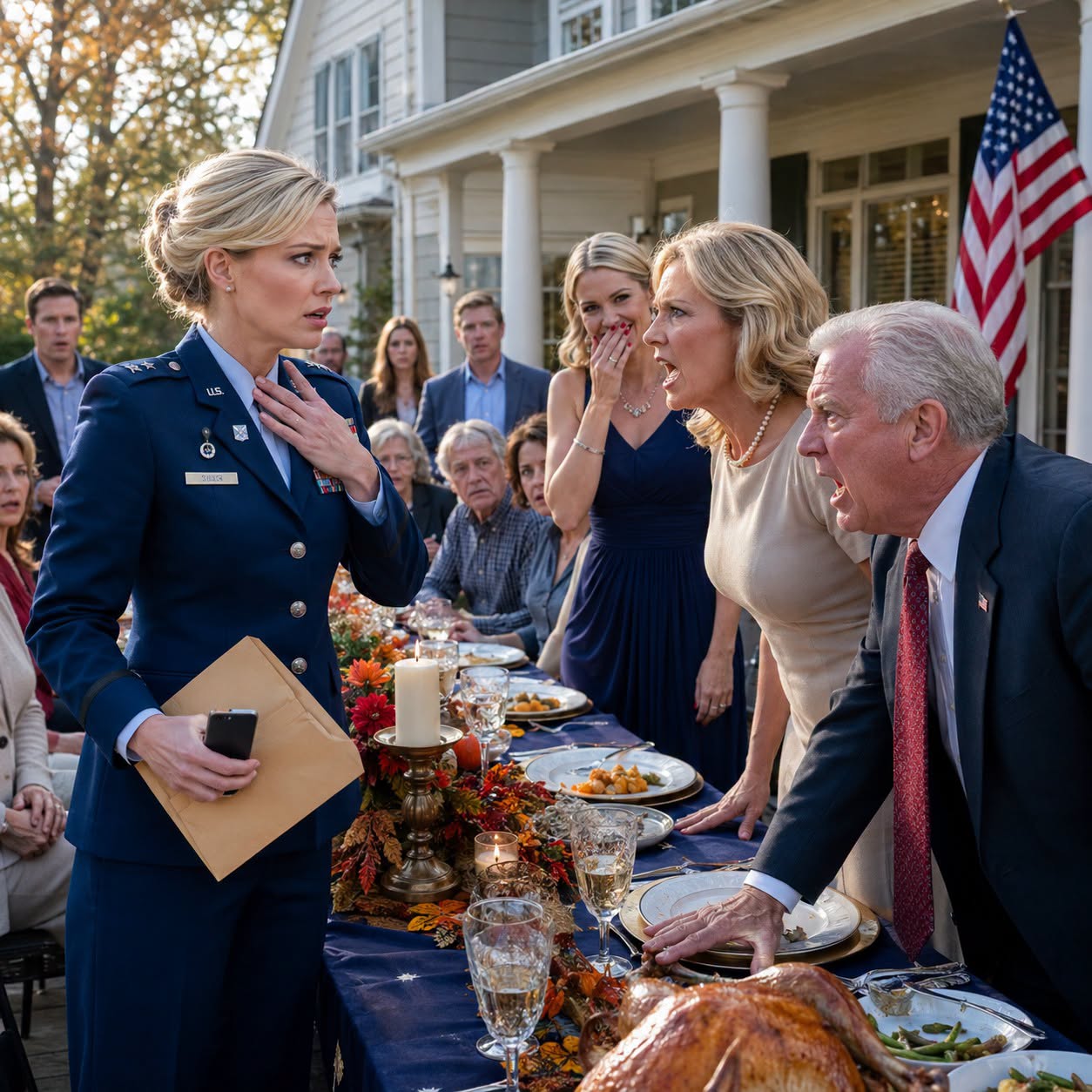
“Pay the hundred and fifty thousand, Abigail,” my mother said, her voice slicing through the murmurs like a blade through silk. “Or you’re dead to us.”
She stood at the head of the long oak table, butter knife still poised against her wineglass as if she’d been about to propose a toast to gratitude. Linda Hayes had always been a master of appearances: silver-blonde hair lacquered into submission, pearls resting against the high collar of her burgundy dress, and that practiced smile—warm from a distance, venomous up close. The Thanksgiving table groaned under the weight of porcelain and pretense. Fifty-four relatives filled the room like a jury assembled for judgment, their eyes gleaming beneath the golden spill of the chandelier. Steam rose from platters of roasted turkey and candied yams, but the air tasted of something sharper—expectation, resentment, and the brittle sweetness of family lies.
My father slammed his palm on the table. Crystal rattled. My younger sister, Sarah, hid her triumphant little smile behind a manicured hand, her diamond engagement ring catching the light like a trophy already claimed.
They thought they had me cornered. The quiet Air Force major. The reliable one. The woman who had spent years swallowing silence in exchange for scraps of belonging. They had no idea that the real reckoning had been waiting in a battered gray box on my bookshelf for fourteen years.
“You will wire the first fifty thousand by Friday,” my mother continued, as casually as if she were asking me to pass the gravy boat. The room fell into a stunned hush. Forks hovered mid-air. Aunts and uncles exchanged glances, but no one spoke.
Sarah sat near the fireplace in a cream sweater that probably cost more than my first month’s rent after basic training. She lowered her gaze like the demure bride-to-be, but I caught the flicker of satisfaction in her eyes—the same look she’d worn since childhood whenever the spotlight tilted her way.
I stared at the printed wedding proposal my mother slid beside my plate. Lakefront ceremony. French lace gown flown in from Paris. Imported orchids. A live string quartet. Luxury accommodations for the groom’s sprawling family. The numbers blurred.
“You want me to cover the entire bill?” My voice came out steadier than I felt. A laugh—short, hollow—escaped before I could stop it. Not amusement. Disbelief, raw and disorienting, like waking from a nightmare only to find it had followed you into daylight.
My fork slipped from my fingers and clattered against the hardwood. No one moved to retrieve it.
Aunt Marlene crossed her arms. “You have that military salary. What else are you saving for?”
The words landed like a slap. Military money. As if the endless nights I’d spent in flight suits, heart hammering against G-forces, as if the friends I’d lost to desert sands and invisible wounds, as if every deployment where I buried fear beneath duty and protocol—that had all been some grand lottery ticket.
I scanned the table. “Does anyone here actually believe this is reasonable?”
Silence answered. The kind that confirmed everything.
My mother moved behind me, her fingers digging into my shoulder with surprising strength. Her perfume—something floral and cloying—mixed with the scent of roasted turkey and hairspray. “After everything we sacrificed to raise you,” she whispered, breath hot against my ear, “this is the least you can do.”
To keep you. The phrase echoed in my mind. I had heard variations of it my whole life: the difficult child, the one who asked too many questions, the one who never quite fit the golden mold Sarah occupied so effortlessly.
I remembered the diner shifts at sixteen, handing over every paycheck while my parents praised Sarah’s dance recitals. The college applications I abandoned because “we can’t afford it.” The deployments where I wired money home so Dad wouldn’t lose the house, only for Sarah’s wardrobe to grow and the house to receive fresh renovations.
For thirty years, I had bled quietly to earn a seat at this table.
Now they wanted my life savings as tribute.
The room tilted. Tactical breathing kicked in instinctively—four seconds in, hold, four seconds out. The same technique that had kept me alive during emergency descents and incoming threats. Here, it kept my hands from trembling.
Across the room, Sarah’s shoulders shook with theatrical sobs. But her eyes sparkled with victory.
Something inside me settled. Not rage. Clarity. Cold, crystalline, and final.
I placed my napkin beside my plate and stood.
“Sit down,” my mother hissed, tightening her grip.
I shrugged her hand away with the precision of someone who had trained for close-quarters resistance. “I need air.”
Sarah’s sobs escalated into a wail. “You always ruin everything!”
My father jabbed a finger toward my chair. “Apologize. Now.”
“No.”
One word. Quiet. Absolute. The kind of command I’d issued in operations rooms where lives hung in the balance.
I walked past the fifty-four faces—some shocked, some averted in silent complicity. Freezing rain stung my cheeks as I crossed the driveway to my truck. My phone vibrated relentlessly in my pocket. I flipped it face-down and drove into the night.
Back in my apartment, triple deadbolts clicked into place like armor sealing. Only then did my legs betray me. I slid down the wall, hardwood cold against my back, as the phone buzzed against my ribs like a dying insect. Dozens of missed calls. Messages that grew uglier with every ping.
Selfish. Embarrassing. Cheap.
I silenced it and let my gaze drift across the shadowed living room. There, on the bottom shelf of the bookcase, sat the battered gray metal box. Grandma’s final gift.
She had been my anchor in a childhood where love felt conditional and fleeting. While my parents chased Sarah’s pageants and parties, Grandma worked night shifts at the laundry, her hands raw from bleach, her shoes worn through. She fed me soup from dented cans and told me stories of resilience that no one else bothered to share.
At sixteen, beside her hospice bed, her frail fingers had pressed a brass key into my palm. “You’ll need to remember what really happened,” she’d whispered.
I had kept the box sealed, afraid of what truths it might exhume. Tonight, the fear no longer mattered.
The lock clicked open like a confession.
Photographs spilled out first. Sarah at seven, plastic crown gleaming atop a three-tiered birthday cake. In the background, twelve-year-old me hauled garbage bags into the freezing night.
Then the documents. An educational savings account in my name—$65,000, built from Grandma’s pennies and overtime. Drained systematically over two years. My father’s handwriting catalogued the thefts: Sarah’s car, dance camps, sweet sixteen extravaganzas, home renovations. My future, bartered away for her spotlight.
The diner miles walked in snow. Boots held together with duct tape. Ramen eaten in the dark to keep bills low. They hadn’t been poor. They had been predators wearing the mask of family.
At the bottom lay Grandma’s note, her handwriting shaky but resolute:
Abigail, if you’re reading this, they’ve finally asked for too much. In this family, sacrifice means you bleed so Sarah can feast. Do not let them turn your kindness into a contract. Defend yourself.
My phone lit up again. A text from Sarah:
Mom is hyperventilating because of you. Apologize, pay up, and stop being cheap. Grandma left you plenty anyway.
Grandma left you plenty.
The inheritance I had never seen. The final thread of deception.
I photographed everything—statements, note, Sarah’s message—and secured it in an encrypted folder. The frightened girl inside me still whispered for explanations, for one last chance at reconciliation.
But Major Abigail Hayes knew better. Evidence was armor. Explanations were traps.
At dawn, after 312 missed calls and a voicemail from my father demanding my surrender, I made the call that would ignite the war.
“Colonel Vance,” I said, voice steady as steel, “I need the name of the most ruthless attorney you know.”
His answer was the spark.
The real storm was only beginning.
PART 2
Colonel Vance didn’t hesitate. “Eleanor Whitaker,” he said. “She eats families like yours for breakfast. Tell her I sent you.”
By noon the next day, I sat across from Eleanor in a sleek downtown office that smelled of polished leather and quiet power. She was in her late fifties, sharp-eyed and silver-haired, with the kind of stillness that made courtrooms hold their breath. I laid everything out: the box, the statements, the messages, the inheritance hint. No emotion. Just facts—the language I had been trained to trust.
She listened without interrupting, then leaned forward. “This isn’t just theft, Major. This is a pattern of financial abuse spanning decades. We can freeze accounts, demand restitution, and—if the will surfaces—unravel whatever they’ve been hiding. But first, we send a message.”
The letter went out that afternoon. Certified. Ice-cold. It demanded full accounting of Grandma’s estate, immediate repayment of the drained college fund with interest, and a cease-and-desist on all harassment. Copies were cc’d to my parents’ attorney of record and the local prosecutor’s office.
I expected silence. I received detonation.
The first blow came through Sarah’s Instagram. A tear-streaked video, filmed in the same dining room where everything had shattered. She sobbed about her “selfish sister” who was “destroying our family over jealousy.” Comments flooded in from relatives and strangers alike: Gold-digger. Ungrateful. Military brat who thinks she’s better than everyone.
My mother followed with a group text to the entire family network: Abigail has chosen money over blood. Pray for her soul.
I didn’t respond. Instead, I forwarded everything to Eleanor.
The real storm broke three days later.
My father showed up at my apartment building with two uncles in tow, pounding on the lobby door like they still owned my loyalty. Through the security camera, I watched his face twist with the same righteous fury that once sent me running as a child.
“Open this door, Abigail! We raised you better than this betrayal!”
I called building security instead. They escorted the trio out while neighbors watched from cracked doors. The humiliation burned in my father’s eyes as he was led away. For the first time, I saw it—not power, but fear.
That night, Eleanor called. Her voice was calm, but I heard the hunter’s edge beneath it. “We found the will. Your grandmother filed it with a different attorney two weeks before she died. It leaves everything—the house she secretly bought, investments, and a trust—to you. Over four hundred thousand dollars total. Your parents contested it quietly and lost. They never told you.”
The numbers hit like altitude change—my ears rang. Four hundred thousand. A lifetime of night shifts and sacrifice, meant for me.
“They’ve been living off it for years,” Eleanor continued. “Sarah’s wedding? Financed partly by your inheritance. They forged documents. We have proof.”
I closed my eyes, leaning against the kitchen counter. The frightened daughter inside me fractured a little more. The officer sharpened.
“File it all,” I said.
The climax arrived at the annual family Christmas fundraiser my mother organized every year—a glittering event at the community hall where she played benevolent queen. I hadn’t planned to go, but Eleanor advised a controlled appearance. “Let them see you unbroken.”
I walked in wearing my dress uniform, medals gleaming under the lights. The room went still, just like Thanksgiving. Fifty-plus faces turned. My mother’s smile froze mid-sentence as she greeted guests.
Sarah spotted me first. Her face drained of color.
I crossed the room slowly, Eleanor at my side like silent artillery. My father stepped forward, voice low and threatening. “You dare show your face here after what you’ve done?”
I met his eyes—those eyes that once terrified me. “I dare because the truth finally does.”
Eleanor slid a thick folder onto the nearest table. “Mr. and Mrs. Hayes, this is a formal demand for restitution of $312,000 plus interest, plus notice of intent to pursue criminal charges for fraud and forgery. The contested will has been validated. The house, the accounts—everything your mother intended for Abigail—is now under her control.”
Gasps rippled through the crowd. Aunt Marlene clutched her pearls. Cousins who had once begged me for loans looked suddenly ill.
My mother’s voice rose, shrill and cracking. “This is a lie! She’s twisting everything! After everything we did for her—”
“No,” I cut in, my voice carrying the quiet authority of command. “After everything I did for you. The diner money. The deployments. The taxes. The rent. You stole my future to buy hers. And you still wanted more.”
Sarah stepped forward, tears streaming—real ones this time, born of panic. “Abby, please. We’re family. Don’t do this.”
For a heartbeat, the old wound ached. The little girl who just wanted to belong whispered to forgive, to pay, to keep the peace.
But I had bled enough.
I looked at my sister—truly looked—and saw the crown she still wore, built on my sacrifice. “Family doesn’t keep balance sheets of love and then demand payment with interest. You made your choice at Thanksgiving. Now I’ve made mine.”
My father lunged forward, face purple with rage. “You’ll regret this—”
Security moved in. Cameras flashed—someone had been livestreaming. The entire spectacle unfolding in real time.
As chaos erupted around us—relatives shouting, my mother hyperventilating into a chair, Sarah clutching her fiancé’s arm—I felt something I hadn’t in decades.
Freedom.
But as Eleanor guided me toward the exit, my phone buzzed with an unknown number. I answered.
A gravelly voice on the other end spoke words that turned the victory to ice.
“Major Hayes? This is Detective Harlan. We need to talk about your grandmother’s death. New evidence suggests it wasn’t natural causes.”
The room spun.
The war had just grown far darker than I imagined.
PART 3
The detective’s words hung in the air like smoke after an explosion. I stepped outside the community hall into the biting December wind, phone pressed to my ear, my dress uniform suddenly feeling too tight against my chest.
“Grandma’s death?” My voice barely carried. “She had advanced cancer. Hospice signed off on it.”
Detective Harlan’s tone was measured, careful. “New evidence from a reopened cold file. Your grandmother’s morphine levels were inconsistent with her prescribed dosage. We found records suggesting someone had access to her medication in the final weeks. Your parents were her primary caregivers during that time.”
The parking lot lights blurred. Fourteen years of grief cracked open, revealing something sharper beneath—betrayal laced with poison.
Eleanor placed a steadying hand on my arm. “We’ll handle this together.”
The weeks that followed were a controlled unraveling.
My parents’ attorney tried every maneuver—delay tactics, character assassination, even leaking old family photos to paint me as the ungrateful daughter who abandoned them in their “time of need.” But Eleanor Whitaker was relentless. Court filings piled up like precision strikes. Forensic accountants traced every dollar of Grandma’s estate. The forged documents crumbled under scrutiny. Bank records showed transfers from my inheritance into accounts linked to Sarah’s lifestyle—vacations, designer clothes, even the down payment on the lakefront wedding venue.
At the preliminary hearing, the courtroom was packed. My mother sat rigid, her pearls replaced by a simple black dress meant to evoke sympathy. My father stared straight ahead, jaw clenched. Sarah avoided my eyes entirely.
When the judge reviewed the evidence of financial elder abuse and the suspicious morphine discrepancies, his gavel came down like final judgment.
Restitution ordered in full. Criminal charges referred to the district attorney. The contested will upheld without question.
Outside the courthouse, snow fell softly, blanketing the steps in quiet white. My mother approached me one last time, her face gaunt, the gracious mask finally shattered.
“You’ve destroyed us,” she whispered. “All for money.”
I looked at the woman who had once defined my worth by how well I could disappear. “No, Mom. You destroyed yourselves the day you chose theft over love. The day you chose Sarah’s crown over my future. I just stopped letting you.”
Sarah stood a few feet away, mascara streaked, no longer the victorious bride. She opened her mouth as if to speak, but nothing came. The sister I had protected for so long was a stranger now—entitled, hollow, and finally exposed.
I turned and walked away without looking back.
The investigation into Grandma’s death moved slowly, as such things do. Toxicology re-examinations and witness statements painted a damning picture: my father adjusting medication “to ease her pain,” my mother dismissing hospice nurses’ concerns. Whether it was deliberate murder or reckless negligence born of greed, the courts would decide. Either way, justice—cold and methodical—closed in.
I sold the house Grandma had secretly bought for me. The proceeds, combined with the recovered funds, went into a trust in her name. Part funded scholarships for young women pursuing military or trade careers—the ones who came from families that saw ambition as a threat. The rest built a quiet life for myself: a small cabin near the mountains, away from chandeliers and demands, where the only noise was wind through pine trees and the occasional roar of a jet overhead.
Months later, I stood at Grandma’s gravesite on a clear spring morning. Fresh flowers rested against the stone. No relatives. No performances. Just me, the brass key still on my chain, and the weight of truth finally lifted.
Colonel Vance had once told me that the hardest battles are the ones fought against the people who were supposed to protect you. He was right. But surviving them forged something unbreakable.
My phone buzzed—Eleanor, confirming the final settlement. I smiled faintly and deleted the message without reading the numbers. Some victories aren’t measured in dollars.
As I walked back to my truck, the sun warmed my face. For the first time in thirty years, I wasn’t carrying anyone else’s debts.
I was finally, completely, free.
The End