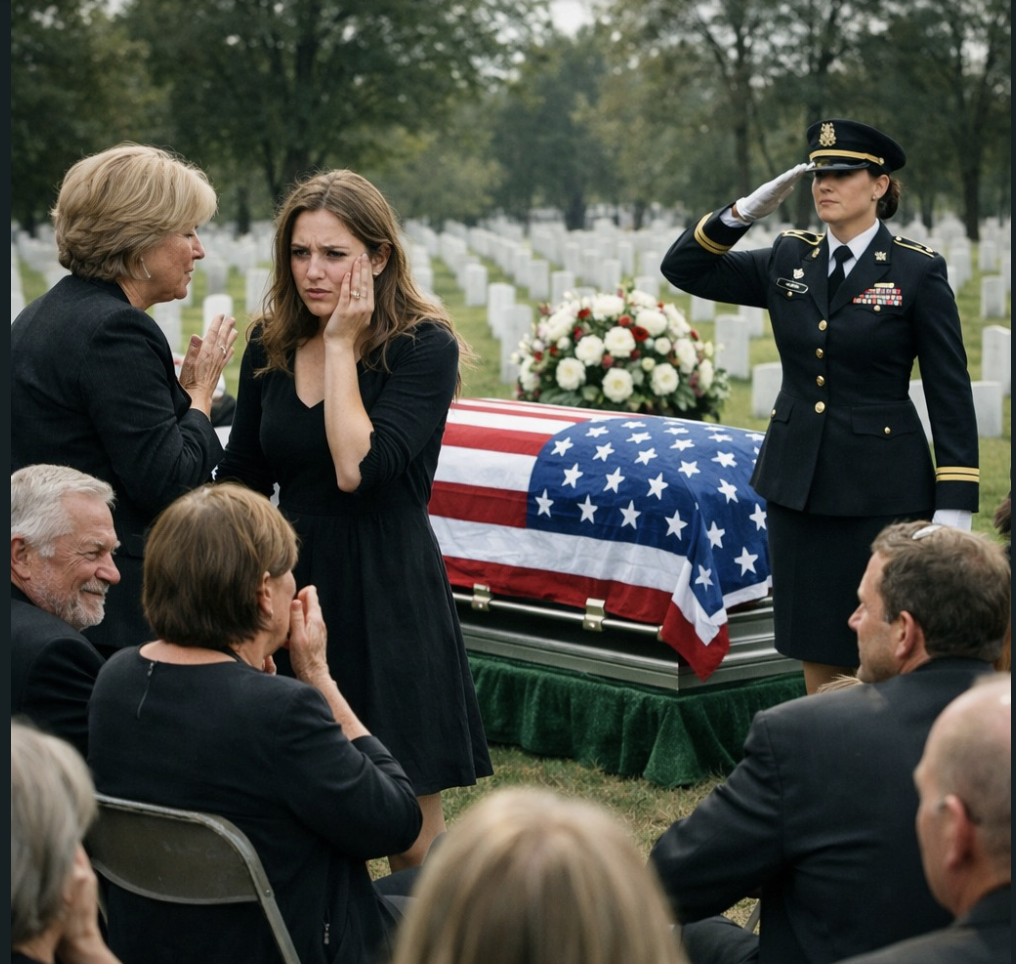
My mother hit me at my father’s funeral—she had no idea I was a Major General… until the truth came out
“You’re No Soldier—Just A Helper,” My Mother Sneered At My Father’s Funeral, Then Slapped Me Across The Face. Everyone Smirked. Then A Woman In Uniform Stood, Saluted, And Said: “Respectfully—Major General Bruce Is A War Hero.”
Part 1
The slap sounded sharper than it should have.
Not loud, exactly. Just clean. A dry crack in a room full of polished wood and people pretending not to hear ugly things.
A second earlier I’d been standing in my father’s library, staring at the place above the fireplace where my West Point graduation photo used to hang. My father had kept it there for years, right in the middle of his shelves of military history and old leather-bound biographies. Now the photo was gone. In its place hung a fresh oil portrait of my brother Julian, chin tipped up, one hand in his pocket, looking like he’d personally invented money.
Then my mother’s white-gloved hand crossed the space between us and landed on my cheek.
The sting came hot and immediate. I tasted copper where my teeth clipped the inside of my mouth. I didn’t move.
My mother, Saraphina Blackwood Bruce, stood breathing hard in front of me, her pearl earrings trembling, her face beautiful in the way expensive things can still be beautiful even when they’re cold. She had spent the whole morning moving through our house in Greenwich like a queen visiting her own court. White lilies overflowed from silver urns in the foyer. Caterers in black jackets floated past with trays of champagne nobody really wanted. Men in dark suits talked in lowered voices about legacy, boards, markets, and my father’s “remarkable life,” as if grief were just another subject you could manage with the right tone.
I had come in uniform.
That had been my first offense.
My Army service uniform felt stiff across my shoulders after a long day of condolences and handshakes. The dark blue wool held the faint smell of winter air and starch. My ribbons sat in perfect rows. Two silver stars marked my rank. To anyone who knew the difference, they meant something. To my mother, they might as well have been decorative buttons.
She’d made that clear within ten minutes of my arrival.
Senator Thompson, one of my father’s old friends, had crossed the foyer to take my hand in both of his. His eyes had gone genuinely soft when he looked at me.
“General Bruce,” he said. “Your father talked about you all the time. He was proud of you in a way that lit up the room.”
Before I could answer, my mother drifted to my side with the smell of gardenia perfume and diamonds cold against her wrist.
“Senator, you are too kind,” she said, smiling that polished smile she used when she was about to cut someone without drawing blood. “Heidi has always liked staying busy. She helps out with military administration. It gives her structure.”
There had been a tiny pause after that. A tiny inhale from somebody nearby. The senator’s mouth tightened. He knew enough to understand he’d just watched a mother erase her daughter in public.
So did I.
I stood there with my hands clasped behind my back, parade rest in a house that had never once felt like mine, while my mother chatted lightly about grief and the weather and how “children express themselves in all kinds of ways.”
Then, the first moment we were out of the main room, she grabbed my arm and dragged me into the library.
“I told you not to come dressed like that,” she hissed.
I looked at her. “This is my dress uniform, Mother.”
“That costume,” she snapped. “On this day, of all days.”
“This day is exactly why I wore it.”
She laughed, and it was ugly. Not loud. Just ugly. “Don’t be dramatic, Heidi. You are not what you think you are.”
I felt something in me go very still. “And what do I think I am?”
She looked me over from collar to shoes, slow and contemptuous, like she was assessing a stain on silk. “A helper. A glorified assistant with medals. You move paper and play soldier and embarrass this family in front of people who matter.”
I should have walked out then. A sane woman probably would have. But I made the mistake I’d been making since childhood. I stayed, hoping maybe this time she’d say one honest thing.
“You never even bothered to learn my rank,” I said.
Her nostrils flared. “Don’t be absurd.”
“Do you know what two stars mean?”
“What they mean,” she said, stepping closer, “is that you found a way to wear authority without ever becoming truly important.”
That was when she slapped me.
I kept my eyes on her for one beat, then looked past her shoulder and saw Julian in the doorway.
He stood there with one hand around a glass of Macallan, watching. Not shocked. Not embarrassed. Just mildly inconvenienced, like the whole thing was running a little longer than expected. When our eyes met, he gave the smallest shrug in the world and took a sip.
That shrug hurt more than the slap.
Because it confirmed something I’d spent half my life trying not to name. In that house, I wasn’t misjudged. I was designated. Assigned a role. Julian was the heir. My mother was the keeper of appearances. I was the thing they tolerated until I threatened the story they told about themselves.
My cheek burned. The room smelled like old paper, scotch, fireplace ash, and my mother’s perfume. Outside the half-open door, I could hear the muffled rise and fall of funeral voices, silverware tapping china, somebody laughing too loudly in the dining room because rich people always laugh too loudly around death.
My mother lifted her chin, waiting.
Waiting for tears, maybe. Waiting for an apology. Waiting for me to finally collapse into the obedient, lesser version of myself she had preferred since I was old enough to notice the difference between how she looked at Julian and how she looked at me.
Instead I noticed details.
The oil paint on Julian’s portrait still had that faint chemical smell of something newly varnished. A drop of wax had hardened on the library mantel beside one of my father’s campaign coins. My mother’s right glove had a tiny loose thread near the wrist. Julian’s wedding band from his engagement dinner—temporary, ceremonial, more symbol than marriage—glinted when he shifted his glass.
My mind did what training had taught it to do under pressure. It narrowed. Organized. Assessed.
Objective: survive the engagement.
Threats: hostile family, no allies in room, emotionally compromised environment.
Assets: discipline, rank, truth.
My mother saw the calm settle over my face and mistook it for surrender.
“Take that uniform off before you come back out there,” she said. “I will not have you shame your father’s memory.”
I looked at her for a long second.
“This uniform honored him,” I said quietly.
“No,” she said. “It advertised you.”
Julian gave a soft, irritated exhale from the doorway, as if we were both making a scene in his house instead of our father’s.
And that was the moment something shifted inside me.
Not broke. Shifted.
Like a heavy mechanism finally dropping into place.
All my life I had stood in rooms like that one, trying to win tenderness from people whose idea of love was ownership. I had tried excellence. Silence. Distance. Forgiveness. Achievement. Endurance. None of it had changed the basic terrain. My mother didn’t want to understand me. Julian didn’t want to see me. They wanted my absence, or my usefulness, whichever was easier.
I touched the side of my face once, lightly. It was already swelling.
Then I met my mother’s gaze and saw, maybe for the first time, what she actually was when the performance fell away: not powerful, not elegant, not even particularly brave. Just frightened. Frightened of anything she couldn’t rank, display, or control.
“You made a mistake,” I said.
Her brows snapped together. “Excuse me?”
She honestly didn’t know. That was the part that almost made me laugh. She had spent my entire adult life dismissing my career as if it were volunteer work, social camouflage, something vaguely embarrassing that kept me from embarrassing her in other ways. She had never asked what command meant. Never learned what those stars on my shoulders represented. Never cared enough to understand that while she was arranging flowers and seating charts, I had led divisions, made decisions that sent people home or failed to, stood in rooms where one wrong word changed who lived through the hour.
“You think this is a family tantrum,” I said. “It isn’t.”
Julian straightened a little in the doorway.
My mother’s mouth tightened. “Don’t threaten me in my own house.”
I looked around the library. My father’s library. My father’s books. My father’s fireplace. My father’s coin rack, compass collection, and the faint groove in the desk where his wedding ring used to tap when he was thinking.
Then I looked back at her.
“You just struck a general,” I said. “And you still have no idea what battlefield you’re standing on.”
For the first time all day, she had no immediate reply.
Out in the hallway, I heard footsteps coming toward the library, then hesitating outside the door. Someone knew enough not to enter.
Good.
Let them wonder.
I walked past Julian without brushing him, opened the door, and stepped back into the house full of lilies, whispers, and inherited lies. My cheek throbbed. My chest felt hollowed out and lined with steel.
My father was dead. My mother had declared herself. My brother had chosen his side with a shrug and a glass of scotch.
And all I could think, as I crossed the foyer under the chandelier he used to complain was too gaudy, was this: if they had treated a stranger with more respect than they’d ever shown me, what exactly had my father spent his life trying to protect me from?
Part 2
The war didn’t start at my father’s funeral.
That was just the first time I stopped pretending it wasn’t a war.
A week after the service, I found myself remembering my eighteenth birthday because pain has a way of circling back to its original shape. I was in my apartment in Alexandria by then, but the memory came with perfect clarity anyway: the sunroom in the Greenwich house, the glass walls hazy with spring pollen, my mother at the marble console trimming pale pink roses as if every flower had personally disappointed her.
I stood there with my West Point acceptance letter in both hands, trying not to smile too hard.
The paper felt thick and official. I’d opened it in the driveway because I couldn’t wait until I got inside. My hands had actually shaken. I had worked for it like people work for oxygen. Grades. Fitness scores. nomination interviews. endless forms. I knew what it meant. Not just school. Not just prestige. A doorway.
I held the letter out. “I got in.”
My mother didn’t even set down the shears. She glanced at the crest, then at me.
“Well,” she said, “at least now you’ll have someplace to do all that rough work you like.”
I remember blinking. “Rough work?”
She snipped another stem. “Menial, physical, whatever they call it. Marching around. Carrying things. It’s better than sitting idle.”
That was it. No hug. No congratulations. No pride. Just casual reduction, like she was assigning a use to an object.
I stood there long enough to realize nothing else was coming.
When I turned to leave, I almost walked into my father in the doorway. Colonel Sterling Bruce, retired, six feet two, shoulders still broad, hair already silvering at the temples, eyes so blue they always looked clearer than the sky. He had heard enough to understand what had happened because he only flicked one glance at my mother before looking back at me.
“Get your coat,” he said.
My mother frowned. “Sterling, luncheon is in twenty minutes.”
“We’ll be back when we’re back.”
He drove me two hours south in his old dark green Range Rover with the cracked leather seat and the heater that worked when it felt like it. We didn’t go someplace polished. We didn’t go to the kind of restaurant my mother would have approved of with little towers of food and waiters who whispered about wine.
He took me to Ben’s Chili Bowl in D.C.
We sat on red vinyl stools with the smell of grilled onions, spice, and hot grease in the air. He ordered two half-smokes and fries and a slice of pie to split. I can still see the steam rising off the chili, still remember the paper napkin sticking slightly to my damp fingers, still hear the radio behind the counter playing old soul music too low to name.
He waited until I’d taken the first bite.
Then he nodded at the acceptance letter folded beside my tray and said, “Don’t you ever let anybody convince you your dream is a small one because they can’t recognize it.”
I swallowed hard. “She thinks I’m going there to be useful in the background.”
He snorted. “Your mother thinks the center of every universe has a guest list.”
That made me laugh, and he smiled too, the tired crooked smile I trusted more than almost anything.
“You earned this, honey,” he said. “Not because of the name on the envelope. Because of what you did before the envelope ever arrived.”
We didn’t need to say anything after that for a while. The heat from the grill, the clatter from the kitchen, the ordinary noise of that place—it all felt more like celebration than any ballroom ever had.
Three days later, my brother Julian got accepted into a perfectly respectable, perfectly unremarkable business program, and my mother threw a reception at the yacht club that looked like a small royal wedding.
White tent. String quartet. Ice sculpture. Imported flowers. My mother in a silver dress touching Julian’s arm every thirty seconds like she was presenting him to the world and the world ought to be grateful.
“My son is going to build something extraordinary,” she told people.
I was standing beside a catering table trying to make a plate out of the last deviled eggs when I heard her say, “Julian understands leadership.”
She said it while looking right at me.
I learned then that contempt can be delivered with a champagne smile.
Years later, in Kandahar, I finally understood it wasn’t personal in the way I had thought. It was ideological. My mother valued visibility. Prestige. Influence. A life she could explain in three polished sentences to people she wanted to impress. Military service only interested her when it appeared at galas or on Memorial Day podiums. The actual thing—dust, fear, responsibility, sacrifice, the kind of leadership that stains you—she found vulgar.
I was twenty-nine when Private Miller died.
Nineteen years old, Ohio kid, freckles across his nose, bad luck with card games, good laugh. He kept a photo of his high school girlfriend tucked under the lining of his helmet. An IED took him on a road he had driven ten times before. One second he was making fun of our coffee. The next second I was kneeling in sand and smoke with blood on my gloves and the flat metallic taste of shock in my mouth.
That night I made the call to his parents.
After that, I called home.
I don’t know why. Habit, maybe. Hunger. Some idiot part of me that still wanted my mother to say the words every daughter wants at least once: I’m proud of you. Are you okay?
Her face came up on my laptop screen in pixelated blocks. She was in her dressing room. I recognized the mirrored closet behind her.
“Heidi,” she said immediately, leaning closer, “your skin looks terrible. Are they not giving you proper moisturizer over there?”
I just stared.
My boots were still dusted in Afghan dirt. I’d been up for thirty-one hours. A boy under my command was dead. I could hear generators outside the tent and somebody two cots down throwing up in a trash can from stress and bad chow.
Behind my mother, Julian wandered into frame with a grin and a glass of something amber.
“Hey, sis,” he said. “Guess what I bought.”
I don’t remember if I answered.
“Porsche,” he said proudly. “A 911 Turbo. It’s insane.”
He turned the camera so I could see the key fob in his palm like that was a sacred object and not a piece of metal.
I ended the call without speaking.
The silence after was the kind that presses on your eardrums. But it was cleaner than their voices.
That was the night I stopped expecting them to meet me where I lived.
Not physically. Morally.
My father was different. Always had been. Not perfect. He didn’t fight my mother often enough for my sake. He could withdraw into silence and let peacekeeping do the work courage should have done. But he saw me.
One summer when I was sixteen, before West Point, before deployments, before any of it had hardened into fact, he took me camping in Shenandoah. We lay on our backs outside the tent with the smell of pine and damp soil rising around us. The night air had a bite to it. Somewhere nearby, a creek kept moving over stone.
He pointed up.
“You know what your mother likes?” he asked.
“Constellations she can name in front of people?”
He laughed softly. “Bright things. Obvious things. Big stars. But navigation doesn’t happen because something is flashy. It happens because something is steady.”
He told me then about the Four Chaplains in World War II, how they gave away their life jackets and went down arm in arm. Not famous in the way politicians are famous. Not glamorous. But real.
“Be a dim star,” my father said. “The kind somebody can find when they’re lost.”
At the funeral, standing in the library with my cheek still stinging, that memory came back so hard it felt like someone had put a hand between my shoulder blades.
A week later, my mother’s lawyer called.
He had the kind of smooth voice men cultivate when they make ugly things sound procedural. He said the estate was undergoing “restructuring.” He said the Greenwich residence would be “reimagined.” He said my room and any personal effects needed to be cleared out within forty-eight hours to accommodate renovations.
I stood in my temporary hotel room in Arlington, staring at the generic framed print over the desk while he spoke.
“So I’m being evicted,” I said.
“I wouldn’t characterize it that way, General Bruce.”
“Of course you wouldn’t.”
A pause. Paper shuffling.
“We will have staff available to facilitate removal.”
I almost laughed.
My father had been dead eight days. The lilies from the funeral were probably still alive in the downstairs hall, still over-sweet and opening too wide in the heat, and my mother was already clearing evidence that I had ever lived under that roof.
When the lawyer hung up, I sat on the edge of the bed and looked at my hands for a long time.
I had led soldiers out of kill zones. I had signed casualty paperwork. I had briefed senators who liked to pretend war had neat edges. But somehow that phone call landed in a place I didn’t know how to armor.
Because it said, very plainly: you were tolerated here only as long as your father was alive to make room for you.
I booked a car to Connecticut for the next morning.
And as I packed a single duffel, one thought kept circling me like a hawk over an open field: if my mother was in that much of a hurry to erase me from the house, what exactly was she afraid I might find before I left?
Part 3
I packed my life into an olive-drab military footlocker.
That sentence sounds more dramatic than the reality of it, but not by much. The footlocker was scuffed at the corners and still smelled faintly of canvas, metal, and old dust when I pulled it from the back of my closet. It had followed me through bases, deployments, government housing, and two different continents. It looked more at home in that room than I did.
My bedroom in the Greenwich house had barely changed since college because my mother had always treated it like a guest room somebody sentimental had forgotten to clear out. The curtains were still the same pale blue she’d chosen when I was fourteen. The bookshelf still leaned slightly to the left because my father had promised to fix it and then never had. On the dresser sat a silver-backed brush I never used, a crystal perfume bottle I hated, and one framed photo of me and my father at my West Point graduation. That photo, unlike the one from the library, had somehow survived.
I wrapped it in one of my old academy T-shirts and placed it carefully in the trunk.
Uniforms. A handful of books. My father’s battered travel chess set. A cigar box full of challenge coins he’d quietly slipped me over the years. A wool blanket from my first post. Paperbacks with cracked spines. A pair of running shoes. Nothing else mattered enough to earn the space.
As I hauled the footlocker down the long staircase, the brass corner clipped the edge of every third step with a dull metallic thunk. Each sound echoed through the foyer.
From the drawing room, I heard my mother’s voice.
“No, no, dove gray is too sad,” she said. “Robin’s egg blue is cleaner. More forward-looking.”
Another woman murmured agreement.
I dragged the trunk into view. My mother was seated on the sofa with an interior designer, fabric samples fanned across the coffee table like oversized playing cards. She looked directly at me once, then at the footlocker, then back to the swatches.
“Something brighter,” she said. “This house needs light again.”
That was the closest thing to goodbye.
I got the trunk into my rental car by myself. The metal scraped my knuckles. The late afternoon air smelled like cut grass and cold stone. I stood in the driveway for a second, looking at the house—the white clapboard, black shutters, climbing ivy, old money pretending it had deep roots—and waited for some cinematic feeling to arrive.
It didn’t.
I just felt tired.
My apartment in Alexandria was on the third floor of a brick building with a narrow hallway that always smelled faintly of someone else’s dinner. The walls were beige. The carpet was thin. The window looked out at another building’s wall so closely I could count the mortar lines. There was a laundromat two blocks over and a decent coffee place if you walked past the pharmacy and turned right at the dry cleaner.
It was anonymous.
That helped.
For the first time in my life, nobody there knew my family name. Nobody looked at me and saw the wrong version first.
Still, anonymity has a sound. It’s the hum of a refrigerator in an otherwise empty kitchen. The hollow echo of your own footsteps before furniture arrives. The click of a bathroom fan in the middle of the night because there’s no other human noise to interrupt it.
I told myself that after twenty-five years in uniform, civilian life would be manageable. Leadership is leadership, right? Crisis management. Logistics. Personnel. Strategy. I had commanded thousands. I had briefed cabinet officials. I had overseen budgets large enough to make most CEOs sweat. Surely somewhere in the private sector there was a place for that.
I updated my résumé until it read like a sanitized obituary. I translated operations into management, command into executive oversight, intelligence synthesis into strategic analysis. I sent applications to three defense consulting firms, two security contractors, and one think tank whose website used the phrase “agile leadership ecosystem” so often it practically glowed.
One recruiter called me in.
He was thirty, maybe thirty-two, with expensive loafers, a watch too large for subtlety, and teeth so white they made the conference room look dim. We sat across from each other at a glass table that still had fingerprints on it from the last meeting.
He scanned my résumé, eyebrows lifting at the right moments.
“This is all very impressive, General Bruce,” he said. “Truly.”
The “truly” was never a good sign.
He tapped the page with one manicured fingernail. “What we really need, though, is someone with direct corporate P and L experience.”
I said nothing.
He leaned back, trying to soften the blow with a sympathetic smile. “Your background seems more…adjacent. High-level support operations. Organizational execution. Not quite the same as owning business outcomes in a competitive marketplace.”
Support operations.
For one insane second I saw my mother standing in the foyer telling the senator I “helped out.” Same insult, new vocabulary.
I kept my face neutral. “I was responsible for lives, billions in assets, classified material, and operational readiness across multiple theaters.”
“Yes,” he said, like I had just proven his point. “But not sales.”
I thanked him for his time.
In the elevator down, I caught my reflection in the brushed steel doors and barely recognized it. No uniform. No briefcase. Just a woman in a charcoal suit with a government haircut and the look of somebody who had spent years being understood in one language and was now expected to beg in another.
That night I sat on the floor of my apartment because I still didn’t own a couch.
The city lights through the blinds striped the wall in pale bars. Somewhere outside, a siren rose and fell. The radiator clanked once, then settled. I ate stale crackers from a paper sleeve and drank water from a coffee mug because I hadn’t unpacked the glasses yet.
I felt, for the first time in decades, useless.
Not incapable. Not weak. Useless. A tool built for a job that no longer existed in my hands.
I don’t know how long I sat there before I remembered the card in my father’s wallet.
He had kept it folded behind his driver’s license all through the weird, airless years after his own retirement, when he went from colonel to donor luncheon ornament faster than he knew how to handle. Once, when I was home on leave, I found the card on the bathroom counter after he’d emptied his pockets. The paper was soft at the creases from being unfolded so many times.
I had read it then. I recited it now in the dark, one line at a time.
Grant me the serenity to accept the things I cannot change.
I cannot change my mother. I cannot change the fact that Julian was built to take and call it destiny. I cannot change the shape of the family I got.
The courage to change the things I can.
I can get off this floor. I can unpack. I can run in the morning. I can stop asking strangers in suits to validate work I already know mattered.
And the wisdom to know the difference.
By the time I finished, the apartment was still empty, still beige, still lonely—but it no longer felt like an ambush. It felt like bare ground. Difficult ground, maybe. But mine.
I got up.
The next morning I ran five miles along the Potomac before sunrise. The air had that cold metallic edge it gets just before dawn. My breath burned. My calves complained. The river looked like hammered pewter in the half-light. When the sun finally lifted, it turned the water pink for about thirty seconds and then gave up and went plain again.
Back home, I unpacked the footlocker with the same precision I had once used to establish a forward command post.
Books on the single shelf. Uniforms in the closet. Coins in a neat row on the windowsill. Running shoes by the door. My father’s photo on the kitchen counter because I wasn’t ready to decide on a permanent place for it.
That was when my phone buzzed.
Unknown number.
I almost let it go to voicemail. Most unknown numbers in those weeks were reporters, lawyers, or the sort of people who smell scandal and call it concern.
Instead I answered.
“Bruce.”
A woman’s voice came through, clear but tight. “General Bruce? This is Captain Kalin Vance.”
I knew the name, but only in the loose social way you know names that orbit your family. Julian’s fiancée. Air Force. Seen at holidays and fundraisers, always looking slightly too self-possessed for our dining room.
My shoulders tightened.
“Yes?”
There was a tiny pause, the sound of someone taking a breath they’d been holding too long.
“I need to speak with you in person,” she said. “About the funeral. And about what your family is doing.”
My fingers closed around the phone.
“How did you get this number?”
“Your father gave it to me two years ago,” she said quietly. “He told me if anything ever felt wrong, I should call you directly.”
That landed somewhere deep.
I looked around my little apartment—the sunlight on the beige wall, the steam still rising off my coffee, my father’s picture on the counter catching the window glare.
“What do you want to talk about, Captain?”
“The truth, ma’am,” she said. “And I think you need to hear it before your brother makes his next move.”
Part 4
I chose the meeting place.
Not because I didn’t trust Kalin Vance, though I didn’t. Not yet. I chose it because after years in command, I knew the first rule of uncertain contact: never meet on terrain chosen by the other side.
There was a small café near the Women in Military Service for America Memorial, tucked off the main pedestrian flow, half brick, half glass, with old photographs of servicewomen on one wall and the smell of espresso soaked so deep into the wood that even the tables carried it. It stayed quiet in the afternoons. The chairs were uncomfortable enough that nobody camped there too long. Best of all, the front windows reflected just enough that I could watch the door without looking like I was watching the door.
I got there twenty minutes early.
Old habits. I took the back corner table, ordered black coffee, and noted exits, sightlines, and the elderly couple sharing carrot cake near the register. A barista with blue hair was wiping down the pastry case with the resigned expression of somebody who had already seen too much of humanity for a Tuesday.
When Kalin came in, I almost didn’t recognize her.
At family events she wore sleek dresses and the controlled smile of a woman doing diplomatic work in hostile territory. Here she was in Air Force service dress, every line clean, shoes mirror-bright, blonde hair pinned so precisely it looked engineered. She spotted me, squared her shoulders, and crossed the room with the purposeful stride of somebody who had already talked herself out of leaving twice.
She stopped at the table, brought herself to attention for one beat, and said, “Major General Bruce.”
Something in me softened despite myself. Not because of the rank. Because of the respect.
“At ease, Captain,” I said.
She sat.
For a second we both just looked at each other across the scratched wooden table, two women in uniform-adjacent grief, each trying to calculate whether the other was about to open a door or trigger a mine.
“You said my brother was making a move,” I said.
“Yes, ma’am.”
“Then start there.”
Instead, she looked down at her hands. They were folded neatly, but I could see the pulse beating hard at her wrist.
“I was near the library at the funeral,” she said. “I saw what your mother did.”
I said nothing.
“I heard what she said first,” Kalin went on. “‘Helper.’ ‘Costume.’” Her jaw tightened. “Then she hit you. And your brother just stood there.”
The coffee tasted suddenly bitter.
Kalin finally met my eyes. “I’m sorry. I should have come in sooner.”
“It wasn’t your job.”
“No,” she said. “But silence starts to look like agreement after a while.”
That was a smart answer. Honest, too. I leaned back a fraction.
She took a breath.
“Your mother and Julian talk about you like they’re discussing a charity relative they can’t quite place,” she said. “Something embarrassing but manageable. But that isn’t how I know you.”
I felt a small frown form. “You don’t know me.”
“I do,” she said quietly. “You just don’t remember me.”
And then she took me back ten years in a single sentence.
“Korengal Valley,” she said. “June. My bird went down.”
The room changed.
Not literally, of course. The café stayed warm and smelled like cinnamon and burnt coffee. Cups still clinked. The blue-haired barista still steamed milk at the counter. But my body remembered before my mind fully did. Heat. Rotor wash. Screaming radios. Dust in teeth. The whole valley a bowl of gunfire.
Kalin’s voice turned flatter, like she was reading from a report only she could see.
“We were a recon team attached to a joint operation. Twelve of us. The helicopter took an RPG on approach. We made it down hard. I broke two ribs and thought that was the good news.” She gave a humorless little laugh. “The bad news was we landed in a kill pocket and command decided we were unrecoverable.”
Memory surged, jagged and incomplete. A map spread under red light. Men arguing over risk ratios. Someone saying, “We’ll lose more going in than we save.” My own voice saying, “Then send the ones who know how not to lose.”
Kalin’s fingers tightened around her cup.
“You overruled the recommendation,” she said. “You built a quick reaction force in fifteen minutes and led the extraction yourself. You came in low through a route nobody else wanted to try because the ridgeline gave you maybe forty seconds of concealment before the whole valley lit up.”
Now I remembered. Not her face at first—faces blur when everybody’s covered in dust and blood and adrenaline—but the shape of the op, the timing, the impossible narrowness of it. The way one medic kept swearing because his hands were slipping. The weight of a wounded airman against my shoulder as we loaded out. The smell of leaking fuel.
Kalin swallowed. “You pulled eleven of us out. One didn’t make it. But the rest of us got to go home because you said no when everybody else said write them off.”
The café noise seemed to recede.
“My mother called you a helper,” Kalin said, and there was anger in her now, raw and clean. “To me, you were command when command had already given up. You were the reason I got another decade of life.”
I looked at her and something in my chest unlocked so fast it hurt.
Validation is too small a word for it. It wasn’t vanity. It wasn’t even pride. It was the sharp, almost unbearable relief of hearing the truth stated out loud after years of living inside other people’s versions of you.
Kalin reached into her bag and set a key on the table between us.
I stared at it.
“That’s a spare to my apartment in Arlington,” she said. “Secure building. Third floor. If you ever need a safe place to disappear for a few days, use it.”
“I don’t need—”
“I know,” she said. “That’s why I brought it.”
I almost smiled.
Then the bell over the café door rang, and every muscle in my body tightened.
Julian.
Even in a coffee shop near a military memorial, he looked like he’d been assembled by a committee devoted to wealth. Navy cashmere coat. Pale blue shirt open at the throat. Watch worth more than my first car. His expression when he saw us was not shock. It was annoyance sharpened by possession.
He came straight to the table.
“Kalin,” he said, not looking at her until he absolutely had to. “What are you doing?”
She didn’t stand. “Having coffee.”
“With her?”
There it was. Her. Not Heidi. Not my sister. Not General. Just a pronoun you flick at something inconvenient.
His eyes cut to me. “You need to stop dragging people into your drama.”
I felt the old family dynamic trying to arrange itself around us: Julian center stage, everybody else expected to orbit his irritation.
Kalin spoke before I could.
“She didn’t drag me anywhere.”
Julian blinked as if the furniture had just spoken.
“You left my meeting to do this?” he asked.
“I didn’t leave your meeting,” Kalin said. “I skipped it.”
His nostrils flared. He wasn’t used to resistance in public. He was especially not used to resistance from the woman he considered an accessory to his future.
“Kalin,” he said, lowering his voice, “let’s go.”
“No.”
It was a small word, but she said it with military clarity, and I felt a flash of fierce respect for her.
Julian looked back at me, smile gone. “What exactly are you telling her?”
“The truth,” I said.
He gave a short laugh. “You’ve always loved that word when it suits you.”
He was about to say something worse. I could see it gathering in his face. But the café had gotten quiet. The elderly couple by the register were openly staring now. The barista had paused mid-wipe. Julian noticed. He cared very much about witnesses when they were the wrong kind.
He leaned closer to me instead.
“You have no idea how badly this will go for you if you keep making scenes.”
I held his gaze. “Then stop bringing them to my table.”
For a moment his mask slipped and I saw what my mother had spent decades feeding in him: entitlement so total it had calcified into belief. He truly thought proximity to power was the same thing as power. He truly thought threats counted as strategy.
He straightened his coat, looked at Kalin one last time, and said, “We’ll discuss this at home.”
Then he left.
Kalin let out the breath she’d been holding.
“He’s planning something,” she said once the door closed behind him. “I don’t know exactly what, but your mother keeps saying you need to be ‘handled before probate gets messy.’ I heard that much.”
Probate.
The word landed like a tap on thin ice.
I picked up the key she had given me. It was warm from the café lights.
“Thank you,” I said.
She nodded once. “Ma’am, I’m sorry to say this, but I think what happened at the funeral was not spontaneous. I think they already believed you were the obstacle.”
That night, two days later, they showed up at my apartment with a gift basket and smiles.
My mother’s hair was blown out to perfection. Julian carried a leather portfolio under one arm. Saraphina held a Dean & DeLuca basket filled with cheeses, olives, crackers, and the kind of apology money buys when it has no intention of changing.
“Heidi, darling,” my mother said as though we’d had a misunderstanding over table linens instead of a public and private assault. “We’ve all been so strained. Your father’s death has been hard on everyone.”
I didn’t invite them in.
Julian did it for me, brushing past my shoulder with the confidence of a man who had never once been told a boundary applied to him. My mother followed, wrinkling her nose almost imperceptibly at the smell of coffee and fresh paint.
They sat at my tiny kitchen table like they were granting me an audience.
Then Julian opened the portfolio.
“A defense subcontract,” he said smoothly. “Very lucrative. Family-adjacent, really. There’s a technical hurdle, though. The prime wants a board guarantor with active top-secret SCI clearance. Pure formality.”
He slid the signature page toward me.
I read.
Shell corporation in Delaware. Liability clauses broad enough to swallow a career whole. Indemnification language that practically screamed scapegoat. Buried names I recognized from procurement rumor mills for all the wrong reasons.
They wanted my name. My clearance. My rank. My credibility.
Not me.
Just the parts of me they could monetize.
“Sign as honorary board,” Julian said. “Your general status finally does something useful for the family.”
That was his mistake—not the scheme itself, but the little sneer riding beneath it. The belief that because he had reduced me all his life, he had the right to continue.
I set the papers down carefully.
“No.”
My mother blinked. “Heidi, don’t be childish.”
“I said no.”
Julian’s smile thinned. “Do you understand what you’re turning down?”
“Yes,” I said. “Fraud with better stationery.”
The room went still.
My mother’s face changed first, sympathy peeling away like cheap varnish. “After everything this family has done for you—”
I laughed then. I couldn’t help it. One short, stunned laugh.
“For me?”
Julian pushed back his chair. “You need to think very carefully.”
“I have,” I said. “Take your papers and get out of my home.”
When they left, the apartment felt smaller but cleaner, like somebody had taken out rotten food.
I locked the door, stood in the kitchen listening to my own heartbeat, then scrolled to a number I hadn’t called in years. My father’s closest friend. Former Defense Intelligence Agency. The man my father used to jokingly call “our family’s least decorative secret.”
Aerys Thorne answered on the second ring.
“Heidi,” he said, as if he had expected this call all along.
“It’s bad,” I said.
There was no pause. “Come to Georgetown. Now.”
When he opened the door of his brownstone twenty-five minutes later, he took one look at my face and stepped aside.
“Tell me everything,” he said.
And when I finished, he led me through a hidden door behind a bookshelf into a soundproof room with maps, monitors, and a whiteboard big enough to plan a war.
Which, suddenly, was exactly what it felt like we were doing.
Part 5
Aerys didn’t waste time on comfort.
That was one of the reasons my father trusted him.
His Georgetown brownstone looked like old Washington on the surface—narrow staircase, Persian runner, framed naval prints, books everywhere, the faint smell of bergamot and furniture polish—but the room behind the false bookshelf belonged to a different world entirely. It was windowless, climate-controlled, and lit with that flat, clean light that made everything look actionable. One wall held dark monitors. Another was dominated by a whiteboard already ghosted with the residue of previous operations.
He closed the hidden door behind us and handed me a mug of black tea.
“Start with the funeral,” he said.
So I did.
I gave him facts first because facts are the bones of things. My mother’s public diminishment. The slap. Julian’s witness. The eviction. Kalin’s warning. The portfolio. The shell corporation. The pressure for my clearance. I kept my voice even, report-style, but by the time I got to the end, my grip on the mug had tightened so hard the ceramic handle dug into my finger.
Aerys listened without interrupting. He stood by the whiteboard, marker uncapped, eyes narrowed not in sympathy but concentration.
When I finished, he wrote three names.
Saraphina Blackwood Bruce.
Julian Bruce.
Heidi Bruce.
Then he drew arrows between them.
“Your mother,” he said, tapping the first name, “is not just cruel. Cruelty is often lazy. This is organized. Repetitive. Intentional. She has been running an information campaign against you for years.”
I leaned back in the chair. “Information campaign.”
“She defines you socially before you can define yourself. She minimizes rank, reframes service, poisons perception, isolates targets, rewards compliant witnesses.” He clicked the marker closed, then opened it again. “That’s not family dysfunction. That’s strategy.”
I should have felt insulted on some level, my life diagrammed like a hostile network. Instead I felt something closer to relief. Because he wasn’t asking me to treat what had happened like a misunderstanding. He was naming it correctly.
“And Julian?” I asked.
“Primary actor with secondary dependence,” Aerys said. “Your mother built the narrative. He exploits it.”
That sounded exactly right.
He began outlining assets and vulnerabilities in neat block letters.
Saraphina: social power, financial access, cultivated reputation, dependence on appearances.
Julian: arrogance, greed, impatience, legal exposure, relationship instability.
He drew another box and looked at me.
“Captain Vance.”
“Asset in place,” I said before I could stop myself.
Aerys glanced over with the faintest flash of approval. “Good. You’re thinking clearly.”
He opened a drawer in a locked cabinet and took out two items. The first was a digital recorder no larger than a coat button. The second was an encrypted flash drive in a black metal case.
“From now on,” he said, placing them on the table, “you record everything. Calls, meetings, drop-ins, threats, apologies. Especially apologies. Amateur liars reveal more in remorse than in intimidation.”
I picked up the recorder. It was absurdly small, light enough to disappear in a pocket seam.
“Kalin?” I asked.
“If she volunteers, she gathers what she can without compromising herself.” He folded his arms. “We don’t ask her for heroics. We ask for observable truth.”
That was the line. Not revenge. Truth.
My apartment became a command post by the end of the week.
The dining table held a legal pad, two sharpened pencils, a laptop, and a growing stack of notes. My kitchen counter became evidence overflow. I started dating every contact. Time, place, content, tone. I had done after-action documentation for years; this was just more personal and, somehow, dirtier.
Julian called first.
He opened with annoyance, pivoted to persuasion, and ended with threats so clumsy they almost embarrassed me for him.
“You’re blowing this out of proportion.”
Silence on my end.
“Mom is devastated.”
More silence.
“You have no idea how many people are watching this.”
“Watching what?” I asked.
“You self-destruct.”
The recorder caught every word.
Three days later my mother left a voicemail soft enough to drip. She said grief had made us all “temperamental.” She said my father would hate “division.” She said family should never let “outsiders” misread private pain.
Outsiders. Meaning witnesses.
I saved that too.
Kalin moved more carefully.
She never called from Julian’s house. She used short texts from secure military lines or met me twice in person, both times in crowded public places where she could plausibly be anywhere. What she brought back wasn’t gossip. It was structure.
“They’ve already spoken to two estate attorneys,” she told me over soup one rainy Thursday. “One declined representation. The other suggested a competency angle if you resisted.”
“Competency,” I repeated.
“She heard your mother say grief can make veterans unstable. That phrase exactly.”
I sat very still.
Later that week, Kalin sent one message only: Access possible tonight.
I didn’t sleep.
The next morning she arrived at a park bench near the Pentagon in civilian clothes and sunglasses, hair loose for once, looking both younger and more exhausted.
“He was on a conference call,” she said. “I had six minutes.”
She handed me the encrypted drive wrapped in a pharmacy receipt.
I closed my hand around it. “Were you seen?”
“No.”
“Did he suspect?”
A beat. “Julian suspects everybody. That’s not the same as knowing.”
Aerys handled the forensic copy in his secure room. We watched the contents populate across a monitor in clean folders and ugly file names. Emails. Draft agreements. Trust summaries. Messages between Julian and my mother that began months before my father died and stretched through the funeral week.
I stood behind Aerys’s chair reading words I wished I didn’t recognize as my family’s.
Heidi must not be allowed moral leverage.
We need the house clean before she starts digging.
She has no appetite for prolonged conflict if isolated.
If necessary, competency review. Her service history makes emotional instability plausible.
I read that line twice.
My service history.
The thing I had built with everything in me was now being positioned as evidence against my judgment. I felt a hard, bright fury begin under my ribs.
Aerys didn’t look away from the screen. “Premeditated,” he said.
“Yes.”
“And very sloppy in places.”
That surprised me. “Sloppy?”
He zoomed in on a chain between Julian and a contractor whose name made my stomach tighten.
“Greedy people mistake boldness for intelligence,” Aerys said. “They always think speed is sophistication.”
We printed, catalogued, cross-referenced.
By midnight I felt scraped hollow.
When I got home, I didn’t want strategy. I wanted my father.
Not literally. I’m old enough to know the dead do not return because the living are lonely. But I wanted evidence of him unfiltered by my mother’s staging, some small ordinary thing that still belonged to the version of him that existed when nobody was looking.
So I pulled his old footlocker from my closet.
He had given it to me years ago when he said any officer worth the commission should know how to keep the essentials together. The lock was dented. One hinge squeaked. Inside were his extra gloves, a wool scarf that still held a trace of cedar from his closet, a stack of books, and old notebooks banded in twine.
As I lifted the bottom tray, my fingers brushed a loose board.
I froze.
The board shifted under pressure. I pried it up with my pocketknife.
Beneath it was a shallow hidden compartment.
Inside lay a worn leather journal and a thick cream envelope sealed with dark red wax. My name was written across the front in my father’s hand.
Not printed. Written. Slow, deliberate, unmistakable.
Heidi Anne Bruce.
For a moment I couldn’t breathe.
The apartment around me fell silent except for the refrigerator hum and the far-off hiss of tires on wet pavement outside. My father had hidden something where only a person who packed carefully, who touched the structure instead of the surface, would find it.
Of course he had.
I picked up the journal first. The leather was soft with age. The envelope beneath it felt heavy, important in the old-fashioned way serious paper feels important.
I knew before I broke the seal that whatever was inside had been left for me on purpose.
And as I sat there on my living room floor with the journal in one hand and my father’s last unopened secret in the other, one cold thought moved through me with absolute certainty: he had known my mother and brother would come for me the moment he was gone.
Part 6
I read my father’s journal through tears I hadn’t let myself shed at his funeral.
The first entry was dated eleven years earlier. The handwriting was steady, the same square military script I’d seen on birthday cards, briefing notes, and the little paper slips he used as bookmarks. But the voice was different from the one he used at dinner parties. Less careful. More tired. Honest in ways he had rarely allowed himself to be out loud.
Saraphina does not hate Heidi, he wrote. Hate would require seeing her clearly. She dismisses what she cannot socially convert.
I sat on the floor with my back against the couch, the lamp beside me throwing a circle of warm light over the pages. Outside, rain tapped at the window. Inside, the radiator hissed and settled and hissed again.
He wrote about arguments I had never heard. About my mother calling military service “performative hardship.” About Julian parroting her language too early, too easily. About my father’s guilt for not stopping it when it was still small enough to stop.
One entry from five years before his death made me press the heel of my hand to my mouth.
Heidi thinks I do not notice the way she scans a room before sitting. The way she braces before family dinners as if entering a briefing with hostile variables. I notice. God forgive me, I notice.
Another, later:
If Saraphina ever strikes at Heidi’s integrity, she will be striking at the one thing our daughter built without any help from us. That will not end well for anyone.
He had known.
Not vaguely. Specifically.
I set the journal aside and stared at the envelope with my name on it until the letters blurred. Then I slid my thumb under the wax and opened it.
Inside was a notarized codicil to my father’s will.
Legal language is not written for comfort, but I had spent enough time around military directives and contracting documents to read for consequence instead of tone. I sat up straighter as the meaning sharpened.
My father had separated his personal estate from the shared marital assets. His investment portfolio. Certain accounts. His personal effects. Most critically, the deed to the Greenwich house, which had belonged to his family long before he married Saraphina Blackwood. All of it was to be transferred into a private trust upon his death.
The sole trustee with final authority: me.
I read the paragraph twice. Then a third time.
He had done it six months before he died.
Not in anger. Not impulsively. With witnesses, a notary, and the kind of precision that suggested months of deliberation. He had anticipated a fight and placed the legal high ground where my mother could not strip it from me with charm or pressure.
My hands shook so badly I almost dropped the pages.
I called Aerys at 6:14 a.m.
He answered on the first ring.
“I found something.”
“Bring it.”
He read the codicil in silence under the hard white light of the situation room, then read it again. When he finally looked up, his eyes were bright in a way I had never seen before.
“Well,” he said, almost gently, “that changes the map.”
I laughed once, breathless and stunned. “That’s one way to put it.”
“It gives us legal command terrain,” he said. “It gives your father a posthumous voice no one can credibly call emotional. And it explains their urgency.”
I thought of the eviction, the rushed renovation lie, the competency language, the pressure for my signature.
“They knew?” I asked.
“Maybe not specifics. But they knew he was protecting something.”
Aerys set the codicil down carefully. “Your father did not leave you a sentimental note, Heidi. He left you defensive infrastructure.”
That should have made me feel triumphant. Instead it made me ache.
Because even in his protection there was regret. He had hidden this because he knew he might not win the argument while alive.
By noon, Julian’s attorney sent a formal letter accusing me of “destabilizing the family during a period of bereavement” and warning against “interference with the orderly administration of estate matters.” It was expensive paper carrying cheap intimidation.
Aerys read it and smiled without humor. “They’re rattled.”
My mother, meanwhile, began her own counteroffensive in the only theater she truly understood: society.
A woman I vaguely knew from my father’s donor circles called “just to check in” and, in the course of three syrupy minutes, let slip that some people were concerned grief had “hit me hard.” Another said she had heard I was “not myself.” A former neighbor sent flowers with a card that read, Thinking of you during this fragile time.
Fragile.
I was forty-seven years old, two-star general, combat veteran, and somehow Greenwich was trying to turn me into a hysterical spinster in sensible shoes.
If it hadn’t been my life, it would have been almost funny.
Instead it clarified something.
“They want me defensive,” I told Aerys.
He nodded. “Exactly. Fighting rumors one by one is tactical stupidity. You need a decisive engagement.”
He turned to the whiteboard and wrote one phrase in block capitals.
BLACKWOOD FOUNDATION GALA
I stared at it.
Every spring, my mother hosted the foundation’s flagship charity gala in New York. This year it would be at the Metropolitan Museum’s Egyptian Wing, because my mother liked fundraising best when dead empires could be rented as scenery.
“She’ll have donors, press, trustees, politicians,” I said slowly.
“And witnesses,” Aerys said. “More importantly, the right kind.”
He outlined it cleanly. Kalin could get close without raising suspicion. Davies—Aerys’s recommendation, a probate litigator with the manner of a patient undertaker—would be ready to authenticate the codicil. Aerys could tip selected journalists with just enough smoke to guarantee cameras nearby if fire appeared. My role was simpler and harder: show up, hold the line, speak only truth.
“No theatrics?” I asked.
“Truth in the right room is theatrical enough.”
I should have hesitated more than I did. Public exposure is a blunt instrument. Once used, it changes everything, even when you win. But my mother had already chosen the public arena when she erased me in her foyer and rewrote me to senators, donors, and anyone with a business card worth collecting.
She had made the audience part of the weapon.
So I agreed.
For the next six days I prepared with the strange calm that comes before operations and storms. Davies reviewed the codicil and grunted approvingly. The notary’s office confirmed records. Aerys assembled exhibits. I slept badly. Kalin and I met twice to coordinate nothing that could not be written down.
On the afternoon of the gala, I stood in my apartment in front of a mirror wearing a black dress so simple it looked severe. No jewelry except my father’s watch. No military decorations. No camouflage of status. If my mother had spent years telling people I was trying to advertise myself, tonight I wanted nothing on me she could blame but my face and my voice.
As I pinned my hair, I caught sight of the fading yellow trace where her slap had been.
The bruise was almost gone.
Interesting, how the body lets go before the mind does.
A town car took me north through cold evening traffic. Manhattan rose up in glass and old stone, lit in a hundred shades of ambition. By the time we reached the museum steps, camera flashes were already popping at the entrance, and the air smelled like rain on pavement, perfume, gasoline, and expensive flowers being rushed through side doors.
I stepped out and looked up at the façade.
Inside, my mother would be gliding between donors in silk and diamonds, speaking in that low honeyed voice about legacy and stewardship and service as if she’d invented all three. Julian would be nearby, handsome and sleek, collecting handshakes he hadn’t earned. They would think the room belonged to them.
I smoothed my dress once, felt the hard edge of the recorder in my bag, and started up the steps.
At the top, just before I entered, my phone buzzed.
A single text from Kalin.
In position.
I slipped the phone away, drew one steady breath, and walked under the museum lights into my mother’s kingdom with my father’s last weapon in my hand and the clear, electric knowledge that by the end of the night, somebody’s version of the family story was going to die.
Part 7
The Egyptian Wing always smelled faintly of stone dust and money.
Not actual dust, probably. The museum kept everything immaculate. But old stone has a dry, mineral coolness to it, and when you mix that with candlelight, catered lamb, polished glass, and New York philanthropy, you get an atmosphere that says civilization while meaning hierarchy.
My mother loved rooms like that.
I saw her almost immediately, halfway across the hall beneath a sandstone arch, one hand lightly resting on a donor’s sleeve while she listened with her head tilted just enough to signal interest without surrendering status. She wore deep emerald silk that made her skin look luminous. Her diamonds caught every light. Julian stood ten feet away with the bored confidence of a prince who expects inheritance more than scrutiny.
I felt the shift go through the crowd before either of them saw me.
Whispers move differently in rich rooms. They don’t swell; they ripple. A glance here, a pause there, one woman turning slightly to murmur into another’s ear. My appearance was an event because my mother had made my absence part of the program.
I kept walking.
Aerys appeared at my left shoulder as if summoned by pressure rather than timing, dark tuxedo, silver at the temples, expression unreadable.
“Davies is ready,” he murmured.
I gave the smallest nod.
At the far edge of the stage, Kalin stood beside one of the foundation coordinators. She wore Air Force blue tonight, not evening wear. The uniform cut through the room like a clean line in dirty water. Julian noticed her at the same moment I did. Confusion flickered across his face.
Good.
A waiter passed with champagne. I took a glass purely for camouflage and did not drink from it.
The program began fifteen minutes later.
Guests drifted toward their seats under soft golden lighting while a string quartet near the columns played something tasteful and forgettable. I took a place halfway back beside Aerys. Davies sat on the aisle three rows ahead with a slim leather folio across his lap. Kalin remained standing offstage, posture composed, hands at her sides.
My mother ascended the podium to warm applause.
From a distance she looked magnificent. That was the terrible thing about people like her. They often do. They train the body into grace the way soldiers train it into readiness, and if you don’t know what sits under the skin, you mistake elegance for virtue.
She began with my father.
“Sterling believed deeply in responsibility,” she said, voice amplified and velvet-smooth. “To community. To family. To the careful stewardship of all we are fortunate enough to hold.”
I almost laughed at stewardship.
She spoke for six minutes about philanthropy, heritage, and moral obligation. She mentioned veterans twice, children once, and the foundation’s planned expansion three times. It was a good speech. That was the problem. Lies told by clumsy people collapse under their own weight. Lies told by talented people can buy themselves applause.
Then she lifted her champagne flute.
“To the enduring legacy of the Bruce and Blackwood families—”
Kalin moved.
Not fast. Deliberate. She stepped away from the stage edge, took the wireless microphone a technician handed her, and walked down the side aisle toward me.
At first the room didn’t understand what it was seeing. A few heads turned. Someone near the front gave a little laugh, thinking maybe this was part of the program. My mother faltered for half a beat, then smiled, trying to absorb the interruption into her control.
Kalin stopped two feet in front of me.
Then she came to full attention and saluted.
The crack of her palm at her brow seemed to split the room down the middle.
“Major General Bruce,” she said into the microphone, her voice clear and carrying to every corner of the hall. “It is the greatest honor of my life to stand in your presence.”
The silence after that was enormous.
My mother’s hand tightened around the stem of her glass. Julian went white first, then red.
Kalin lowered her salute but did not move.
“I am alive,” she said, “because when my aircraft was brought down in the Korengal Valley and command assessed my team unrecoverable, General Heidi Bruce overruled that assessment and led the extraction that brought eleven of us home.”
Nobody breathed.
I could hear the hum of the projector behind the stage. The soft shifting of fabric as people turned in their seats. The tiny high buzz of feedback before the sound system corrected itself.
“She is not a helper,” Kalin said, and the controlled anger in her voice made my skin prickle. “She is not ornamental. She is not a costume in a room that mistakes money for character. She is the reason my mother did not bury an empty flag.”
A murmur broke across the audience.
Behind my mother, the giant screen flickered.
That was Aerys.
The foundation crest vanished. In its place came a scanned email chain, crisp and impossible to explain away. Julian’s name at the top. My mother’s beneath it. Subject lines. Dates. Phrases big enough for the whole room to read.
We need the house cleared before she starts asking questions.
If she refuses, we pivot to competency.
Her rank is useful if properly contained.
The room came apart in sound. Not chaos yet. Intake. Shock. The sharp involuntary noises people make when they realize they are no longer sitting in a performance but an exposure.
Then the audio started.
Julian’s voice rolled through the speakers, smug and intimate and unmistakable.
“Even if you’re just helping out over there, that general status still has value to us.”
There it was. The greed stripped bare of tuxedo and philanthropy.
My mother stepped back from the podium as if the screen might burn her. Her face had gone a shade I had only ever seen on the sick and the terrified. Julian half rose from his seat, then stopped because every camera in the room had already turned toward him.
Davies moved then, calm as a man crossing a street.
He took the stage, accepted the podium mic from a technician who looked like he wished very much to be elsewhere, and opened his folio.
“Ladies and gentlemen,” he said, voice measured, “my name is Thomas Davies, counsel to General Heidi Bruce. In light of the materials now before you, I have a legal notice to place into the record.”
He held up the codicil.
The paper looked almost modest in his hand. Cream-colored. Official seal at the bottom. My father’s signature, undeniable even at distance if you had ever seen him sign a donation check or Christmas card.
“This document, executed, witnessed, and notarized six months prior to Colonel Sterling Bruce’s death, transfers his personal estate, including the Greenwich family residence, into a private trust. Sole trustee with final authority: Major General Heidi Bruce.”
This time the room did not murmur. It broke.
People stood. Chairs scraped. Someone near the back said, very loudly, “My God.” A woman in diamonds put a hand to her mouth. A trustee I recognized from years of stiff donor dinners turned fully away from my mother as if reputation itself were contagious.
Julian lunged for the aisle, but two reporters intercepted him before he reached it. They were young, hungry, and very well briefed. Flashbulbs began detonating around him in furious white bursts.
My mother gripped the podium so hard I thought she might splinter it.
I rose.
It is a strange thing to walk toward the center of your own family’s collapse. There was no thrill in it. No giddy rush. Just clarity so strong it made the air feel cold.
I mounted the stage, stepped beside my mother, and gently removed the microphone from her hand because she was no longer steady enough to hold it.
She looked at me then.
Really looked.
For the first time in my life, I think she saw the full outline of what she had dismissed. Not because I had changed in that second, but because the room had. Her social gravity was gone. The narrative she had arranged around herself had cracked open. And suddenly rank, truth, discipline, and witness mattered in a way she could no longer wave away with a smile.
I did not look back at her.
I looked out at the hall.
At donors, trustees, journalists, old political friends of my father’s, women who had kissed my cheek as a child and forgotten my birthday every year after, men who had called Julian “promising” because he wore expensive suits and repeated market language in a confident tone. I let them look at me.
Then I spoke.
“Honor,” I said, “is not something you inherit from a family name. And it is not something you can purchase with a donation, a title, or a room full of important people.”
The hall quieted by degrees.
“My father taught me that service means doing the right thing when nobody is clapping. He taught me that integrity matters most precisely where it costs you something.”
I let that sit.
“The materials you’ve seen tonight are not revenge. They are correction.”
My voice sounded calm to my own ears, which surprised me. My pulse was hammering everywhere else.
“My father’s legacy does not belong to those who use grief as camouflage and loyalty as leverage. His legacy was service. It was steadiness. It was the belief that character survives scrutiny.”
I set the microphone back on the podium.
“I intend to protect that legacy.”
No grand finish. No shouting. No tears. I was too tired for theatrics and too angry for sentiment.
I turned and walked off the stage while the room exploded behind me.
The museum air outside hit my face cold and damp. Traffic hissed along Fifth Avenue. Somewhere down the block a siren wailed and then disappeared into distance. I stood on the stone steps for one second, breathing in rain, gasoline, and freedom that did not yet feel like freedom.
My phone lit up in my hand.
Thirty-seven unread messages in less than three minutes.
The first was from a reporter. The second from a former trustee. The third from an unknown number.
The last was from Julian.
This isn’t over.
I stared at those three words while the wind lifted the hem of my dress and camera flashes started bursting at the museum doors behind me.
And for the first time that night, I wondered what a man like my brother would do when humiliation stripped away his last illusion of control.
Part 8
The morning after the gala, the internet had already decided on a vocabulary.
Society Scandal.
Funeral Feud.
General Daughter Strikes Back.
Blackwood Empire in Crisis.
I learned this because my phone, which I had foolishly turned back on before coffee, detonated like a munitions dump. News alerts. Unknown numbers. Former acquaintances rediscovering my existence in the language of concern. One cable producer wanted an exclusive. Another wanted “a healing conversation.” A third promised a respectful platform for my side.
My side.
As if truth were two equal opinions in formal wear.
I turned the phone face down on the counter and watched my kettle hiss itself toward boiling. The apartment smelled like burnt toast because I’d gotten distracted by a headline and forgotten breakfast under the broiler. Outside, rain had given up, leaving the street wet and gray. The world looked scrubbed and unforgiving.
I had imagined that if I ever exposed my mother and brother, I would feel vindicated.
Instead I felt emptied out.
Not regret. That would imply I thought I had been wrong. I didn’t. The gala had ended the only way it was ever going to end once they forced the conflict into daylight. But victory, if that was the word, felt less like triumph than collapse after adrenaline. My whole body hummed with fatigue. My jaw ached from clenching. I stood in my kitchen in socks and an old Army sweatshirt, holding a mug of coffee I kept forgetting to drink, and understood something I had only ever understood after operations: sometimes the mission succeeds and you still come home shaking.
Julian did not.
He texted nine times before nine a.m.
You humiliated our mother.
You are out of your mind.
Davies will hear from our counsel.
This will destroy you too.
You forged that document.
You manipulated Dad.
You were always jealous.
You’ve always been jealous.
Answer me.
I didn’t.
At 10:12, Davies called.
“They’re filing a probate challenge,” he said. I could hear papers moving on his end, efficient and dry. “Forgery, undue influence, capacity questions regarding your father at time of execution. Standard desperate package.”
“Will it work?”
“No.”
The speed of the answer steadied me.
“Because the codicil is valid?”
“Because your father was thorough,” Davies said. “And because slanderous children in expensive ties rarely beat notarized documents, billing records, and witness testimony.”
The hearing was set quickly, partly because wealth accelerates legal panic, partly because Connecticut probate courts do not enjoy being used as social weaponry by rich widows. A week later I found myself in a wood-paneled hearing room that smelled faintly of old paper, lemon polish, and wet umbrellas.
My mother sat at the petitioner’s table in dove-gray silk, the picture of wounded dignity if you didn’t look too closely at her mouth. Julian beside her looked worse. Poor sleep. Fresh anger. The kind of brittle energy men get when they mistake escalation for recovery.
I wore navy. No uniform. No medals. Just a dark suit and my father’s watch.
Davies led. He moved through evidence the way some surgeons move through anatomy—cleanly, without indulgence, revealing structure until argument had nowhere left to hide. Notary logs. Billing entries from my father’s estate lawyer. Two witnesses. Handwriting exemplars. The deed history on the Greenwich property. My father’s medical records, which showed he was fully competent at the time of execution.
Then came the journal.
Not as legal authority. As context.
Davies had warned me we might need it if my mother’s counsel pushed the narrative that I had somehow engineered the codicil in secret. They did. Of course they did. Their attorney, a woman with a sharp black bob and the weary expression of someone who had realized halfway through the retainer that her clients were both guilty and exhausting, suggested that my father had been isolated, emotionally manipulated by a daughter with “considerable command presence.”
I almost admired the phrase.
Davies responded by asking permission to read a dated passage from my father’s personal writings that had been verified in his hand.
The judge allowed it.
Davies read:
If anything happens to me, Heidi will be blamed for surviving what this family cannot understand. If I can spare her one battle after I’m gone, I mean to do it.
My mother went very still.
Julian muttered something under his breath and got shushed by his own attorney.
When my turn came to speak, I kept it simple. My father had informed me after the fact that he was “getting his papers in order.” He had not shown me the codicil. I discovered it only after the funeral. He had never once discussed competence concerns, confusion, or coercion. If anything, he had expressed concern for my mother’s fixation on appearances and Julian’s appetite for leverage.
Davies did not need me emotional, so I wasn’t. That seemed to unsettle them more.
The judge ruled from the bench.
The codicil stood. The challenge failed. Costs assessed accordingly.
It was not cinematic. No gavel slammed like in the movies. Just a quiet legal demolition delivered in measured sentences while rain tapped at the courthouse windows.
Outside, under the stone awning, reporters waited with microphones and eager eyes. Davies guided me past them with professional calm. Flashbulbs popped. Somebody shouted a question about reconciliation. Another asked whether I regretted taking “private family conflict public.”
I kept walking.
Julian did not.
He pushed through the courthouse doors ten seconds later and came straight toward me with the reckless certainty of a man who had never had consequences land hard enough to teach him anything.
“This is on you,” he hissed.
Davies stepped between us automatically. So did one of the courthouse officers.
Julian pointed at me over the lawyer’s shoulder. “You think because you wear rank like armor you get to destroy everybody and call it integrity?”
The rain had darkened his hair at the temples. His face looked older than it had a month earlier.
I met his eyes.
“You did that yourself.”
For one brief second I saw something under the rage. Not remorse. That would have required depth. But fear. Pure, animal fear. Because the fraud investigation attached to that defense subcontract had begun to move. Federal procurement people had started asking questions. One board had already suspended him. Two donors had publicly resigned from the foundation. His world was not ending because I had spoken. It was ending because truth was expensive and he had been living on credit.
Kalin called me that night.
“It’s done,” she said.
“What is?”
“The engagement.”
I sat on my couch—yes, I owned one by then, secondhand and too firm but mine—and looked out at the wet streetlights.
“How bad?”
“She accused me of betrayal. He accused me of treason. It got repetitive.” A pause. “I left the ring on his desk.”
I exhaled. “Are you safe?”
“Yes.”
We said little else. We didn’t need to. There are some endings that don’t improve under discussion.
A few days later, Aerys sent a package by courier. Inside was a hardcover copy of Daring Greatly and a note in his compact handwriting.
For the next campaign. The internal one.
I was halfway through the second chapter on a Sunday afternoon when someone knocked on my apartment door.
Not the light double tap of a delivery driver. Not the heavy knock of a man. Three slow strikes, spaced like somebody rehearsing humility.
I opened it and found my mother standing there.
She looked smaller.
Not physically, perhaps. But socially reduced people often seem to lose a few inches of force. Her coat was expensive, but she had buttoned it wrong. Her lipstick had feathered at one corner. Her eyes were red-rimmed in a way I had never seen because my mother usually only cried in ways that improved her.
For a moment neither of us spoke.
The hallway smelled like old carpet and somebody’s garlic-heavy dinner from downstairs. Behind me, my apartment held the ordinary clutter of a life I had built without asking her permission.
Then my mother put one hand on the doorframe as if she needed support and said, in a voice rough with either panic or performance or both, “Heidi, please.”
I did not invite her in.
“They’re taking everything,” she said. “The lawyers, the trustees, the board. You have to stop this.”
“You mean the consequences.”
“Don’t do that,” she snapped, and for one instant I heard the old mother, the commanding one. Then it vanished. “Please. I’m your mother.”
I waited.
She looked past me into my apartment with open distaste—beige walls, simple lamp, bookshelf, one framed photograph on the sideboard. Even in collapse, she could not quite stop judging.
Then she looked back at me and said the words I had wanted my whole life and no longer needed.
“You have to forgive me.”
I stood there with my hand still on the doorknob, my father’s watch warm against my wrist, and realized that what happened in the next thirty seconds would matter more than the hearing, the gala, or the headlines.
Because court had decided the law.
Now I had to decide the boundary.
Part 9
My mother had always been most dangerous when she sounded soft.
Even as a child I knew that. A raised voice at least told the truth about itself. But softness? Softness from her was often a velvet cover over a blade. So when she stood in my apartment doorway with damp lashes and shaking hands and said, “You have to forgive me,” I did not respond to the tears first. I listened to the structure beneath them.
What she meant was: restore me.
What she meant was: absorb the cost so I do not have to.
What she meant was: be the better person in the way women are always expected to be better people—quietly, at their own expense.
I looked at her and waited long enough for the silence to become uncomfortable.
The hallway light buzzed overhead. A door opened somewhere down the corridor, then shut. The building smelled like detergent and onions and winter coats drying. Ordinary life. No chandeliers. No silver trays. No carefully arranged audience.
“Say something,” she whispered.
So I did.
“I forgive you.”
The relief that flashed across her face was instant and ugly in its speed. It wasn’t repentance. It was advantage. A calculation resetting itself.
“I knew you would,” she said, taking half a step forward. “Heidi, tell Davies to stop the eviction proceedings. Tell the board this has gone far enough. We can put all of this behind us.”
I held up a hand, and she stopped.
It hit her then. Not what I had said. What I hadn’t.
“I forgive you,” I repeated, “for being incapable of being the mother I needed.”
Her mouth opened slightly.
“But forgiveness is not reconciliation. And it is not access.”
She stared.
I had imagined this moment angry. Cold. Maybe even triumphant. Instead I felt almost eerily calm, as if some long fever had finally broken and left only clarity behind.
“You do not get to come back into my life because you are frightened now,” I said. “You do not get to hurt me for forty years and then call yourself restored because you are finally facing a consequence you can’t flirt or fundraise your way around.”
“Heidi—”
“No.”
Her chin trembled. “I said I was sorry.”
“No,” I said again, softer this time but firmer. “You said you were cornered.”
That landed.
She flinched like I had touched the same cheek she slapped.
I wasn’t cruel after that. I didn’t need to be. Cruelty is usually insecurity trying to feel tall. I had no interest in being tall at her expense. I only wanted the line where it belonged.
“You will not call me unless it concerns legal administration of the trust,” I said. “You will not come here again without permission. You will not use grief, religion, or family language as a tool to get around what I’m saying. This boundary is permanent.”
Her face changed then. Not into remorse. Into something harder and more childish: disbelief that a locked door could exist if she wanted it open.
“You can’t mean that.”
“I do.”
“I’m your mother.”
“And I’m done paying for that title with my peace.”
She made a small, strangled sound I could not identify. Anger, maybe. Fear. Wounded vanity. The collapse of a lifelong assumption.
Then I closed the door.
Not slammed. Just closed.
The latch clicked with a sound so small it almost disappeared under the hallway buzz. But when I leaned back against the wood afterward, it felt like the loudest thing I had ever done.
The next morning I met Davies at his office.
He had a conference room with frosted glass walls, a teak table, and coffee strong enough to strip paint. Sunlight slid across the city outside in cold silver bars. He laid out our options with the kind of legal neutrality that respects grief by not indulging it.
We could sell the Greenwich house.
We could remove my mother entirely.
We could partition assets, settle aggressively, and leave her to manage whatever remained.
I listened. Then I looked down at my father’s watch on my wrist and thought about what legacy actually was.
Not vengeance. Not humiliation. Not some sugar-high satisfaction of seeing my mother frightened in a place she once ruled. Those feelings burn fast and leave you hungry again.
Legacy is structure.
“What if we don’t sell it?” I asked.
Davies folded his hands. “Then the trust retains the property.”
“What if the property serves something beyond the family?”
He watched me for a beat. Smart men do that when they think you’ve finally reached the question that matters.
“Go on,” he said.
So I did.
By the end of the meeting, the Colonel Sterling Bruce Legacy Foundation existed in outline. We would fund scholarships for children of fallen service members, wounded veterans, and military families carrying the kind of burdens my mother had spent a lifetime pretending were decorative. The trust would endow it. The house would remain an asset within the trust.
And my mother?
“She may remain in residence,” I said, “as a tenant.”
Davies’ eyebrows lifted slightly. “At fair market rent?”
“Yes.”
“Paid to the foundation?”
“Yes.”
He allowed himself the smallest smile. “There is an elegance to that.”
I thought so too.
Not because it was poetic punishment, though on bad days I won’t pretend I didn’t enjoy that aspect. But because it converted dead conflict into living use. Every rent check she wrote from that house would fund somebody’s tuition, books, housing, or lab fees. Every month she stayed under the roof my father protected would be another month she subsidized the values she had mocked.
It wasn’t revenge.
It was redirection.
Julian, meanwhile, kept falling.
The federal inquiry into the subcontract deepened. One consulting board removed him “pending review.” A bank withdrew an offer. He left me two voicemails in one night—one furious, one almost pleading. I deleted both unheard. There are some sounds I had already survived too many times.
Kalin stopped by the foundation office the week we signed the papers. It wasn’t really an office yet, just two rented rooms in Alexandria with folding tables, unopened supply boxes, and a printer that jammed whenever anybody looked at it too directly. But the windows got good afternoon light, and the place smelled like coffee instead of curated grief.
She brought donuts.
“Diplomatic gift,” she said.
“Bribery,” I corrected.
“Effective bribery.”
We ate standing up over cardboard boxes labeled FILES and OUTREACH while I told her the plan for the house. She laughed so hard she had to set her coffee down.
“That,” she said, wiping her eyes, “is the most strategic thing I’ve ever heard.”
Aerys came later that evening with a banker’s box full of contacts and a yellow legal pad covered in names of people he trusted.
“Nonprofit work,” he said dryly, “is just war with better stationary and worse snacks.”
We sat on folding chairs until almost dark, planning scholarship criteria, governance structure, outreach, audit protocols. The practical work steadied me more than therapy might have, though I did both eventually. Application deadlines are a balm when your private life has been all wound and no scar.
Three months later, after the foundation was legally operational and the first board meeting was behind us, a cream-colored envelope arrived with the seal of the United States Military Academy.
I turned it over in my hands before opening it.
The paper was thick. Official. Familiar in a way that went straight under my ribs.
Inside was an invitation to return to West Point as a guest lecturer on leadership and ethics for the senior cadets.
I read it twice.
Then I sat back in my chair and looked around the little office—file trays, whiteboard, half-dead office plant Kalin swore she could still save, my father’s photo on the shelf beside a stack of scholarship applications.
For years I had fought to defend the fortress inside me.
Now, apparently, I was being asked to teach other people how to build their own.
I folded the invitation carefully and slid it into my notebook.
Outside, late spring light spilled gold across the parking lot. Inside, the printer coughed itself awake for no reason at all. My phone buzzed with a deposit notification: the first rent payment from the Greenwich house had cleared into the foundation account.
I looked at the number on the screen, then at the West Point crest on the paper in front of me, and felt something I had not felt in a very long time.
Not relief. Not victory.
Purpose.
But as I reached for the next scholarship file, my fingers paused.
Because tucked beneath the invitation was a handwritten letter from a girl in rural Pennsylvania, and the first line on the page made my chest tighten before I had even finished reading it.
Dear General Bruce, my dad died before he could ever see me go to college…
Part 10
A year after the gala, my life smelled like coffee, printer toner, and hope written in uneven handwriting.
The Colonel Sterling Bruce Legacy Foundation occupied three rooms by then instead of two. We had a receptionist named Marisol who could out-organize a battalion and made everyone feel underdressed and beloved at the same time. We had decent chairs, a real conference table, and a wall of framed thank-you notes because I preferred proof over branding.
Every week, letters arrived.
Some were typed, careful and formal, written by school counselors or surviving spouses who still felt the need to apologize for asking for help. Some came on lined notebook paper in all caps. Some had coffee stains. A few had stickers. One had glitter that lived in the carpet for months afterward like a tiny insurgency.
I read every one.
The letter from Pennsylvania belonged to a girl named Emma Kerrigan. Her father had been killed in Iraq when she was six. Her mother worked nights at a nursing home and still found time to spell-check the first paragraph but not the second. Emma wanted to study environmental engineering because, as she wrote, “I got tired of hearing adults say everything is broken like that means nobody has to fix anything.”
I laughed out loud at that.
Then I cried.
Not hard. Not the body-breaking kind of grief that had hit me on my living room floor with my father’s journal in my lap. This was different. Cleaner. A release that came from seeing pain transformed into motion. That scholarship file smelled faintly of pencil shavings and laundry detergent. Her essay had one corner folded over as if she had reread it too many times before mailing it. It felt real in a way awards and headlines never had.
When the board approved our first class of recipients, I stood in the conference room holding the final list and felt more pride than I had at some promotions.
Texas A&M. UCLA. Penn State. Howard. Community colleges. Nursing programs. Welding certification. Engineering. Teaching. One young man wanted aviation maintenance because his mother came home from Afghanistan with one hand that didn’t work the way it used to and “planes still have to fly for people to get home.”
That sentence stayed with me for days.
My mother remained in the Greenwich house.
Tenant is such a plain little word for such an enormous reversal. She paid on time every month after a brief attempt through counsel to negotiate “legacy occupancy consideration.” Davies crushed that with the dryness of a man who enjoys using other people’s paperwork against them. The checks arrived, were logged, and went directly into scholarships. I never saw her. I never spoke to her. Once, around Christmas, she mailed a card with no note inside. Just her signature.
I shredded it unopened.
Julian drifted into the kind of social exile that doesn’t look dramatic from a distance. No cuffs. No movie-scene disgrace. Just invitations not extended, partnerships quietly dissolved, an investigation that lingered like mildew, and a name people stopped returning quickly. He sent one email six months after the hearing with the subject line We should talk. I archived it unread.
No forgiveness there. None requested in any meaningful way. None offered.
People like to romanticize blood. I don’t anymore.
Chosen family requires more courage because it requires judgment.
Mine arrived in ordinary ways. Kalin dropping by with coffee and operational opinions about scholarship vetting. Aerys bringing me books and pretending not to enjoy mentoring our young staff. Marisol forcing me to eat lunch when I would have worked through it. A retired sergeant major volunteering to review trade-school applications because “the kids need somebody who speaks wrench as a first language.”
That was family. Repetition. Respect. Reliability. The steady kind.
West Point invited me in late April.
The Hudson Valley was green in that tender early-spring way where the trees are still deciding whether to commit. The air smelled like river water, cut grass, and old stone warming in the sun. Cadets in gray moved across the Plain in clusters, purposeful and young, carrying the impossible combination of discipline and untested certainty that I remembered from my own days there.
Walking back onto that ground felt like stepping through two versions of myself at once.
I remembered being eighteen and stubborn and so hungry for purpose I could taste it. I remembered boots not yet broken in, textbooks marked up until the pages softened, winter wind that cut straight through academy wool, the chapel bells on Sundays, the ache of proving you belonged before anyone else decided you did.
Now I was the visitor.
The auditorium lights were bright enough that I could not see every face clearly, but I saw enough—rows of cadets upright in gray, notebooks open, eyes alert, some skeptical, some tired, some eager, all of them standing at the edge of becoming people the world would test very quickly and not always fairly.
I had prepared remarks.
I put them aside after the first minute.
“The hardest battlefield of my life,” I told them, “was not overseas.”
That got their attention.
“It was not a valley. Not a convoy route. Not a command center. It was my own home.”
You could feel the room settle around that sentence.
I told them what I was willing to tell. Not names. Not headlines. Not gossip. I told them that honor can be attacked by people who claim to love you. That rank does not protect you from being diminished. That courage is often quieter than the movies promised us. That boundaries are not betrayal. That truth is still truth even when it embarrasses the right families.
“Your rank,” I said, “is not your soul. Your medals are not your soul. Those things matter, yes. They represent service. They can open doors or place burdens. But the one piece of ground no one can take unless you surrender it is your integrity.”
I let the silence work.
“You will someday be asked to trade that integrity for comfort. Or approval. Or family peace. Or career speed. You may even be asked by people you love. Especially by people you love. Decide now what your no sounds like.”
Afterward, a line formed.
Questions about ethics. Command. Burnout. Loyalty. One cadet asked how to know when forgiveness is wise. Another asked how to survive disappointing your parents. A third, a young woman with a jaw set like she’d been misunderstood professionally since middle school, waited until everyone else had cleared out and asked in a low voice, “How do you stop trying to earn love from people who only respect versions of you that aren’t real?”
I looked at her for a long second.
Then I said, “You grieve it. And then you stop auditioning.”
She nodded like somebody had finally handed her a language for the bruise.
At dusk I walked alone across the Plain.
The sky over the Hudson turned that deep velvet blue that always makes the first stars look tentative before they brighten. Wind moved over the grass in soft shivers. Somewhere behind me, laughter rose from a barracks window and vanished. The stone buildings held the day’s warmth a little longer than the air did.
I thought about my father then.
Not with the old ache. Not with the raw wish that he had stayed long enough to see the foundation, the letters, the scholarships, the board meetings, the absurd printer, the rent checks transformed into tuition deposits. Not even with regret, though I still carried some. Just with peace.
He had told me once to be a dim star. The kind people can find when they’re lost.
For years I thought that meant enduring quietly. Staying steady while others burned brighter and crueler. I was wrong. Steadiness is not passivity. It is alignment. It is knowing what you are and refusing distortion. It is holding your position without needing spectacle.
I stopped near the edge of the field and looked up.
There they were—small lights, not dramatic, not arranged for applause, not asking anybody to name them correctly in order to matter. Just present. Reliable. Enough.
My phone buzzed.
A message from Marisol: Emma Kerrigan accepted Penn State. She says tell the general she’s going to fix what adults gave up on.
I laughed into the twilight.
Then another message, this one from the foundation account: monthly rent deposit received.
Life, apparently, was not above irony.
I slipped the phone back into my pocket and stood there a little longer under the evening sky, feeling the wind lift my hair off my collar.
My mother never came back into my life. Julian never earned his way into it. I did not reconcile for the sake of appearances, blood, or some sentimental fantasy that pain automatically makes people wiser. Sometimes the holiest thing you can do is close the gate and guard the ground inside it.
What I built afterward was smaller than my mother’s empire, and far more useful.
It existed in tuition payments, recommendation letters, office coffee, chosen loyalty, and the relieved tears of a widow who no longer had to tell her son maybe next semester. It existed in a young woman in Pennsylvania who wanted to fix what others had abandoned. It existed in cadets learning that honor is not obedience to cruelty. It existed in me.
That was enough.
More than enough.
I stood on the Plain until the stars came fully out, and when I finally turned back toward the lights of West Point, I was no longer walking away from a war.
I was walking home.
THE END!
Disclaimer: Our stories are inspired by real-life events but are carefully rewritten for entertainment. Any resemblance to actual people or situations is purely coincidental.