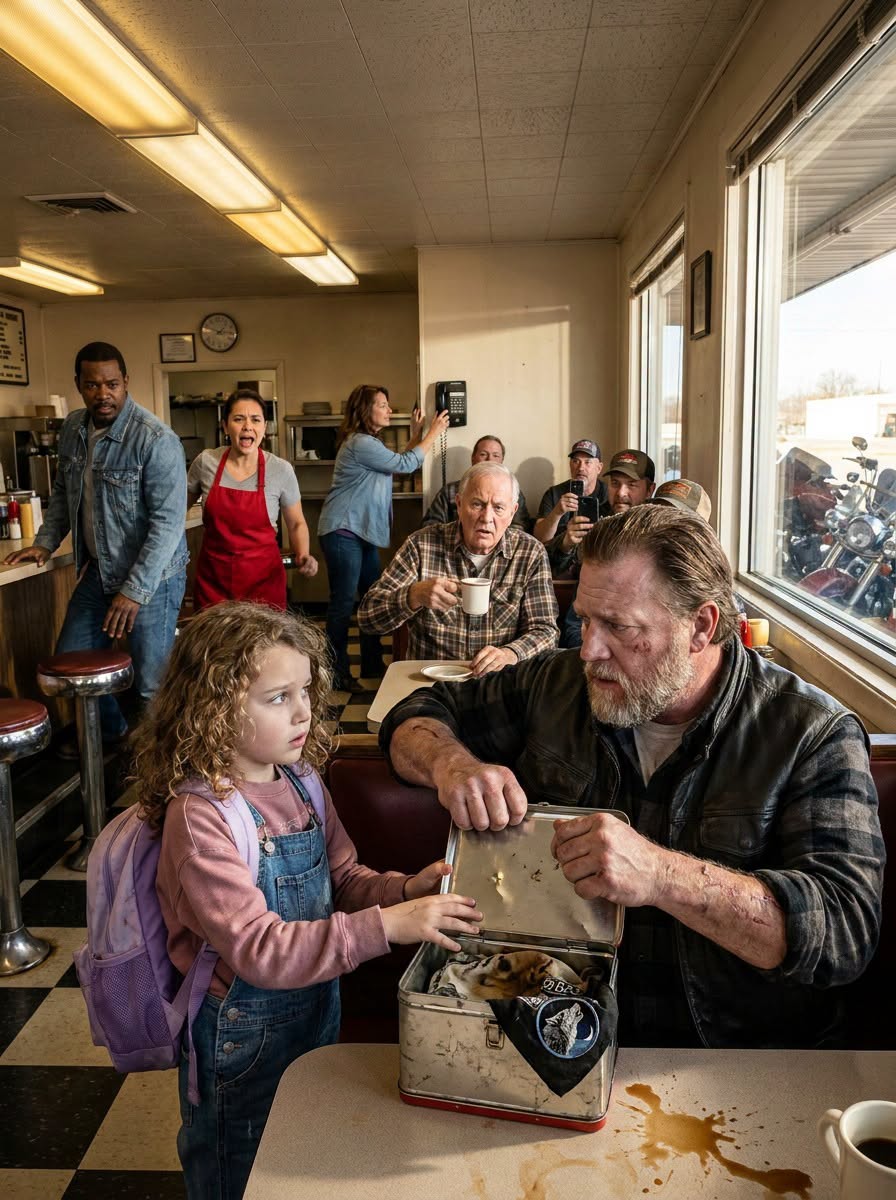
PART 3 – They Thought a Giant Biker Had Grabbed a Child’s Lunchbox. He Had Grabbed the Last Thing His Brother Was Supposed to Take Into the Ground — and the Men Who Called Themselves Pallbearers Were Already in the Lot
PART 3 – What Should Have Gone Into the Ground
The second shot did not come.
The clean engine stopped at the edge of the service road, far enough to speak, close enough to be believed. Mason told Whitaker to kill the lights and keep the motor running. He got out with the lunchbox and left the door open so the child would see that leaving was still a shape in the dark.
A man stepped into the weak spill of the sedan’s interior lamp.
He was Mason’s age and had kept none of the miles in his face. A coat too good for this lot. Hands empty, which meant nothing. Men who send a warning into gravel rarely need to show the tool they used.
“Grave,” he said, as if the name were a receipt.
Mason did not give him Caleb’s name. Not here.
“You buried a patch twenty years late,” the man said. “We can call that a mistake and go home. The girl doesn’t need to learn how clubs used to finish their business.”
Behind Mason, Emma’s window was down an inch. Whitaker’s breath was audible. The bruise on her jaw looked darker in this light.
“Caleb didn’t have a club,” Mason said. “He had a patch he made in a garage because he liked wolves and bad weather. You stood at the grave and called yourselves something afterward so the story would pay.”
The man’s mouth tightened.
“He owed people. The wolf was the mark. You don’t put a mark in the dirt and expect the debt to die with him.”
Mason opened the lunchbox.
The bandana. The dull thread. The broken moon.
He had carried heavier things. He had not carried this. He had believed the casket.
“What’s the debt,” he asked, “if the only man who could have paid it is bone?”
“Lineage,” the man said, and his eyes went past Mason to the back seat. “A daughter is a kind of signature. So is a sister’s friend who kept a box too long. So are you, if you walk it into a diner and show the whole county the moon.”
Emma’s voice, small and precise:
“I’m not a signature.”
The man smiled without kindness.
“Then give me the patch, little girl, and you can go back to being seven.”
Mason closed the lid.
He understood, then, why Caleb’s sister had left before the flowers died. Why a woman with a bruise and a dented lunchbox had chosen a child as courier. Why the wolf had never been about colors or a table or a name sewn over a heart. It had been about men who needed an object to make a dead friend still useful.
Mason had promised, over cheap whiskey, that the patch would go into the ground.
He had watched the wrong lid shut.
He set the lunchbox on the hood of the sedan.
“You want it,” he said. “Come take it from a booth you already filmed and a lot with cameras on the pumps. Or you can watch me do what I failed to do in 2006.”
He took the patch out.
He walked to the ditch at the edge of the grain elevators, where the soil was soft from last week’s rain, and he knelt. His knees remembered older work. He dug with his hands until the hole was deep enough that a thing put there would have to be wanted badly to come back.
The man did not move at first.
Then he took one step.
Whitaker’s sedan lurched forward half a length, not a hit, a line. Emma’s face was at the glass. Mason did not look up. He laid the wolf in the mud and the broken moon after it, and he covered them the way you cover a name you intend to stop answering.
When he stood, his palms were black.
“Caleb’s daughter doesn’t owe you a moon,” he said. “Neither does the woman who kept it warm. If you follow that car, you follow me. And I am done letting you rent a dead man.”
The good coat considered the ditch, the diner glow in the distance, the fact of phones that had already decided a different crime in a different room.
He chose the math of witnesses.
He walked back to the clean engine.
It left the way patient things leave: without drama, without surrender, only a delay.
Mason stayed until the sound was gone. Then he washed his hands on the wet grass and went back to the sedan.
Whitaker was crying with her mouth closed. Emma was not. She looked at his dirty palms and then at the empty lunchbox.
“Mom said it should have been buried with him.”
“It is now,” Mason said.
He did not get in.
A man who had just put a wolf in the ground had no right to sit in a child’s morning as if he belonged there. He gave Whitaker a number that was not a club and not a debt, only a diner that opened before dawn and a man who would answer if the clean engine learned new patience.
“You go north,” he said. “You don’t tell anyone else I knew the name. If they come anyway, you call. Not the girl. You.”
Whitaker nodded.
Emma held out the purple backpack. Inside, the cloth-wrapped paper was a photograph: a younger Mason, a man with a laugh that had not yet been closed into a box, a white wolf sewn crooked on a vest that had never been voted in by anyone.
“You can keep him,” Emma said.
Mason shook his head.
“I kept him too long the first time.”
He shut the lunchbox and handed it back empty, a vessel returned to being only metal.
The sedan found the service road and then the darker road beyond it. Mason walked toward Rosie’s neon with mud on his jeans and the diner already rewriting him into a story with raised phones and a snatched box.
He sat in the same booth.
He ordered coffee he would not drink.
Out behind the grain elevators the ground settled over a moon that had no business ruling the living.
He had been twenty years late.
He had not been too late for the child.
That would have to be enough.
THE END