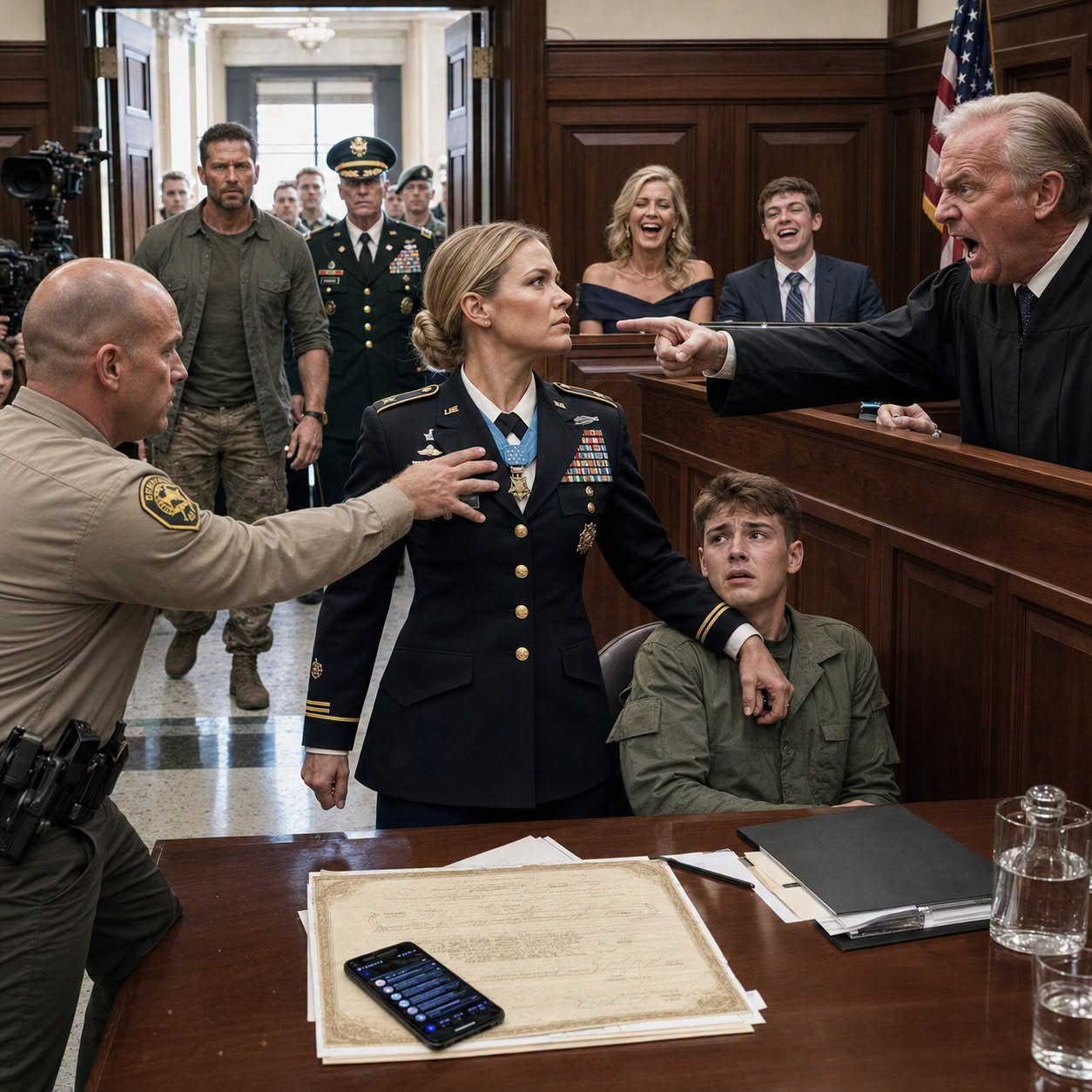
PART 3 – “Rip That Piece of Trash Off Her Neck”: A Judge Humiliated His Medal of Honor Sister—He Didn’t Know the Doors Were About to Explode
PART 3 – What the Doors Let In
General Robert Mitchell did not hurry.
He entered in service dress, four stars dull under the courtroom lights, two officers behind him and a woman from the Judicial Conduct Commission who already held a tablet. Pastor Bell rose. The dead notary’s daughter stepped in from the hall with a folder pressed to her chest. No one announced them. They did not need announcing.
Mitchell’s gaze found the medal first.
It still lay in Cobb’s open palm, ribbon hanging like something unfinished.
“Return it,” Mitchell said.
Cobb crossed the marble without looking at the bench. He set the medal against my uniform with a care that belonged to funerals and promotions. The ribbon settled. The weight came home. I fastened it myself. My hands were steady.
Arthur had not sat down.
“This hearing is not adjourned,” he said. The gavel looked smaller in his fist. “You have no standing—”
Mitchell did not raise his voice.
“Play it.”
Marcus Vance did not wait for permission. The audio from the flash drive filled the room first: Julian’s texts, read in the flat tone of a man who had typed too many last words.
Make the old lady’s deed disappear.
Dad will handle the hearing.
Once the soldier kid is out, we split the conversion fee.
Then the church camera. Night. Alley. Julian’s walk, the exact time stamp, the door that should not have opened. Then the deposit slip. Then Victoria’s voicemail, her voice bright and careful:
Keep Arthur’s name clean.
The notary’s death certificate landed on the clerk’s desk last.
No one in the gallery spoke. The cameras had never stopped.
Arthur looked at his son. Julian looked at the floor. Victoria’s hand found the railing and stayed there, white at the knuckles.
Lucas made a sound that was almost a laugh and almost a sob. I put my hand on his shoulder and left it there.
Mitchell addressed the bench as if it were a briefing table.
“Judge Morris, you will recuse. You will not touch this file again. The Commission will take custody of the record. Private Reed remains in his mother’s building until a lawful court—not this one—says otherwise. Colonel Morris is not in contempt. She is a living recipient of the Medal of Honor. You called it trash in a room full of cameras. That sentence belongs to you now.”
Arthur’s mouth opened. Nothing useful came out.
I did not watch him search for a version of the story that still fit. I had given him twenty-five years of versions. He had chosen the one that made me small.
I turned to Lucas.
“You’re going home,” I said.
He nodded once, hard, as if the motion itself might break.
Cobb stepped back to the wall. Marcus Vance closed his laptop. Mitchell looked at me the way he had looked in the hangar years ago, after the dust and the four men and the ribbon that was never jewelry.
“Colonel.”
“Sir.”
That was all.
I walked Lucas out through the same doors that had opened on my brother. Behind us the room began to make the sounds rooms make when power changes hands: chairs, whispers, a gavel that no longer mattered.
On the steps the air was ordinary. Traffic. A bus. September light on Cambridge Street.
Lucas stopped.
“Ma’am. Why didn’t you say any of it yourself?”
I touched the medal once, not for him, not for the cameras.
“Because some men only believe a sentence after they have finished speaking it.”
We went down the steps together.
The doors closed.
THE END