“Rip That Piece of Trash Off Her Neck”: A Judge Humiliated His Medal of Honor Sister—He Didn’t Know the Doors Were About to Explode
PART 1 – The Thing He Called a Necklace
The gavel struck like a small, expensive gunshot.
“Rip that piece of trash off her neck.”
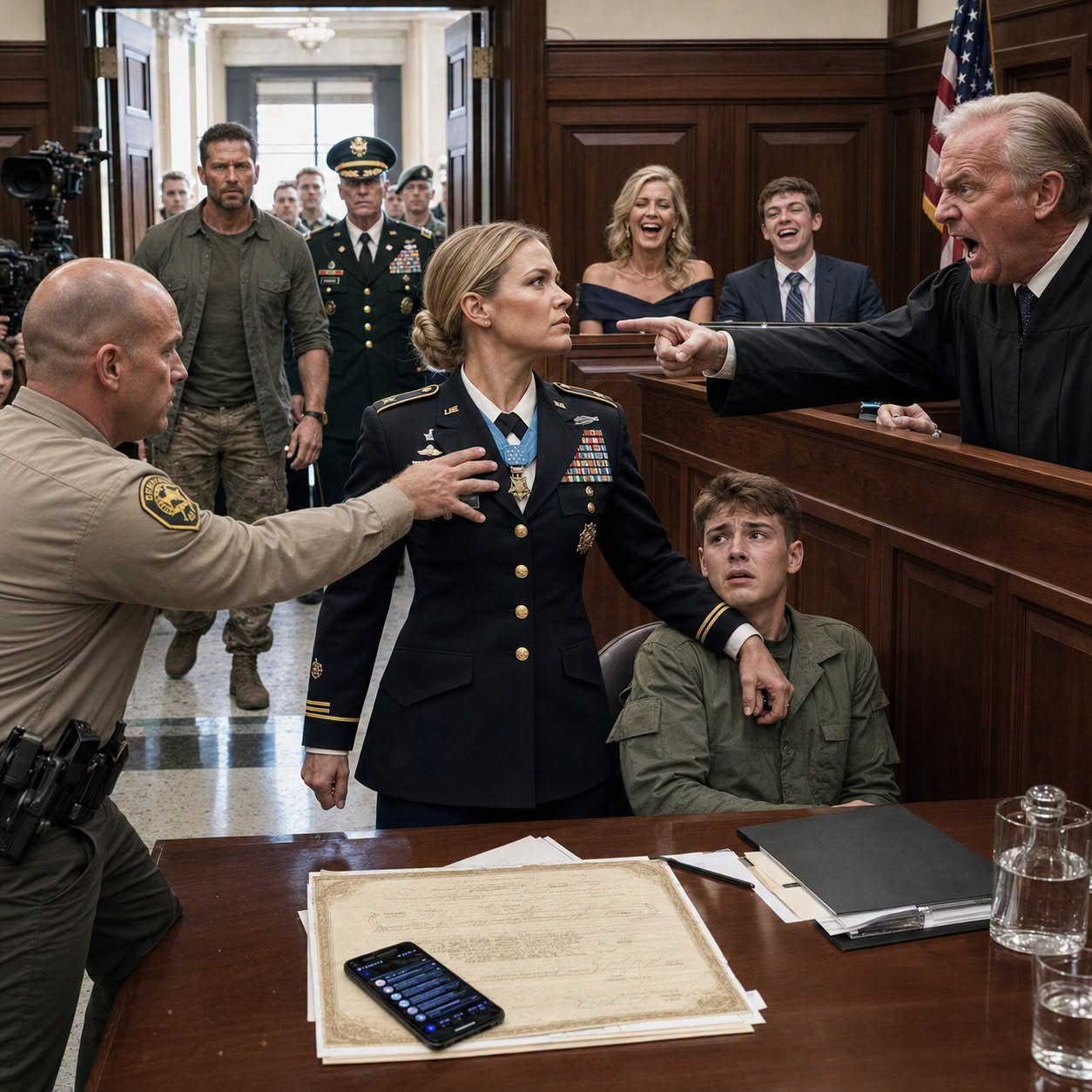
Judge Arthur Morris said it from the bench, black robe immaculate, our father’s watch catching the overhead lights as he pointed. The Medal of Honor lay against the wool of my dress uniform, pale-blue ribbon still exact after all these years. He called it a necklace. He called it garbage. He called it a costume.
Victoria covered her mouth with one manicured hand, but the smile reached her eyes. Their son Julian did not bother with the courtesy. He laughed outright, a bright, practiced sound that belonged at country-club dinners, not here.
Beside me, Private Lucas Reed sat very still. Nineteen. Broke. Three days from being put on the street. His fingers locked around a paper cup of courthouse coffee that trembled at the rim. He whispered without looking at me.
“Ma’am. Is he allowed to do that?”
“No,” I said.
Arthur heard. The gavel came down again.
“Bailiff Cobb, confiscate the necklace.”
Necklace.
Not the ribbon General Robert Mitchell had settled around my neck after Helmand, after I had dragged four men through fire that should have killed all of us. Not the thing I had earned while Arthur was still learning how to bill hours. A necklace.
I kept both hands flat on the defense table and remembered the last Thanksgiving I had attended at their house. Victoria had served turkey on our grandmother’s china and asked me, quite politely, to change because the medals looked aggressive. Arthur had observed that some people joined the Army because they could not survive Harvard. He had survived Harvard with my money. Twenty-five years earlier I had signed over the education trust so he could pay tuition. I enlisted two weeks later with eighty-three dollars and a bus ticket. He received a law degree. I received scars. He preferred his version of the story.
“Remove it voluntarily,” he said now, leaning toward the microphone, “or I will hold you in contempt.”
The courtroom smelled of floor wax and yesterday’s roast-beef sandwich. A siren faded down Cambridge Street. Lucas’s face had gone the color of old paper.
Developer Preston Vale claimed Lucas’s mother had transferred the apartment building before she died. The deed bore Nora Reed’s signature and a notary stamp from a woman who had been dead eleven months. Arthur had refused to admit the stamp. He had also refused the bank records showing Vale paid Julian forty thousand dollars two days before the eviction filing. That was why I wore the uniform. Lucas had called me from a diner outside Fort Marshall, crying over untouched fries because every lawyer wanted money he did not have. I was retired and tired of rich men using paper like a weapon.
Arthur knew all of it. He also knew I had filed a motion with the judicial conduct commission concerning his connection to Vale. So he had turned a housing hearing into a public stripping.
“You always needed attention,” he said. “First the Army. Now this.”
A woman in the gallery drew a sharp breath. Victoria’s smile widened. Julian leaned over the velvet rail.
“Come on, Aunt Eloise. Stop embarrassing the family. Take off the toy.”
Lucas started to rise. I caught his wrist.
“Stay seated.”
“But—”
“Let him talk.”
Arthur had never understood silence. He had mistaken it for surrender since we were children. The courtroom held six cameras. The reporter had an audio backup. Inside my left breast pocket sat a sealed flash drive containing Julian’s texts to Vale:
Make the old lady’s deed disappear.
Dad will handle the hearing.
Once the soldier kid is out, we split the conversion fee.
Sent from a number on the Morris family plan. Cocky people leave fingerprints everywhere.
“Bailiff.”
Henry Cobb left the jury box. Near fifty, tired eyes. He looked at the medal, then at Arthur.
“Your Honor, perhaps counsel could remove it herself.”
“I did not ask for your opinion.”
Cobb’s jaw tightened. Arthur stood. For a second I saw what lived under the robe: fear. Reporters had arrived. Lucas’s pastor sat behind us. The dead notary’s daughter waited in the hall with a death certificate. Arthur needed me humiliated before the evidence could breathe.
“Strip it from her.”
Cobb walked toward me. Handcuffs knocked softly against his hip. Lucas began to breathe too fast. I pressed two fingers to his forearm.
“In through your nose. Slow.”
Cobb stopped inches away.
“I’m sorry, ma’am.”
“I know.”
At the stenographer’s desk, Marcus Vance had stopped typing. I saw the Ranger scroll tattoo beneath his cuff. He looked at the medal, then at Arthur. His chair rolled back half an inch. A folder slipped. He bent to retrieve it and vanished below the wooden panel.
Arthur raised the gavel.
“Last warning, Eloise.”
I stood. Jump boots struck marble. The room went still.
I had been shot three times. I had held Private Daniel Hayes while his blood soaked through my gloves and later called his mother from a hospital bed. My brother’s anger did not frighten me. It disappointed me.
I met Cobb’s eyes.
“Do what he ordered.”
Arthur smiled. He thought I had broken.
What he did not know was that Pastor Bell had brought more than moral support. The church security camera faced Nora Reed’s back alley. It showed Julian entering the building at 11:42 p.m. the night the deed vanished. The next morning Vale’s assistant deposited cash into Julian’s account at First Harbor Bank. I had the footage, the deposit slip, and a voicemail of Victoria telling Vale to keep Arthur’s name clean. I had not played any of it yet. I wanted Arthur speaking on camera first. Arrogance is most useful when allowed to finish its own sentence.
Under the stenographer’s desk, Marcus Vance was already making one quiet phone call.
Ten minutes away, a four-star general reached for his coat.
TO BE CONTINUE…