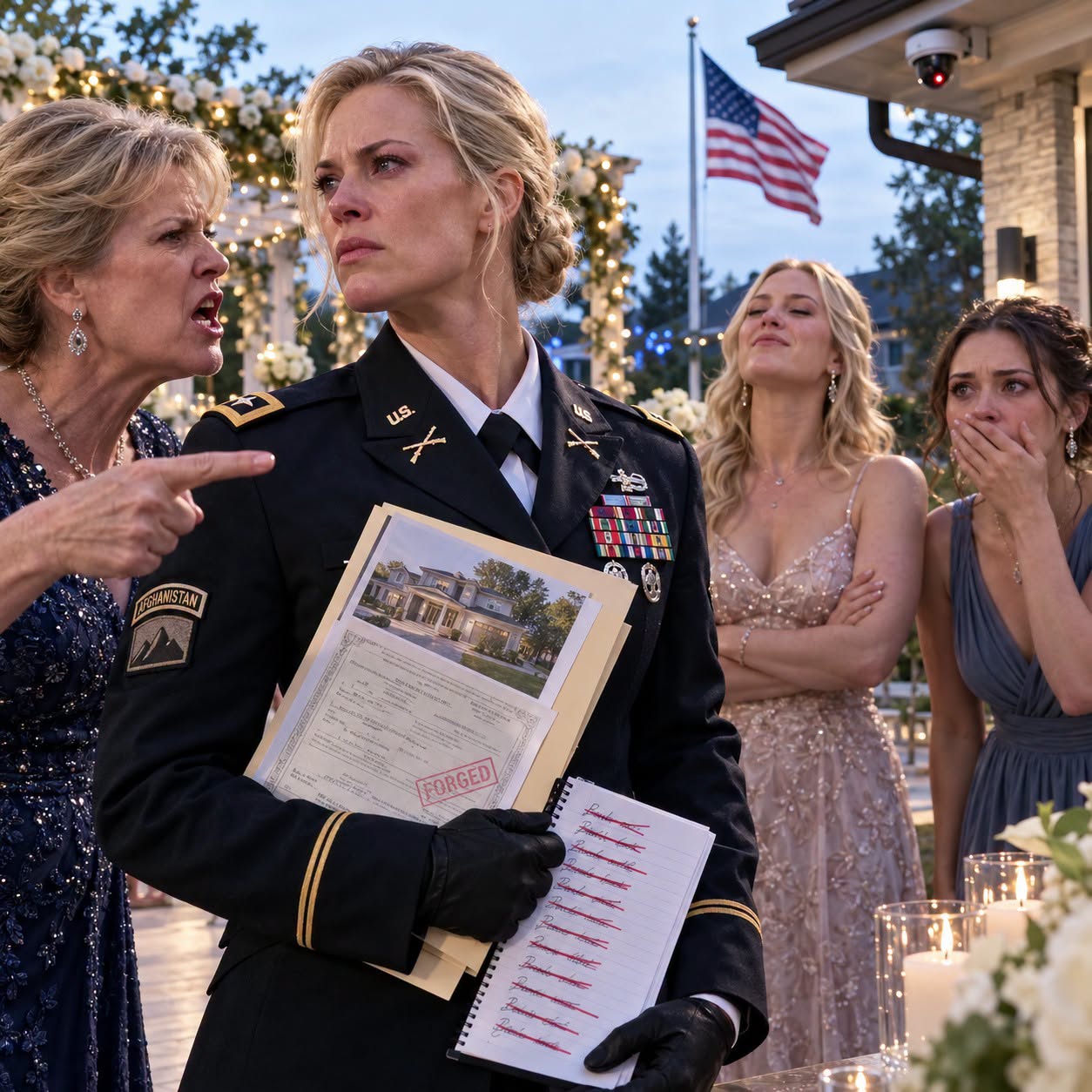
The invitation had already been printed for a year when my mother decided my wedding was optional. I stood on the raised platform of a Charleston bridal boutique in six thousand dollars of ivory silk, the seamstress’s fingers still pinched around the hem, when her voice came through the phone like a verdict
“Move it,” she said. “Emily only gets one first house, Ruby. Family should be there for her.”
October twelfth. The date that had lived on my calendar, on the chapel contract, on the leave forms of men who had once stood beside me in the sand. Soldiers from my unit had already requested time. My West Point roommate was flying in from Seoul. Ethan’s parents had reserved rooms near the small stone church outside Savannah where my grandmother once held my hand every Sunday and taught me that some promises were sacred.
My mother spoke as if I had simply booked a hair appointment.
“The deposits are nonrefundable,” I said. Quietly. The way I had learned to speak when emotion was considered a personal failure. “People have flights.”
“You earn good money. You’ll recover.”
Behind me, Dana stopped pretending to scroll through her phone. The seamstress had gone completely still.
“Mom. This is my wedding.”
“And Emily is your sister.”
There it was. The family scripture I had been forced to memorize since childhood, recited every time the scale tipped against me.
Emily is your sister.
It was why she received a new Jeep at sixteen while I rode the city bus with a backpack full of books and a quiet, growing fury. Why Mom skipped my scholarship banquet for Emily’s dance rehearsal. Why both my parents missed my commissioning ceremony at West Point because Emily had a regional pageant two states away. I had stood alone in dress uniform while classmates posed between proud parents, smiling for photographs I would never have. I told myself duty had made me independent. The truth was simpler and uglier: my family had trained me, carefully and thoroughly, not to expect a seat in their priorities.
“You’re the oldest,” Mom said. “You should understand.”
Something inside me—something that had bent for thirty-two years—finally stopped.
I looked at my reflection in the boutique mirror. Major Ruby Henderson. Ribbons on a uniform from places my mother could not find on a map. A woman who had led soldiers through things that still woke her at night. And still, somehow, the daughter expected to vanish whenever Emily wanted the room.
“Then don’t come,” I said.
The silence on the line was immediate and absolute.
“What did you say?”
“You chose the housewarming. Go to it.”
“Ruby, don’t be dramatic.”
“I’m not.”
I ended the call.
Dana rose from her chair. “Tell me you’re not moving the wedding.”
I stepped down from the platform and met my own eyes in the glass. The woman looking back no longer looked like someone who would keep making herself smaller for people who had never once made room.
“I’m changing the guest list.”
That night Ethan found me at the kitchen table in the dark, laptop open, a cold mug of coffee forgotten beside the seating chart. Sixty-three names. Thirty-one of them Hendersons.
He loosened his tie, pulled out the chair beside me, and waited the way he always did—without rushing, without filling the silence with comfort I hadn’t asked for.
When I told him what Mom had said, his jaw tightened once.
“If you keep choosing people who never choose you,” he said, “they’ll never stop asking.”
I stared at my mother’s name for a long time.
Then I clicked delete.
My father disappeared next. Emily. Aunt Carol. Uncle Pete. Every cousin who had watched me pay for Thanksgiving groceries, wash their dishes, organize hospital visits, and wire emergency money without ever once asking what it cost me to keep their lives upright.
By 1:17 a.m., every Henderson was gone.
I emailed the wedding coordinator a revised list and requested professional security at both the chapel and the reception. Then I sent one sentence to the family group chat.
Since my wedding is not important enough to protect, none of you need to attend it.
The responses arrived before I could block the thread.
Mom: Stop this nonsense. Emily: Are you seriously punishing everyone because I bought a house? Aunt Carol: You will regret humiliating your mother. Dad: Don’t turn this into a family war.
I read his message twice.
As if I had fired the first shot. As if thirty-two years of being carefully, consistently ignored counted as peace.
I blocked them all.
For the first time in my adult life, the apartment became quiet enough for me to hear my own anger without interruption.
At 2:04 a.m., my phone vibrated again.
This time it was not family.
An automated alert from Palmetto Federal Bank. A transfer of $18,500 had been approved from an account ending in 4419. I frowned. I did not recognize the account. The alert listed me as the primary beneficiary.
Ethan leaned closer while I opened the secure message.
The account title made something cold and precise settle in my chest.
Evelyn Henderson Testamentary Trust—For the Benefit of Ruby Henderson.
My grandmother Evelyn had died six years earlier. Mom had told me the estate was nearly empty after medical bills. I had never heard of a trust.
A second document appeared beneath the alert: Beneficiary Consent to Distribution.
The digital signature looked exactly like mine.
It wasn’t.
The destination account belonged to Emily Henderson.
I felt the same cold clarity that came before a dangerous mission. No tears. No shouting. Just details assembling themselves with lethal order.
Date. Amount. Routing number. Signature.
The transfer had been initiated three days earlier—the same week Emily closed on her new house.
“Ruby,” Ethan said carefully, “call a lawyer.”
I downloaded everything before anyone could erase it.
At 7:30 the next morning I sat across from Mark Caldwell, a former Army JAG officer whose office occupied the second floor above a small-town diner that still served coffee strong enough to wake the dead. He read the documents without interrupting. When he finished, he asked only one question.
“Did you authorize your sister to take money from this trust?”
“No.”
He turned the laptop toward me.
There were five earlier transfers. Roof repair. Dad’s surgery. Mortgage assistance. Those were the reasons Mom had given every time she asked me for money over the years. But the trust records showed something else entirely.
Each time I had wired my parents thousands from my own salary, Mom had also withdrawn matching amounts from my grandmother’s trust.
More than seventy-four thousand dollars was missing.
The final $18,500 had gone directly toward Emily’s down payment.
Mark removed his glasses.
“This is not favoritism,” he said quietly. He tapped the forged signature once. “This may be fraud.”
Outside his window, church bells began to ring across the square.
My family thought I had only taken away their wedding invitations.
They had no idea I had just found the weapon that could take away Emily’s house.
PART 2
Mark Caldwell did not waste time with soft language.
“You have three options,” he said, sliding a legal pad across the desk. “You can confront them privately and demand repayment. You can report it to the bank and let them open an internal investigation. Or you can file a formal complaint with the state and let the system do what systems are built to do.”
I stared at the pad. The ink looked too clean for what it represented.
“If I report it,” I said, “Emily loses the house.”
“Possibly.” Mark’s voice stayed even. “If the bank freezes the funds and the title company is notified that the down payment was obtained through fraud, the closing can be challenged. Even if the house is already in her name, a civil claim could force a sale or a lien. It depends how clean the paperwork is and how fast we move.”
Ethan sat beside me, silent, one hand resting lightly against the back of my chair. He had not tried to tell me what to do. That was one of the reasons I had married him in the first place.
I thought of my grandmother’s hands. The way they used to smell of lavender and flour. The way she used to look at me across the kitchen table when no one else was listening and say, You don’t have to keep making yourself smaller just because they prefer the room that way.
I had not understood her then. I did now.
“I want everything documented,” I said. “Every transfer. Every signature. Every time my mother asked me for money while she was already taking from the trust.”
Mark nodded once. “I’ll have a forensic accountant start today. In the meantime, do not speak to them. Do not answer calls. Do not give them anything they can later claim was a conversation.”
I left his office with a folder that felt heavier than its weight.
The next three days passed in a strange, almost clinical quiet. I went to work. I ran the same routes I always ran at dawn. I answered emails from the wedding coordinator about seating and flowers as if my life had not just been split open. Ethan moved around me carefully, the way soldiers move around an unexploded charge—close enough to help, far enough not to set it off.
The family did not stay quiet.
Mom called thirty-seven times. Emily texted paragraphs that swung between wounded innocence and cold fury. Dad left a voicemail that began with “This has gone far enough” and ended with the soft, disappointed sigh he had used on me since I was twelve.
I did not answer any of them.
On the fourth morning, Mark called.
“There’s more,” he said. “Your grandmother amended the trust two years before she died. The language is clear. You were the sole primary beneficiary. Your mother was listed only as trustee, with strict limitations. She had no authority to authorize distributions to anyone else without your written consent. And the signatures on the earlier transfers… they’re not just forged. They’re consistent. Same hand, same pressure, same slight lag on the capital R. A handwriting expert will have no trouble.”
I closed my eyes.
“How much total?”
“Seventy-eight thousand, four hundred and twelve dollars. Including the most recent transfer.”
I opened my eyes again and looked out the window of my office at the gray morning. Somewhere across town, Emily was probably arranging furniture in a house that did not belong to her.
“File the complaint,” I said.
Mark was quiet for a moment. “You’re certain?”
“Yes.”
That afternoon the bank froze the account. By evening, a preliminary notice had been sent to the title company that had handled Emily’s closing. I did not know the exact legal language. I only knew that something irreversible had begun to move.
The first crack appeared at 9:14 p.m.
Emily called from a number I had not blocked. I almost ignored it. Then I answered, because some part of me still needed to hear the sound of the thing breaking.
“What the hell did you do?” Her voice was high, tight, already cracking. “The bank just called. They’re saying the down payment is under review. They’re saying there might be a problem with the funds. Ruby—what did you do?”
I stood in the dark kitchen and listened to my sister’s panic the way I had once listened to incoming fire: without flinching, without looking away.
“I found the trust,” I said.
Silence.
Then, smaller: “Mom said it was empty.”
“Mom lied.”
“You don’t understand. We already moved in. The furniture is here. The mortgage is set. You can’t just—”
“I didn’t take anything that wasn’t already mine,” I said. “You did.”
Her breath hitched. “This is about the wedding, isn’t it? You’re doing this because Mom asked you to move the date. You’re punishing me.”
I almost laughed. The sound would have been ugly.
“No, Emily. This is about seventy-eight thousand dollars and a signature that isn’t mine. The wedding was only the moment I finally stopped pretending I didn’t see what was in front of me.”
She started to cry then. Real tears, the kind that used to make everyone in the house rearrange themselves around her. I waited until the worst of it passed.
“Call Mom,” I said. “Tell her the bank is involved. Tell her a lawyer is involved. Tell her I have every document.”
I ended the call.
Twenty minutes later the group chat exploded back to life—messages I had not unblocked, but which somehow still found their way through the edges of the system. Mom’s words came in short, furious bursts. Dad’s were colder. Aunt Carol declared that I had lost my mind. Someone used the word ungrateful. Someone else used the word vindictive.
I read none of them fully.
Ethan found me on the back steps sometime after midnight, the folder open on my knees, the city lights blurred by the humidity. He sat down without speaking and rested his shoulder against mine.
“They’re going to come for you,” he said eventually.
“I know.”
“They’ll say you’re destroying the family.”
“I know that too.”
He was quiet for a long time. Then: “Do you regret it?”
I thought of the bridal boutique. The $6,000 dress. The seamstress’s frozen hands. The way my mother’s voice had treated my wedding like an inconvenience that could be moved for convenience.
I thought of the trust statement with my name on it and someone else’s signature beneath it.
“No,” I said.
The next morning Mark called again. His voice was different—sharper, more urgent.
“They moved faster than I expected,” he said. “Your mother just attempted to access the trust account remotely. The bank flagged it. And there’s something else. The title company has already placed a temporary hold on the property pending the investigation. Emily’s lender is demanding clarification within seventy-two hours or they will initiate their own review.”
I stood very still.
“What does that mean in plain language?”
“It means the house is no longer secure. If the funds are proven to be the product of fraud, the lender can accelerate the process. In the worst case for them, the sale can be challenged. In the best case for you, the money comes back and the house becomes a very expensive problem that is no longer yours to solve.”
I looked at the calendar on my desk. The wedding was still twenty-six days away. The chapel was still reserved. The soldiers were still coming. The guest list still contained no Hendersons.
Somewhere across the city, my sister was standing in a house that had just begun to slip beneath her feet.
And for the first time in thirty-two years, I was the one who had moved the ground.
I closed the folder, locked it in the bottom drawer of my desk, and reached for my phone.
There was one more call I needed to make.
The call I made was not to my mother.
It was to the one person who had never once asked me to shrink.
My grandmother’s attorney, retired now, answered on the second ring. His voice was older, thinner, but still sharp. When I told him what we had found, there was a long silence on the line. Then he said, very quietly, “Evelyn always worried they would try something after she was gone. She made me keep a second set of records. I still have them.”
By the following afternoon those records were in Mark’s hands. The original trust documents. The amendment in my grandmother’s clear, deliberate handwriting. A letter she had written to be opened only if the trust was ever contested—naming me as the sole intended beneficiary and stating, in language that left no room for interpretation, that my mother was never to treat the money as a family resource.
Mark read the letter twice. Then he looked up.
“This changes the tone of everything,” he said. “We’re no longer just alleging forgery. We can show intent.”
I nodded. The word intent sat heavy in the room.
That evening the formal notice went out. The bank, the title company, and Emily’s lender all received certified documentation. The temporary hold on the property became something firmer. Within forty-eight hours Emily’s lender issued a formal demand: either the source of the down payment was cleared and replaced with verified funds within ten business days, or they would begin the process of challenging the loan.
The house, the one my mother had insisted was more important than my wedding, was no longer safe.
I did not celebrate.
I sat on the back steps again that night and watched the dark settle over the city while Ethan moved quietly around the kitchen behind me. He brought me coffee I didn’t drink and sat down without asking questions. After a long time I said, “They’re going to lose it.”
“Yes,” he answered.
“And they’ll never forgive me.”
“They never chose you first,” he said. “Forgiveness was never the currency they used with you.”
I turned the mug in my hands. The ceramic was warm. My grandmother’s letter was still open on the table inside. I had read it three times. In the final paragraph she had written: Ruby does not owe them the shape of her life. If they forget that, the trust will remember for her.
I had spent most of my life trying not to need that kind of protection. Now I was using it.
The confrontation came three days later, uninvited and inevitable.
Mom and Emily arrived at the apartment just after seven. They did not knock so much as push their way in when Ethan opened the door. Dad waited in the car, the engine still running, as if he wanted the option of leaving without having to look at me.
Emily’s face was blotched and furious. Mom’s was colder.
“You will stop this,” Mom said. No greeting. No pretense. “You will tell the bank there was a misunderstanding. You will sign whatever they need. You will fix what you broke.”
I stood in my own living room and looked at the two of them. The women who had taught me, year after year, that my place was to give and theirs was to receive.
“I didn’t break anything,” I said. “I found what was already broken.”
Emily’s voice cracked. “You’re taking my house.”
“No,” I said. “You took money that was never yours. The house is only the consequence.”
Mom stepped closer. “You are destroying this family over a wedding date.”
I almost smiled then. It was not a kind expression.
“You still think this is about the wedding.”
I walked to the table, opened the folder, and laid out the documents one by one. The trust. The forged signatures. The transfers. The letter from my grandmother. I did not raise my voice. I did not rush. I simply placed the truth between us and let it sit there.
Emily’s hands started to shake first. Mom’s face went very still.
“You forged my name,” I said. “You spent money set aside for me while you asked me for more of my own. And when I finally said no to one more demand, you treated my refusal like betrayal.”
Mom’s mouth opened, then closed. For the first time in my life, she had no script ready.
Emily whispered, “I didn’t know about all of it.”
“You knew about the last transfer,” I said. “You signed the closing papers. You lived in the benefit of it.”
Silence stretched. Outside, a car door slammed—Dad, perhaps, deciding he had heard enough from a distance.
Mom finally spoke, quieter than I had ever heard her. “What do you want?”
I looked at her for a long moment.
“I want you to leave my wedding alone. I want the money returned to the trust. And I want you to understand that I am finished making myself smaller so the rest of you can keep the shape of the life you prefer.”
She stared at me as if she no longer recognized the daughter in front of her. Perhaps she didn’t. I no longer recognized the daughter who would have folded.
They left without another word. Emily was crying openly by the time she reached the door. Mom’s back was rigid. The car pulled away too fast.
I stood in the quiet that followed and felt something settle inside my chest—not triumph, not relief exactly, but a kind of finality. The ground had shifted. It would not shift back.
In the weeks that followed, the legal process moved with the slow, impersonal force of institutions. The forensic accountant’s report confirmed every transfer. The handwriting expert’s opinion left no ambiguity. Facing the weight of the evidence and the risk of criminal referral, my mother authorized the return of the funds. The full amount was restored to the trust. Emily’s lender, unsatisfied with the delay and the cloud over the original down payment, ultimately required a new infusion of verified capital she could not produce in time. The house went into a forced sale. She and her husband moved into a smaller rental across town.
I did not attend the closing. I did not send a message. The family group chat remained blocked.
The wedding took place on the original date beneath the stone chapel outside Savannah. The light came through the old windows the way it always had when my grandmother used to sit in the third pew. Soldiers from my unit stood in dress uniform along the aisle. My West Point roommate flew in from Seoul and cried during the vows. Dana held the bouquet with steady hands. Ethan’s parents sat in the front row where my own parents would have been, and when the ceremony ended they hugged me as if I had always belonged to them.
There were no Hendersons in the photographs.
That night, after the last guest had gone and the chapel had emptied, I walked alone into the small cemetery behind the church. My grandmother’s stone was simple. I rested my hand on the cool granite and stood there for a long time while the cicadas sang in the dark.
“I kept it,” I said quietly.
I did not specify whether I meant the money, the wedding, or the version of myself she had always believed I could become. Perhaps it was all three.
Ethan found me there after a while. He didn’t speak. He simply took my hand and waited until I was ready to walk back toward the lights.
We drove home in the quiet. The apartment was still and clean. The folder of documents had been filed away. The guest list that no longer contained my family sat on the desk like a finished chapter.
I was thirty-two years old. A major in the United States Army. A wife. A woman who had finally stopped asking permission to take up space in her own life.
Outside, the city continued its ordinary night. Inside, for the first time, the silence felt like something I had chosen rather than something that had been given to me by other people’s absence.
I turned off the last light and went to bed.
The war, at least this one, was over.
THE END