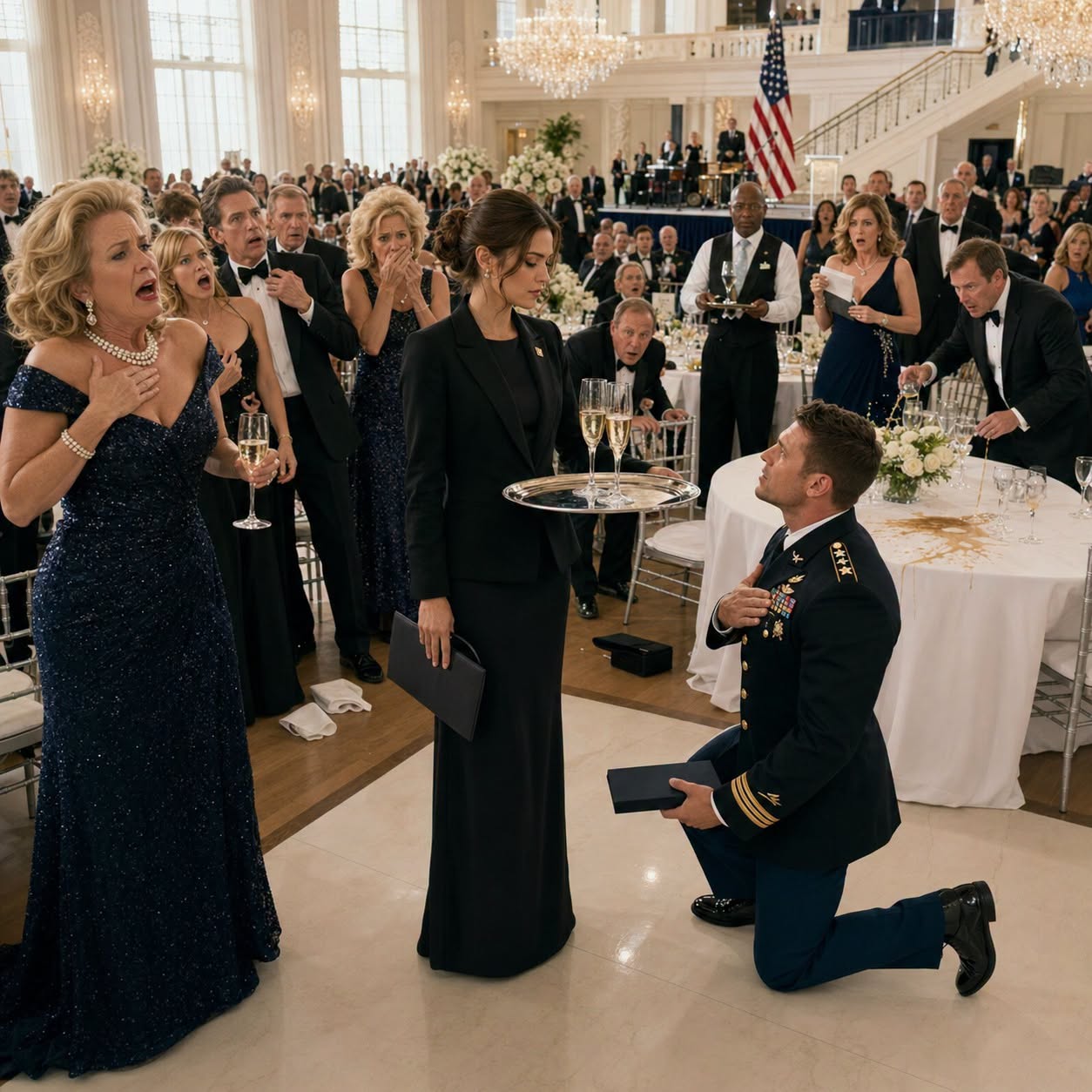
The tray was heavier than it had any right to be—thirty-six flutes of champagne trembling on silver like fragile stars about to fall. I balanced it anyway, the way I had balanced far worse things in places the world would never see
My shoulder still burned from the carry-on bag I’d dropped in the shadows of the service corridor, but pain was an old companion. Thirty hours without real sleep will teach you that some weights are simply carried in silence.
Dock Street Theatre glittered around me like a stage set built for someone else’s life. Crystal chandeliers dripped golden light onto white linens starched to perfection. Orchids the color of fresh cream spilled from antique vases, and the faint scent of roasted tenderloin and aged bourbon drifted through the air like expensive ghosts. Beyond the tall windows, Charleston’s evening sky bled soft indigo and rose. Inside, the city’s oldest money moved in careful orbits—laughing too politely, touching arms too deliberately, guarding secrets as old as the cobblestones outside.
I was not supposed to be part of the orbit. I was the furniture.
“Hold that tray steady. You’re in the way of the donors.”
The catering manager didn’t even look at my face. He simply shoved the burden into my hands and moved on, already barking orders at someone else. I adjusted my grip, feeling the cold condensation kiss my palms. My plain navy dress—practical, unremarkable, chosen for airports rather than galas—clung to me with the stale smell of recycled airplane air. I had tried to smooth my hair in the airport bathroom mirror somewhere over the Atlantic, but exhaustion had won.
Then came the click of heels I would recognize in any lifetime.
“Arden.”
My mother spoke my name like a judge pronouncing sentence. Maribel Bellamy emerged from the corridor in a gown of pearl silk that moved like liquid moonlight. Her silver-blonde hair was sculpted into an elegant twist, diamonds flashing at her ears and throat. She was beautiful in the way marble statues are beautiful—cold, flawless, and impossible to warm. One glance at me—travel-wrinkled coat still draped over my arm, eyes shadowed by jet lag—and her lips pressed into a thin, disappointed line.
“What were you thinking, showing up like this?”
“I came the moment the plane landed,” I said quietly.
“I didn’t ask about your travel schedule.” Her fingers closed around my upper arm, steering me into the narrow hallway beside the kitchen with surprising strength. The pressure of her nails through fabric was sharp, but I remained still. I had learned long ago that the most dangerous weapons are not the ones you draw, but the ones you choose not to.
She studied me with clinical distaste. “You look like you’ve been dragged through a war zone.”
Closer than you know, I thought, but said nothing. Three days earlier I had been in a different kind of war zone—one of sterile corridors, biometric locks, and briefings that left scars no one could see. But Maribel Bellamy had never asked about my work beyond the dismissive label she preferred: government clerk. A phrase she wielded like a small, elegant blade.
“Do you have any idea what this night is costing us?” she hissed, leaning close enough that I could smell the champagne on her breath beneath layers of expensive powder and perfume. “The flowers alone were forty thousand dollars. Every family that matters in Charleston is here. Every donor. Every board member. This is your sister’s engagement gala, Arden—not a place for your… government-office melancholy.”
The words landed with practiced precision. My mother had always known exactly where to cut so the wound looked like an accident.
I met her eyes. “What would you like me to do?”
For a fraction of a second, satisfaction flickered across her face—not warmth, never warmth, but the quiet pleasure of possession. She had summoned me across oceans and time zones not because she missed her daughter, but because daughters were useful props.
“You will serve,” she said, voice low and final. “Champagne. Hors d’oeuvres. Whatever is needed. Smile if you can manage it. And for God’s sake, try not to embarrass us further.”
She released my arm and stepped back, smoothing her gown as though the conversation had been nothing more than a minor wardrobe adjustment. Then, louder, loud enough for passing staff and a few curious guests to hear:
“You disgrace us, Arden. Standing there like some tired little civil servant while your sister celebrates what real success looks like.”
The ballroom seemed to hold its breath. A few heads turned. Crystal glasses paused halfway to lips. I felt the weight of their stares like additional trays I was expected to carry without complaint. Heat rose in my chest—not rage, exactly, but something deeper. A slow-burning recognition of every time I had swallowed silence to keep the peace. Every classified mission I could never speak of. Every truth I had buried so this fragile, glittering world of hers could remain intact.
I lowered my gaze to the tray, adjusting a flute that had tilted. The bubbles inside rose relentlessly, fragile and determined. Much like the version of myself I had once tried to be for her.
“Understood,” I said.
My mother gave a sharp nod of approval and turned away, already smiling for the crowd, the perfect hostess once more. I moved toward the ballroom floor with the tray, footsteps measured, face calm. Inside, something ancient and unyielding stirred—the part of me that had earned names in shadowed rooms, the part that had walked through fire and come back carrying secrets heavier than champagne and pride.
I was halfway across the room when the atmosphere shifted.
A ripple moved through the crowd. Conversations faltered. The string quartet’s melody seemed to hesitate. Heads turned toward the grand entrance.
A man in a perfectly tailored dark suit had just entered. Tall. Broad-shouldered. The kind of presence that didn’t need to announce itself—it simply was. His face carried the quiet authority of someone who had stared down death and taught it manners. Navy dress uniform beneath the jacket, I realized. The kind reserved for the most elite.
He scanned the room once, then locked eyes with me.
Without hesitation, he crossed the floor in long, purposeful strides. Guests parted instinctively. When he reached me, he did something no one in that glittering room could have anticipated.
He knelt.
One knee to the polished hardwood, right there among the orchids and crystal and old Southern judgment. His voice, low and resonant, carried just far enough.
“Hades.”
The entire ballroom fell silent.
The tray in my hands remained perfectly steady.
PART 2
The word hung in the air like a blade drawn in church.
Hades.
Not whispered. Spoken with reverence. The Navy SEAL remained on one knee before me, his posture straight and unyielding, as though the opulent ballroom were merely another battlefield and I its rightful commander. His uniform bore the unmistakable insignia of the most elite forces—silent proof of operations the public would never know existed. Up close, his face was a map of controlled violence: a faint scar along the jaw, eyes the color of winter seas, and a gaze that saw through every mask I had ever worn.
The tray in my hands no longer felt heavy. It felt absurd. Thirty-six flutes of champagne trembling between us while the rest of the room stood frozen in collective disbelief.
A glass slipped from a donor’s hand somewhere behind me and shattered against the floor. The sound cracked through the silence like a gunshot.
My mother’s voice sliced through next, sharp and brittle. “What is the meaning of this? Who are you?”
The SEAL rose slowly, with the fluid grace of a man who had practiced rising from far worse positions. He stood a head taller than most men in the room, yet his eyes never left mine. A faint, knowing smile touched his lips—the kind shared only between soldiers who had bled together in places without names.
“Captain Arden Bellamy,” he said, voice carrying across the ballroom with quiet authority. “Or, as we call her in the shadows… Hades. The ghost who walks through walls. The woman who dismantled the Khartoum network in seventy-two hours with nothing but encrypted whispers and a laptop older than some of the analysts in this room.”
Gasps rippled outward like stones dropped in still water. I felt my mother’s stare burning into the side of my face—shock, disbelief, and something uglier twisting beneath her perfect makeup.
He continued, each word a deliberate hammer against the fragile illusion my family had built. “Three days ago, while you were choosing floral arrangements and arguing over vintage champagne, she was extracting a high-value asset from a compound most governments won’t even admit exists. She saved seventeen lives that night. Seventeen people who will never know the name of the woman who dragged them out of hell.”
My sister, Elena, stood near the stage in her shimmering engagement gown, her fiancé’s hand suddenly limp in hers. Her face had gone the color of the tablecloths. For once, the golden child had nothing to say.
I set the silver tray down on the nearest table with deliberate calm. The crystal sang softly as it settled. For the first time that evening, I allowed myself to straighten fully, shedding the hunched posture of the dutiful, disappointing daughter.
“Marcus,” I said, my voice low but clear. The name felt strange on my tongue here, in this world of pearls and pretense. “You weren’t supposed to be here.”
“Neither were you, ma’am.” His eyes flicked briefly to my mother, then back to me with unmistakable respect. “But when I heard Maribel Bellamy was parading her ‘government clerk’ daughter around like an embarrassment at her own daughter’s engagement gala… I couldn’t let that stand. Not after what you did for my team in Mogadishu. Not after you carried me out of that ambush with a bullet in your own leg.”
The silence deepened. I could hear the string quartet’s violinist still holding a trembling note that never resolved.
My mother stepped forward, heels clicking like accusations. Her face was a masterpiece of controlled fury. “This is ridiculous. Arden is a mid-level analyst at best. She processes paperwork. She—”
“Paperwork?” Marcus’s laugh was short, dangerous. “Ma’am, your daughter doesn’t process paperwork. She writes the fates of nations in code and blood when necessary. She is the reason certain terrorist leaders still check their shadows before sleeping. And you… you made her serve champagne?”
He turned to me fully then, ignoring the gathering crowd. “Hades, the floor is yours. Say the word, and I’ll clear this room. Or say nothing, and I’ll stand beside you while you finally tell them the truth.”
All eyes were on me now. The donors. The board members. The families who had whispered about the disappointing Bellamy daughter for years. My mother’s carefully constructed empire of appearances trembled on the edge of collapse.
I felt the old restraint—the instinct to protect them from the weight of who I truly was—war with something fiercer. Something exhausted. Something that had carried too many trays for too long.
My gaze met my mother’s. For the first time in my life, I did not look away first.
The air crackled with unspoken revelations, the high-society facade fracturing under the weight of truth. One more word from me, and everything would shatter.
PART 3
The ballroom had become a pressure chamber. Every breath, every heartbeat, every rustle of silk felt amplified. I stood at the center of it all—no longer the invisible daughter with the serving tray, but the woman they had never bothered to truly see.
I looked at my mother. Really looked. Beneath the flawless makeup and the pearl silk, I saw the fear. Not of me, but of the collapse of the narrative she had spent decades curating: the perfect Bellamy family, where Elena shone and Arden faded politely into the background.
“Enough,” I said. My voice was quiet, yet it carried the same calm authority I used when briefing generals or negotiating with shadows that had names on no official list. “Marcus, stand down. This isn’t an extraction.”
He gave a single nod and stepped back, but not far—ever the guardian, loyal to the legend I had never wanted publicized.
I turned to my mother. “You called me a disgrace tonight. You’ve called me that in a hundred different ways my entire life. Too quiet. Too plain. Too ordinary. And I let you. Because carrying your disappointment was easier than carrying the guilt of destroying the world you built your identity around.”
A tear—genuine, unscripted—slid down Maribel Bellamy’s cheek. She brushed it away angrily, as if even her emotions needed to behave.
“But the truth is,” I continued, stepping closer so only she, Elena, and the closest circle could hear every word, “I have spent years protecting people like you from realities that would break your carefully arranged lives. While you planned galas and judged hemlines, I was deciding which monsters got to keep breathing and which ones didn’t. I chose silence so you could keep your illusions. Tonight, you stripped that silence away.”
Elena’s fiancé shifted uncomfortably. My sister stared at me as though I were a stranger wearing her disappointing sister’s face.
I reached out and, for the first time in years, touched my mother’s arm gently. “I’m not angry anymore, Mother. I’m tired. Tired of shrinking so you can stand tall. Tired of pretending the ‘government clerk’ label doesn’t hide a life you could never comprehend.”
Marcus spoke again, softer this time, addressing the entire room. “Hades isn’t a myth we invented. She’s the reason some of you are still alive and free to attend parties like this. She has more medals than most admirals, but you’ll never see them. She asked for none of the glory. Only the peace to visit her family without becoming a prop.”
The silence that followed was different—weighty, reflective, almost sacred.
My mother’s shoulders trembled. For once, she had no scripted reply. No cutting remark polished by decades of Charleston society. She simply looked at me, and in that gaze I saw the first crack in her armor: regret, raw and unfiltered.
“I…” Her voice broke. “I didn’t know.”
“You never asked,” I replied. There was no cruelty in it, only truth. The kind of truth that heals even as it wounds.
I turned to the room, offering a small, weary smile. “Enjoy the rest of the evening. My sister deserves a beautiful celebration. As for me… I think I’ve served enough for one night.”
I picked up the silver tray one last time, but instead of offering champagne, I set it down definitively on a side table. Then I walked toward the exit, Marcus falling into step beside me like the loyal shadow he had always been.
Behind me, I heard my mother’s heels—hesitant now—starting to follow.
“Arden… wait.”
I paused at the grand doors, the cool Charleston night air brushing against my skin. I didn’t turn around immediately. I had carried enough tonight.
But when I finally did, I saw her—not the imperious hostess, but a mother who had just watched her entire worldview fracture under the weight of her own daughter’s hidden light.
The disgrace was gone.
In its place stood something far more powerful: recognition.
THE END