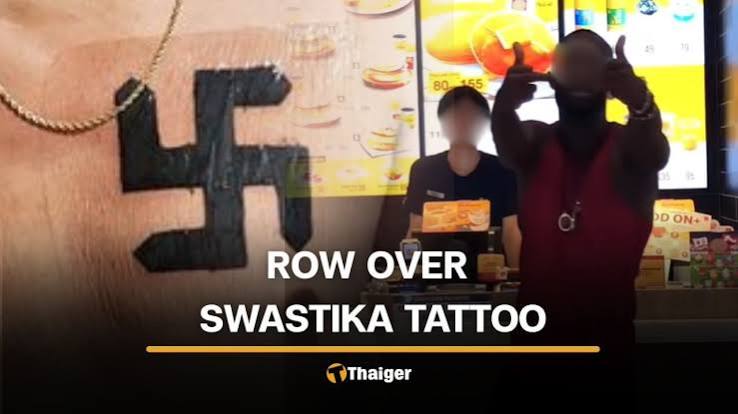
Foreign Man Confronts Thai Woman Over Swastika Tattoo in Fast-Food Restaurant
Viral Video Sparks Global Debate: Foreign Man Confronts Thai Woman Over Swastika Tattoo in Fast-Food Restaurant
A seemingly routine day at a fast-food restaurant in Thailand took a dramatic turn when a heated confrontation erupted between a foreign man and a local Thai woman. What started as an ordinary exchange quickly escalated into a viral sensation after the man’s attention focused on a controversial tattoo on the woman’s body. The clip has exploded across social media platforms, leaving viewers fiercely divided over issues of cultural sensitivity, historical awareness, personal freedom, and the complex legacy of one of the world’s most loaded symbols.
The Incident Unfolds: Tension at the Counter
According to reports and the widely circulated video, the altercation took place at a popular fast-food outlet. The foreign man, dressed in a red shirt and accompanied by his Thai partner, was at the counter when he noticed the Thai woman. She began filming him, suggesting the argument may have already been brewing.
The man turned his attention to restaurant staff, expressing strong disapproval of the woman’s visible tattoo—a swastika on her inner ankle. He described the symbol as one representing fascism and violence, urging staff to address the situation. The employee, caught off guard, reportedly encouraged the man to simply proceed with his order rather than escalating further.
The Thai woman defended herself passionately. She explained that she got the tattoo years earlier and claimed she had no understanding of its dark historical associations at the time. “There is no law in Thailand banning the symbol,” she asserted during the exchange, emphasizing her right to express herself through body art. As the confrontation continued, she showed the tattoo on camera while continuing to record. The foreign man responded by filming her and the tattoo in return.
The tense standoff eventually de-escalated when the man’s Thai girlfriend intervened, helping to calm the situation and allowing everyone to move on. However, the video—originally recorded by the woman herself and later amplified by Thai Facebook pages like “อยากดังเดี๋ยวจัดให้ รีเทริน์ part 7″—has since garnered thousands of views, comments, and shares.
The Power of a Symbol: From Ancient Roots to Modern Controversy
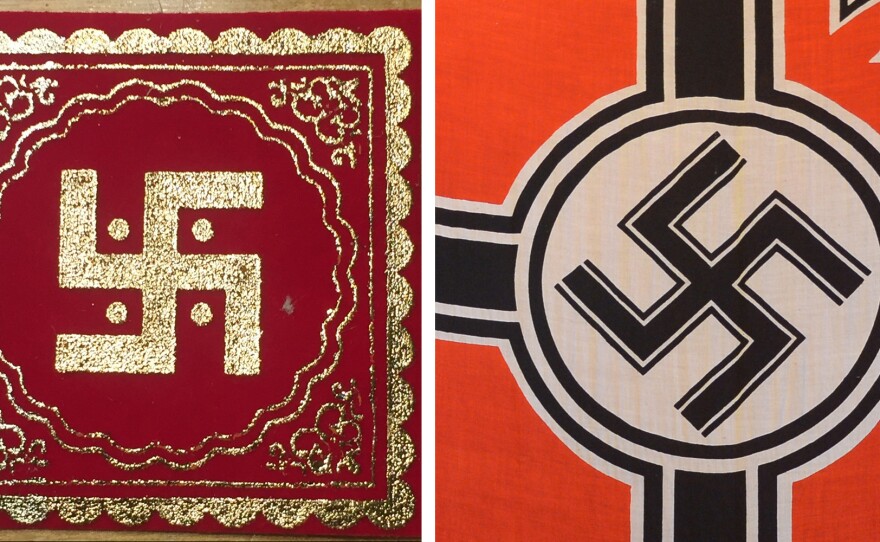
To fully understand why this encounter struck such a nerve, it’s essential to explore the swastika’s multifaceted history. Long before its association with Nazi Germany, the swastika (or “svastika” in Sanskrit) was a sacred symbol used across numerous cultures for thousands of years. In Hinduism, Buddhism, and Jainism—religions with deep roots in Asia—it represents good fortune, prosperity, and well-being. The word itself derives from Sanskrit terms meaning “conducive to well-being.”

Ancient artifacts featuring the swastika have been found in Europe, Asia, Africa, and the Americas. It appeared in decorative art, religious iconography, and even early Christian contexts in some regions. In Thailand and other Southeast Asian countries influenced by Buddhism, variations of the symbol are still used today in temples, festivals, and traditional designs without any negative connotation.
:focal(1000x752:1001x753)/https://tf-cmsv2-smithsonianmag-media.s3.amazonaws.com/filer_public/cb/08/cb08d242-04f2-4ae7-8484-da02225f5097/swastika-postcard.jpg)
This changed dramatically in the 20th century. Adolf Hitler and the Nazi Party adopted a rotated version of the swastika (often called the Hakenkreuz or “hooked cross”) as their emblem. Under the Nazis, it became inextricably linked to antisemitism, totalitarianism, the Holocaust, and World War II atrocities that claimed millions of lives. Post-war, many countries, particularly in the West, banned or heavily restricted its display in certain contexts due to its hateful associations.
The Thai woman’s claim of ignorance about these associations highlights a common reality in regions where the symbol retains its original positive meanings. Many young people in Asia may encounter the swastika in temples or cultural contexts long before learning about its Western appropriation. This cultural disconnect lies at the heart of the online debate.
Social Media Reactions: A Deeply Divided Audience
As the video spread like wildfire, opinions polarized sharply. Many viewers, especially those with Western perspectives or personal connections to Holocaust history, sided with the foreign man. They argued that regardless of intent, displaying the symbol in public can cause genuine distress and reflects a lack of sensitivity to global history.
Comments ranged from empathetic calls for education—”She should remove it now that she knows”—to stronger condemnations labeling the tattoo as inherently offensive. Some drew parallels to other hate symbols, questioning whether “I didn’t know” is a valid defense in the age of instant information.
On the other side, numerous Thai netizens and supporters of personal freedom defended the woman. They pointed out that Thailand has no laws prohibiting the swastika, and its use in Buddhist contexts remains common and innocuous. Critics accused the foreign man of cultural imperialism—imposing Western sensitivities on a Thai citizen in her own country. “This is Thailand,” one popular comment read. “We have our own history with the symbol.”
Others highlighted the woman’s right to bodily autonomy. Tattoos are deeply personal, and demanding someone alter their body art, especially over a misunderstanding from years prior, crosses a line for many. The intervention by the man’s Thai partner also fueled discussions about cross-cultural relationships and differing viewpoints within them.
The divide underscores broader tensions in our increasingly globalized world: How do we balance respect for historical trauma with cultural relativism? When does personal expression infringe on others’ comfort?
Cultural Context in Thailand and Southeast Asia
Thailand’s relationship with the swastika is markedly different from that in Europe or the United States. Buddhist temples across the country feature the symbol as a representation of the Buddha’s footprints or auspicious markings. It appears in architecture, clothing patterns, and religious art without evoking Nazi associations for most locals.
This incident isn’t isolated. Thailand frequently sees cultural clashes involving foreigners, from dress code misunderstandings at temples to debates over “farang” (foreigner) behavior. While tourism brings economic benefits, it also creates friction when visitors apply their home-country norms without context.
Experts in cultural studies note that symbols are not universal. What horrifies one person might be spiritually significant to another. Education, rather than confrontation, is often proposed as the better path forward—perhaps through respectful dialogue that acknowledges both histories.
Broader Implications: Free Speech, Tattoos, and Global Sensitivities
This viral moment raises important questions about free speech in public spaces. Should individuals have the unrestricted right to display any tattoo, or do societies have a responsibility to curb symbols linked to genocide? In Thailand, the answer leans heavily toward personal liberty, but international platforms amplify Western viewpoints.
Tattoo culture itself has evolved rapidly. Once taboo in many conservative societies, body art is now mainstream among younger generations in Thailand. Many get tattoos for aesthetic, spiritual, or impulsive reasons during their youth, only later learning deeper meanings.
The role of social media cannot be overstated. A private disagreement captured on a smartphone becomes global entertainment and debate fodder within hours. This democratization of information spreads awareness but also fuels outrage cycles and misinterpretations.
Lessons Learned and Moving Forward
As the dust settles on this particular incident, several takeaways emerge. First, awareness matters. The woman has reportedly acknowledged the symbol’s associations post-incident, which could prompt reflection for others in similar situations. Second, empathy on both sides is crucial—the foreign man’s reaction stems from legitimate historical pain, while the woman’s stems from cultural innocence.
For travelers and expats in Thailand or other Asian countries, this serves as a reminder to approach cultural differences with curiosity rather than confrontation. For locals, it highlights the importance of understanding how symbols travel and transform across borders.
Ultimately, the confrontation in the fast-food restaurant is more than just a viral spat—it’s a microcosm of our interconnected yet fragmented world. In an era where history, culture, and personal identity collide daily online, moments like these force us to confront uncomfortable questions about tolerance, education, and shared humanity.
What do you think? Should the tattoo have been covered or removed? Or does the woman have every right to keep it? Share your thoughts in the comments below.
Recommended Viewing and Further Reading:
- Documentaries on the history of the swastika
- Thai Buddhist cultural sites showcasing traditional symbols
- Discussions on cultural appropriation vs. appreciation
This incident reminds us that while symbols can divide, thoughtful conversation can bridge gaps. In Thailand’s vibrant fast-food scene and beyond, respect remains the best order on the menu.