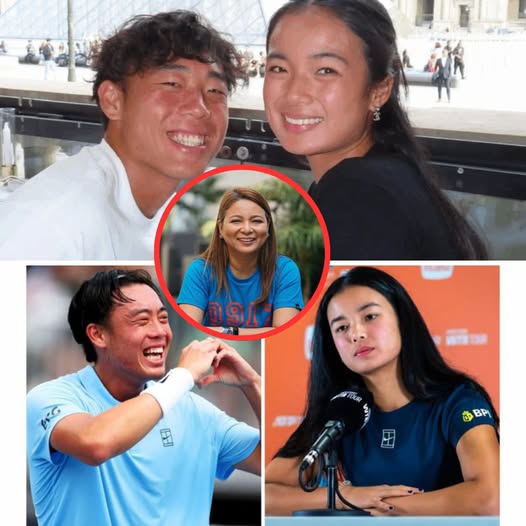
COURT TRIUMPHS VS. TABLOID FICTION: DECONSTRUCTING THE VIRAL ROMANCE RUMORS SURROUNDING ALEX EALA AND COLEMAN WONG
Deconstructing the Clickbait Teaser
A sensational social media teaser recently began circulating across Asian sports forums and digital media feeds, dramatically hinting that “their relationship may be more than just classmates”. Featuring urgent phrasing and ominous framing, the viral post claimed that photos of Filipina tennis prodigy Alex Eala and Hong Kong star Coleman Wong were “spreading rapidly across social media.” It went on to assert that fans of both young athletes were deeply concerned that they were “too young for a relationship” and that romantic entanglements could jeopardize their promising careers. The post concluded with an artificial cliffhanger, claiming that a statement from Eala’s mother had “unexpectedly added another layer of mystery,” before inviting readers to click an external link to view the photos and read the full statement.
While digital content aggregators frequently manufacture romantic intrigue around rising sports stars to generate online engagement, this post is a classic example of clickbait sensationalism. By weaponizing real-world camaraderie between two historic young athletes, fabricating public “paternalistic concern,” and mischaracterizing routine family privacy statements, online content mills convert genuine athletic achievement into manufactured tabloid drama.
Shared Roots in Mallorca: The Rafa Nadal Academy Connection
To understand the origin of the media speculation surrounding Alex Eala and Coleman Wong, one must examine their shared background rather than social media rumors.
Both athletes represent groundbreaking pioneers for tennis in their respective home territories:
-
Alex Eala: The first tennis player from the Philippines to win a junior Grand Slam singles title (2022 US Open Girls’ Singles) and the first Filipina in the Open Era to secure main-draw match wins at WTA 1000 events and Grand Slam tournaments.
-
Coleman Wong: The first male player from Hong Kong to win a Grand Slam main-draw match in the Open Era and a multi-time junior Grand Slam doubles champion.
The foundational bond between Eala and Wong stems from their developmental years in Manacor, Mallorca, where both trained as teenagers at the elite Rafa Nadal Academy. Living, training, and competing side-by-side in Spain created a natural peer support network as both navigated the transition from junior champions to the grueling professional WTA and ATP circuits.
When both players achieved simultaneous historic victories at major tournaments—such as their breakthrough main-draw wins at Flushing Meadows and the Miami Open—they frequently cheered for each other from court side boxes and celebrated shared milestones on social media. However, tabloid outlets routinely misinterpret this professional solidarity and mutual encouragement among academy alumni as proof of secret, high-stakes romance.
The “Mysterious Mother” Trope and the Defense of Personal Privacy
The viral teaser’s assertion that a statement from Eala’s mother “added another layer of mystery” is an engineered narrative tactic designed to exploit family dynamics for clicks.
Alex Eala’s mother, Rikka Lizarondo Eala—a former national swimmer who earned a silver medal for the Philippines at the Southeast Asian Games—has long been a cornerstone of Alex’s support system. Alongside her husband, Mike Eala, Rikka has consistently advocated for maintaining her daughter’s mental focus, protecting her from media overexposure, and emphasizing academic and athletic discipline over public celebrity.
When public figures or their parents issue statements regarding personal lives, they typically fall into one of two categories: a request for privacy or an emphasis on athletic priorities. Clickbait aggregators routinely seize upon standard, protective statements—such as a mother reminding the press that her daughter is focused exclusively on training and professional tournaments—and reframe them as “cryptic warnings” or “mysterious hints.”
By promising that tapping a link will reveal “her mother’s full statement,” content aggregators create an artificial information gap. Readers who click through are invariably redirected to ad-monetized landing pages or automated video loops that offer no actual revelation, serving only to generate pay-per-click ad revenue at the expense of a family’s privacy.
Moral Panics and the Paternalism Surrounding Young Athletes
The premise embedded within the teaser—that fans are “concerned that they may be too young for a relationship and that it could potentially affect their careers”—highlights a broader sociological trend in the coverage of young international sports figures.
Emerging athletes, particularly those from Asian nations where public support is intensely concentrated on individual prodigies, often face an exceptional degree of public paternalism:
-
The Myth of Monastic Isolation: Public commentary frequently insists that young athletes must lead lives of absolute, monastic isolation, viewing any personal relationship, social activity, or normal adolescent milestone as a dangerous distraction from athletic performance.
-
Gendered Scrutiny: Female athletes like Eala often face disproportionate media scrutiny regarding their personal lives, attire, and emotional state compared to their male counterparts, with tabloid outlets attempting to reduce career achievements to romantic narratives.
-
Algorithmic Moral Panics: Social media algorithms prioritize content that triggers moral anxiety or protective defensiveness among fans. By framing a rumor around “career threat” and “youth concern,” clickbait creators guarantee high volumes of heated debate in comment sections, amplifying the post’s viral reach.
In reality, professional athletes on the tour routinely build strong interpersonal friendships and support systems to combat the extreme loneliness, travel fatigue, and psychological strain associated with global tennis competition.
Grounding Fandom in Authentic Sports Achievement
The manufactured drama surrounding Alex Eala and Coleman Wong serves as a reminder of the vital distinction between authentic sports journalism and algorithmic digital gossip.
Alex Eala and Coleman Wong have earned international respect through relentless hard work, tactical intelligence on court, and historic victories that have put Philippine and Hong Kong tennis on the global map. Their accomplishments are recorded in official WTA and ATP match logs, Grand Slam draw sheets, and world ranking points—not in the speculative captions of social media clickbait.
As digital media ecosystems continue to generate artificial scandals around young public figures, critical media literacy remains essential. Evaluating sports stars based on their performance under pressure and respecting their boundaries off the court ensures that public discourse remains grounded in genuine athletic excellence rather than manufactured fiction.