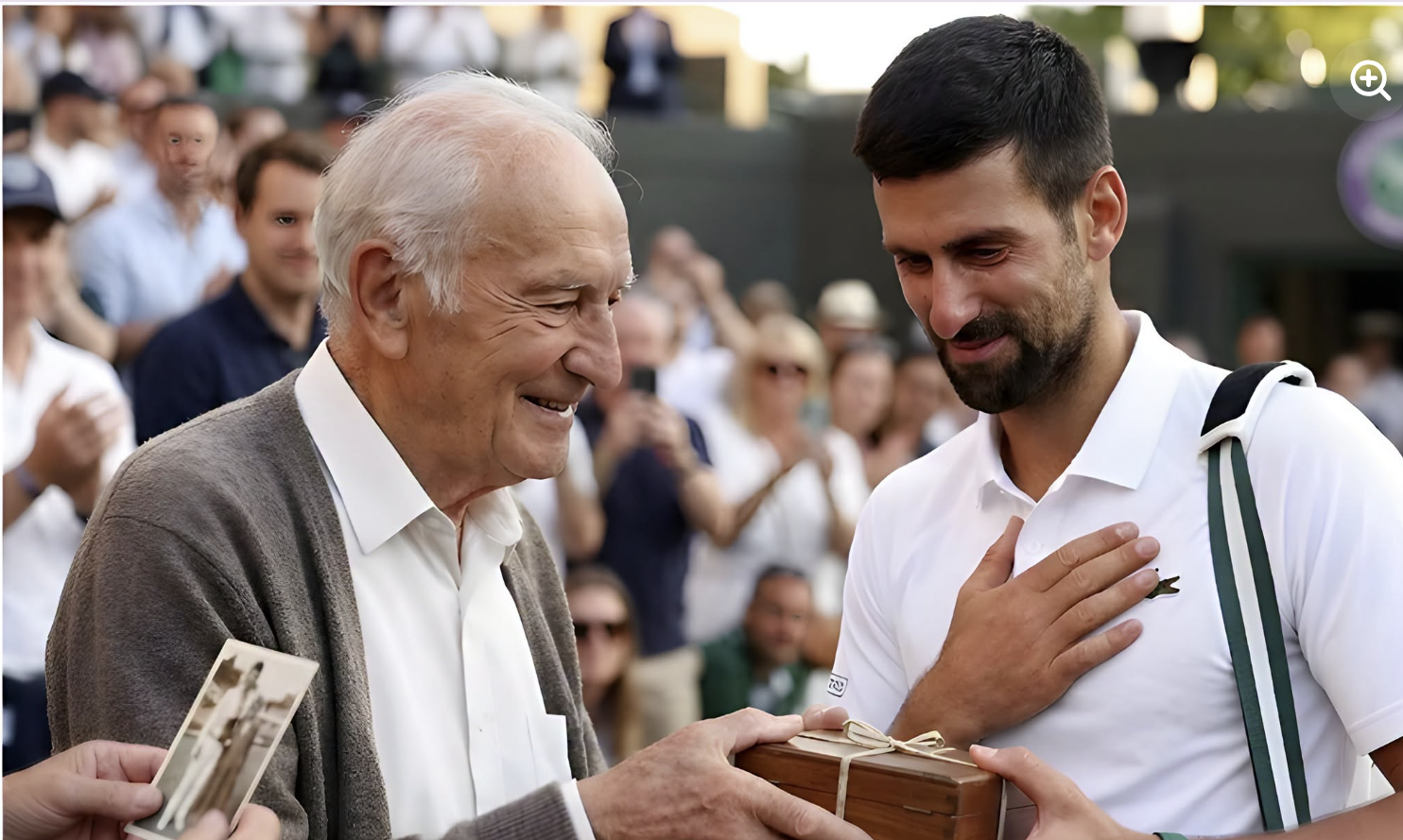
THE HOAX OF THE “SAVED FAMILY” SIGNED BALL: UNMASKING THE FABRICATED MELODRAMA SURROUNDING NOVAK DJOKOVIC AND GAËL MONFILS
Behind the viral tear-jerker about a mysterious vintage box, a dying wife, and a weeping Gaël Monfils lies an AI-generated sports soap opera designed to exploit human empathy for ad revenue.
A heart-wrenching narrative has been sweeping through social media feeds, claiming that an emotional spectacle took place at a “Novak & Friends” exhibition event. According to the viral posts, an elderly French gentleman named Jean-Luc walked onto the court to confront 24-time Grand Slam champion Novak Djokovic. Jean-Luc allegedly confessed that selling a tennis ball signed by Djokovic years ago saved his dying wife’s life by paying for her medical treatment. To complete the dramatic arc, the story claims Jean-Luc presented Djokovic with a “mysterious vintage box”—causing fellow tennis star Gaël Monfils to burst into uncontrollable sobs when a handwritten note inside revealed a personal connection to Monfils’ own late relative.
It is a story tailored perfectly for Hollywood: tragedy, miraculous salvation, deep nostalgia, and a shocking twist involving two of tennis’s most beloved figures.
However, there is a fundamental problem with this cinematic tale: It is 100% fake.
No elderly man named Jean-Luc interrupted an event to hand over a vintage box; no signed ball saved a dying wife in this context; and Gaël Monfils did not break down in tears over a secret family relic on court. This entire narrative is a textbook example of AI-generated emotional clickbait, meticulously engineered by online content farms to manipulate sports fans into clicking dangerous links and generating ad revenue.
1. Deconstructing the “Jean-Luc” Narrative: A Masterclass in Scripted Manipulation
To understand how tens of thousands of well-meaning sports fans were tricked into sharing and commenting on this story, one must deconstruct the narrative architecture of modern “digital soap operas.”
Over the past two years, automated content farms have evolved beyond simple fake match results. They now employ sophisticated narrative engines designed to generate multi-tiered emotional dramas. The “Novak & Friends / Jean-Luc” story relies on several classic storytelling tropes intentionally combined to bypass a reader’s logical skepticism:
-
The “Life-Saving Autograph” Trope: By framing a simple sports souvenir as the literal financial savior of a dying human being, the narrative immediately elevates Djokovic from a world-class athlete to a saintly figure. This appeals directly to the deep admiration fans already hold for him.
-
The Vulnerable Protagonist: Introducing “Jean-Luc”—an elderly, fragile man who traveled miles out of sheer gratitude—triggers an instant empathetic response. Audiences are conditioned to respect and feel for elderly individuals seeking closure or expressing heartfelt thanks.
-
The “Mysterious Vintage Box” MacGuffin: Borrowed directly from classic mystery fiction, the inclusion of a physical object containing a hidden secret creates intense suspense. Readers are desperate to know what is inside the box.
-
The Secondary Star Reaction: By claiming that Gaël Monfils “sobbed uncontrollably” upon recognizing an item tied to his late relative, the story doubles its celebrity clout. Monfils, known globally as one of the most expressive, joyful, and emotionally transparent players in tennis history, is the perfect character to cast as the overwhelmed spectator.
-
The Truncated Cliffhanger: The caption deliberately cuts off right at the moment of revelation: “revealing the relic originally belonged to Monfils’ late…” paired with a link to “READ FULL STORY HERE.”
When a reader clicks that link, they do not find a video of Jean-Luc or a statement from Monfils. Instead, they are routed through a maze of spam domains, popup advertisements, tracking scripts, and fake survey forms.
ANATOMY OF AN EMOTIONAL SPORTS HOAX

[Saintly Athlete Action] ──> [Tragic Elderly Stranger] ──> [Mysterious Physical Relic] ──> [Secondary Star Crying] ──> [Clickbait Link]
          │                              │                             │                            │                        │
          ▼                              ▼                             ▼                            ▼                        ▼
 Djokovic's signed ball         Jean-Luc's dying wife           The vintage box             Monfils breaks down        Ad-revenue trap
2. The Real “Novak & Friends” Events vs. Synthetic Drama
While the story of Jean-Luc is pure fiction, the event title “Novak & Friends” is grounded in real tennis history, which is precisely why the hoax gained initial traction.
Prior to major tournaments—most notably before the Australian Open in Melbourne—Novak Djokovic has hosted charity exhibition matches under the banner of “Novak & Friends.” These events are designed to raise funds for the Novak Djokovic Foundation, which focuses on early childhood education and building preschools in underprivileged communities across Serbia, as well as local children’s charities in host countries.
The actual “Novak & Friends” exhibition matches are high-energy, lighthearted spectacles filled with humor and athletic entertainment. They featured real stars, including Stefanos Tsitsipas, Aryna Sabalenka, Maria Sakkari, and wheelchair tennis legend Gordon Reid, alongside gymnasts and Australian rules football players.
In real life, Djokovic’s philanthropic work is extensive, structured, and highly transparent:
-
Infrastructure: The Novak Djokovic Foundation has built or renovated over 50 preschools, impacting tens of thousands of children.
-
Disaster Relief: Djokovic has personally donated millions of dollars to global health initiatives, flood relief in the Balkans, and bushfire relief efforts in Australia.
-
Player Support: He co-founded the Professional Tennis Players Association (PTPA) to advocate for better financial distribution for lower-ranked players struggling to survive on tour.
The irony of the fake “Jean-Luc” story is that Novak Djokovic’s real-world charitable impact is vast and documented. Content farms do not need to invent fake stories about signed balls and vintage boxes to show his generosity; yet, they choose fiction because synthetic melodrama generates higher emotional impulse clicks than real-world policy work.
3. Djokovic and Monfils: The Real Brotherhood Behind the Myth
A key reason this hoax resonated with tennis enthusiasts is the genuine, decades-long relationship between Novak Djokovic and Gaël Monfils.
On the court, Djokovic and Monfils share one of the most unique rivalries in ATP Tour history. Entering the twilight of their careers, Djokovic holds a staggering 19-0 head-to-head record against Monfils—the most one-sided rivalry in the history of men’s professional tennis. Yet, despite Monfils never beating Djokovic in an official ATP match, there is zero bitterness between them.
In fact, their real-life interactions are far more entertaining and touching than any fake script:
-
The Shirt Signing at Cincinnati 2023: After Djokovic defeated Monfils for the 19th time at the Cincinnati Masters, Monfils walked into Djokovic’s locker room holding a t-shirt and asked his conqueror to sign it. Djokovic smiled and wrote: “19 – 0. Sorry not sorry!” Monfils proudly posted the signed shirt on social media, celebrating their shared journey that began in the junior ranks in 2004.
-
Mutual Respect: Monfils has repeatedly cited Djokovic as the greatest player in tennis history, while Djokovic has routinely praised Monfils as the most athletic, charismatic, and entertaining performer ever to step on a tennis court.
Their true friendship is defined by laughter, mutual admiration, and shared memories spanning over twenty years on the grueling professional tour. Reducing Monfils to a weeping prop in a fabricated story about a “vintage box” does a disservice to the real, joyful camaraderie these two icons share.
REALITY CHECK: DJOKOVIC vs. MONFILS

- Head-to-Head Record: 19-0 in favor of Djokovic (most one-sided record in ATP history).
- Actual Relationship: Deep mutual respect, close friends since junior tennis in 2004.
- Famous Moment: Monfils asking Djokovic to sign his shirt after losing in Cincinnati 2023.
- On-Court Reality: High entertainment, comic relief, and intense athletic exhibition.
- The "Jean-Luc" Incident: Completely non-existent; no vintage box or crying spell ever occurred.
4. Why AI Content Farms Target Sports Communities with Emotional Melodrama
The phenomenon of fake sports news has shifted dramatically. A few years ago, sports clickbait focused primarily on fake transfer rumors or exaggerated injury reports. Today, content farms rely heavily on emotional kitsch and synthetic human drama.
Why has this shift occurred?
The Power of Algorithmically Driven Engagement
Social media algorithms (on platforms like Facebook, YouTube, and TikTok) prioritize content that triggers immediate, strong emotional reactions—specifically awe, sorrow, outrage, or heartwarming inspiration. A post claiming “Djokovic won a match” gets standard engagement. A post claiming “Djokovic made a dying fan weep with a vintage relic” triggers thousands of comments, shares, prayer emojis, and tags.
Exploiting the Global Nature of Tennis
Tennis is a global sport with fans spanning every continent, language, and age demographic. Older fans, who may be less familiar with digital media manipulation or AI-generated text, are particularly vulnerable to heartwarming stories involving elderly protagonists, sick relatives, and religious or moral gratitude.
The Rise of Generative AI Scriptwriting
With large language models, malicious actors can generate hundreds of unique, highly detailed melodramatic scripts in seconds. They simply input prompts like: “Write a heart-wrenching story about [Famous Athlete] being surprised on stage by [Elderly Fan] with a secret relic that makes [Other Athlete] cry.” The AI produces a compelling, emotionally charged script complete with cliffhangers, which is then paired with stolen or edited images and broadcast across automated channels.
5. The Dark Side of Synthetic Philanthropy
While some might argue that these fake stories are harmless “feel-good” fiction, the reality is far more damaging to the sports ecosystem and the public consciousness.
1. Desensitization to Real Charitable Needs
When the internet is flooded with fake stories about athletes secretly paying for surgeries or receiving magic relics from dying fans, it obscures real charitable causes. Real non-profits and athletes working to raise money for actual medical treatments find it harder to cut through the digital noise when public emotional energy is drained by synthetic hoaxes.
2. Exploitation of Grief and Vulnerability
Using topics like terminal illness, financial ruin, and deceased family members as mere “clickbait lures” is ethically predatory. It exploits the genuine sympathy of readers who leave heartfelt comments, unknowingly feeding a commercial scam.
3. Degradation of Sports Journalism
When unverified AI stories spread unchecked, they pollute search engine results and social media feeds. Credible sports journalists are forced to spend time debunking absurd fables rather than covering real athletic achievements, grassroots sports development, or critical industry issues.
6. A Guide to Spotting AI-Generated Sports Soap Operas
To protect yourself from falling for synthetic sports stories, look for these telltale red flags whenever you encounter an extraordinary narrative on social media:
-
Generic or Overly Dramatic Names: Notice how the protagonist in these stories is almost always an “elderly fan named Jean-Luc,” “a young girl named Clara,” or “a veteran named Arthur.” These names are chosen by AI models to fit regional stereotypes without linking to a real, verifiable person.
-
The Presence of a “Mysterious Physical Object”: Stories involving handwritten letters found inside vintage boxes, old rackets with hidden inscriptions, or secret family heirloom lockets are almost exclusively fictional plot devices.
-
Extreme Emotional Reactions by Other Celebrities: Claims that third-party stars (like Monfils, Nadal, or Federer) “broke down in tears,” “fell to their knees,” or “walked off the set in shock” are classic clickbait embellishments.
-
The Missing Video Evidence: If an event as dramatic as an elderly man walking onto a stage to hand a famous athlete a life-changing box actually happened during a public exhibition, there would be thousands of fan-cam videos, official press conference transcripts, and coverage on ESPN, Tennis Channel, and the BBC. If the only source is a single suspicious Facebook post or YouTube channel with a robotic voiceover, it is false.
-
Incomplete Sentences Leading to External Links: Any post that stops mid-sentence right at the climax (“revealing he was secretly…”) and directs you to an external link is an ad-arbitrage trap.
Conclusion
The story of Jean-Luc, the signed tennis ball that saved a life, and the mysterious vintage box that brought Gaël Monfils to tears is a complete fabrication—a modern fable constructed by digital algorithms to profit from human empathy.
Novak Djokovic’s career does not require manufactured miracles to be extraordinary. His 24 Grand Slam titles, his relentless drive, and his real-world philanthropic foundation speak for themselves. Likewise, Gaël Monfils’ legacy as one of the most joyful, charismatic, and beloved entertainers in tennis history is built on real sweat, real laughter, and genuine sportsmanship.
In an era where AI can manufacture heartwarming lies in a fraction of a second, the most powerful tool sports fans possess is a healthy skepticism. The next time a headline offers a story that sounds like a Hollywood melodrama, remember: the true beauty of sports lies in its unscripted reality, not in the fake stories crafted to catch your click.