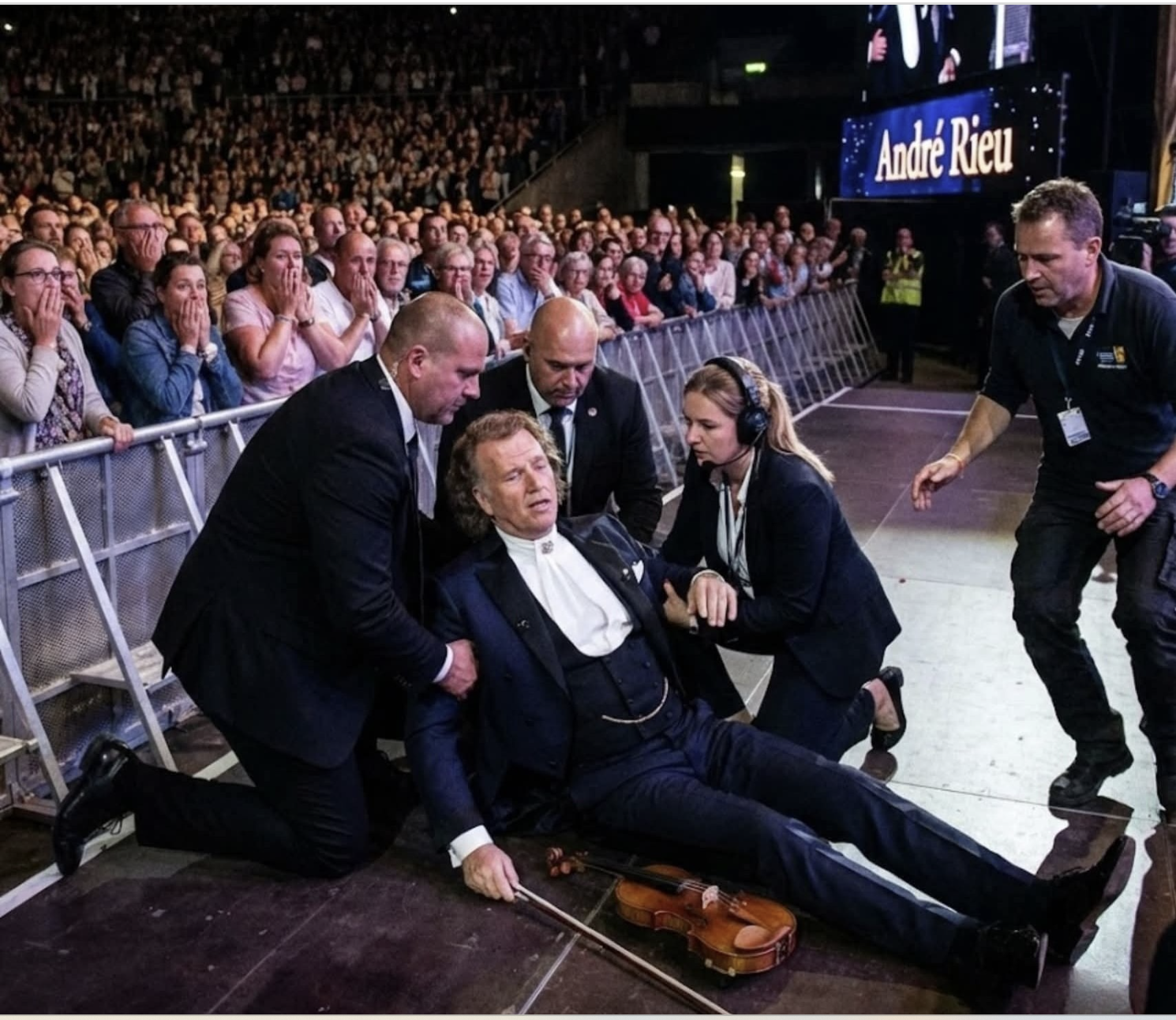
ANDRÉ RIEU STAGE COLLAPSE
Deconstructing the Sensationalist Teaser
An alarmist social media advertisement recently began circulating across automated entertainment feeds, classical music fan communities, and digital message boards, declaring in panic-inducing headlines: “🚨 SHOCK: ANDRÉ RIEU SUFFERS A HEALTH INCIDENT ON STAGE, FORCING HIM TO HALT THE CONCERT. Reports claim he became dizzy and developed a fever backstage shortly after the performance, before collapsing and being rushed to the hospital. Fans were left deeply concerned as news of the incident spread, with fresh updates now emerging about the beloved maestro’s condition. Read the latest details here. 👇👇”
Packed with flashing red emergency siren emojis (🚨), hyper-dramatic medical descriptions (“dizzy”, “fever”, “collapsing”, “rushed to the hospital”), and downward-pointing arrows (👇👇), the post presents itself as an urgent, breaking news bulletin regarding a life-threatening emergency during a live performance. However, despite its visceral phrasing and atmospheric drama, every core assertion in this post represents a complete digital fabrication. Dutch violinist, conductor, and global waltz icon André Rieu did not collapse on stage, nor was he rushed to an emergency room following a sudden concert halt. Instead, this post represents a predatory form of digital entertainment fraud: an automated, narrative-driven clickbait template engineered to weaponize public concern for a beloved performer’s health, simulate a medical crisis, and harvest web traffic for deceptive ad-arbitrage networks.
Fact-Checking Classical Music Reality vs. Fabricated Medical Emergencies
To evaluate why this social media campaign is fundamentally deceptive, one must contrast its sensationalized assertions with the documented realities of André Rieu’s public touring schedule, professional health disclosures, and established media communications.
The post relies on symptom escalation, kernel-of-truth exploitation, and synthetic dramatic tension to deceive scrollers:
-
Escalation of Minor Historical Incidents into Crises: Clickbait operations frequently exploit real historical events to give fake stories a plausible foundation. Over his multi-decade career, André Rieu has occasionally had to postpone performances due to legitimate medical issues—such as a severe inner-ear infection (labyrinthitis) in 2010 or temporary bouts of flu during heavy winter touring schedules. Content mills take these historical health disclosures, strip away the timeline, and exaggerate them into catastrophic scenarios like “collapsing on stage” or “emergency hospital transports.”
-
Strict Formalities of Tour Cancellation Protocols: When a major international touring artist experiences a genuine medical emergency that affects a live concert, official tour management issues immediate, standardized statements through verified channels. The Johann Strauss Orchestra management and official venues communicate delays directly to ticket holders via official press releases, verified social media accounts, and ticketing partners—not via anonymous social media posts demanding clicks in the comment section.
-
Absence of Accredited Journalism: Any genuine medical collapse involving an international icon of André Rieu’s stature during a live concert would be covered instantaneously by major global news agencies (such as Reuters, the Associated Press, and BBC News) as well as Dutch national broadcasters like NOS. The total absence of coverage across accredited news platforms immediately confirms that the claim is an engineered hoax.
The Psychological Mechanics of Health-Scare Clickbait
The structural design of the “André Rieu Stage Collapse” post relies on refined cognitive manipulation techniques engineered to bypass critical skepticism and provoke immediate online action.
Digital content mills deploy specific psychological triggers when crafting fake medical emergency announcements:
1. Parasocial Vulnerability and Fear of Sudden Loss
André Rieu has built an extraordinarily warm, personal connection with millions of fans worldwide through his cheerful stage persona and romantic waltz performances. Older fan demographics, in particular, hold a deep emotional investment in his ongoing health and longevity. Threatening his wellbeing with news of a sudden physical collapse triggers immediate grief and anxiety, causing fans to act on emotion rather than logic.
2. Rapid Symptom Stacking (“dizzy” -> “fever” -> “collapsed”)
The text uses rapid narrative escalation to build overwhelming dramatic tension in a single short paragraph. By listing a sequence of worsening physical states—starting with dizziness, progressing to a fever, escalating to a collapse, and culminating in an ambulance ride—the post creates a vivid, frightening mental picture that forces the reader to seek immediate narrative resolution.
3. Visual Priming and Directional Urgency (🚨 / 👇👇)
High-contrast emergency symbols—flashing red sirens (🚨) and pointing fingers (👇👇)—serve as behavioral cues. These visual markers trigger a sense of immediate alarm and guide the reader’s eyes straight toward the call-to-action link before they can critically evaluate the text.
4. Algorithmic Amplification via Fan Distress
When panicked or well-meaning fans comment on the post with messages like “Prayers for André!” or “Is this true?”, social media algorithms interpret the surge in user activity as high engagement. Consequently, the platform’s recommendation engine broadcasts the fake medical crisis to thousands of additional feeds, multiplying the reach of the hoax.
The Monetization Funnel: Ad Arbitrage and Malicious Networks
Behind these sensationalized health scares lies a lucrative business model known as traffic arbitrage, digital impression farming, and click-fraud networking.
When scrollers tap the provided link or follow the prompt expecting to read an official medical update on André Rieu’s condition, they are never directed to legitimate medical reports, verified news portals, or official artist communications. Instead, the user journey follows a deceptive web funnel:
-
Redirect Chains to Scraper Blogs: Users are routed through multiple URL shorteners to low-quality scraper sites packed with pay-per-click display banner advertisements, auto-playing video commercials, and pop-unders. Every page load generates passive revenue for the clickbait operator.
-
Generic AI-Generated Text Loops: Landing pages rarely contain actual details about a hospital stay or stage incident. Instead, the page displays AI-generated text endlessly repeating generic biographical information, past concert dates, or general statements about performance stress, designed to keep visitors scrolling through ad units.
-
Cybersecurity Hazards and Phishing Traps: In predatory cases, destination sites push invasive browser notification prompts, deceptive scareware pop-ups claiming system infection, or phishing forms designed to capture personal user data under the guise of an “exclusive fan club health bulletin.”
Digital Media Literacy: Spotting Celebrity Health Scams
The widespread distribution of manufactured celebrity medical emergencies highlights the ongoing necessity of digital media literacy when consuming entertainment news online.
To protect themselves from falling victim to fake health scares and digital ad schemes, audiences should adopt key verification habits:
-
Verify Through Official Outlets: Always check the artist’s official website (
andrerieu.com) and verified social media handles (indicated by official checkmarks) to confirm health updates, tour changes, or concert postponements. -
Recognize Medical Clickbait Red Flags: Be skeptical of social media posts using sensationalist capitalizations (“SHOCK”), extreme medical claims (“collapsed on stage”), and directives to click links in the comments.
-
Avoid Tapping Suspicious Comment/Ad Links: Refrain from opening unverified external links posted by non-official accounts across social media feeds and comment sections.
-
Refrain from Engaging with Fake Posts: Avoid commenting on, liking, or sharing unverified celebrity health posts. Every interaction provides engagement metrics that allow clickbait creators to profit from digital spam.
Understanding how automated content networks capitalize on audience empathy, health anxiety, and sensationalist medical narratives allows music lovers to navigate digital news critically without being manipulated by algorithmic click schemes.