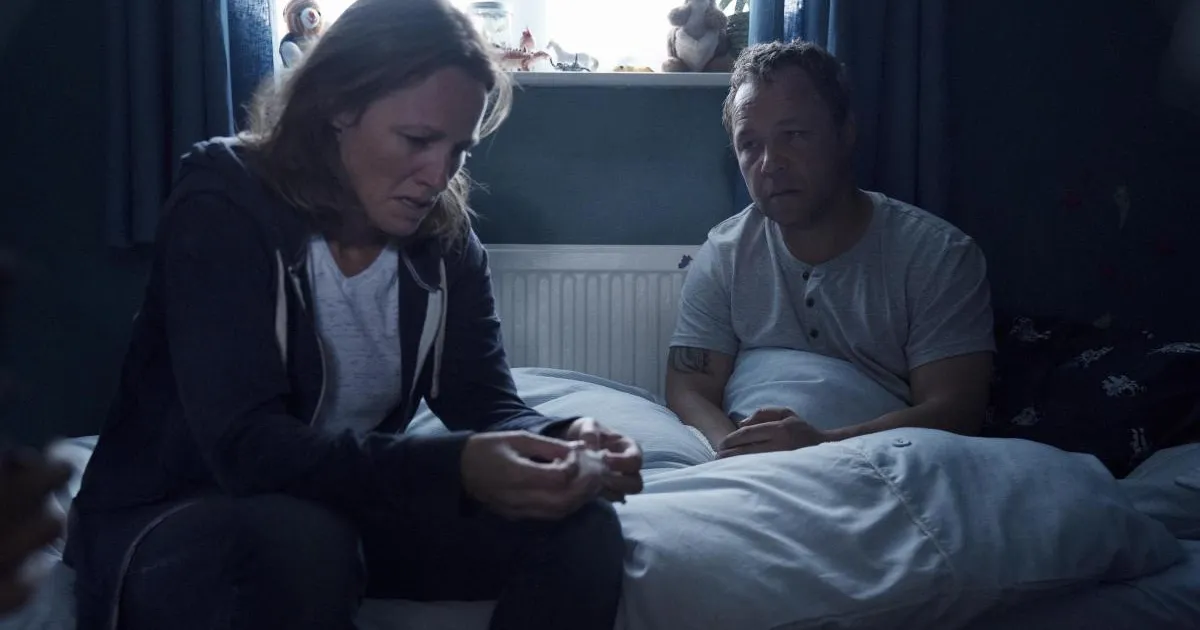
Stephen Graham’s Most Heartbreaking Performance Ever? Why This Hidden British Drama Still Leaves Viewers Completely Speechless
A broken father. A painful past. And a journey that forces him to confront memories he spent a lifetime trying to forget.
In an era saturated with glossy prestige television and endless streaming options, true emotional devastation is rare. Yet every so often a drama emerges that does not merely tug at the heartstrings — it rips them out, holds them up to the light, and forces you to look. Shane Meadows’ 2019 Channel 4 miniseries The Virtues is exactly that kind of work. And at its shattered, beating centre stands Stephen Graham, delivering what a growing chorus of critics and viewers now openly call the performance of his career.
Viewers who stumble upon it years later still describe the same experience: they start watching casually, perhaps drawn by Graham’s name after Adolescence, Boiling Point or This Is England, and by the final episode they are left hollowed out, staring at the credits in silence. Many admit they cannot bring themselves to rewatch it. Others say they have never cried harder at a screen. The ending, they warn, may completely shatter you.
This is the story of The Virtues — the hidden gem that refuses to stay buried.
The Man Who Could Not Stay Numb
Stephen Graham has built a career on raw authenticity. From the volatile Combo in This Is England to the desperate chef in Boiling Point and the haunted father in Adolescence, he specialises in men whose pain leaks through every pore. But nothing — not even those towering roles — quite prepared audiences for Joseph.
Joseph is a painter-decorator living a fragile, day-to-day existence in Liverpool. He is a recovering alcoholic clinging to sobriety by his fingernails. His entire emotional world orbits his young son, Shea. When his ex-partner decides to move to Australia with the boy and her new partner, Joseph’s carefully constructed life collapses overnight. What follows is not a conventional “man on a mission” story. It is a slow, devastating unravelling.
With almost no money and a head full of ghosts, Joseph boards a ferry to Ireland — the place he left as a child and has spent three decades trying to forget. What begins as a desperate search for his long-lost sister becomes a confrontation with a childhood trauma so profound that his mind had buried it for survival.
Meadows, who co-wrote the series with Jack Thorne, draws from deeply personal wellsprings. The director has spoken publicly about his own experiences of childhood sexual abuse. The Virtues feels like an exorcism — not just for Joseph, but for anyone who has ever carried unspoken pain.

A Masterclass in Quiet Devastation
What makes Graham’s performance so shattering is its lack of showiness. There are no grand speeches, no Oscar-bait breakdowns for the first two episodes. Instead, Graham plays Joseph as a man permanently braced for impact. His smile never quite reaches his eyes. His hands fidget constantly. When he finally allows himself a drink again, the relapse is not glamorous or dramatic — it is pathetic, lonely, and heartbreakingly ordinary.
Critics were unanimous. The Guardian called it “a harrowing triumph” and later ranked The Virtues among the top five television shows of 2019. The Daily Telegraph labelled it a “dramatic masterpiece.” Rotten Tomatoes critics consensus praised Graham’s “masterful performance” in a “deeply personal depiction of trauma.” One reviewer wrote: “It is almost impossible to imagine this riveting, emotionally devastating mini-series without Stephen Graham at its centre.” Another simply said: “This is Stephen Graham’s greatest thing he’s ever been in.”
Viewers echo the sentiment in droves. Social media is littered with comments like “I still haven’t recovered,” “Stephen Graham destroyed me,” and “How is this not talked about more?” Many call it the most powerful British drama of the decade — more devastating than Happy Valley, more intimate than I May Destroy You, more spiritually exhausting than After Life.
The supporting cast matches Graham note for note. Niamh Algar is a revelation as Dinah, a young woman whose own buried grief collides with Joseph’s in unexpected and explosive ways. Helen Behan brings quiet steel as Joseph’s sister Anna. The chemistry between the ensemble feels lived-in, messy, and real — hallmarks of Meadows’ best work since the This Is England series.

Trauma, Addiction, and the Long Shadow of Childhood
At its core, The Virtues is about the stories we tell ourselves in order to keep breathing. Joseph has spent his adult life running — from Ireland, from memory, from intimacy. Alcohol was never just a habit; it was anaesthesia. Fatherhood became his one pure thing, the single role in which he felt he could not fail. When that is taken away, the dam breaks.
Meadows and Thorne refuse easy catharsis. The series does not offer neat therapy-speak or sudden redemption arcs. Instead it sits with the mess: the rage, the shame, the self-loathing, the tiny flickers of hope that feel almost cruel in their fragility. When long-buried secrets finally surface, the emotional violence is almost physical. Graham’s face in those moments — eyes wide, body locked, voice cracking into something primal — is the kind of acting that rewires how you understand human pain.
The show is also profoundly Catholic in texture without ever preaching. Guilt, confession, penance, and the faint possibility of grace hang over every frame. The title itself — The Virtues — feels ironic and aspirational at once. These characters are not virtuous in any conventional sense. They are broken people trying, failing, and occasionally succeeding in being a little less broken than yesterday.
Why It Remains a “Hidden” Drama
Despite glowing reviews and a BAFTA nomination for Graham, The Virtues never became the water-cooler phenomenon it deserved. It aired in May–June 2019 on Channel 4, a four-episode run that felt almost deliberately intimate. In the years since, it has lived in the shadow of louder, flashier series. Many people still discover it accidentally — a late-night recommendation, a “if you liked Adolescence” algorithm nudge, a frantic Twitter thread titled “Why has no one told me about this?”
That under-the-radar status only adds to its power. There is no massive marketing machine, no endless think-pieces diluting the experience. When you watch The Virtues, it feels like a private confession between the screen and your soul.

The Ending That Shatters
Without spoiling the final hour, it is enough to say that Meadows does not flinch. The last episode is an emotional reckoning of almost unbearable intensity. Graham reaches a place few actors ever access on camera — a place beyond performance, somewhere closer to possession. Viewers report needing hours, sometimes days, to recover. Some say they sat in silence long after the credits rolled. Others admit they called people they loved just to hear their voices.
It is the rare drama that does not merely depict trauma; it transmits it. You do not watch Joseph’s journey. You survive it with him.
A Career-Defining Peak
Stephen Graham has given us many unforgettable characters. Combo’s racist fury. Andrew’s kitchen meltdown. The quiet dignity of his turn in Help. Yet Joseph feels different. It is the role in which Graham’s famous intensity finally meets total vulnerability. There is nowhere for the character — or the actor — to hide. Every micro-expression, every hitch in breath, every moment of sudden stillness is loaded with decades of unspoken history.
In interviews around the time of release, Graham spoke of the responsibility he felt. Working with Meadows again after This Is England carried extra weight because both men understood the material was not theoretical. The result is acting that feels less like craft and more like bloodletting.
Why You Should Watch It Now
In 2026, with Graham’s star higher than ever after Adolescence and ongoing acclaim, The Virtues has found a new generation of devastated admirers. It streams on various platforms depending on region (often Channel 4’s own service in the UK, and periodically on others internationally). It is only four episodes. You can finish it in a single devastated evening.
But be warned: this is not comfort television. It is not background noise. It demands your full attention and will take something from you in return. Have tissues ready. Have time afterwards to sit with what you have seen. And perhaps most importantly, have someone to talk to.
Because once you have witnessed Stephen Graham as Joseph — a broken father forced to walk back into the fire of his own past — you will never quite forget him.
The Virtues is not just one of the most powerful British dramas ever made. For many who have seen it, it remains the most heartbreaking performance of Stephen Graham’s extraordinary career.
And the ending?
It may completely shatter you.
Watch it. Just… be prepared.
