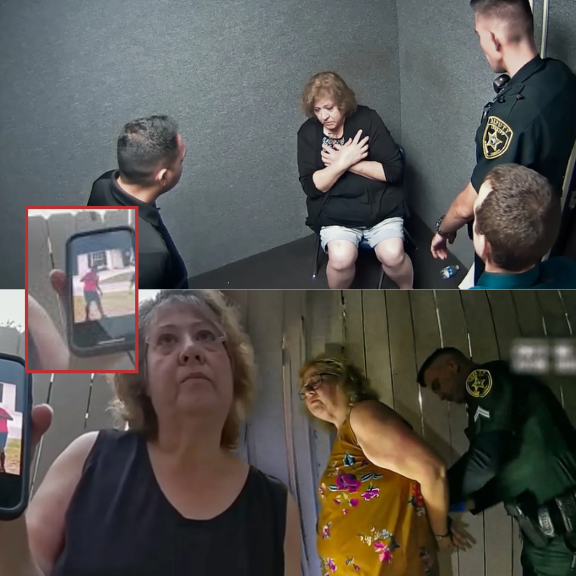
FLORIDA GOING INSANE: Minor Dispute From White Woman Susan Lorincz Spirals Into M.u.r.d.e.r Conviction
In June 2023, in a quiet neighborhood in Ocala, Florida, a dispute that had simmered for two years reached a catastrophic conclusion. Ajike “AJ” Owens, a 35-year-old Black mother of four, walked across a grass lot to the front door of her neighbor, Susan Lorincz. Owens was there to confront Lorincz after the latter had reportedly swung a pair of skates at Owens’ children and called them racial slurs.
Owens knocked on the door. She never got a chance to speak. Lorincz fired a single shot from a .380 handgun through the closed, locked door, striking Owens in the chest. Owens died in front of her nine-year-old son.
The documentary The Perfect Neighbor, directed by Geeta Gandbhir and recently analyzed by The New Yorker, uses this tragedy to hold a mirror up to 21st-century America. It is a film that moves beyond the “True Crime” genre to become a searing indictment of how we live, how we police, and how we fear one another.
Part I: The Digital Panopticon – Policing by Proxy
The most striking technical aspect of The Perfect Neighbor is its source material. Much of the documentary is constructed from hundreds of hours of police body-camera footage and 911 audio recordings dating back nearly two years before the killing.
1. The Weaponization of the 911 Call The footage reveals a chilling pattern: Susan Lorincz used the police as a personal concierge service to litigate her annoyance with the neighborhood’s children. She called 911 dozens of times to complain about children playing on “her” grass (which was actually a common area) or the “noise” of life.
As The New Yorker notes, this is “policing by proxy.” Lorincz was not calling because of an immediate threat; she was calling to exert power. By summoning armed officers to deal with children playing, she effectively weaponized the state against her Black neighbors long before she ever pulled the trigger.
2. The Failure of the “Warning Signs” The documentary poses a haunting question: If the police were there so often, why didn’t they see the disaster coming? The body-cam footage shows officers becoming visibly frustrated with Lorincz’s petty complaints, yet they continued to show up, documenting the escalating tension without ever successfully de-escalating the underlying vitriol. It serves as a lesson in the limitations of modern policing—officers are trained to respond to incidents, not to mend the social fabric of a broken neighborhood.
Part II: The Myth of the “Perfect Neighbor”
The title of the film is bitingly ironic. In the classic American suburban dream, the “perfect neighbor” is someone who watches your house or lends you a cup of sugar. Susan Lorincz, however, represents the “New American Neighbor”: isolated, paranoid, and fortified behind digital doorbells and firearms.
1. The Architecture of Isolation The film explores how Lorincz viewed the world outside her door as a hostile territory. Her house was a fortress. This isolation, fueled by a diet of fear-based media and digital echo chambers, transformed a group of children playing into an “invading force.”
2. The Dehumanization of the “Other” Through interviews with the Owens family and other neighbors, Gandbhir reconstructs the life of AJ Owens—not as a victim, but as a vibrant, protective “mama bear” who was beloved in her community. By contrasting Owens’ warmth with Lorincz’s cold, recorded interactions with police, the film highlights how racism acts as a filter that strips away humanity, allowing a shooter to see a mother of four merely as a “threat” to be neutralized.
Part III: The “Stand Your Ground” Paradox
A central pillar of the documentary—and the New Yorker’s critique—is the legal framework that emboldens such violence: Florida’s “Stand Your Ground” law.
1. Subjective Fear vs. Objective Danger Lorincz initially claimed she acted in self-defense, citing a fear for her life. The documentary exposes the absurdity of this claim: she was behind a locked door, armed with a gun, while Owens was unarmed on a porch. Yet, “Stand Your Ground” laws shift the burden of proof, often allowing shooters to claim that if they felt afraid, their actions were justified.
2. The Racial Geometry of Justice The film forces viewers to confront a uncomfortable reality: had the roles been reversed—if a Black mother had shot a white neighbor through a door—the legal outcome and public outcry would likely have been instantaneous and severe. The documentary tracks the delays in Lorincz’s arrest (it took four days), highlighting the systemic hesitation to prosecute white defendants who invoke self-defense against Black victims.
Part IV: The Toll on the Children
Perhaps the most devastating lesson of The Perfect Neighbor is its focus on the “collateral damage”—the children who witnessed their mother’s death.
The documentary refuses to look away from the trauma inflicted on Owens’ sons. It documents the “theft of innocence” that occurs when a neighborhood playground becomes a crime scene. By centering the children’s voices, the film argues that the cost of “neighborhood disputes” isn’t just a legal fee or a prison sentence; it is a multi-generational scar on the community.
Part V: The Legal Reckoning
While the documentary is a cultural critique, it is also a record of a trial.
-
The Charge: After intense public pressure and civil rights activism, Lorincz was charged with manslaughter with a firearm.
-
The Verdict: In August 2024, she was found guilty.
-
The Sentence: She was sentenced to 25 years in prison, the maximum under Florida law for that charge.
However, the film suggests that while Lorincz is behind bars, the conditions that created her remain. The laws that prioritize gun rights over community safety and the racial biases that influence police response are still very much in place.
Conclusion: Can We Be Neighbors Again?
The Perfect Neighbor ends not with a sense of closure, but with a plea for reflection. The “lessons” derived from this tragedy are a call to dismantle the “stand your ground” culture that views every stranger as a suspect.
As The New Yorker eloquently summarizes, AJ Owens’ death was not an accident; it was the logical conclusion of a society that has traded community trust for individual paranoia. The film challenges us to ask: Are we building neighborhoods, or are we building battlefields?
Until we can answer that question, the tragedy at the threshold in Ocala remains a warning to us all.