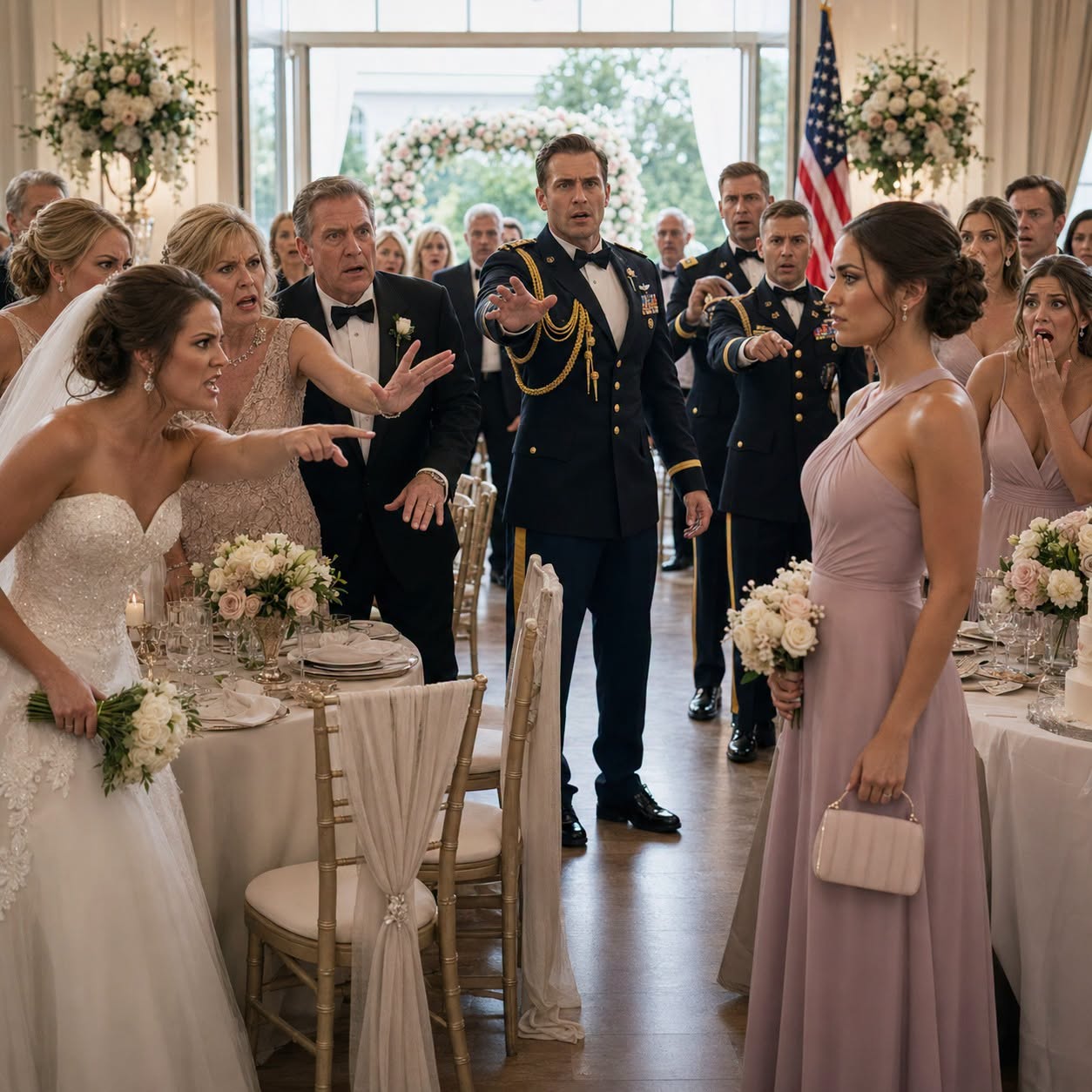
My Sister Said My Army Uniform Would Ruin Her Wedding. So I Wore the Bridesmaid Dress. Then a NATO Prince Stopped the Reception
The blush chiffon dress whispered lies against my skin.
It was supposed to feel like silk and dreams, the kind of gown that made ordinary women glow under fairy lights and champagne. Instead, it itched like regret at my collarbone with every breath I drew. I stood alone in the bridal suite, fingers tracing the delicate neckline as if I could bargain with the fabric itself. In the tall mirror, I looked soft. Feminine. Harmless. Exactly what Brielle had demanded.
Exactly the version of me the family had always preferred.
Three feet away, my Army dress uniform hung like a silent sentinel from the closet door. Deep midnight blue, creases sharp enough to cut glass, brass gleaming with the quiet dignity of twelve hard years. The ribbons on my chest told stories no one in this room wanted to hear: deployments under desert skies, nights in field hospitals where the only music was the steady beep of monitors and the low murmur of soldiers clinging to life. The medical badge above my pocket felt heavier than any medal. Sergeant First Class Mireya Aldridge wasn’t just a name on those tags. She was the woman who had learned to hold a dying boy’s hand and still stand tall the next morning.
I reached for the garment bag’s zipper, my hand trembling with the weight of old promises and newer resentments.
Not today, I thought. Not for her.
The door opened without a knock. Brielle swept in like a summer storm wrapped in white silk, her monogrammed robe catching the light from the crystal chandelier. Her golden curls were pinned to perfection, and that monstrous diamond on her finger threw rainbows across the walls, as if even the light had been hired to celebrate her. She paused, scanning me with the critical eye of a wedding planner who tolerated no deviations.
“Good,” she said, exhaling. “You listened.”
I let my fingers linger near the uniform. “I never agreed to anything.”
Her smile faltered, then reset into that polished, practiced curve she reserved for difficult vendors and inconvenient truths. “Mireya. We discussed this.”
“You discussed it. I endured it.”
“It’s my wedding.” Her voice carried the gentle finality of someone who had always gotten her way by framing resistance as selfishness.
“I know,” I replied quietly. “And I deserve to be there as myself.”
She stepped closer, lowering her tone as though the antique wallpaper might carry tales back to the guests gathering downstairs. “Preston’s family isn’t like ours. His father has senators on speed dial. Judges. Diplomats. Prince Alaric is flying in from Brussels—if his schedule allows. This isn’t some regimental ball where everyone salutes your ribbons. This is elegance. Beauty. One perfect day.”
I glanced at the dress again. Its layers of tulle floated uselessly, a costume for a role I had never auditioned for. “And beauty requires me to disappear? To become background decor so no one asks about the soldier in the family?”
Brielle’s eyes flicked to the uniform, distaste flickering across her features like a shadow. “It’s too much, Mireya. It’s intense. It pulls focus. People will want stories about deployments and blood and whatever else you’ve seen over there. The photographer will chase dramatic shots of you instead of me in my dress. The whole reception will turn into ‘the brave sister who serves’ instead of my marriage.”
The words landed like shrapnel—small, precise, embedding deep.
I had spent years swallowing silences for her. Childhood birthdays eclipsed by her recitals. Family dinners where my return from overseas was acknowledged with a quick toast before conversation drifted back to Brielle’s latest achievement. Our parents had always framed my service as a phase: admirable, yes, but best kept in the background like an old family photo that no longer matched the decor. “Wear something softer next time, honey,” my mother had once said after a cousin’s graduation. “You intimidate people.”
People. Code for the world she and Brielle curated so carefully.
“The uniform is who I am,” I said, my voice steady but threaded with the ache of years unacknowledged. “It’s the woman who learned to stitch wounds and carry the weight of decisions that keep others alive. It’s not a costume I can fold away when it inconveniences you.”
Brielle reached out, touching my arm with a gentleness that somehow hurt more than anger. “Not today, okay? For me. Just this once. Be my sister, not the sergeant.”
That softness was her sharpest weapon. It always had been. It made refusal feel like cruelty.
I looked at her—truly looked. The little girl who once cried when I left for basic training, now a bride orchestrating a fairy tale where I played the supporting role. Part of me wanted to fight. The other part, exhausted from battles far bloodier than this, wondered if one day of erasure was such a terrible price for her happiness.
In the end, I nodded.
I wore the bridesmaid dress.
The reception unfolded like a dream someone else had written. Crystal clinked, string quartets played, and laughter rose in waves around tables heavy with flowers and fine china. I moved through it all like a ghost in blush chiffon, smiling when expected, deflecting questions about my “interesting job,” and watching Brielle shine at the center of her perfect universe. Preston beamed beside her, the picture of polished privilege.
Then the music faltered.
A ripple moved through the crowd near the grand entrance. Whispers spread like wildfire. Heads turned. Security shifted uneasily.
A tall figure in a tailored suit cut through the guests with purposeful strides, his presence commanding the room without effort. Even from across the ballroom, I felt the shift in gravity. Dark hair, sharp jaw, eyes that had clearly seen their share of strategy rooms and high-stakes decisions. Prince Alaric of the House of Windom, NATO’s quiet power behind more alliances than most civilians would ever know.
He stopped the orchestra with a single raised hand.
His gaze swept the room once, twice, then locked on me with unmistakable recognition.
The entire reception held its breath.
“Where is Sergeant First Class Aldridge?” His voice carried, calm yet edged with urgency that silenced every conversation. “I need to speak with her. Now.”
PART 2
The silence that followed Prince Alaric’s words was absolute, the kind of hush that falls over a battlefield right before the first shot. Every eye in the opulent ballroom turned toward me. Crystal glasses froze halfway to lips. Brielle’s perfect smile cracked like fine porcelain.
I stood there in that ridiculous blush dress, feeling more exposed than I ever had in full combat gear. The chiffon suddenly felt like chains.
Prince Alaric moved through the parting crowd with the effortless authority of a man born to command rooms far more consequential than this one. His eyes—storm-gray and unflinching—never left mine. Up close, I could see the faint lines of exhaustion around them, the look of someone who had flown across oceans not for cake and toasts, but for necessity.
“Sergeant First Class Aldridge,” he said, his voice lower now, resonant with respect that cut through the murmurs. “I apologize for the interruption. But time is critical.”
Brielle stepped forward, her white gown a stark contrast to the sudden fracture in her perfect day. “Your Highness, this is my wedding reception. Whatever this is about, surely it can wait—”
“It cannot.” His tone was polite, yet forged from steel. He turned back to me. “We’ve been trying to reach you for eighteen hours. Your encrypted comms were dark. The situation in the Eastern Sector has escalated. The medical evacuation protocol you designed last year—the one they said was ‘overly cautious’—just saved three entire forward teams. But we need the architect on the ground. Now. A private jet is waiting at the airstrip. You’ll be briefed en route.”
The words landed like thunder in slow motion.
I felt the room tilt. Twelve years of invisible service, of family dinners where my stories were gently redirected, of promotions celebrated with lukewarm “that’s nice, dear” over dessert. And here was a prince of a nation, a key figure in NATO’s inner circle, standing in my sister’s fairytale and naming my work like it mattered more than anything else in this glittering hall.
Preston’s father, the man with half the state in his pocket, stared openly. Judges and diplomats who had barely glanced at me earlier now studied me with new interest. My mother’s hand fluttered to her pearls. My father looked… proud? Or perhaps simply stunned.
Brielle’s face cycled through emotions too quickly for the photographer to capture: shock, embarrassment, then something sharper—resentment laced with dawning realization.
“Mireya?” she whispered, her voice small for the first time all day. “What is he talking about?”
I met her eyes. For years I had softened myself for her, folded my edges so they wouldn’t cut her spotlight. The dress scratched harder now, a reminder of the erasure I had almost accepted.
“It’s the work I do when no one’s watching,” I said quietly, but clearly enough for the nearest tables to hear. “The part of me you wanted hidden today.”
Prince Alaric inclined his head with genuine deference. “Sergeant, your innovations in triage logistics under fire have changed protocols across allied forces. Lives are on the line. I wouldn’t ask if it weren’t urgent.”
I looked at my sister one last time. The woman who had once been my shadow, now standing in the ruins of her curated perfection. Part of me ached for her—the little girl who used to beg for stories of my training days. But another part, the soldier who had learned that some bridges must be crossed alone, felt the weight lift.
I reached up, unzipped the side of the bridesmaid dress just enough to breathe, and nodded to the prince.
“Give me five minutes to change.”
The uniform was waiting upstairs, exactly where I had left it. As I shed the chiffon and stepped back into midnight blue, the fabric settled over me like coming home. Ribbons aligned. Brass caught the light. Sergeant First Class Mireya Aldridge looked back at me from the mirror—whole, unbroken, seen.
When I descended the grand staircase minutes later, the reception had transformed. No longer Brielle’s flawless tableau, but a moment suspended between two worlds. Prince Alaric waited at the bottom, offering a crisp salute that I returned instinctively. Guests parted with murmurs of respect.
Brielle stood near the cake, tears threatening her mascara. She didn’t stop me. For once, there were no words, no gentle manipulations. Just the raw truth that the sister she had tried to diminish had never needed her permission to shine.
As we walked toward the exit, the prince spoke softly. “You know, Sergeant, in my line of work we learn quickly: the most valuable people are rarely the ones demanding the spotlight. They’re the ones who show up when it matters.”
I allowed myself a small smile, the first real one all day. Outside, the evening air carried the promise of purpose beyond silk and toasts. Somewhere across the ocean, soldiers were waiting because of work I had done in silence.
Back in the ballroom, the string quartet tentatively resumed, but the music sounded different now—smaller, somehow. Brielle’s perfect wedding would continue, but its center of gravity had irrevocably shifted.
And for the first time in years, I felt no guilt walking away.
PART 3
The ballroom, once a symphony of crystal and carefully curated joy, now felt like a stage after the final curtain—awkward, exposed, and strangely quiet. Prince Alaric’s presence had rewritten the entire evening in a single command. No one dared speak above a whisper. Even the flowers on the tables seemed to lean in, listening.
I stood between two worlds: the soft, suffocating blush of the bridesmaid dress and the crisp authority of the uniform still hanging upstairs like a second skin waiting to be reclaimed. Brielle’s eyes burned into me, wide with disbelief and something deeper—betrayal, perhaps, or the first sharp sting of regret.
“Your Highness,” she tried again, her voice trembling on the edge of tears, “this is supposed to be my day. Mireya, please… don’t do this.”
For a heartbeat, I hesitated. Years of love, resentment, and reluctant sacrifices rose in my throat. I remembered the little sister who once crawled into my bed after nightmares, the one who cried when I shipped out the first time. But I also remembered every family gathering where my service was politely sidelined, every “not now, honey” when I tried to share the weight I carried so others could live lighter lives.
Prince Alaric remained silent, giving me the dignity of choice. His respect felt like oxygen after years underwater.
I turned to my sister fully. “Brielle, I love you. I have always loved you. But love doesn’t mean erasing myself so your picture stays perfect. This uniform isn’t a costume—it’s the proof that I’ve saved lives while the world kept turning. Today, those lives need me again.”
A single tear slipped down her cheek, carving a path through flawless makeup. Preston placed a hand on her shoulder, but even he looked uncertain, glancing at his father whose expression had shifted from mild annoyance to quiet calculation.
I didn’t wait for permission. I walked upstairs, shed the chiffon like an old identity that no longer fit, and put on my uniform. The fabric embraced me—familiar, grounding, true. When I returned, the transformation was complete. Medals caught the light. My posture straightened. Sergeant First Class Mireya Aldridge was no longer background. She was the story.
Prince Alaric nodded once, approval in his eyes. “The car is ready. We’ll brief you on the flight. Your work on adaptive triage algorithms just became doctrine. Three teams owe you their lives tonight.”
As we moved toward the exit, the guests parted like water. Some clapped—hesitant at first, then stronger. My mother’s face held a complicated mix of shock and pride. My father actually stood a little taller.
Brielle followed us to the doorway, her white gown trailing behind her like a surrendered flag. “Mireya… I’m sorry,” she whispered, the words barely audible over the night breeze. “I didn’t see you. I didn’t want to.”
I paused, touching her arm gently. “Then see me now. All of me. When I come back, maybe we can plan a different kind of celebration. One where both sisters get to be who they are.”
She nodded, lips pressed tight, as the weight of the evening settled over her.
Prince Alaric and I stepped into the waiting car. The engine purred to life, carrying us away from the lights and music toward duty, purpose, and the vast unknown. In the rearview mirror, the wedding reception glowed smaller and smaller until it was just another memory.
I had chosen the uniform.
And for the first time, my family—and the world—had been forced to see what that really meant.
THE END