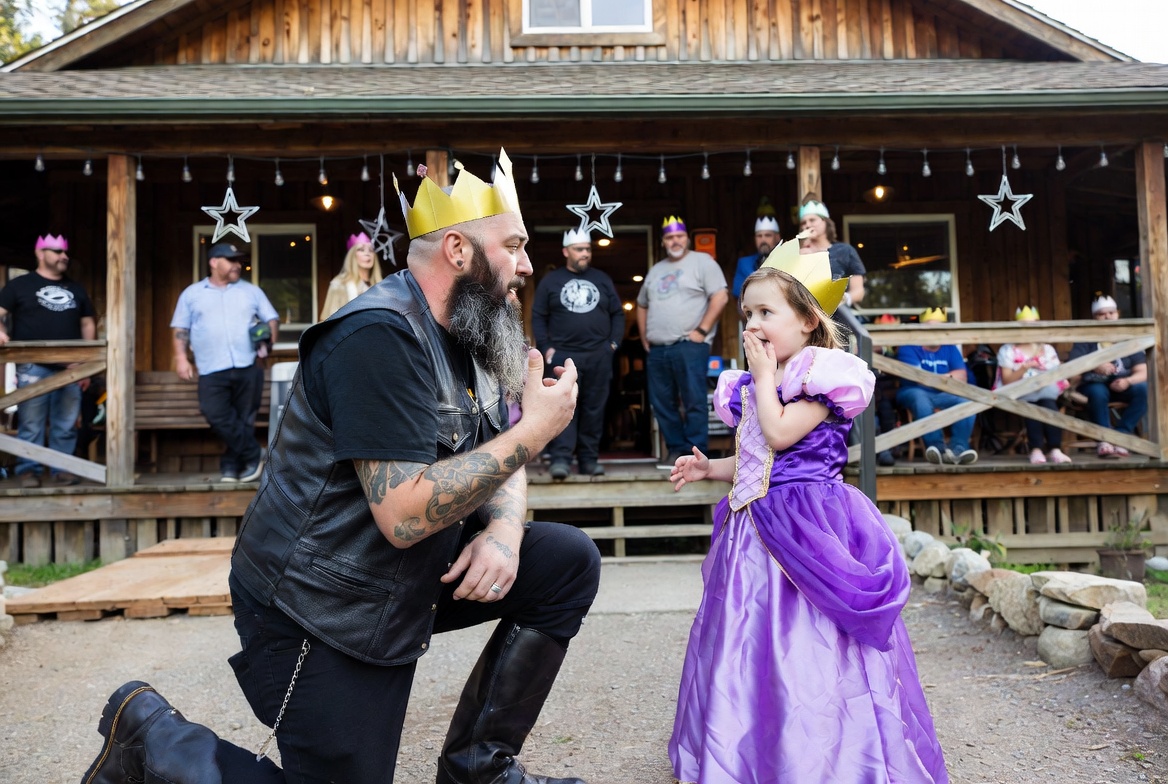
In the hush of a midsummer evening, three nights after seventeen small hearts had failed to appear, thirty iron-clad princes rode into the fractured world of an eight-year-old girl
The first motorcycle growled into the clubhouse lot at precisely 5:42 p.m. The last rolled in at 5:59. Thirty Harley-Davidson engines fell silent in a staggered chorus, and for a moment the night itself seemed to hold its breath. Out of the chrome and leather stepped men who had spent their lives chasing horizons, now transformed. Thrift-store suit jackets strained across broad shoulders. Mismatched bow ties sat crooked beneath paper crowns adorned with silver stars and childish crayon flourishes. They looked ridiculous. They looked magnificent.
At the center of this unlikely procession stood Marcus “Bear” Carter—fifty-six years old, six-foot-five, two-hundred-ninety-five pounds of weathered muscle and quiet authority. His thick black-and-gray beard spilled over the collar of a white dress shirt that refused to button at the neck. Tattoos snaked up both forearms and disappeared beneath the fabric, stories inked across decades of loyalty and loss. Perched atop his massive head was a paper crown bearing the words Prince Number One, written in purple crayon by the small hand of my daughter.
I was Emily, June’s mother, and I had watched her eighth birthday disintegrate three days earlier like a castle made of sand.
She had invited every child in her third-grade class to a princess party in the community room. Eleven families had RSVP’d yes. Balloons swayed. A lavender dress shimmered under fluorescent lights. A table groaned beneath pink-frosted cupcakes and melting ice cream. June stood by the door in her tiara, eyes bright with expectation, until the brightness slowly dimmed.
No one came.
She asked if the invitations had the wrong address. Then, with a wisdom far too heavy for eight years, she concluded that the other children simply did not like her.
The truth was crueler.
Someone—another parent—had unearthed an old photograph from Daniel’s funeral procession. There he was, my late husband, riding with his Iron Hounds brothers as they escorted him to his final rest. The message that accompanied the image warned that little June’s birthday party might be nothing more than a motorcycle club recruitment front. No one bothered to ask questions. No one verified the story. They simply chose absence.
Daniel had died of cancer. The motorcycles had carried his chosen family to say goodbye.
Bear learned of the empty chairs while standing among them. He did not storm anyone’s home. He did not threaten or confront. He simply pulled out his phone and made one call.
“We need princes,” he said.
For two evenings afterward, the clubhouse became an unlikely dance studio. Rosa Vega—a fifty-three-year-old rider with a sharp tongue and military bearing—taught thirty hardened men the basic steps of a waltz. They practiced until their boots, built for long highways and heavy pegs, learned something resembling grace. Bear struggled the most. His size made every turn feel like steering a battleship through a creek. Yet he practiced longest, sweat darkening his shirt, because this was for June.
On the third night, the clubhouse was reborn as a ballroom. Soft lights replaced the usual harsh glare. Paper streamers and fairy lights transformed cinderblock walls into something enchanted. Each rider approached my daughter alone, engines silent, voices low. They bowed—some awkwardly, some with surprising elegance—and asked permission before offering their calloused hands.
The first dance was Bear’s.
He lowered himself to one knee so their eyes could meet. “May I have this dance, Princess June?” His voice, usually a rumble that could quiet a barroom, was gentle as summer rain.
June placed her small hand in his. For the length of that song, the weight of rejection lifted from her narrow shoulders.
The second dance went to Preacher. The third to Chains. By the time the thirtieth biker—Boone—took her hand, June had kicked off her patent-leather shoes and climbed onto his boots. She laughed as he guided them both across the floor, her laughter ringing like bells in a place that had known mostly engines and silence.
She danced every dance. She danced until her cheeks glowed and her lavender dress swirled like mist around her knees. For one perfect night, she was not the girl whose father’s memory had been weaponized against her. She was royalty, and thirty unlikely princes had come to prove that she was worthy of being celebrated.
Then came the knock at the heavy clubhouse door.
Three of June’s classmates stood outside with their parents, clutching unopened birthday gifts like shields. Their faces were pale with shame and uncertainty. Word had finally spread about the rumor, about the misunderstanding, about the empty chairs. They had come to apologize.
The music faded. The room grew still.
June looked up at Bear, her small hand still resting in his massive one. Her voice was quiet but steady.
“Do I have to let them in?”
Bear crouched down slowly, bringing his weathered face level with hers. The paper crown tilted slightly on his head.
“No, Princess,” he said, his deep voice warm with unwavering loyalty. “Tonight, this door belongs to you.”
June turned toward the waiting children outside. Their parents shifted uncomfortably under the weight of thirty silent, watchful gazes. She studied them for a long moment, then reached into the small backpack she had carried all evening. From it, she pulled a folded piece of paper—a secret list of six other names. Children the school had quietly allowed to vanish from invitations and playdates, just as she had been made to vanish.
They were not her friends.
Not yet.
June looked at Bear once more, drew in a breath that carried the entire weight of her young heart, and reached for the door.
TO BE CONTINUE IN PART 2…